
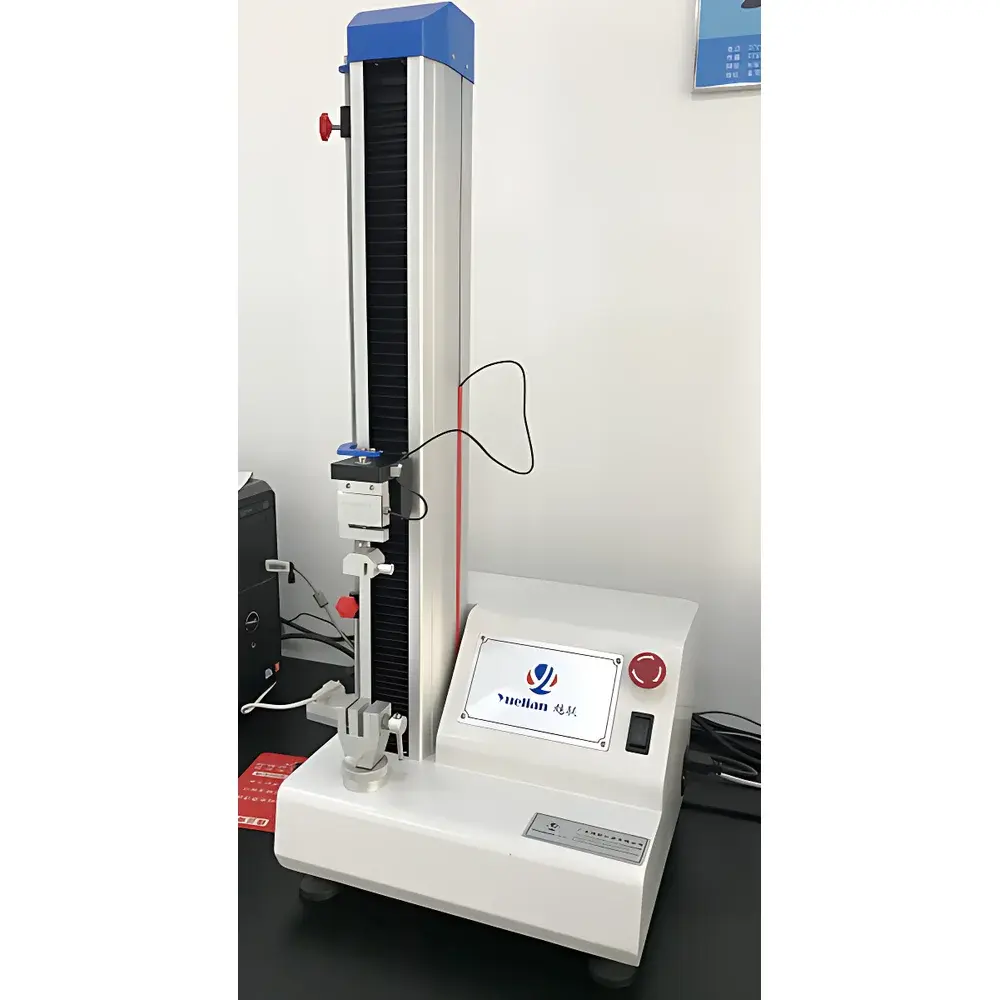
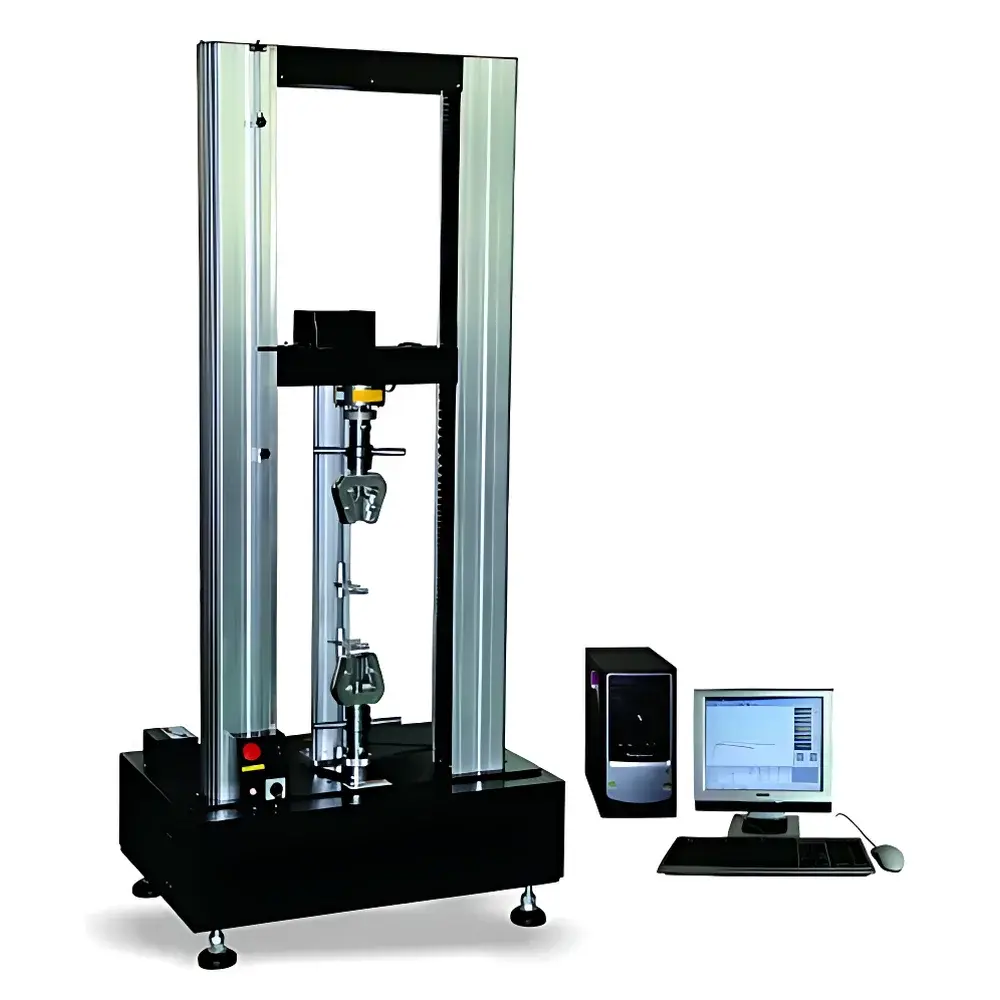
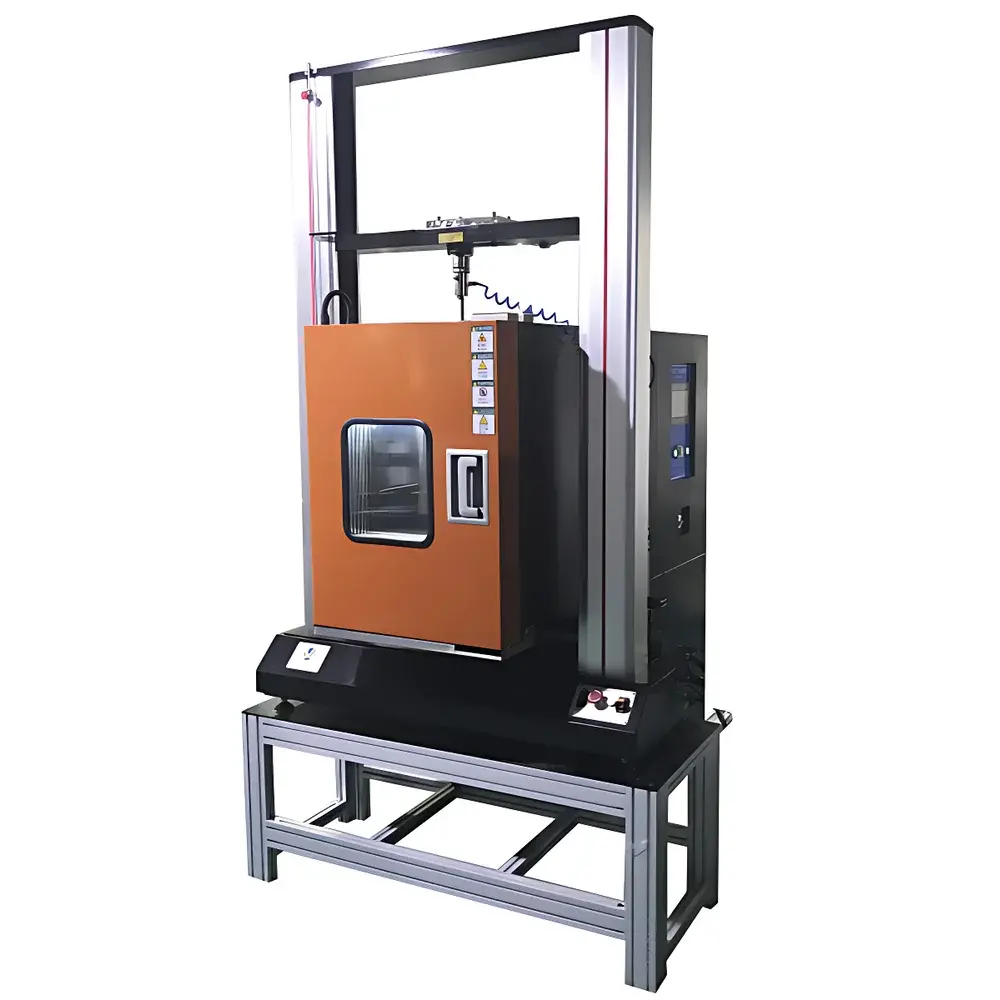
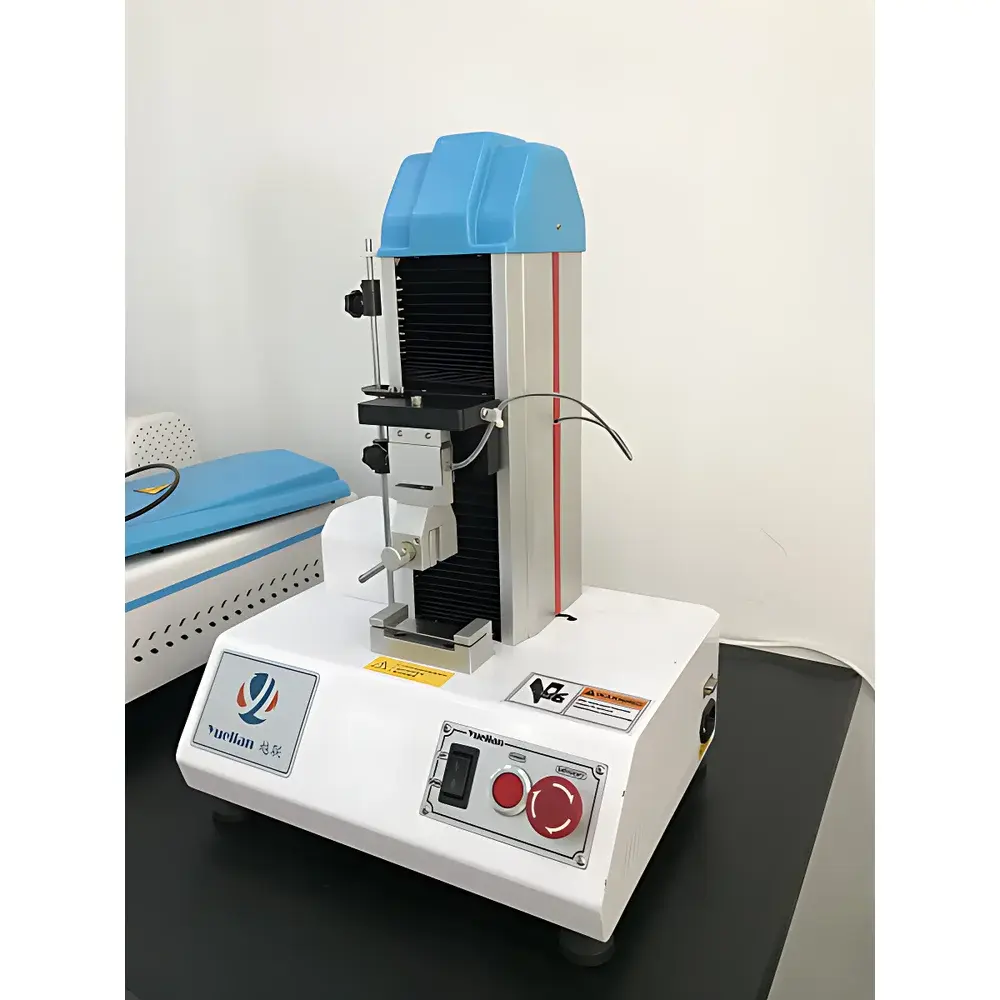
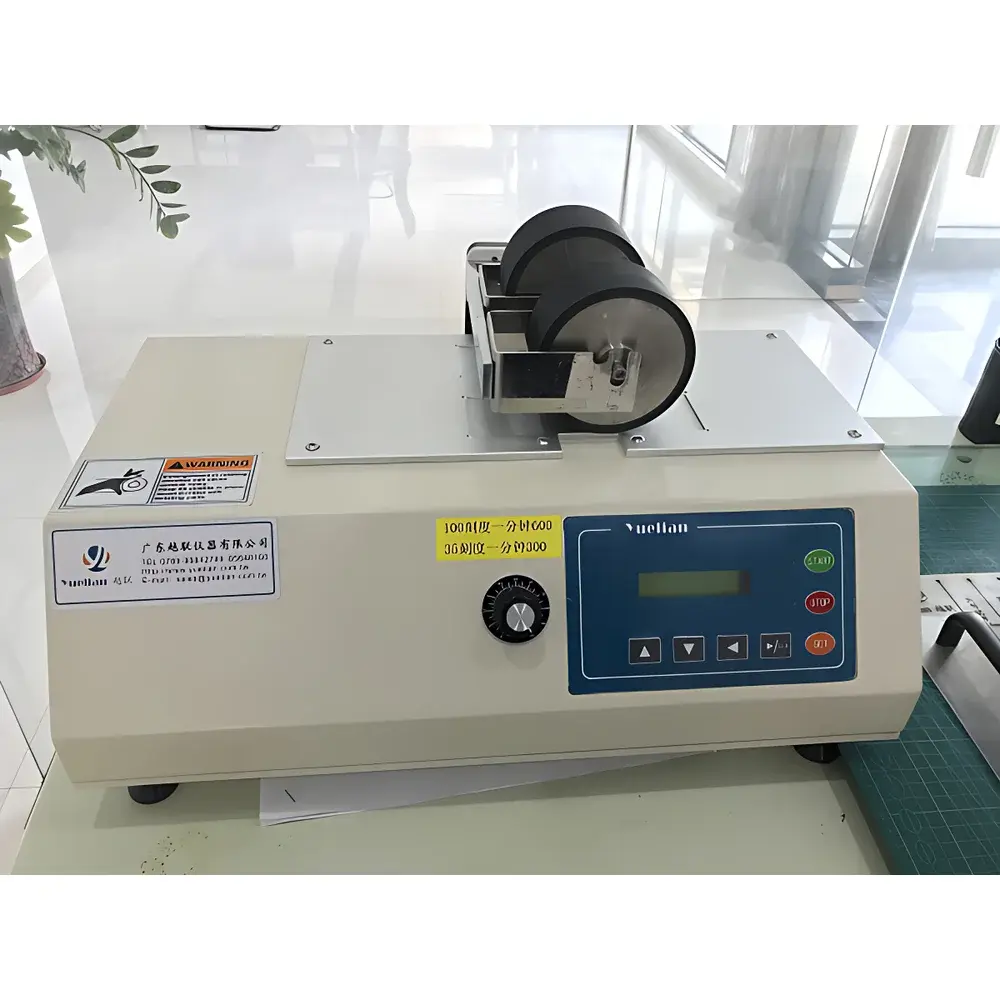
Yuelian YLS90 Digital Universal Testing Machine for Peel, Tensile, and Compression Testing
| Brand | Yuelian |
|---|---|
| Model | YLS90 |
| Type | Electromechanical Universal Testing Machine |
| Origin | Guangdong, China |
| Force Capacity Options | 10 N, 20 N, 50 N, 100 N, 200 N, 500 N, 1 kN (dual-range configuration available) |
| Load Resolution | 1/500,000 full scale |
| Load Accuracy | ±0.3% of reading |
| Displacement Resolution | 1/500,000 full stroke |
| Test Speed Range | 0.5–600 mm/min (programmable via PC) |
| Maximum Stroke | 500 mm |
| Test Width | 140 mm |
| Power Supply | 220 V AC, 50/60 Hz, 10 A |
| Motor | Stepper motor with precision ball screw drive |
| Rated Power | 180 W |
| Dimensions (W×D×H) | 400 × 300 × 230 mm or 400 × 300 × 300 mm |
| Weight | ~28 kg |
| Standard Accessories | One set of quick-change fixtures, PC software, RS-232 interface cable |
| Optional | External PC |
Overview
The Yuelian YLS90 Digital Universal Testing Machine is an electromechanical force measurement system engineered for high-reproducibility mechanical characterization of thin films, laminates, adhesives, packaging materials, textiles, and polymer-based composites. It operates on the principle of controlled displacement-driven loading, utilizing a stepper motor coupled to a precision-ground ball screw transmission to deliver stable, low-noise motion across its full 500 mm travel range. Designed specifically for peel testing—including standardized 90° and 180° configurations—the instrument complies with core mechanical test methodologies referenced in ASTM D903, ASTM D3330, ISO 8510-2, and GB/T 2790–1995. Its modular fixture architecture supports rapid reconfiguration between tensile, compression, tear, shear, loop tack, and peel modes without recalibration, enabling laboratories to maintain consistent test protocols across multiple material classes within a single platform.
Key Features
- High-resolution load measurement with 1/500,000 full-scale resolution and ±0.3% accuracy—validated per ISO 7500-1 Class 0.5 requirements
- Programmable crosshead speed from 0.5 to 600 mm/min, adjustable in 0.1 mm/min increments via PC interface
- Integrated dual-mode control: standalone operation using front-panel inputs or synchronized PC-based test sequencing via USB/RS-232
- Auto-return function triggered upon test completion or specimen failure; programmable upper/lower limit stops for safety-critical applications
- Quick-release fixture interface compatible with standard wedge, pneumatic, peel arm, and shear jig assemblies
- Real-time dual-channel display of force (N, kgf, lbf, g, ton, MPa) and displacement (mm), with automatic unit conversion
- Overload protection, emergency stop button, and failure-triggered halt ensure operator and equipment safety during high-cycle fatigue or brittle fracture events
Sample Compatibility & Compliance
The YLS90 accommodates specimens up to 140 mm wide and 500 mm in effective gauge length, supporting standardized strip geometries defined in ISO 6892-1 (tensile), ASTM D882 (thin plastic film), and TAPPI T813 (paper peel). Its mechanical architecture meets structural integrity criteria outlined in EN 10002-2 for static testing machines. While not certified to ISO/IEC 17025 as a calibration laboratory, the system is designed to support GLP-compliant data generation when operated with audit-trail-enabled software and documented calibration procedures traceable to NIM (China National Institute of Metrology). All firmware and driver binaries are compatible with Windows 10/11 x64 environments and support export to CSV, PDF, and XML formats required for regulatory submissions under FDA 21 CFR Part 11 when paired with validated third-party LIMS integration.
Software & Data Management
The included PC software provides full test method definition, real-time curve visualization (force vs. displacement, stress vs. strain), and post-test analysis including peak load, elongation at break, modulus calculation (secant/tangent), and area-under-curve (energy absorption). Raw data files retain timestamped metadata (operator ID, environmental conditions if logged externally, fixture type, test standard reference). Audit trail functionality records all parameter changes, test start/stop events, and user logins—essential for QA/QC documentation in ISO 9001-certified manufacturing facilities. Export modules generate compliant reports aligned with internal SOPs or external standards such as ASTM E1447 and ISO 14556.
Applications
- Quantitative evaluation of pressure-sensitive adhesive bond strength in medical tapes, labels, and protective films
- Quality control of laminated food packaging integrity under simulated shelf-life conditions
- Mechanical validation of textile seam strength and nonwoven substrate delamination resistance
- R&D screening of biodegradable polymer blends for tensile modulus and peel onset behavior
- Verification of automotive interior trim bonding performance per OEM specifications (e.g., Ford WSS-M99P1111-A)
- Compliance testing of printed electronics substrates for flex circuit adhesion reliability
FAQ
What standards does the YLS90 support for peel testing?
It is configured to execute ASTM D903 (adhesive bond strength), ISO 8510-2 (peel resistance of flexible materials), and GB/T 2790–1995 (peel strength of rubber-to-substrate bonds). Custom test templates can be built for proprietary methods.
Can the system perform constant-load (creep) or constant-strain (stress relaxation) tests?
Yes—via closed-loop PID control in the software, enabling hold periods at specified force or displacement targets for durations up to 99 hours.
Is calibration certification included with purchase?
A factory-as-tested certificate is supplied. For accredited calibration, users must engage a CNAS-recognized metrology lab using traceable deadweight or reference load cells.
What is the maximum recommended sample thickness for 180° peel tests?
For optimal alignment and minimal bending moment error, samples should not exceed 3 mm total thickness when tested at 180° per ISO 8510-2 guidelines.
Does the software support multi-user permissions and electronic signatures?
Role-based access control and digital signature workflows require integration with validated third-party document management systems compliant with 21 CFR Part 11.



