
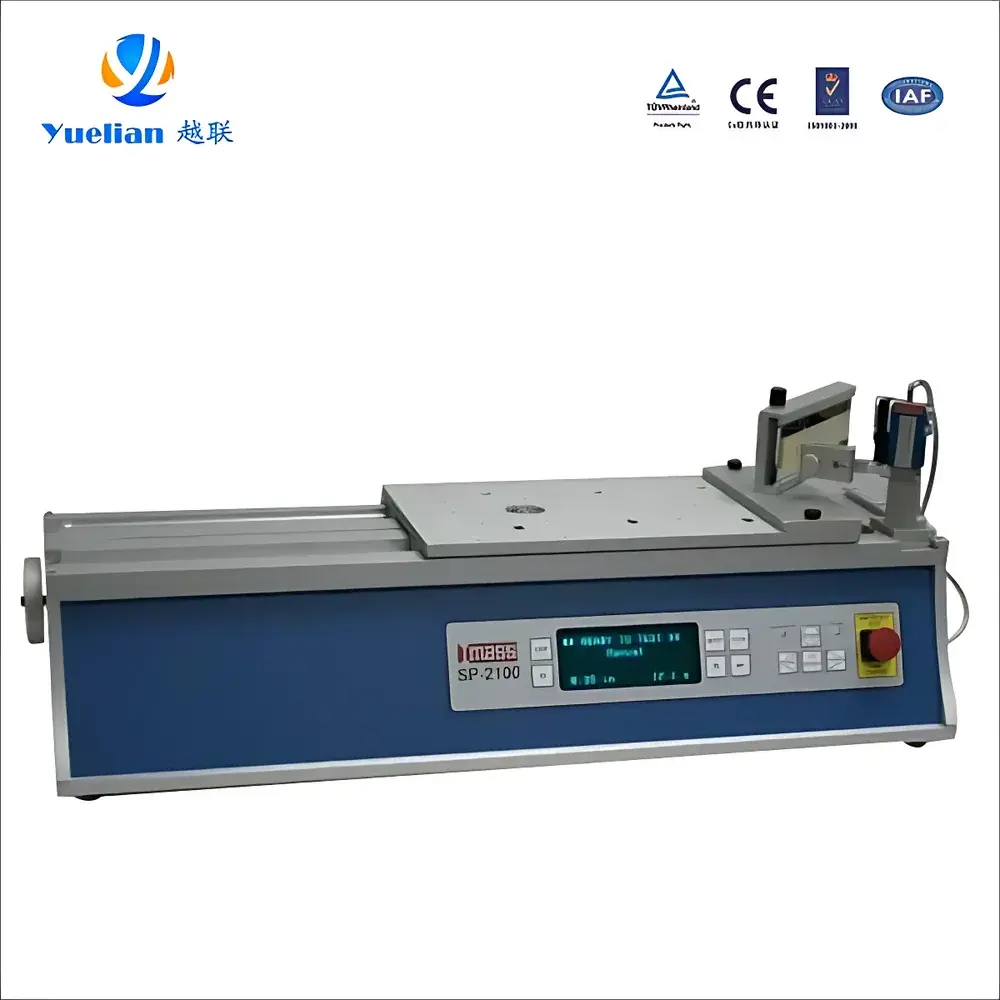
IMASS SP-2100 Sliding/Peel Tester
| Brand | IMASS |
|---|---|
| Origin | USA |
| Model | SP-2100 |
| Force Capacity | 25 lbf (111 N) |
| Speed Range | 0.2–300 in/min (0.5–762 cm/min) |
| Sampling Rate | Up to 4000 Hz |
| Delay Time (T1) | 0.1–4 s |
| Average Time (T2) | 0.1–50 s |
| Display | 4-line × 20-character VFD |
| Power Input | Auto-ranging 90–262 VAC, 47–63 Hz |
| Compliance | ASTM D1894, PSTC Test Methods, TLMI, FINAT, TAPPI |
| Software | DataLink21, ExLink21, StatsLink21 |
| Unit Systems | Imperial, Metric, SI |
| Fixture Angles | 67.5°–180° (indexed at 22.5° intervals) |
| Standard Fixtures | 180° peel, variable-angle peel, COF slider block (200 g), stainless steel test panels (2"×6", 6"×12") |
Overview
The IMASS SP-2100 Sliding/Peel Tester is an engineered precision instrument designed for quantitative mechanical characterization of pressure-sensitive adhesives (PSAs), laminates, medical tapes, packaging films, and soft membrane interconnects. It operates on the fundamental principle of controlled tensile separation—measuring force response as a substrate is peeled or slid under defined geometric, kinematic, and environmental conditions. Unlike generic tensile testers, the SP-2100 implements dual-phase force acquisition logic: static peak detection during initial motion onset (T1 delay period), followed by high-resolution dynamic sampling (T2 averaging window) to extract motion peak, valley, mean, and RMS force values. This architecture enables rigorous differentiation between static coefficient of friction (COF), dynamic COF, and peel adhesion energy—critical parameters for regulatory submissions, process validation, and material qualification in ISO 13485, FDA 21 CFR Part 11, and GMP-compliant environments.
Key Features
- Precision servo-driven crosshead with encoder feedback, delivering repeatable speed control from 0.2 to 300 in/min (0.5–762 cm/min) with user-selectable resolution across the full range
- Integrated load cell system with TEDS (IEEE 1451.4) auto-identification—supports interchangeable 2 kg, 5 kg, and 10 kg capacity transducers; automatic scaling ensures consistent unit output regardless of sensor selection
- Real-time analog signal conditioning using ultra-low-noise linear circuitry and 16-bit A/D conversion, enabling stable force measurement with minimal drift or thermal artifact
- Variable-angle peel fixture with mechanically indexed positions at 67.5°, 90°, 112.5°, 135°, 157.5°, and 180°—adjustable via pin-and-scale mechanism for interpolation between fixed angles
- Vacuum fluorescent display (VFD) with four brightness levels, automatic screen dimming, and context-sensitive prompts for intuitive operator interaction without external PC dependency
- Embedded microprocessor architecture enabling fully autonomous operation: onboard statistics (mean, SD, CV), auto-zero/balance, span verification, and seven recallable test configurations
- Universal power input (90–264 VAC, 47–63 Hz) with <2 A max draw—certified for global deployment without voltage converters or frequency adapters
Sample Compatibility & Compliance
The SP-2100 accommodates standard test geometries per major international standards: 180° peel per PSTC 101 and ASTM D903; 90° and variable-angle peel per FINAT FTM 1 and TLMI guidelines; sliding friction per ASTM D1894 using the included 200 g slider block and polished 304 stainless steel panel (6″ × 12″, 2B finish). Its modular fixture interface—featuring a 24-hole M4-0.7 mounting array—accepts both supplied hardware (e.g., quick-release tape clamps, 2″ × 6″ test panels) and third-party or custom fixtures. The system inherently supports COF calculation without external instrumentation: force and normal load are measured simultaneously, yielding dimensionless COF ratios directly. All mechanical components—including load train, crosshead rails, and fixture interfaces—are constructed from corrosion-resistant materials to maintain dimensional stability over extended calibration intervals.
Software & Data Management
Three dedicated software modules provide tiered data handling capabilities. DataLink21 serves as the foundational serial interface utility, transmitting raw test metadata (speed, T1/T2, units) and force-time traces to Windows PCs via RS-232. ExLink21 extends this functionality by streaming timestamped force data directly into Excel® worksheets—each test occupies one row of tabular data, with corresponding graphical plots generated on successive worksheet tabs. This structure supports exploratory analysis and batch logging where statistical aggregation is not required. StatsLink21 implements full GLP-aligned reporting: it organizes tests into batches (up to 25 per session), computes descriptive statistics (mean, standard deviation, coefficient of variation) for all five force parameters, generates consolidated graphical overlays, and exports audit-trail-ready archive files (.sl2) containing raw digitized force/time pairs. All software modules support configurable export paths for seamless integration with LIMS or enterprise data repositories.
Applications
The SP-2100 is routinely deployed in R&D laboratories and QC/QA departments for adhesive formulation development, incoming raw material screening, finished product release testing, and stability studies. Key use cases include: quantifying peel strength degradation in accelerated aging protocols; validating low-tack performance of pediatric medical tapes under ISO 22866; characterizing “stick-slip” behavior in automotive interior laminates via RMS force analysis; verifying consistency of label adhesion across temperature gradients using optional heated platen accessories; and supporting 510(k) submissions for wound closure devices through traceable, instrument-calibrated COF and peel datasets. Its ability to switch between COF, 180° peel, and variable-angle modes—without recalibration or tooling changes—reduces method transfer time and minimizes operator-induced variability.
FAQ
Does the SP-2100 require annual recalibration by an external service provider?
No. The embedded TEDS-enabled load cells support internal span verification and zero-balance functions accessible via front-panel controls. While traceable NIST-certified calibration is recommended every 12 months for regulated environments, routine daily verification is performed autonomously.
Can the SP-2100 measure peel angle beyond 180°, such as reverse peel or curl?
The standard variable-angle fixture covers 67.5° to 180°. Reverse-angle configurations (e.g., 270°) require custom tooling—not supported out-of-the-box but feasible via third-party fixture design leveraging the M4 mounting array.
Is StatsLink21 compliant with FDA 21 CFR Part 11 electronic record requirements?
StatsLink21 supports audit trail generation, electronic signatures (via Windows login integration), and immutable archive files—but full Part 11 compliance depends on site-specific IT infrastructure, password policies, and electronic signature validation procedures implemented by the end user.
What is the maximum sample width the SP-2100 can accommodate with standard fixtures?
The base 180° and variable-angle fixtures accept 2-inch-wide specimens. Optional wide-format fixtures (e.g., 2.375″ × 12″) are available separately and mount identically to standard hardware.
How does the system handle data loss during power interruption?
All test execution logic resides in non-volatile memory. In-progress tests are not saved mid-cycle; however, completed test results are retained in volatile RAM until manually cleared or exported. No persistent storage is onboard—data persistence relies on timely transmission to external systems via RS-232.



