
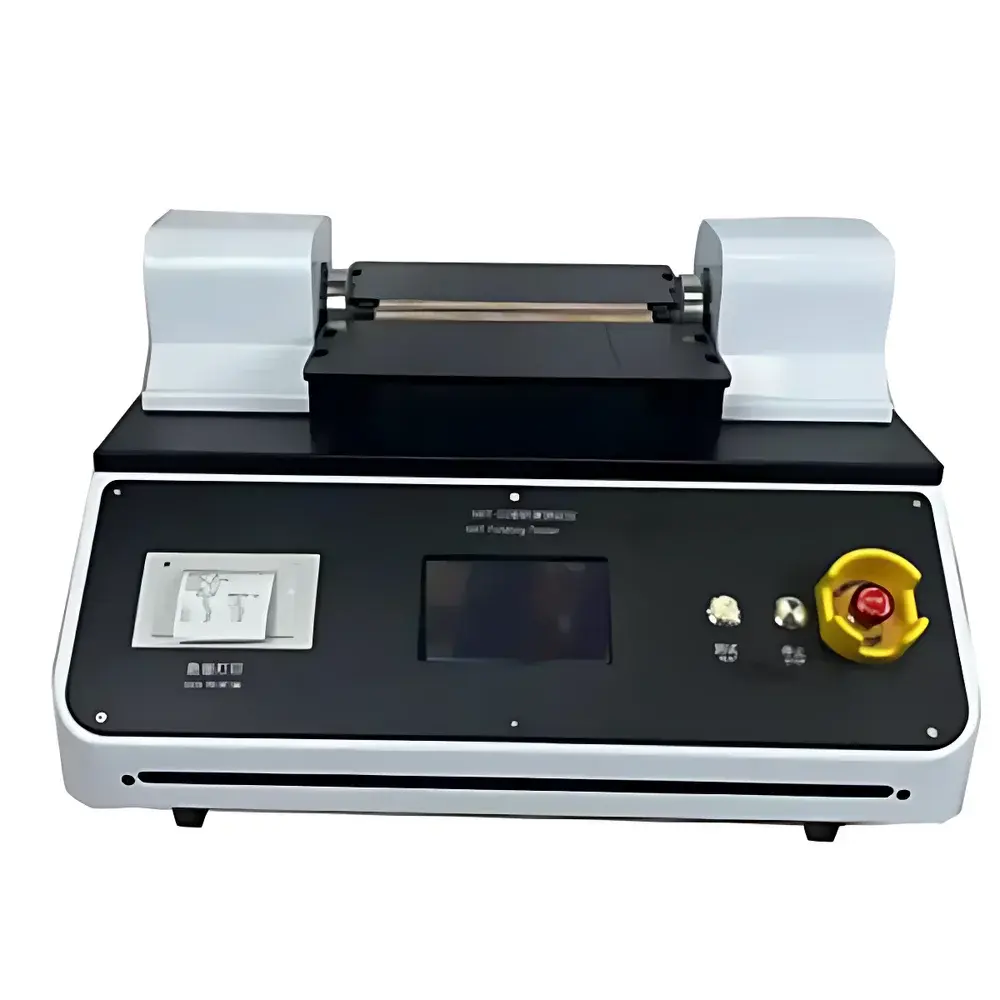
PW-MIT02 Fold Endurance Tester for Flexible Electronics and Thin-Film Materials
| Brand | YueLian / PW |
|---|---|
| Origin | Guangdong, China |
| Manufacturer Type | Authorized Distributor |
| Origin Category | Domestic (China) |
| Model | PW-MIT02 |
| Pricing | Available Upon Request |
| Power Supply | AC 220 V ±10%, 50 Hz (AC 110 V ±10%, 60 Hz optional) |
| Operating Temperature | 10–35 °C |
| Relative Humidity | ≤85% RH |
| Display | 5-inch color TFT touchscreen interface |
| Test Area | 7 ± 0.05 cm² |
| Folding Angle Range | 0–180° (user-configurable and real-time displayed) |
| Cycle Count Range | 0–99,999 cycles |
| Folding Speed | 5–65 cycles/min |
| Bend Radius Options | R1 mm, R1.5 mm, R2 mm (three interchangeable mandrels supplied) |
| Dwell Time Adjustment | 0–99 s (programmable) |
| Folding Platform Dimensions | 200 × 150 mm (dual stations: front & rear) |
| Overall Dimensions | 580 × 490 × 360 mm (W × D × H) |
| Net Weight | ~35 kg |
| Data Output | Built-in thermal printer |
| Standard Configuration | Main unit + embedded thermal printer |
| Optional | Continuity monitoring module (open/short detection during folding) |
Overview
The PW-MIT02 Fold Endurance Tester is an engineered solution for quantifying the mechanical fatigue resistance of thin, flexible substrates under repeated bending stress—critical for reliability validation in flexible electronics manufacturing. Designed according to principles of controlled cyclic flexural deformation, the instrument subjects specimens to standardized, programmable folding motion around precision-ground cylindrical mandrels. Its operation adheres to foundational mechanical test paradigms defined in ASTM D2176 (for paper fold endurance) and adapted for modern thin-film applications through user-defined parameters including bend radius, angular displacement, dwell time, and cycle count. The system implements a dual-station folding platform to enable comparative testing or sequential evaluation of multiple samples without manual repositioning. Unlike generic bending testers, the PW-MIT02 integrates closed-loop motion control via microprocessor-based timing and position feedback, ensuring high reproducibility across extended test durations—essential for qualifying materials such as polyimide-based FPCs, ultra-thin glass substrates, graphene-coated films, and laminated touch panel assemblies.
Key Features
- Programmable folding parameters: angle (0–180°), speed (5–65 cycles/min), dwell time (0–99 s), and total cycle count (up to 99,999)
- Dual independent folding platforms (200 × 150 mm each) supporting parallel or staggered test protocols
- Three precision-machined stainless-steel mandrels (R1 mm, R1.5 mm, R2 mm) included as standard—interchangeable and traceably calibrated
- 5-inch full-color resistive touchscreen with intuitive Chinese interface (English firmware available upon request)
- Onboard data logging with automatic timestamped storage; internal memory retains ≥1,000 test records
- Integrated thermal printer for immediate hardcopy reporting—including test ID, parameters, pass/fail status, and cycle-to-failure result
- Robust mechanical architecture with reinforced aluminum frame and low-backlash drive train to minimize positional drift over 10,000+ cycles
- Compliance-ready design: supports audit trails when used with optional continuity monitoring module (detects electrical open/short events synchronously with fold actuation)
Sample Compatibility & Compliance
The PW-MIT02 accommodates specimens up to 7 ± 0.05 cm² in active test area—optimized for strip-shaped or rectangular coupons typical in flexible circuit qualification. It is routinely deployed for evaluating FFC (flat flexible cable), FPC (flexible printed circuit), TP (touch panel) laminates, PET/PEN-based conductive films, and emerging 2D-material-integrated composites. While not certified to ISO/IEC 17025 as a standalone testing laboratory, the instrument’s repeatability (±0.5° angular accuracy, ±1 cycle count tolerance) meets internal QC requirements aligned with IPC-6013 (Flexible Printed Boards) and JEDEC JESD22-B113 (Flex Life Testing). When operated with documented SOPs and calibrated mandrels, test outputs support GLP-compliant reporting for R&D and pre-production validation.
Software & Data Management
The embedded control firmware enables fully autonomous test execution without external PC dependency. All configuration settings—including mandrel selection, folding profile, and pass criteria—are stored in non-volatile memory. Each test record includes metadata (date/time, operator ID if entered, parameter set ID) and raw cycle-count-at-failure. Data export is currently limited to printed reports; however, the RS-232 serial port (standard) allows integration with custom LabVIEW or Python-based data aggregation tools for batch analysis. Future firmware updates may introduce USB host functionality for CSV log export. For regulated environments, the system supports basic 21 CFR Part 11 readiness when paired with external electronic lab notebook (ELN) systems that manage user authentication and electronic signatures.
Applications
- Qualification of dynamic bend radius limits for foldable display interconnects
- Comparative lifetime assessment of adhesive layers in multilayer flexible laminates
- Screening of metallization adhesion stability on PI substrates under cyclic strain
- Process validation for roll-to-roll coating and laser patterning steps affecting mechanical robustness
- Accelerated aging studies correlating fold cycles with impedance shift or contact resistance drift
- Supporting failure mode analysis (FMA) in conjunction with post-test SEM/EDS inspection
FAQ
Is the PW-MIT02 compliant with international standards such as ISO 7854 or ASTM D2176?
It implements test methodologies consistent with ASTM D2176 for angular fold endurance, though its enhanced programmability (e.g., dwell time, variable speed) extends beyond the scope of that standard. No formal ISO/IEC 17025 calibration certificate is provided by default.
Can test data be exported digitally for statistical process control (SPC)?
Raw data is retained internally and printable only; digital export requires third-party serial communication software interfacing via RS-232.
What maintenance is required to ensure long-term measurement stability?
Mandrels should be inspected monthly for surface wear using optical profilometry; drive belt tension and guide rail lubrication are recommended every 6 months under continuous use.
Does the optional continuity monitoring module meet IPC-A-600 Class 3 requirements?
The module provides real-time open/short detection but does not constitute full electrical test compliance—it serves as a supplementary diagnostic channel during mechanical stress application.
Is firmware upgrade support available after purchase?
Yes—YueLian provides free firmware updates via secure download portal for registered users, with version history and release notes published quarterly.





