
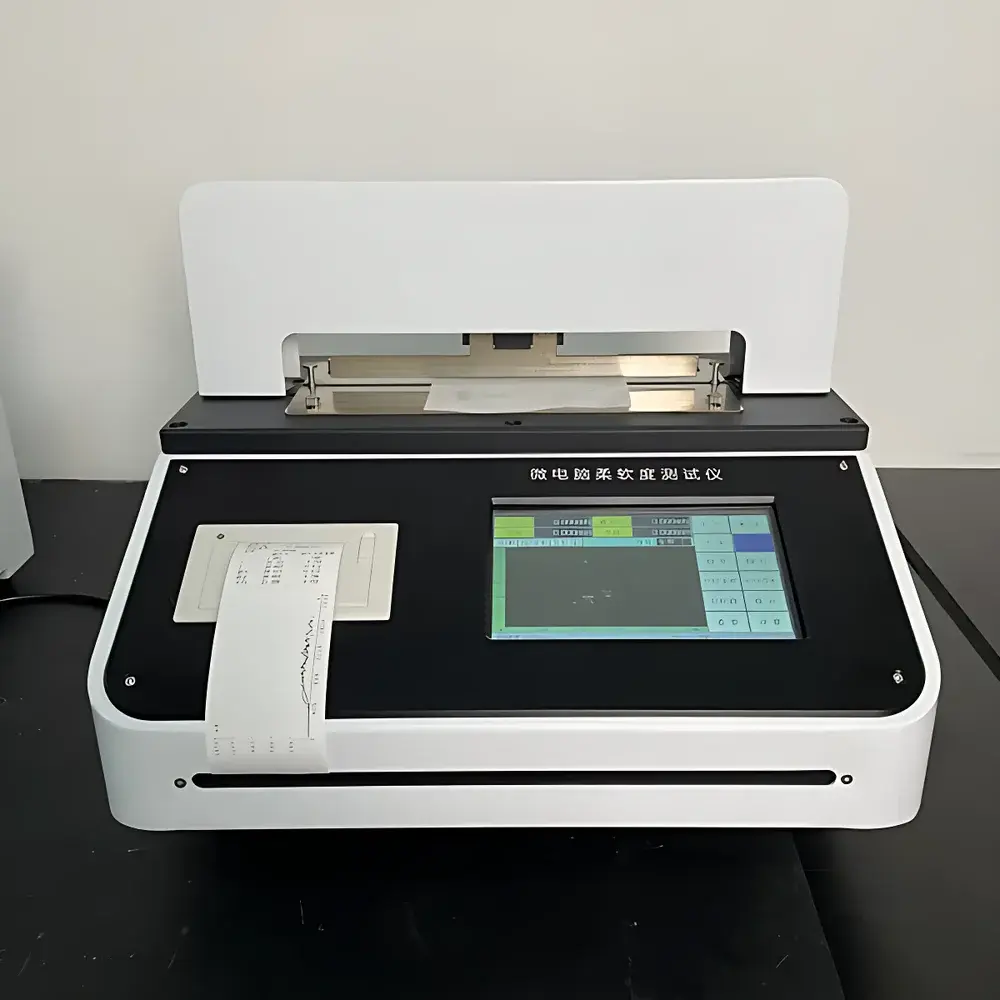
English Product Name
| Brand | Yuelian / PW |
|---|---|
| Origin | Guangdong, China |
| Manufacturer Type | Authorized Distributor |
| Country of Manufacture | China |
| Model | PW-6610 |
| Pricing | Upon Request |
| Measurement Range | 0.01–1000 mN |
| Test Speed | 1.2 mm/s |
| Total Stroke | 1–12 mm (adjustable) |
| Test Duration | 2–15 s (adjustable) |
| Resolution | 0.01 mN |
| Accuracy | ±1% of full scale |
| Repeatability | ≤1% RSD |
| Probe Penetration Depth | 8 ±0.5 mm (1–8 mm adjustable) |
| Max Sample Thickness | ≤5 mm |
| Probe Width | 200 ±0.5 mm |
| Slit Width Options | 5, 6.35, 10, 20, or 30 mm (standard: 5 mm |
| Lever Ratio | 32:73 |
| Calibration Weights | 5 g, 10 g |
| Parallelism Error | ≤0.05 mm |
| Display | 7.2-inch capacitive touchscreen with real-time force curve |
| Dimensions (Tester) | 440 × 350 × 320 mm |
| Weight | ~32 kg |
| Optional Sample Cutter | 100 × 100 mm cut size, 0.01–20 mm thickness capacity, 150 × 220 × 350 mm, 5 kg |
Overview
The Yuelian PW-6610 Softness Tester is an electromechanical instrument engineered for objective quantification of tactile softness in flexible sheet and filamentous materials. It operates on the validated Handle-O-Meter principle—widely adopted in international standards—and measures the combined resistance to bending and interfacial friction when a standardized probe vertically displaces a specimen into a narrow slit under controlled kinematic conditions. This resultant peak force (expressed in millinewtons, mN) serves as the quantitative softness index: lower values indicate greater perceived softness. Designed in strict alignment with GB/T 8942, ASTM D2923, ASTM D6828-02, TAPPI T498, INDA IST 90.3, and EDANA WSP 90.3, the PW-6610 delivers metrologically traceable data for R&D laboratories, QC/QA departments, and regulatory compliance units across tissue, hygiene, packaging, and advanced material sectors.
Key Features
- Full-touch 7.2-inch industrial HMI interface with intuitive navigation, one-touch statistical analysis (mean, SD, CV%), and real-time force-vs.-displacement curve visualization.
- Micro-sensor-based closed-loop control system with auto-zeroing, overload protection, and automatic return-to-home upon over-travel—preserving sensor integrity and long-term calibration stability.
- Adjustable penetration depth (1–8 mm), stroke (1–12 mm), and dwell time (2–15 s) to accommodate diverse material stiffness profiles—from ultra-thin optical films to reinforced nonwovens.
- Modular slit insert system supporting five standard widths (5, 6.35, 10, 20 mm) and optional 30 mm configuration for specialized applications such as filament bundling or thick composite laminates.
- Integrated thermal printer enabling immediate hardcopy output of test reports—including sample ID, operator, date/time stamp, raw data table, and graphical curve—fully compliant with GLP documentation requirements.
- Anodized aluminum base frame with corrosion-resistant composite coating ensures mechanical rigidity and dimensional stability across extended operational cycles and varying ambient humidity.
Sample Compatibility & Compliance
The PW-6610 accommodates flat, flexible specimens up to 5 mm in thickness and 100 × 100 mm in planar dimension. Validated use cases include: virgin and recycled paper grades (newsprint, carbon paper, tissue), sanitary products (facial tissues, toilet paper, cotton pads), spunbond/meltblown nonwovens, polymer films (PET, PP, PE, barrier-coated laminates), optical and functional thin films, and linear materials (insulated wires, surgical sutures, textile filaments). All test protocols adhere to statutory and consensus-based frameworks—including ISO/IEC 17025-aligned uncertainty estimation—and support audit-ready documentation for FDA-regulated environments (e.g., 21 CFR Part 11-compliant software add-on available separately).
Software & Data Management
While the embedded firmware provides standalone operation, optional PC-based software enables advanced data management: batch export to CSV/XLSX, customizable report templates, multi-user access control, electronic signature logging, and audit trail generation per FDA 21 CFR Part 11 Annex 11 guidelines. Raw force-time datasets are timestamped and digitally signed at acquisition, ensuring data integrity from measurement to archival. The system supports RS-232 and USB-C communication interfaces for seamless integration into LIMS or MES platforms used in certified manufacturing facilities.
Applications
- Quality benchmarking of tissue softness during pulp refining and creping optimization.
- Formulation screening of binder systems in nonwoven hygiene absorbents.
- Comparative evaluation of surface modification treatments (e.g., silicone finishing, plasma etching) on film haptics.
- Regulatory submission support for EN 13432-compliant biodegradable packaging softness specifications.
- Process validation of calendering, embossing, or thermal bonding parameters affecting end-product hand-feel.
- Material substitution studies where tactile performance must be preserved despite substrate changes (e.g., PET → PLA film).
FAQ
What physical principle does the PW-6610 employ to quantify softness?
It applies the Handle-O-Meter method: a rigid probe displaces a clamped specimen into a fixed-width slit at constant velocity; the maximum resistive force (bending + friction) is recorded as the softness value in mN.
Is the instrument suitable for testing 3D or textured surfaces?
Yes—provided the specimen remains planar within the 5 mm thickness limit and fits the 100 × 100 mm cutter aperture; surface topography is captured inherently through dynamic force response.
Can test parameters be locked to prevent operator deviation?
Yes—the touchscreen interface supports password-protected parameter presets aligned with specific standards (e.g., GB/T 8942 mode: 8 mm depth, 5 mm slit, 1.2 mm/s speed).
How is calibration traceability maintained?
Using NIST-traceable stainless-steel calibration weights (5 g, 10 g) and documented lever-ratio verification (32:73); full calibration certificates are issued upon installation and annually thereafter.
Does the system meet ISO/IEC 17025 requirements for accredited labs?
The hardware design, resolution (0.01 mN), accuracy (±1%), and repeatability (≤1% RSD) satisfy Clause 6.4 and Annex A of ISO/IEC 17025:2017 for mechanical property testing; formal accreditation requires lab-specific validation per ILAC-G8.







