
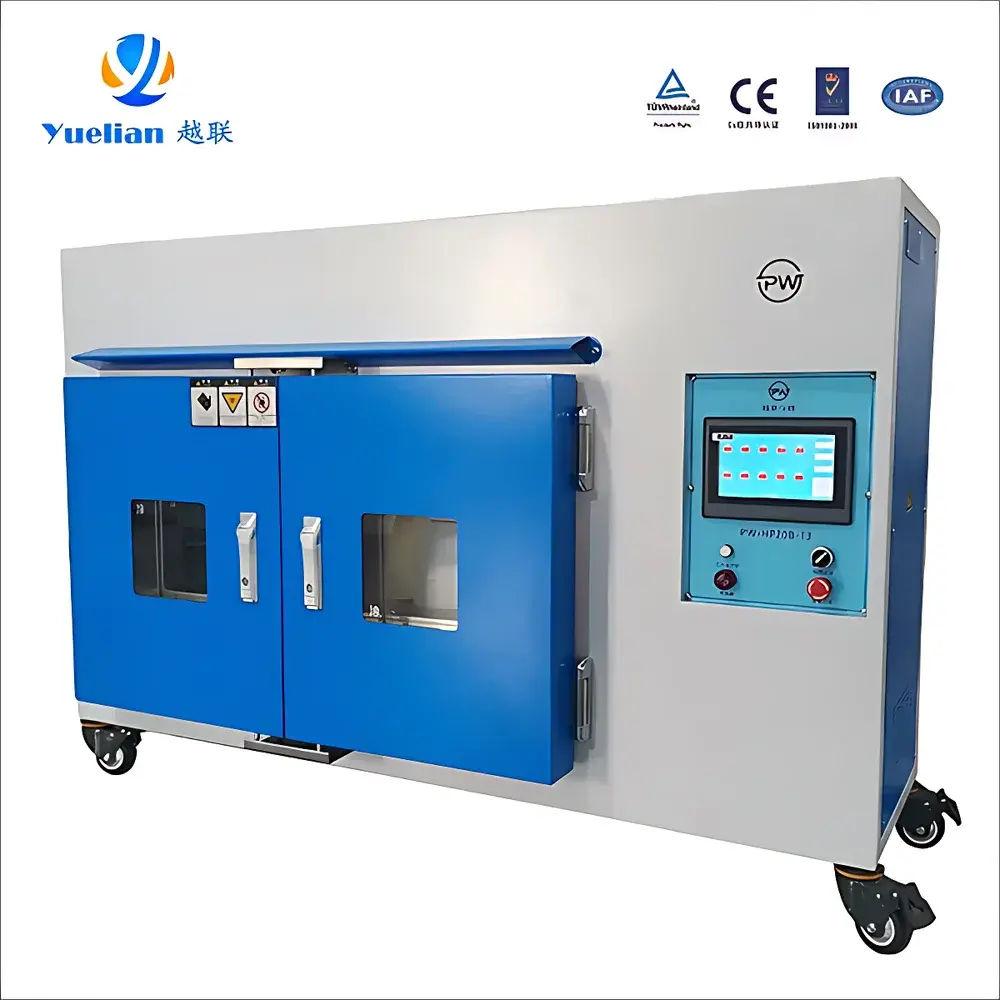
PW-SAFT20 Advanced Shear Adhesion Failure Temperature Tester
| Brand | PW (Yuelian) |
|---|---|
| Origin | Guangdong, China |
| Model | PW-SAFT20 |
| Temperature Range | Ambient +5 °C to 250 °C |
| Temperature Uniformity | ±1 °C |
| Temperature Resolution | 0.1 °C |
| Load Options | 0.5 kg or 1 kg (20 independent test positions) |
| Sample Area | 24 mm × 24 mm |
| Test Plate Dimensions | 72 mm × 50 mm |
| Sample Cutter Width | 24 mm |
| Timer Accuracy | ±0.5 min |
| Initial Temperature | 40 °C |
| Heating Program Control | Multi-segment ramping via touchscreen interface |
| Chamber Interior | 304 stainless steel |
| Exterior Finish | Electrostatic powder coating |
| Power Supply | 220 V, 2 kW |
| Compliance | GB/T 36794–2018 |
Overview
The PW-SAFT20 Advanced Shear Adhesion Failure Temperature Tester is an engineered thermal-mechanical testing system designed to determine the Shear Adhesion Failure Temperature (SAFT) of pressure-sensitive adhesives (PSAs), including tapes, labels, and transfer adhesives. SAFT is defined as the maximum temperature at which a standardized adhesive bond maintains structural integrity under a constant shear load—per ASTM D4498 and aligned with the methodology specified in GB/T 36794–2018. The instrument operates on a controlled thermal ramp principle: a pre-conditioned specimen is affixed to a vertical stainless-steel test plate, loaded with either 0.5 kg or 1 kg mass, and subjected to programmable heating within a precision convection chamber. Failure is detected visually or via optional integrated displacement monitoring when the bonded area exhibits measurable slippage (>0.5 mm) or complete detachment. Unlike static peel or lap-shear tests, SAFT quantifies thermally induced cohesive or interfacial failure under sustained shear stress—a critical parameter for applications involving elevated service temperatures, such as automotive trim bonding, electronics assembly, and HVAC duct sealing.
Key Features
- Precision convection oven with 304 stainless-steel interior and uniform airflow design, ensuring ±1 °C temperature uniformity across all 20 test positions.
- Multi-segment programmable temperature ramping via intuitive 7-inch capacitive touchscreen interface—supporting up to 10 custom heating profiles with variable rate control (e.g., 1–5 °C/min).
- 20 independent test stations arranged in staggered configuration; each station features individual mechanical load application and real-time timer activation upon specimen insertion.
- High-stability thermal sensor array calibrated to NIST-traceable standards, delivering 0.1 °C resolution and long-term drift <±0.3 °C/year.
- Dual-load capability (0.5 kg and 1 kg weights) with quick-release fixtures compatible with standard GB/T 36794–2018 test plates (72 mm × 50 mm) and die-cut specimens (24 mm × 24 mm).
- Integrated safety architecture: over-temperature cutoff (260 °C), door interlock, and thermal fuse redundancy compliant with IEC 61010-1.
Sample Compatibility & Compliance
The PW-SAFT20 accommodates a broad range of PSA formats—including acrylic, rubber-based, silicone, and hot-melt tapes—as well as laminated films and coated foils. Specimen preparation follows strict dimensional tolerances per GB/T 36794–2018: 24 mm × 24 mm cut using certified precision die-cutters (24 mm width cutter supplied). Test plates are manufactured from polished 304 stainless steel with surface roughness Ra ≤ 0.8 µm to minimize variability in substrate-adhesive interaction. The system supports regulatory documentation requirements for quality-controlled environments: audit trails, user access levels, and electronic signature readiness align with GLP and GMP frameworks. While not FDA 21 CFR Part 11–certified out-of-the-box, the firmware architecture enables validation support packages for laboratories operating under ISO/IEC 17025 or ICH Q5E guidelines.
Software & Data Management
The embedded controller logs timestamped temperature, elapsed time, and pass/fail status for each of the 20 channels. Data export is supported via USB 2.0 (CSV format) and optional Ethernet connectivity for LAN-based lab network integration. The system does not include proprietary PC software; however, raw output files are structured for direct import into LIMS platforms (e.g., LabWare, Thermo Fisher SampleManager) or statistical analysis tools (Minitab, JMP). All test parameters—including start temperature (default 40 °C), ramp rate, hold duration, and load selection—are stored with versioned metadata and operator ID tagging. Firmware updates are delivered via signed binary files with SHA-256 verification to ensure traceability and cybersecurity compliance.
Applications
- Quality assurance of high-temperature PSA formulations used in EV battery module bonding and under-hood automotive applications.
- Comparative thermal stability screening during R&D of acrylic emulsion adhesives intended for solar panel backsheet lamination.
- Supplier qualification testing per OEM specifications requiring SAFT ≥ 120 °C at 1 kg load.
- Failure mode analysis—distinguishing between cohesive failure (bulk polymer degradation) and interfacial failure (primer delamination) through post-test residue inspection.
- Accelerated aging correlation studies linking SAFT values to long-term performance at 85 °C/85% RH per IPC-TM-650 2.6.25.
FAQ
What standards does the PW-SAFT20 comply with?
It is fully aligned with GB/T 36794–2018 and technically compatible with ASTM D4498, ISO 4587, and JIS Z 0237 Annex C for shear adhesion thermal failure assessment.
Can the instrument be validated for ISO/IEC 17025 accreditation?
Yes—the system provides documented calibration certificates for temperature sensors and load cells, configurable test logs, and firmware revision history required for method validation and equipment qualification (IQ/OQ/PQ).
Is manual roller compaction included or optional?
Roller compaction (manual or motorized) is available as an accessory kit (PW-RC24); it is not bundled with the base PW-SAFT20 unit but is recommended for consistent wetting and air elimination per GB/T 36794–2018 Section 6.3.
How is temperature uniformity verified across all 20 positions?
A 20-point mapping protocol using calibrated PT100 probes (±0.05 °C accuracy) is provided in the Installation Qualification (IQ) manual; users may perform annual verification per internal SOP or third-party metrology service.
Does the system support automated failure detection?
No—failure determination remains visual or operator-observed per standard practice; however, optional digital caliper integration (via RS-232) can be configured for displacement-triggered logging upon request.



