
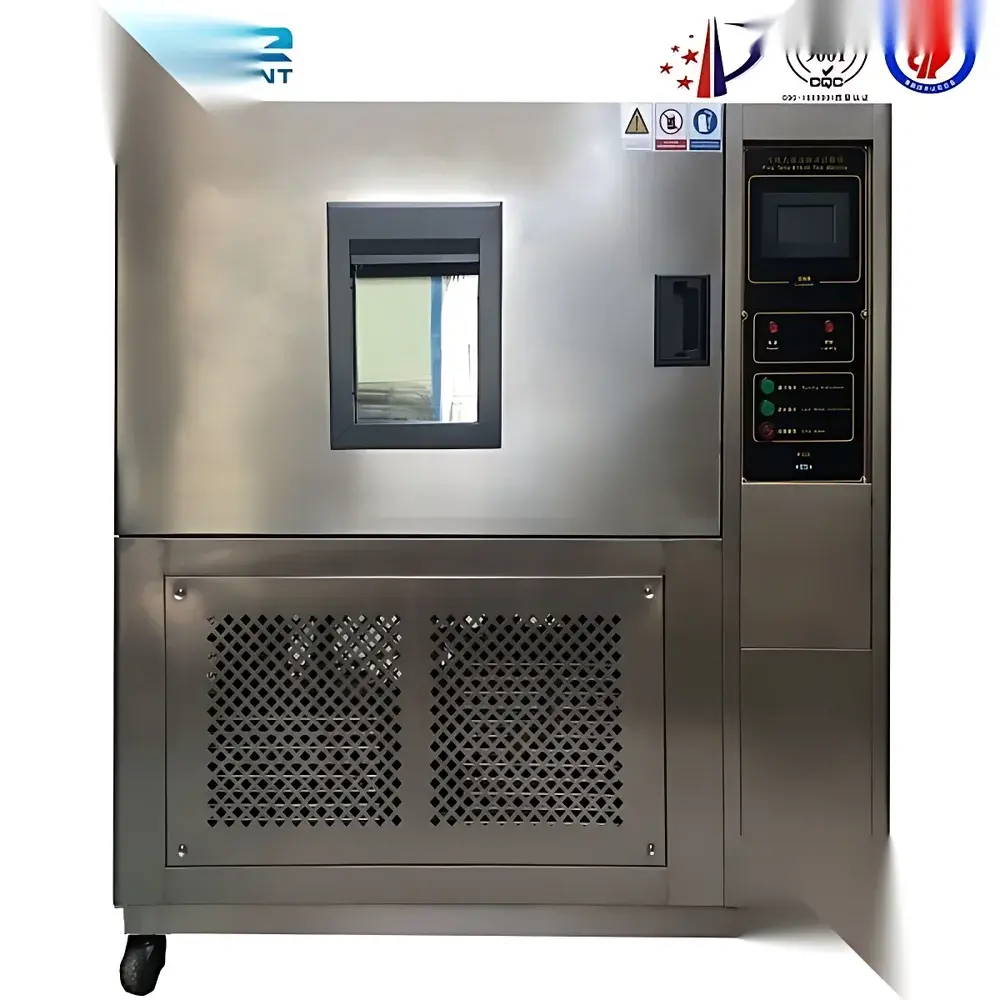
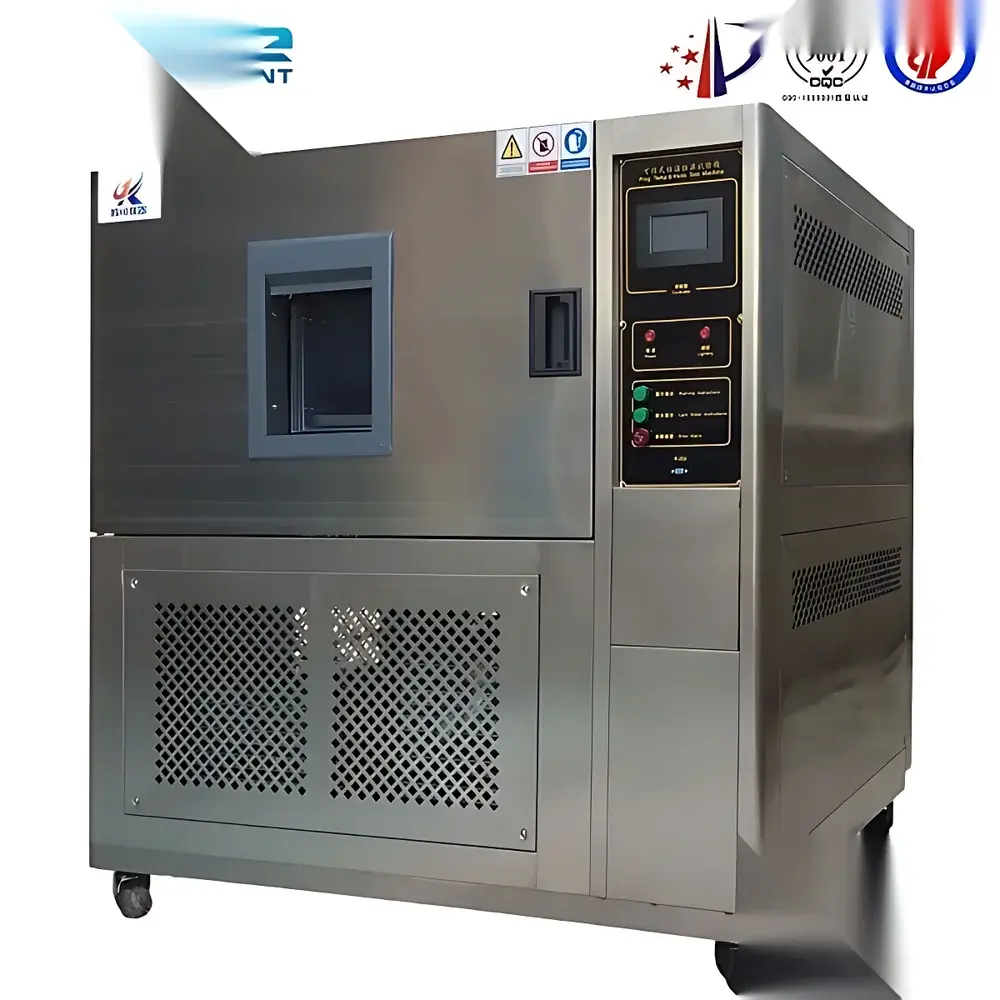
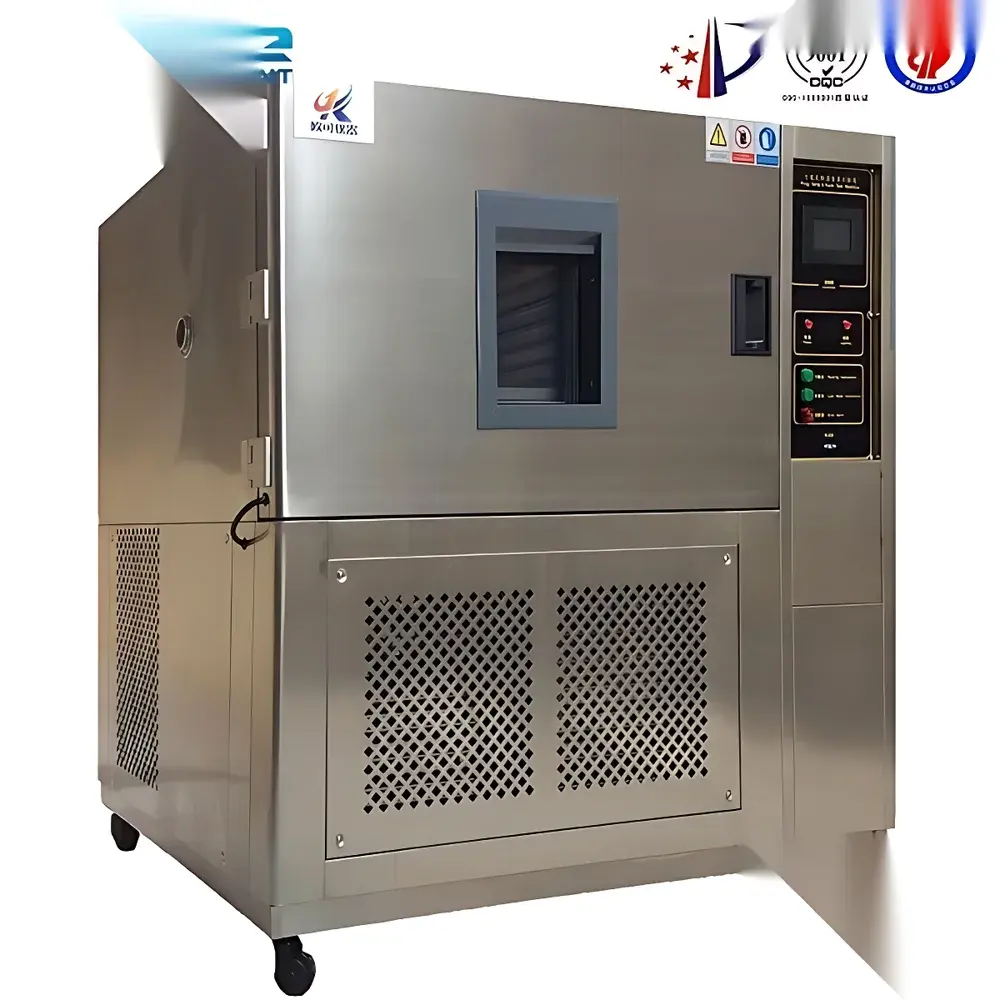
Three-Tier Temperature and Humidity Controlled Environmental Test Chamber
| Brand | OEM |
|---|---|
| Origin | Imported |
| Manufacturer Type | Authorized Distributor |
| Temperature Range | –40 °C to +150 °C (optional down to –120 °C) |
| Humidity Range | 30–98% RH (optional 5–98% RH) |
| Temperature Resolution | 0.01 °C |
| Humidity Resolution | 0.1% RH |
| Temperature Uniformity | ±0.5 °C |
| Temperature Deviation | ≤±2 °C |
| Humidity Deviation | ≤±2.5% RH |
| Cooling Rate | 0.7–1.0 °C/min |
| Heating Rate | 2.0–3.0 °C/min |
| Control System | TEMI880 Color LCD Touchscreen Programmable Controller |
| Power Supply | 380 V ±5%, 50 Hz, 3P+N+G |
| Inner Chamber Material | SUS304 Stainless Steel |
| Outer Casing | SUS304 Stainless Steel or A3 Steel with Electrostatic Powder Coating |
| Compliance | GB/T 5170.2–1996, GB/T 5170.5–1996, GB 2423.1–1989, GB 2423.2–1989, GB 2423.22–1987, GB 10589–1989, GB 10592–1989, GB 11158–1989 |
Overview
The Three-Tier Temperature and Humidity Controlled Environmental Test Chamber is an engineered precision system designed for rigorous environmental simulation testing of materials, components, and finished products under controlled thermal and hygroscopic conditions. Based on the principle of forced-air convection combined with dual-stage refrigeration and PID-controlled steam humidification, this chamber delivers stable, repeatable, and traceable climate profiles across wide operational ranges. It supports both steady-state conditioning and dynamic cycling protocols—including temperature-only, humidity-only, and combined temperature-humidity ramp/soak profiles—making it suitable for qualification, reliability screening, and accelerated aging studies in electronics, automotive, aerospace, pharmaceutical packaging, and polymer R&D laboratories.
Key Features
- Triple-tier structural design enables independent zone control or synchronized operation—ideal for comparative testing, multi-batch validation, or sequential conditioning stages without cross-contamination.
- High-efficiency cascade refrigeration system with environmentally compliant refrigerants (R404A/R23), capable of reaching –120 °C with optional low-temperature configuration.
- TEMI880 programmable controller featuring a 7-inch color LCD touchscreen interface, real-time graphing, up to 100 programmable test segments, and user-level access control (operator/engineer/admin).
- SUS304 stainless steel interior chamber ensures corrosion resistance, non-outgassing performance, and compliance with ISO 17025 calibration traceability requirements.
- Integrated water-cooled condenser with inlet water temperature monitoring (10–28 °C) and pressure regulation (0.1–0.3 MPa) to maintain consistent cooling capacity under variable ambient loads.
- Comprehensive safety architecture including over-temperature protection, humidity sensor fault detection, door interlock, refrigerant pressure monitoring, and emergency power-off circuitry.
Sample Compatibility & Compliance
This chamber accommodates samples ranging from small PCB assemblies to medium-sized enclosures (customizable internal dimensions available upon request). Its thermal and humidity uniformity meet the stringent spatial homogeneity criteria defined in GB/T 5170.2–1996 (temperature) and GB/T 5170.5–1996 (humidity), ensuring data integrity for accredited testing labs. The system is fully compatible with international standards including IEC 60068-2 series, MIL-STD-810H (Methods 502.7, 507.6), ASTM D4332, and ISO 16750-4 for automotive environmental stress screening. All control parameters—including setpoints, ramp rates, dwell times, and alarm logs—are timestamped and stored with audit-trail capability, supporting GLP/GMP documentation and FDA 21 CFR Part 11 electronic record compliance when paired with validated software extensions.
Software & Data Management
The TEMI880 controller supports USB export of test logs in CSV format and optional RS485/Ethernet communication for integration into centralized laboratory information management systems (LIMS) or SCADA platforms. Optional PC-based software (e.g., TEMI-PC Suite) provides remote monitoring, multi-chamber synchronization, statistical process control (SPC) charting, and automated report generation compliant with ISO/IEC 17025 Annex A.2 requirements. All data—including sensor raw values, control outputs, and event flags—are retained for ≥12 months onboard and can be backed up externally without interruption to ongoing tests.
Applications
- Electronics: Thermal cycling of PCBs, solder joint fatigue evaluation, moisture sensitivity level (MSL) testing per J-STD-020.
- Automotive: Climate endurance of infotainment modules, battery pack thermal management validation, sealant adhesion under cyclic humidity.
- Pharmaceuticals: Stability testing of primary packaging per ICH Q1A(R2), accelerated shelf-life prediction under stressed conditions.
- Polymers & Composites: Glass transition mapping, hydrolytic degradation kinetics, dimensional stability assessment under humid heat.
- Quality Assurance: In-process verification of material lot consistency, supplier qualification per AS9100 or ISO 9001 clause 8.5.1.
FAQ
What is the difference between “temperature fluctuation” and “temperature deviation”?
Temperature fluctuation refers to short-term variation around the setpoint during steady-state operation (±0.5 °C), while temperature deviation indicates spatial inconsistency across the working volume (≤±2 °C), measured per GB/T 5170.2–1996.
Can the chamber operate at –120 °C continuously?
Yes—with the optional ultra-low-temperature cascade configuration and verified water-cooling infrastructure. Continuous operation requires ambient inlet water ≤20 °C and stable supply pressure ≥0.2 MPa.
Is humidity control possible below 30% RH?
Standard configuration covers 30–98% RH. Sub-30% RH operation (down to 5% RH) is achievable using optional dry-air purge or desiccant-assisted dehumidification modules.
How is calibration traceability ensured?
The chamber includes dual calibrated PT100 sensors (one for control, one for monitoring) with NIST-traceable certificates. Optional on-site calibration services follow ISO/IEC 17025 procedures, including uncertainty budgeting per GUM.
Does the system support remote diagnostics?
Yes—via Ethernet-enabled TEMI880 firmware (v3.2+), enabling secure remote login, live parameter viewing, firmware updates, and diagnostic log retrieval through TLS-encrypted channels.



