
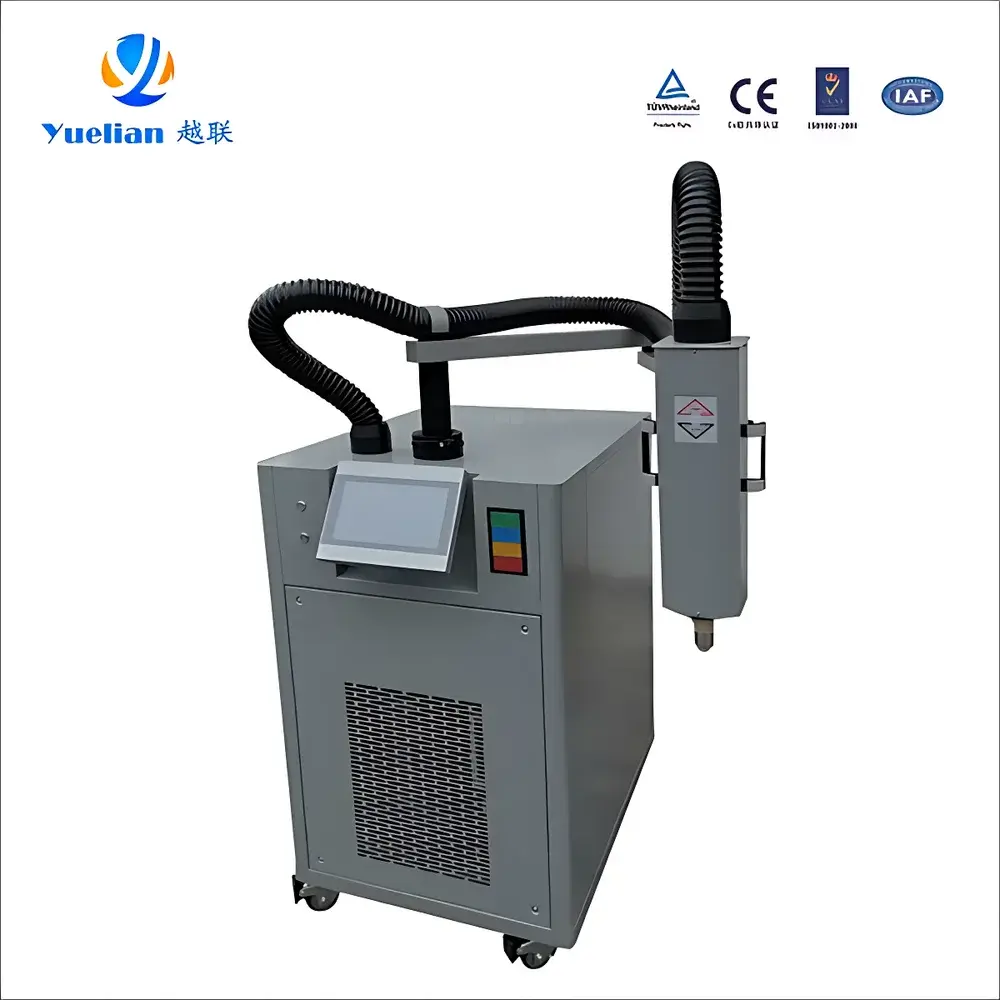
Yuelian YHTS-80 Thermal Streamer
| Brand | Yuelian |
|---|---|
| Origin | Guangdong, China |
| Manufacturer Type | Authorized Distributor |
| Country of Origin | China |
| Model | YHTS-80 |
| Temperature Range | −80 °C to +250 °C |
| Temperature Transition Time (−55 °C ↔ +125 °C) | ≤10 s |
| Temperature Accuracy | ±0.5 °C |
| Temperature Resolution | 0.01 °C |
| Airflow Rate | 4–18 SCFM (1.9–8.5 L/s) |
| Measurement Modes | AIR MODE (ambient air sensing) or DUT MODE (direct device-under-test thermal coupling) |
| Operating Modes | High–Ambient–Low / High–Low / High–Ambient / Low–Ambient / Custom Programmable Sequencing |
| Control Modes | Manual / Programmed / Manual Cycling / Automatic Cycling |
| Dimensions (W×D×H) | 660 × 1050 × 1000 mm |
| Weight | 150 kg |
| Arm Extension Length | 140 cm |
| Vertical Adjustment Range | 720–1220 mm |
| Optional Insulated Viewing Window | Internal Diameter 140 mm, Height 55 mm (customizable per DUT footprint) |
| Power Supply | Single-phase 220 VAC, 50 Hz, 40 A |
| Required Pneumatic Supply | Inlet Temp. +15–+25 °C, Pressure 90–110 psig (6.2–7.6 bar), Flow Rate 1–1.5 m³/min, Dew Point ≤10 °C, Oil Content ≤0.01 ppm |
Overview
The Yuelian YHTS-80 Thermal Streamer is a high-performance, closed-loop thermal test system engineered for precise, rapid, and repeatable temperature conditioning of semiconductor devices and electronic assemblies during reliability validation and failure analysis. It operates on the principle of forced convective heat transfer using regulated, oil-free, desiccated compressed air as the thermal medium—enabling direct, non-contact thermal coupling to the device under test (DUT) without mechanical clamping or thermal interface materials. Unlike conventional environmental chambers, the YHTS-80 delivers dynamic thermal profiles with sub-second response latency and high spatial thermal uniformity across the DUT surface, making it especially suitable for transient thermal characterization, JEDEC-compliant temperature cycling (e.g., JESD22-A104, JESD22-A106), and accelerated stress testing of ICs, flash memory (eMMC/UFS), optical transceivers (SFP+, QSFP28), and multilayer PCB substrates.
Key Features
- Wide operational temperature range from −80 °C to +250 °C, supporting both cryogenic and high-temperature qualification protocols.
- Thermal transition speed of ≤10 seconds between −55 °C and +125 °C—critical for simulating real-world thermal shock conditions per MIL-STD-883 Method 1010 and IEC 60068-2-14.
- Temperature accuracy of ±0.5 °C and resolution of 0.01 °C, traceable to NIST-calibrated reference sensors and validated per ISO/IEC 17025 procedures.
- Dual measurement architecture: AIR MODE for ambient air stream monitoring and DUT MODE for direct thermal feedback via integrated thermocouple or RTD input—enabling closed-loop PID control synchronized to DUT junction temperature.
- Programmable thermal sequencing with up to 99 steps, including ramp-soak-hold profiles, dwell time definition, and user-defined trigger logic for external instrumentation (e.g., parametric testers, oscilloscopes).
- Modular pneumatic interface compliant with ISO 8573-1 Class 1 oil-free air standards (≤0.01 ppm oil content, dew point ≤10 °C), ensuring contamination-free operation for sensitive optoelectronic and MEMS components.
- Ergonomic vertical arm with 140 cm extension and 500 mm vertical travel (720–1220 mm height range), facilitating alignment with probe stations, ATE handlers, and optical test benches.
Sample Compatibility & Compliance
The YHTS-80 accommodates a broad spectrum of DUT form factors—from bare die and wafer-level packages to full SFP modules, BGA-encapsulated ASICs, and multi-layer flex-rigid PCBs. Its open-top design and customizable insulated viewing window (standard ID 140 mm × H 55 mm) permit unobstructed optical access for IR thermography, laser scanning, or real-time electrical probing. The system meets electromagnetic compatibility requirements per CISPR 11 Group 2, Class A and conforms to safety standards IEC 61010-1 for laboratory equipment. All thermal profiles are fully auditable and support GLP/GMP-aligned documentation workflows—including timestamped log files with sensor metadata, operator ID, and sequence versioning—facilitating compliance with FDA 21 CFR Part 11 when integrated with validated data acquisition software.
Software & Data Management
Control and monitoring are executed via Yuelian’s proprietary ThermalStudio™ software suite (Windows-based), which provides intuitive graphical profile editing, real-time thermal mapping visualization, and automated report generation in PDF/CSV formats. The software supports OPC UA and TCP/IP communication protocols for seamless integration into factory MES systems and automated test platforms. Audit trails include full change history of setpoints, calibration events, and user login/logout records. Raw thermal data streams (sampled at 10 Hz) are stored with millisecond timestamps and can be exported for post-processing in MATLAB, Python (Pandas/NumPy), or JMP. Firmware updates are digitally signed and version-controlled to ensure integrity and traceability.
Applications
- JEDEC JESD22-A104 (Temperature Cycling) and JESD22-A106 (Thermal Shock) qualification of automotive-grade ICs and power modules.
- Transient thermal impedance (Zth) extraction of GaN HEMTs and SiC MOSFETs under pulsed bias conditions.
- High-speed temperature profiling of optical transceiver modules during BER (Bit Error Rate) testing across operating temperature envelopes.
- Failure analysis root-cause determination via controlled thermal stress induction followed by SEM/FIB cross-sectioning.
- Process validation of underfill cure kinetics and solder reflow profiles for advanced packaging (e.g., Fan-Out Wafer-Level Packaging).
- Reliability screening of 5G RF front-end modules (FEMs) and mmWave antenna-in-package (AiP) assemblies.
FAQ
What types of compressed air supply are required for stable operation?
The YHTS-80 requires oil-free, desiccated air meeting ISO 8573-1 Class 1 specifications: pressure 90–110 psig (6.2–7.6 bar), flow rate 1–1.5 m³/min, inlet temperature +15–+25 °C, dew point ≤10 °C, and oil content ≤0.01 ppm.
Can the system be integrated with third-party parametric testers or probe stations?
Yes—via TTL/RS232/USB/ethernet interfaces and supported SCPI command sets; full API documentation and LabVIEW drivers are provided.
Is the temperature calibration traceable to national standards?
All factory calibrations are performed using Fluke 1524 Reference Thermometers and dry-block calibrators accredited to ISO/IEC 17025, with certificates issued upon request.
Does the system support automated pass/fail evaluation based on thermal limits?
Yes—user-defined thermal thresholds can be configured per step, triggering alarms, data logging suspension, or external relay outputs for hardware interlocks.
What maintenance intervals are recommended for long-term stability?
Air filter elements require replacement every 6 months under continuous operation; annual verification of thermal sensor linearity and PID loop performance is advised per internal SOP-THM-003.
Related Products



