
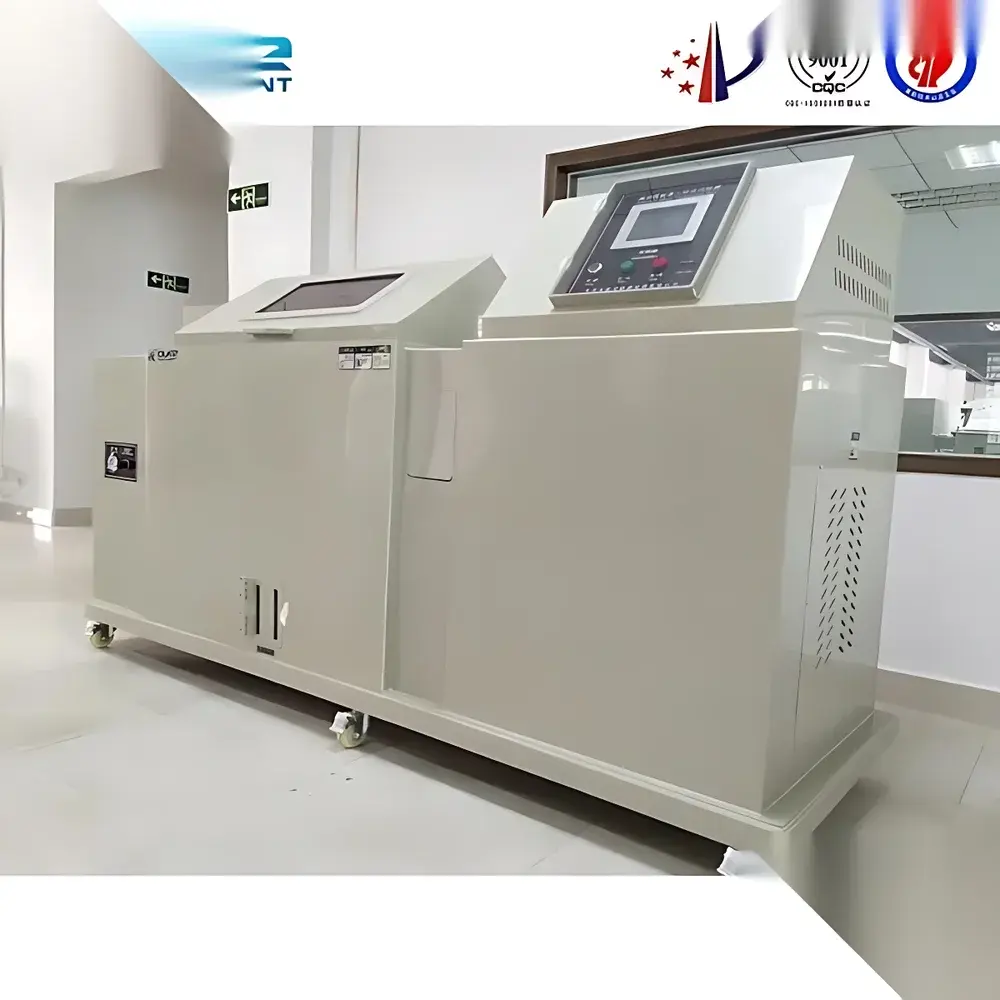
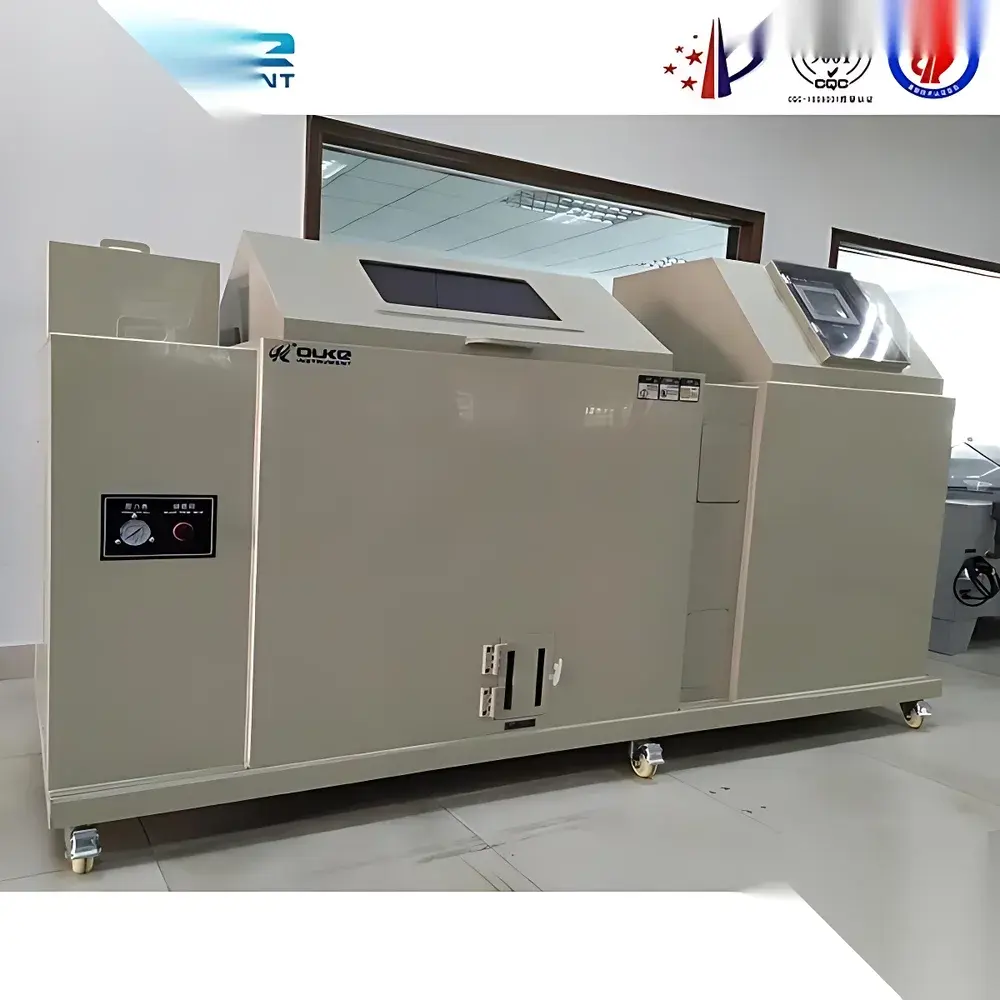
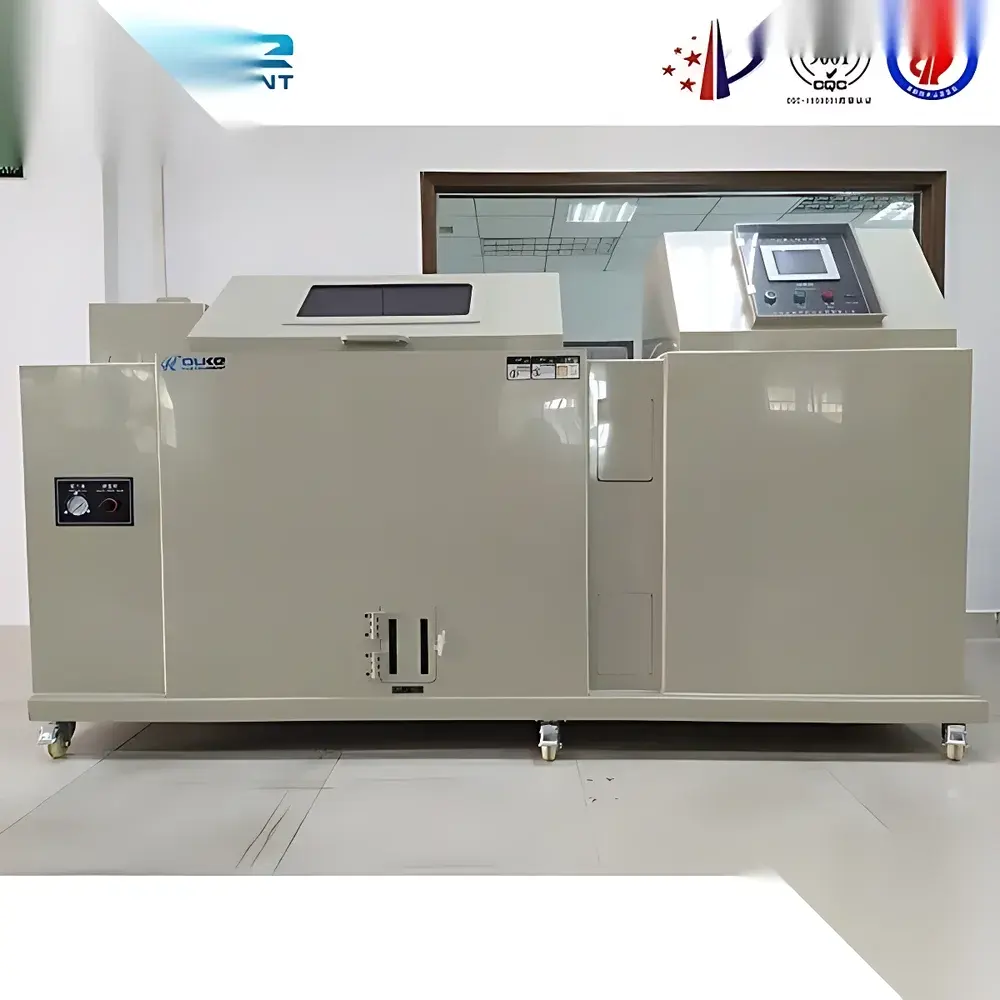
Carbonation-Salt Spray-Humidity-Temperature Environmental Test Chamber
| Brand | Other Brands |
|---|---|
| Origin | Imported |
| Manufacturer Type | General Distributor |
| Temperature Range | +5°C to 55°C |
| Humidity Range | 85–95% RH |
| Temperature Uniformity | ≤ ±2°C |
| Temperature Fluctuation | ≤ ±0.5°C |
| Salt Spray Deposition Rate | 1–2 mL / 80 cm²·h |
| Spray Modes | Continuous or Cyclic |
| Test Timing Range | 1–999 (s/min/h) adjustable |
| Chamber Volume Options | 60 L / 90 L / 120 L |
| Heating Power | 1.3–1.8 kW |
| Saturation Tank Temperature | Up to 63°C |
| Compliance Standards | ASTM B117, ISO 9227, GB/T 2423.17, GB/T 2423.18, GB/T 2423.26 |
Overview
The Carbonation-Salt Spray-Humidity-Temperature Environmental Test Chamber is a multi-stress corrosion testing system engineered for accelerated evaluation of material resistance under combined aggressive environmental conditions—including chloride-induced corrosion, cyclic humidity exposure, thermal stress, and carbon dioxide-assisted degradation mechanisms. Unlike conventional salt spray chambers limited to static NSS/ASS/CASS protocols, this chamber integrates precise humidity control (85–95% RH), programmable temperature gradients (+5°C to 55°C), and optional CO₂-enriched atmosphere capability—enabling simulation of real-world coastal, industrial, or urban atmospheric corrosion pathways where carbonation accelerates chloride penetration in concrete, coatings, and metallic substrates. The chamber operates on the principle of controlled electrochemical acceleration: saline mist generation via pyrex glass nozzles ensures uniform deposition; saturated air conditioning (per Henry’s Law) maintains thermodynamic equilibrium between chamber and saturation tank; and direct steam heating enables rapid, stable thermal ramping with minimal overshoot. Designed for laboratory and QA/QC environments, it supports full traceability and reproducible test cycles aligned with international corrosion standards.
Key Features
- Programmable dual-mode operation: continuous salt fog (ASTM B117 compliant) or cyclic salt-humidity-temperature profiles (GB/T 2423.18 & 2423.26 compliant)
- High-precision digital PID temperature controller (±0.1°C accuracy) with multi-stage auto-tuning and fuzzy logic compensation
- Pyrex glass atomizing nozzles—non-crystallizing, chemically inert, and calibrated for uniform 1–2 mL/80 cm²·h deposition rate
- Dual safety architecture: independent over-temperature cutoff (chamber + saturation tank) and automatic low-water-level detection with audible/visual alarm
- Steam-based direct heating system ensuring rapid thermal stabilization (<15 min from ambient to 50°C) and ≤±2°C spatial uniformity
- Transparent polycarbonate lid for real-time visual monitoring of specimen condition and fog distribution without interrupting test integrity
- Integrated saturation air tower with conical diffuser and adjustable flow baffle—optimizing droplet size distribution and directional fog delivery
- Automatic water replenishment system with inline particulate filtration (5 µm) and pre-heated brine supply to maintain thermal equilibrium
Sample Compatibility & Compliance
The chamber accommodates flat-panel specimens (up to 750 × 1100 mm), coated metal coupons, electronic enclosures, automotive fasteners, and cementitious materials. Internal chamber dimensions are configurable across three standard volumes (60 L, 90 L, 120 L), all constructed from PVC-coated steel with reinforced sealing gaskets and corrosion-resistant internal hardware. All operational parameters—including temperature setpoint, humidity level, spray duration, rest intervals, and CO₂ concentration (if equipped)—are fully programmable and auditable. The system meets ISO/IEC 17025 documentation requirements for calibration traceability and supports GLP-compliant audit trails when paired with optional data logging modules. Regulatory alignment includes ASTM B117 (neutral salt spray), ASTM G85 Annex A2/A3 (acidified and copper-accelerated acetic acid salt spray), ISO 9227 (corrosion tests in artificial atmospheres), and China’s GB/T 2423 series for environmental testing of electrotechnical products.
Software & Data Management
While the base configuration features an embedded LED-based PID controller with manual parameter entry, optional PC-integrated software provides extended functionality: real-time graphing of chamber temperature/humidity/spray status, automated report generation (PDF/CSV), user-access-level management (operator, engineer, administrator), and electronic signature support for 21 CFR Part 11 compliance. All test logs include timestamped metadata—start/stop times, setpoints, deviations, alarm events, and operator ID—stored locally on SD card or remotely via Ethernet. Data export conforms to ASTM E2911 and ISO 10012 standards for measurement process control. Firmware updates are performed via secure USB interface with version rollback capability.
Applications
This chamber serves critical validation roles across aerospace (fastener corrosion screening), automotive (coating adhesion under cyclic wet-dry conditions), construction (rebar passivation in carbonated concrete), electronics (PCB conformal coating durability), and marine equipment (stainless steel grade qualification). It is routinely deployed for:
- Qualification of anti-corrosion coatings per ISO 12944–6
- Accelerated aging of galvanized steel per ASTM A924
- Validation of sealant performance under CO₂-enhanced chloride ingress
- Corrosion product morphology analysis via post-test SEM/EDS
- Interlaboratory round-robin studies requiring cross-platform reproducibility
FAQ
What standards does this chamber support for cyclic corrosion testing?
It natively executes ASTM B117 (NSS), ASTM G85 Annex A2 (ASS), ASTM G85 Annex A3 (CASS), ISO 9227, and GB/T 2423.17–2423.26. Custom cycle programming allows user-defined sequences combining salt fog, drying, humidity, and recovery phases.
Is the saturation tank temperature independently controlled?
Yes—the saturation air tank features dedicated PID-controlled heating (range: 35–63°C) with PT100 sensing, ensuring precise dew point control per Henry’s Law requirements for stable fog generation.
How is salt solution purity maintained during long-duration tests?
A two-stage filtration system (5 µm particulate + activated carbon) is installed at the brine suction line, and the reservoir includes a removable sediment trap. Optional ultrasonic agitation prevents NaCl crystallization in storage.
Can humidity be held independently of salt spray operation?
Yes—humidity-only cycles (85–95% RH, +5°C to 55°C) are fully programmable without activation of the spray system, enabling standalone damp heat testing per IEC 60068-2-78.
What maintenance intervals are recommended for optimal repeatability?
Daily: nozzle inspection and cleaning with deionized water; Weekly: saturation tank descaling and filter replacement; Annually: PT100 sensor calibration verification and door gasket integrity check per ISO/IEC 17025 guidelines.



