
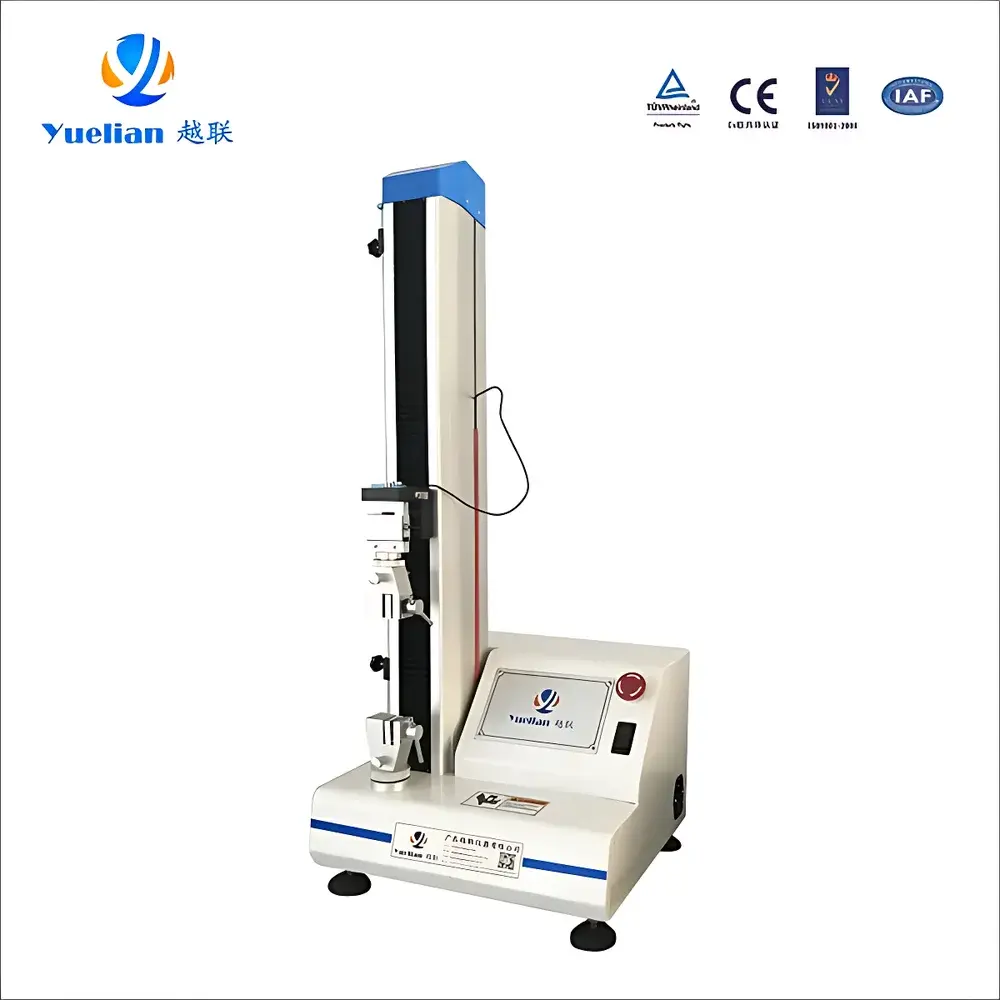
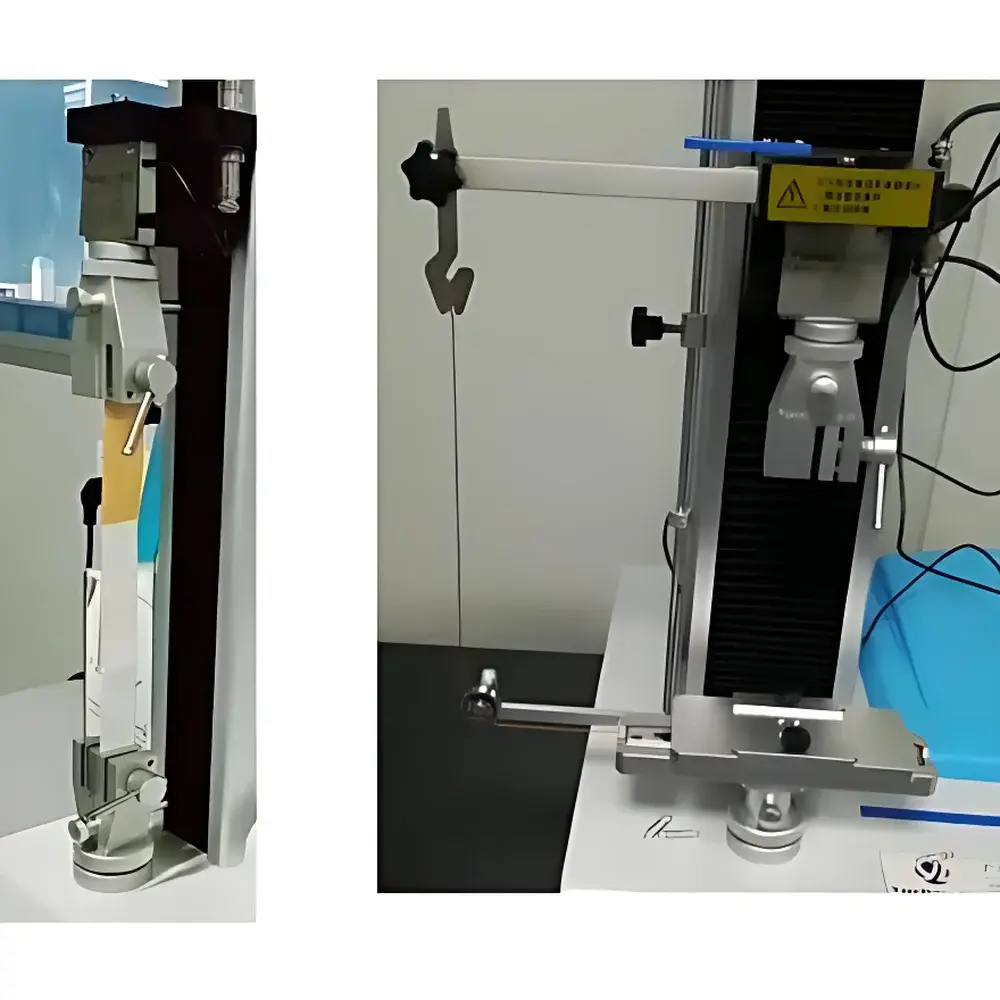
Yuelian YL-S93 Electronic Tensile Testing Machine for Copper Wire Strength and Elongation Measurement
| Brand | Yuelian |
|---|---|
| Origin | Guangdong, China |
| Manufacturer Type | Authorized Distributor |
| Product Category | Domestic |
| Model | YL-S93 |
| Quotation | ¥17,800 |
| Instrument Type | Electronic Tensile Testing Machine |
| Maximum Test Force | 1 kN |
| Force Range | 10 N – 1 kN (Full Scale) |
| Force Accuracy | ±0.30% of reading |
| Test Stroke | 450 mm |
| Displacement Resolution | 1/500,000 mm |
| Drive System | Stepper Motor + Precision Ball Screw |
| Control Interface | Dedicated LCD Display + PC Software via USB/RS-232 |
| Compliant Standards | GB/T 2792, ASTM D3330, GB/T 12914–1991, GB 13022–91, GB/T 1040–92, GB 2792–81, GB/T 14344–9, GB/T 2191–95, QB/T 2171–95, GB/T 10003–2008 |
Overview
The Yuelian YL-S93 Electronic Tensile Testing Machine is a precision-engineered universal testing system designed specifically for mechanical property characterization of metallic wires—particularly copper conductors—under uniaxial tension. It operates on the fundamental principle of controlled force application via stepper motor-driven ball screw actuation, enabling high-fidelity measurement of tensile strength (MPa), yield strength (MPa), elongation at break (%), and modulus of elasticity (GPa) in accordance with standardized quasi-static test protocols. The instrument meets the metrological requirements of ISO 7500-1 (Class 1) for force measurement accuracy and ISO 5893 for displacement resolution, ensuring traceable, repeatable data acquisition across laboratory, QC, and R&D environments. Its compact benchtop architecture (40 × 37 × 92 cm), low power consumption (180 W), and dual-mode operation (standalone LCD or PC-integrated) make it suitable for both production floor verification and accredited materials testing laboratories.
Key Features
- High-resolution force transduction: 1/500,000 internal resolution with ±0.30% full-scale accuracy across the 10 N–1 kN range, calibrated per ISO 376.
- Precision mechanical drive: Closed-loop stepper motor coupled to a ground-precision ball screw ensures >85% transmission efficiency and minimal hysteresis during loading/unloading cycles.
- Adjustable test speed: Programmable from 0.1 to 500 mm/min via PC software or front-panel input, supporting both ASTM E8/E8M and ISO 6892-1 strain rate requirements.
- Dual operation mode: Standalone testing with real-time force/displacement display on integrated B-type LCD; or synchronized data capture via USB/RS-232 to Windows-based analysis software.
- Modular fixture interface: Quick-release couplings accommodate standardized tensile grips (flat, wedge, pneumatic), wire clamps, peel fixtures, and shear adapters per ASTM D1876 and ISO 11339.
- Comprehensive safety logic: Automatic stop triggers include overload detection, specimen rupture recognition, upper/lower stroke limits, emergency halt, and programmable hold-to-load (creep) or hold-to-strain (relaxation) functions.
Sample Compatibility & Compliance
The YL-S93 is validated for tensile evaluation of copper wire specimens conforming to IEC 60228, ASTM B3, and GB/T 3953 standards—including bare soft-drawn, hard-drawn, and annealed Cu conductors (diameters 0.05–3.0 mm). It also supports non-metallic substrates such as polymer films (ASTM D882), paperboard (TAPPI T494), textile yarns (ISO 2062), and adhesive tapes (ASTM D3330). All test methods implemented align with GLP/GMP documentation practices, supporting audit-ready electronic records including operator ID, timestamped test parameters, raw curve data (.csv/.xls), and digital signature-enabled reports. Calibration certificates are traceable to CNAS-accredited national standards.
Software & Data Management
The included Windows-compatible software provides full control over test configuration, real-time graphical monitoring (force vs. displacement, stress vs. strain), and post-test statistical analysis (mean, SD, CV%, min/max, trend charts). Raw data export supports CSV, Excel, and PDF formats with embedded metadata (test standard, sample ID, environmental conditions). Audit trail functionality complies with FDA 21 CFR Part 11 requirements for electronic records—enabling user access control, change history logging, and electronic signature validation. Optional integration with LIMS platforms is supported via ODBC-compliant database output.
Applications
- Copper wire quality assurance: Verification of tensile strength and elongation per IEC 60228 Class 1–5 and GB/T 3953 Grade TR/TX.
- Process validation: Monitoring drawing die wear effects on ductility loss across consecutive batches.
- Material development: Comparative evaluation of oxygen-free copper (OFC) versus electrolytic-tough-pitch (ETP) variants under identical strain rates.
- Failure root cause analysis: Correlation of brittle fracture morphology with measured reduction-in-area and uniform elongation.
- Multi-material benchmarking: Cross-comparison of Cu, Al, Cu-Ni alloys, and polymer-coated conductors under standardized grip geometry and extensometer-free testing.
FAQ
What standards does the YL-S93 comply with for copper wire testing?
It supports GB/T 3953, IEC 60228, ASTM B3, and ISO 15630-1 for metallic conductor tensile evaluation.
Can the machine perform constant-rate-of-extension (CRE) and constant-rate-of-traverse (CRT) tests?
Yes—software-defined speed profiles enable both CRE (per ISO 527-1) and CRT (per ASTM D638) modes with programmable ramp-hold sequences.
Is an extensometer required for accurate modulus measurement?
For ISO 527-2 or ASTM D638 modulus determination, a clip-on or video extensometer is recommended; the base system uses crosshead displacement for compliance-corrected calculations.
Does the system support multi-specimen batch testing with auto-report generation?
Yes—batch mode allows sequential testing of up to 99 specimens with automatic naming, averaging, and customizable report templates.
What maintenance intervals are recommended for long-term force accuracy stability?
Annual calibration verification is advised; ball screw lubrication every 6 months and periodic load cell zero-checking before critical runs ensure sustained metrological integrity.



