
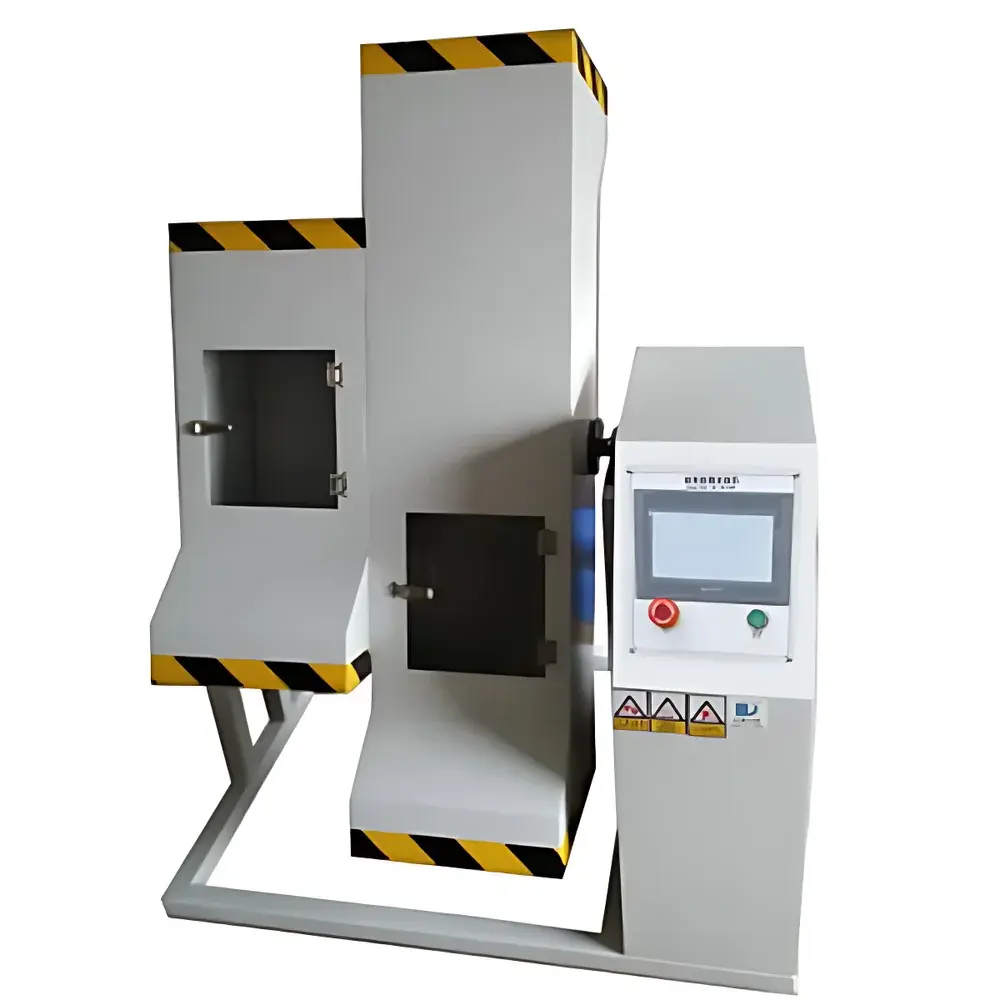
Brookfield PW-DR2P Dual-Drum Drop Tester
| Brand | PW |
|---|---|
| Origin | Guangdong, China |
| Model | PW-DR2P |
| Drop Height | 1000 mm (dual-height: 500 mm & 1000 mm) |
| Max Sample Weight | 5 kg |
| Test Speed | 5–20 cycles/min |
| Cycle Count Range | 1–999,999 (6-digit PLC touch interface with power-loss memory) |
| Drum Quantity | 2 |
| Test Surface | 15 mm plywood + 3 mm steel plate |
| Power Supply | 1-phase AC 220 V / 380 V |
| Dimensions (W×H×D) | 1300 × 780 × 1420 mm |
| Net Weight | ~120 kg |
| Compliance | IEC 60068-2-32, GB/T 2423.8–1995 Annex |
Overview
The Brookfield PW-DR2P Dual-Drum Drop Tester is an electromechanically controlled physical testing instrument engineered for standardized mechanical durability evaluation of portable electronic devices and compact components under repeated tumbling impact conditions. It operates on the principle of controlled rotational drop—where test specimens are placed inside two independently configurable cylindrical drums, each rotating at a defined angular velocity until gravitational release induces a free-fall impact onto a rigid, calibrated test surface. This method replicates real-world handling stresses such as accidental drops during transportation, consumer handling, or packaging shifts. Unlike single-drum testers, the dual-drum configuration enables parallel execution of two distinct test protocols—e.g., one drum at 500 mm drop height for low-energy assessment and the other at 1000 mm for high-intensity validation—thereby improving throughput and comparative repeatability across product variants or material batches.
Key Features
- Dual independent drum stations (500 mm and 1000 mm nominal drop heights), each equipped with transparent polycarbonate viewing windows secured by hinge-mounted latches and locking mechanisms—ensuring operator safety while permitting real-time visual inspection without interrupting test continuity.
- PLC-based 6-digit touch-screen controller with non-volatile memory: retains programmed cycle count, speed setting, and elapsed cycles even after unexpected power interruption; auto-stops upon reaching user-defined termination threshold.
- Precision-adjustable test speed (5–20 cycles per minute) via servo-controlled motor drive, enabling fine-tuned kinetic energy modulation and precise synchronization for failure-mode correlation studies.
- Standardized impact surface assembly comprising 15 mm thick hardwood plywood overlaid with a 3 mm cold-rolled steel plate—rigidly mounted to a reinforced base frame to meet IEC 60068-2-32 mechanical boundary requirements.
- Full-body powder-coated enclosure in matte white finish with ISO-compliant hazard labeling (EN ISO 7010 symbols) applied to all access points and moving components.
- Integrated emergency stop circuit, overload protection, and interlocked drum access doors that halt rotation immediately upon door opening—ensuring full compliance with IEC 61000-6-2 and EN 60204-1 functional safety directives.
Sample Compatibility & Compliance
The PW-DR2P accommodates specimens up to 5 kg mass and dimensions compatible with standard drum internal diameters (typically ≤Φ200 mm × L300 mm). It is routinely deployed for conformance testing of mobile phones, lithium-ion battery packs, PDA housings, USB-C connectors, remote controls, AC adapters, and wearable device enclosures. The system satisfies mandatory test conditions specified in IEC 60068-2-32 (Free Fall) and aligns with the mechanical construction criteria outlined in GB/T 2423.8–1995 Annex (Tumbling Drum Method). While not certified to ISO/IEC 17025 itself, the instrument’s design supports GLP-compliant test record generation when integrated with validated laboratory information management systems (LIMS) and audit-trail-enabled data loggers.
Software & Data Management
The embedded HMI interface supports direct parameter entry—including target cycle count, dwell time per rotation, and speed ramp profiles—with real-time display of elapsed cycles, current speed, and operational status (RUN/PAUSE/STOP). All test logs—including start timestamp, termination reason (normal completion vs. manual abort), and cumulative runtime—are stored internally in CSV-compatible format and exportable via USB port. For regulated environments, optional RS-485 or Ethernet communication modules enable integration with centralized QA databases and support 21 CFR Part 11–compliant electronic signatures when paired with validated third-party software platforms.
Applications
- Pre-production reliability screening of consumer electronics housing materials (e.g., polycarbonate, ABS, magnesium alloy) under cyclic impact loading.
- Comparative analysis of adhesive bond strength in multi-part assemblies subjected to torsional drop stress.
- Verification of connector retention force integrity after simulated shipping vibration and drop sequences.
- Supporting ASTM D5276 (Drop Test of Loaded Containers) protocol adaptations for small-format logistics packages.
- Root cause analysis of brittle fracture initiation in thin-walled plastic components using controlled incremental cycle increments.
FAQ
What standards does the PW-DR2P directly support?
It fulfills the mechanical and procedural requirements of IEC 60068-2-32 and GB/T 2423.8–1995 Annex for tumbling drum drop testing.
Can both drums operate simultaneously at different heights and speeds?
Yes—the two drums are mechanically independent and can be configured with separate height settings (500 mm or 1000 mm) and individual speed parameters (5–20 rpm) within the same test session.
Is calibration documentation provided with the unit?
A factory-issued calibration certificate for the touch-panel counter and motor speed encoder is included; field recalibration intervals are recommended every 12 months or per internal QA policy.
Does the system support external data logging via analog or digital outputs?
Standard configuration includes USB data export; optional serial (RS-485) or TCP/IP Ethernet modules are available for SCADA or MES integration.
What maintenance is required for long-term repeatability?
Monthly inspection of drum bearing preload, verification of latch engagement torque, and annual verification of drop height accuracy using traceable laser distance measurement tools.



