
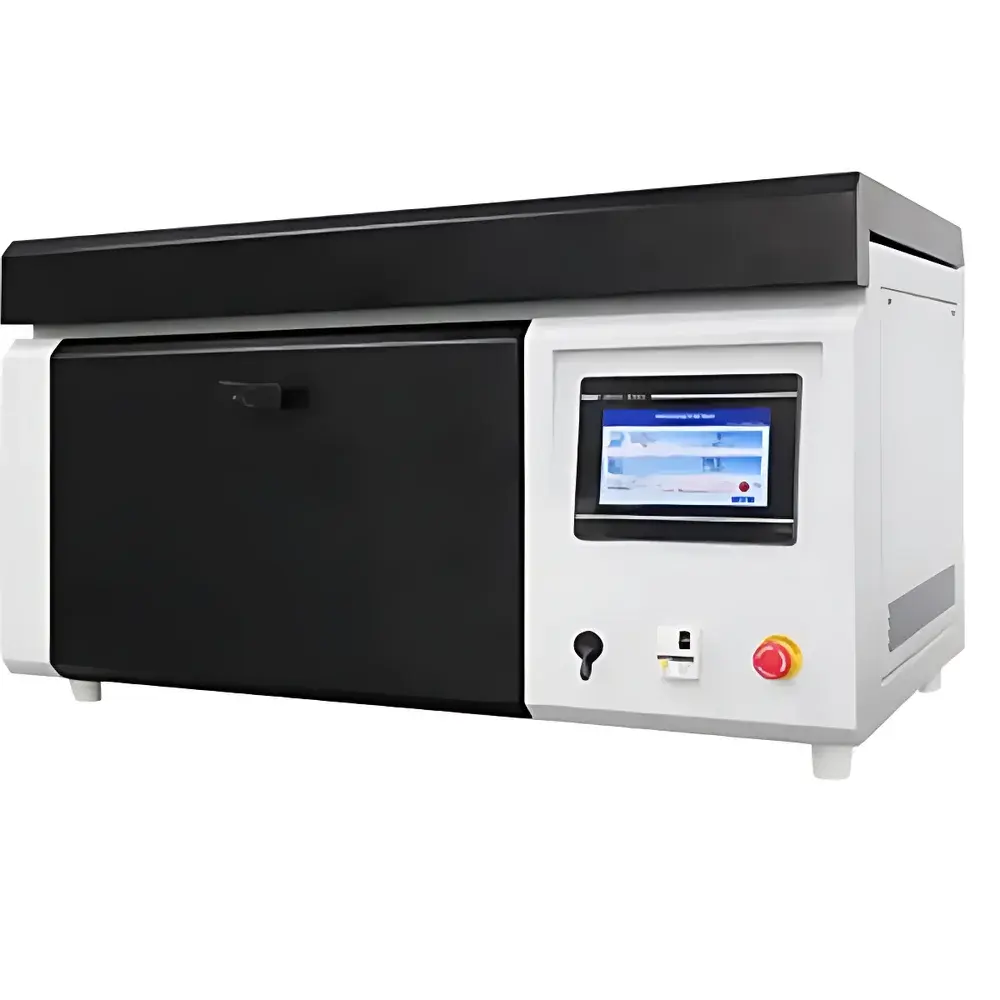
Yuelian PW-CX1800 Benchtop Xenon Arc Weathering Test Chamber
| Brand | Yuelian / PW |
|---|---|
| Origin | Guangdong, China |
| Manufacturer Type | Authorized Distributor |
| Product Origin | Domestic (China) |
| Model | PW-CX1800 |
| Xenon Lamp Power | 3.5 kW (rated system power) |
| Irradiance Range | 30–100 W/m² (300–400 nm) |
| Irradiance Monitoring Options | 340 nm, 420 nm, or 300–400 nm broadband |
| Black Panel Temperature Range | +20°C above ambient to 90°C |
| Effective Exposure Area | 1000 cm² (accommodates nine 150 × 70 mm specimens) |
| Lamp Type | 1.8 kW air-cooled xenon arc lamp |
| Rated Lamp Life | ≈1500 h |
| Filter Options | UV-extended, daylight, or window glass filters |
| Dimensions (L×W×H) | 950 × 570 × 540 mm |
| Net Weight | 93 kg |
| Power Supply | 220 V, 50/60 Hz |
| Max Current | 125 A |
Overview
The Yuelian PW-CX1800 Benchtop Xenon Arc Weathering Test Chamber is an engineered solution for accelerated weathering evaluation of polymeric, coating, textile, and automotive materials under controlled solar-simulated irradiation. It employs a 1.8 kW air-cooled xenon arc lamp—calibrated to replicate the full spectral distribution of natural sunlight (290–800 nm)—and integrates precision optical filtering to emulate specific environmental exposure conditions. Unlike UV fluorescent or QUV-based systems, the PW-CX1800 delivers true broadband solar simulation, enabling correlation with real-world outdoor degradation mechanisms including photooxidation, chalking, color fading, gloss loss, and embrittlement. Its compact footprint (950 × 570 × 540 mm) and benchtop form factor make it suitable for space-constrained laboratories while maintaining compliance with key international test standards such as ISO 4892-2, ASTM G155, SAE J2527, and IEC 60068-2-9.
Key Features
- Air-cooled 1.8 kW xenon arc lamp with nominal service life of 1500 hours—designed for stable spectral output and low maintenance overhead
- Interchangeable optical filter system: UV-extended (enabling sub-290 nm irradiation for aggressive acceleration), daylight, or window glass filters—each with long-term spectral stability and no scheduled replacement requirement
- Digital touchscreen controller with real-time monitoring of irradiance (340 nm, 420 nm, or 300–400 nm broadband), black panel temperature, and elapsed exposure time
- Precise irradiance control within 30–100 W/m² (300–400 nm band); optional calibrated sensor channels at 340 nm (0.3–0.8 W/m²) or 420 nm (0.5–1.5 W/m²)
- Black panel temperature range: +20°C above ambient to 90°C—regulated via proportional-integral-derivative (PID) feedback loop and integrated air circulation
- Uniform irradiance distribution across 1000 cm² exposure area (supports nine 150 × 70 mm specimens on horizontal tray)
- Comprehensive safety architecture: overtemperature cutoff, irradiance deviation alarm (>±10% tolerance), and automatic lamp shutdown upon door opening
- USB data export interface for traceable logging of all operational parameters—including timestamped irradiance, temperature, and runtime—supporting GLP-compliant documentation
Sample Compatibility & Compliance
The PW-CX1800 accommodates flat, rigid specimens up to 150 × 70 mm in dimension, mounted horizontally on a stainless-steel (304 grade) sample tray. Its design supports standard test substrates including painted metal panels, plastic injection-molded parts, textile swatches, and coated films. The chamber meets structural and functional requirements of ISO 4892-2 (Plastics — Methods of exposure to laboratory light sources — Part 2: Xenon-arc lamps), ASTM G155 (Standard Practice for Operating Xenon Arc Light Apparatus for Exposure of Non-Metallic Materials), and SAE J2527 (Surface Vehicle Recommended Practice for Accelerated Exposure of Automotive Exterior Materials Using a Controlled Irradiance Xenon-Arc Apparatus). While not certified for FDA 21 CFR Part 11 compliance out-of-the-box, audit-ready data export and parameter lockout functions enable integration into validated quality systems under GMP/GLP frameworks when paired with documented SOPs.
Software & Data Management
The embedded controller provides local configuration and real-time visualization without external software dependency. All exposure parameters—including irradiance setpoint, black panel temperature, cycle duration (programmable from 1 second to 999 hours), and ramp profiles—are stored in non-volatile memory. Operational logs are exportable via USB mass storage mode as CSV files, preserving timestamps, sensor readings, and system status flags (e.g., lamp-on, door-open, alarm-triggered). This facilitates post-test statistical analysis, trend tracking across multiple test runs, and inclusion in regulatory submission dossiers. Optional third-party data acquisition platforms may interface via RS-232 or analog outputs (0–10 V) for centralized lab management systems.
Applications
- Accelerated aging of automotive interior and exterior trim components per OEM specifications (e.g., Ford CETP, GMW15634)
- Colorfastness and gloss retention testing of architectural coatings and industrial paints
- UV resistance validation of medical device packaging materials (ISO 11607-1)
- Photostability assessment of polymer-based electronics encapsulants and adhesives
- R&D screening of novel UV stabilizers and HALS additives in formulation development
- Quality control verification of batch-to-batch consistency in pigment-dispersed systems
FAQ
What spectral range does the xenon lamp cover?
The lamp emits continuous radiation from 290 nm to >800 nm; spectral output is conditioned by optical filters to match target environments (e.g., UV-extended extends usable range down to ~255 nm).
Is calibration traceable to NIST or other national standards?
Irradiance sensors are factory-calibrated against reference spectroradiometers; users may perform field verification using NIST-traceable transfer standards (e.g., calibrated photodiode sensors).
Can the chamber operate continuously for extended durations?
Yes—designed for unattended operation up to 999 hours per cycle; thermal management and lamp cooling ensure stable performance under prolonged load.
Are filter replacements required during normal operation?
No—optical filters exhibit negligible spectral drift over time; replacement is only necessary after physical damage or contamination.
Does the system support multi-step irradiance or temperature ramping?
Yes—the controller supports up to 10 programmable segments per test cycle, enabling dynamic profiles that simulate diurnal cycles or seasonal transitions.



