
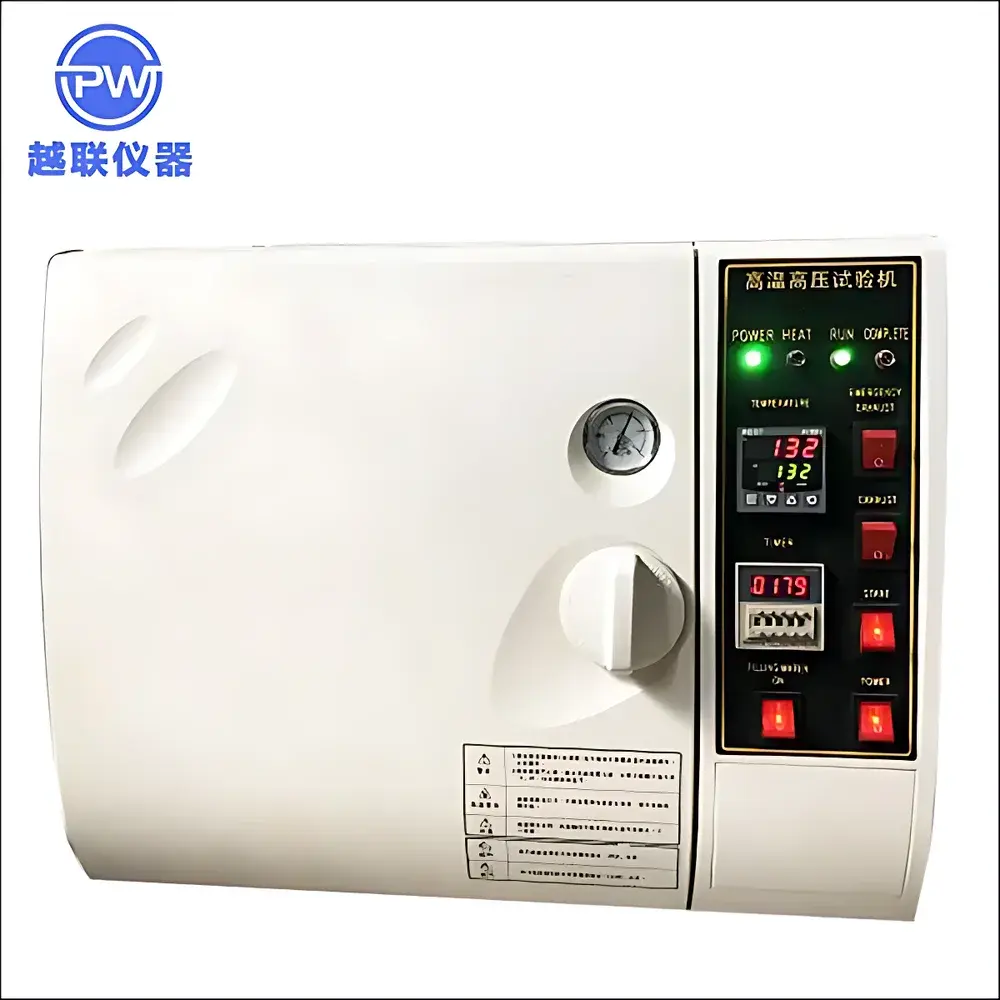
Desktop High-Pressure Accelerated Life Test Chamber
| Brand | Yuelian / PW |
|---|---|
| Model | PCT-30 |
| Temperature Range | +100 °C to +132 °C (saturated steam) |
| Humidity | 100 % RH (saturated steam) |
| Pressure Range | 0.5–3.0 kgf/cm² (internal chamber rated to 4.0 kgf/cm²) |
| Test Duration | 0–999 h |
| Chamber Dimensions (ID) | Ø260 mm × 400 mm (cylindrical) |
| External Dimensions | 1000 × 700 × 1000 mm (desktop) or 1000 × 700 × 1400 mm (floor-standing) |
| Inner Chamber Material | SUS-304 stainless steel |
| Control System | Yokogawa UT-150 microprocessor-based PID controller with LED time display, analog pressure gauge, manual water inlet valve, pre-test vacuum function, and post-test vacuum drying |
| Compliance | GB/T 2423.1–1989, GB/T 2423.2–1989, GB/T 2423.3–1993 |
Overview
The Desktop High-Pressure Accelerated Life Test Chamber (Model PCT-30) is an engineered environmental stress test system designed for accelerated reliability validation of hermetic and moisture-sensitive components under saturated steam conditions. It operates on the principle of high-pressure saturated steam aging—leveraging elevated temperature, full saturation humidity, and controlled overpressure to accelerate hydrolytic degradation mechanisms in encapsulated materials, solder joints, laminates, and sealed assemblies. Unlike conventional thermal cycling or damp heat chambers, this system subjects samples to thermodynamically defined saturated vapor states per IEC 60068-2-66 and ASTM F1876, enabling reproducible acceleration factors for failure modes such as intermetallic growth, delamination, popcorning, and corrosion-induced open/short circuits. Its cylindrical SUS-304 inner chamber conforms to ASME BPVC Section VIII Div. 1 design criteria for low-pressure vessels, ensuring structural integrity and condensate management during repeated pressurization cycles.
Key Features
- Cylindrical inner chamber (Ø260 × 400 mm) constructed from electropolished SUS-304 stainless steel, optimized for uniform steam distribution and minimized condensate pooling.
- Yokogawa UT-150 microprocessor-based PID controller with real-time saturated steam temperature regulation (±0.5 °C accuracy), supporting programmable ramp-hold profiles and auto-compensation for ambient barometric variation.
- Dual-stage safety architecture: mechanical pressure relief valve (set at 4.0 kgf/cm²) combined with electronic LIMIT-based fault detection that halts operation upon sensor deviation, door seal breach, or thermal runaway.
- Integrated vacuum subsystem for pre-test evacuation (≤10 kPa abs) to remove air pockets and ensure complete steam penetration, plus post-test vacuum drying to eliminate residual moisture without thermal shock.
- Patented dual-lip silicone packing design—non-compressive, self-aligning, and resistant to steam-induced compression set—extending gasket service life beyond 5,000 cycles.
- Low water consumption architecture: optimized condensate return path and insulated jacket reduce refill frequency to ≤1 maintenance interval per 400 operational hours under standard 121 °C/2.04 kgf/cm² test conditions.
Sample Compatibility & Compliance
The PCT-30 accommodates a broad spectrum of miniaturized and layered electronic and medical components, including but not limited to multilayer PCBs, IC packages (QFN, BGA, WLCSP), LCD modules, sintered NdFeB magnets, implantable device housings, and sterilizable surgical instruments. Its cylindrical geometry ensures uniform exposure without shadowing effects common in rectangular chambers. The system complies with national standards GB/T 2423.1–1989 (cold testing), GB/T 2423.2–1989 (dry heat), and GB/T 2423.3–1993 (damp heat), and supports protocol alignment with JEDEC JESD22-A102 (accelerated moisture resistance), IPC/JEDEC-95 (moisture sensitivity level classification), and ISO 11737-1 (sterility validation for medical devices). All control logic and data logging functions are structured to support GLP/GMP documentation requirements, including audit-trail-ready event logs and user-access-level permissions.
Software & Data Management
While the base configuration utilizes embedded Yokogawa UT-150 firmware with front-panel LED interface, optional accessories enable full digital integration: a 4–20 mA pressure signal transmitter permits real-time acquisition into third-party SCADA or LIMS platforms; an external data logger (optional) captures timestamped temperature, pressure, vacuum status, and cycle phase metadata at configurable intervals (1–60 s resolution). All recorded parameters adhere to IEEE 11073-10201 nomenclature for interoperability. The system does not include proprietary cloud services or vendor-locked software—data export is supported via USB or RS-485 in CSV or XML format, compatible with MATLAB, Python pandas, and JMP for statistical lifetime modeling (Weibull analysis, Arrhenius extrapolation).
Applications
This chamber is routinely deployed in quality assurance laboratories for qualification testing of moisture barrier integrity in MEMS packaging, evaluation of conformal coating performance under steam penetration stress, validation of adhesive bond durability in humid environments, and accelerated aging of polymer-based diagnostic cartridges. In medical device R&D, it supports ISO 10993-12 extractables/leachables preconditioning and AAMI TIR17 biocompatibility sample preparation. Industrial users apply it to verify solder mask adhesion on HDI boards, assess warpage stability of flex-rigid laminates, and screen ceramic capacitor dielectric reliability under combined thermal-mechanical-hygric stress.
FAQ
What is the maximum allowable test duration per cycle?
The timer supports up to 999 hours per continuous test sequence. For extended reliability studies, multiple sequential cycles may be executed with manual intervention between runs.
Does the system support automated data export to Excel-compatible formats?
Yes—when equipped with the optional data logger, time-stamped parameter sets are saved as UTF-8 encoded CSV files readable by Microsoft Excel, LibreOffice Calc, and statistical analysis tools.
Is distilled water mandatory, or can deionized water be used?
Deionized water with conductivity ≤1 µS/cm is acceptable; however, distilled or ASTM Type II water is recommended to minimize scaling and extend heater service life.
Can the chamber operate continuously at 132 °C without interruption?
Yes—continuous operation at 132 °C and 3.0 kgf/cm² is within design specifications, provided ambient room temperature remains between 5–30 °C and ventilation clearance ≥150 mm is maintained on all sides.
How is calibration traceability maintained for temperature and pressure sensors?
Factory calibration certificates are supplied with NIST-traceable references for both PT100 temperature sensors and Bourdon-tube pressure gauges; field recalibration intervals are recommended every 12 months or after 500 operational cycles, whichever occurs first.



