
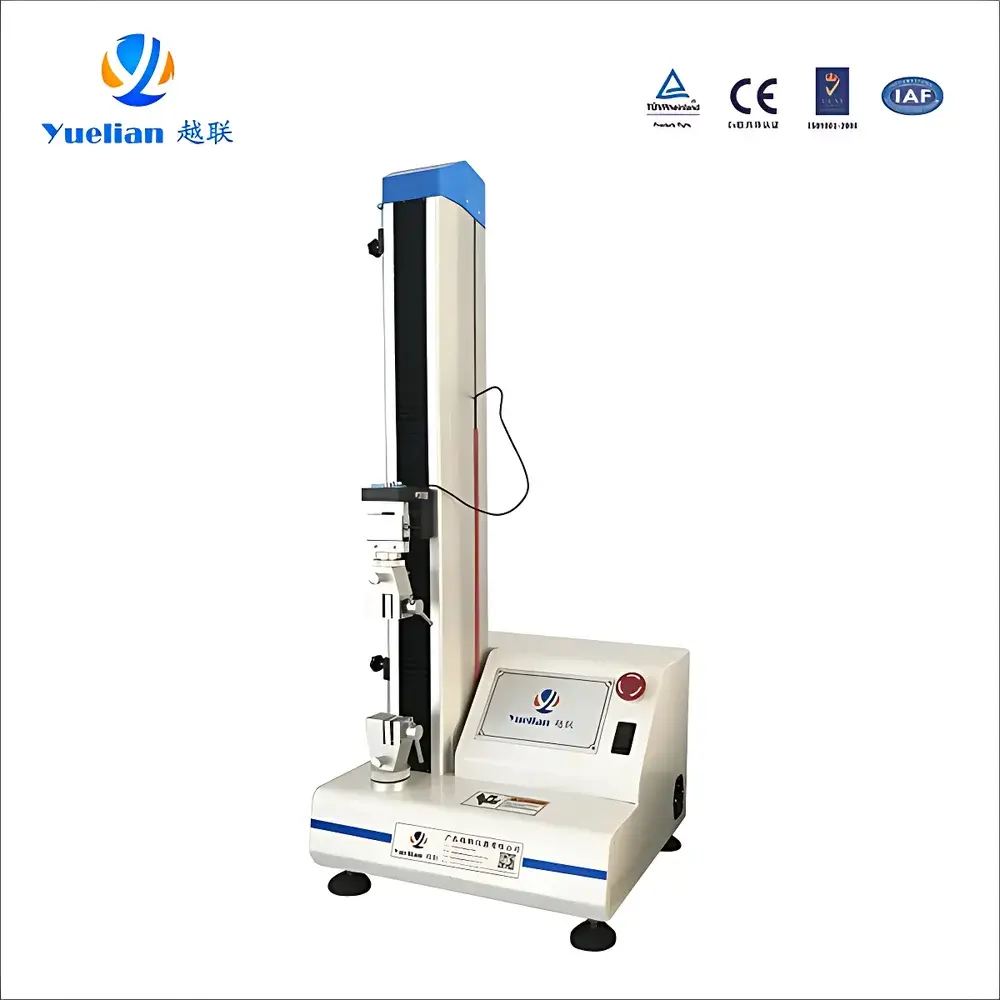
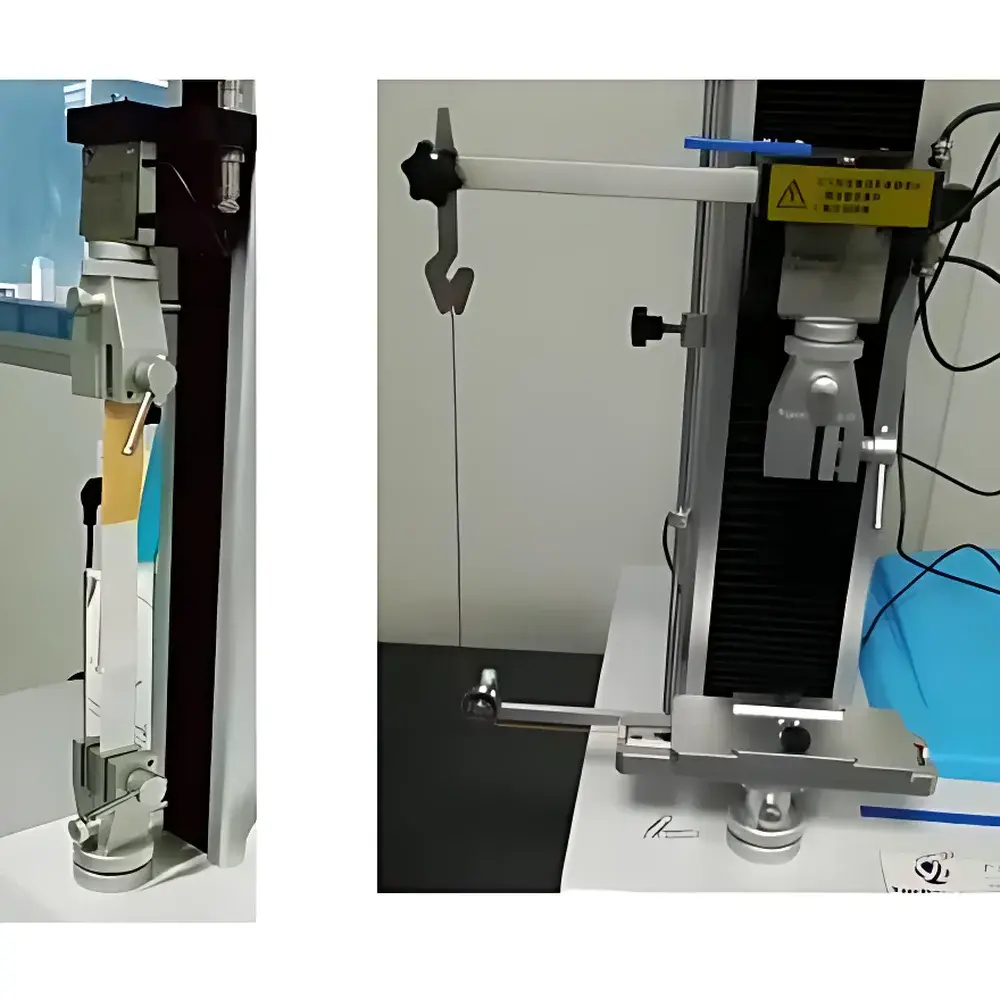
Yuelian YL-S90 Universal Testing Machine for Peel, Tensile, and Compression Testing
| Brand | Yuelian |
|---|---|
| Model | YL-S90 / YL-S91 |
| Type | Electromechanical Universal Testing Machine |
| Load Capacity Options | 10 N, 20 N, 50 N, 100 N, 200 N, 500 N, 1 kN (dual-range configuration available) |
| Force Resolution | 1/500,000 full scale |
| Force Accuracy | ±0.30% of reading |
| Displacement Resolution | 1/500,000 full stroke |
| Test Speed Range | 0.1–500 mm/min (programmable via PC) |
| Maximum Stroke | 500 mm / 800 mm |
| Test Width | 110 mm |
| Drive System | Stepper motor + precision ground ball screw |
| Power Supply | 220 V, 50/60 Hz, 10 A |
| Power Consumption | 180 W |
| Dimensions (W×D×H) | 40×37×92 cm / 40×37×120 cm |
| Weight | 28 kg / 35 kg |
| Compliance Standards | GB/T 2792, ASTM D3330, GB/T 12914–1991, GB 13022–91, GB/T 1040–92, GB 2792–81, GB/T 14344–9, GB/T 2191–95, QB/T 2171–95, GB/T 10003–2008 |
Overview
The Yuelian YL-S90 is an electromechanical universal testing machine engineered for high-reproducibility mechanical characterization of soft and semi-rigid materials across research laboratories, quality control departments, and R&D facilities. It operates on the principle of controlled displacement-driven force measurement, utilizing a stepper motor coupled with a preloaded precision-ground ball screw to deliver linear motion with minimal backlash and thermal drift. Designed specifically for peel, tensile, compression, tear, shear, and initial adhesion testing, the system conforms to internationally recognized test methodologies including ASTM D3330 (peel adhesion of pressure-sensitive tapes), GB/T 2792 (peel strength of adhesive tapes), and ISO 8510-2 (adhesive bond peel testing). Its modular architecture supports both standalone operation via USB-connected PC interface and offline use with real-time dual-channel display of force (N, kgf, lbf, etc.) and displacement (mm), enabling traceable, GLP-compliant data acquisition in regulated environments.
Key Features
- High-precision force measurement with ±0.30% accuracy and 1/500,000 resolution across seven selectable load capacities (10 N to 1 kN), including optional dual-range configurations for extended dynamic range.
- Programmable test speed from 0.1 to 500 mm/min, adjustable in real time via PC software or front-panel controls—ideal for simulating diverse application conditions such as slow-speed tape debonding or rapid film tearing.
- Integrated automatic return-to-start function upon test completion, overload detection, specimen rupture stop, and user-defined upper/lower limit triggers ensure operational safety and repeatability.
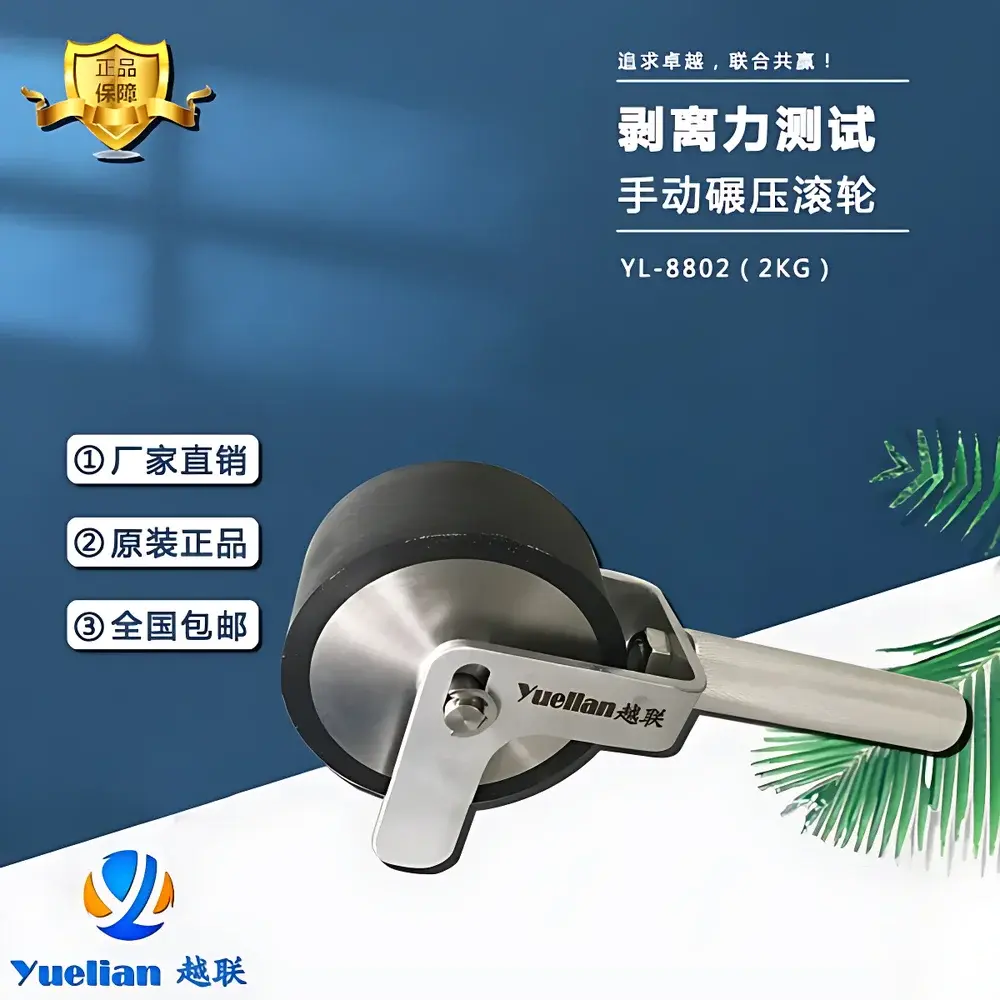
- Quick-release fixture mounting system compatible with standardized grips—including pneumatic, wedge, peel, loop, and shear fixtures—enabling rapid reconfiguration between test types without recalibration.
- Direct USB and RS-232 connectivity supports seamless integration with Windows-based analysis software for statistical evaluation, curve fitting, modulus calculation, yield point identification, and report generation per ISO/IEC 17025 documentation requirements.
- Energy-efficient stepper motor drive achieves >85% mechanical transmission efficiency, minimizing heat generation and positional hysteresis during prolonged cyclic testing sequences.
Sample Compatibility & Compliance
The YL-S90 accommodates a broad spectrum of substrate geometries and material classes: metallic foils, elastomeric films, woven/nonwoven textiles, leather substrates, laminated packaging composites, paperboard, biomedical hydrogels, and pressure-sensitive adhesive (PSA) tapes. Its 110 mm test width and up to 800 mm travel accommodate standard ASTM and GB specimen dimensions—including 180° peel strips (25 mm wide × 150 mm long), T-peel coupons, and loop tack specimens. All firmware and software modules are structured to support audit-ready data integrity: electronic signatures, timestamped test logs, version-controlled calibration records, and exportable XML/CSV datasets compliant with FDA 21 CFR Part 11 requirements when deployed under validated SOPs.
Software & Data Management
The included PC-based control suite provides full I/O mapping, multi-curve overlay, real-time derivative calculation (e.g., tangent modulus), and automated pass/fail threshold evaluation against predefined specification limits. Raw data files retain native resolution and metadata—including environmental temperature/humidity tags (when interfaced with external sensors), operator ID, instrument serial number, and calibration certificate expiry dates. Export formats include PDF reports with embedded graphs, Excel-compatible .csv tables, and encrypted .bin archives for long-term archival. Software updates are delivered via secure HTTPS channel with SHA-256 signature verification to maintain cybersecurity compliance in ISO 27001-aligned laboratories.
Applications
- Peel strength validation of medical device pouch seals (per ISO 11607-2) and pharmaceutical blister packaging.
- Tensile property profiling of biodegradable mulch films (ASTM D882) and lithium-ion battery electrode coatings.
- Compression resilience testing of foam gaskets used in automotive HVAC assemblies.
- Tear propagation resistance of geotextiles (ASTM D4533) and filtration membranes.
- Initial tack assessment of hot-melt adhesives using loop tack or probe tack protocols (FINAT FTM 9).
- Mechanical aging studies involving humidity-temperature cycling followed by post-conditioning mechanical retesting.
FAQ
What standards does the YL-S90 directly support out-of-the-box?
The system includes preconfigured test templates for GB/T 2792, ASTM D3330, GB/T 12914, and ISO 8510-2, with parameter presets aligned to specimen geometry, crosshead speed, and data sampling frequency specified in each standard.
Can the YL-S90 perform hold-force (creep) tests?
Yes—the controller supports constant-load dwell modes with programmable duration (up to 999 hours), real-time force decay monitoring, and automatic termination upon preset % loss threshold.
Is third-party calibration certification available?
Factory calibration is traceable to CNAS-accredited reference standards; optional UKAS or A2LA-certified calibration certificates with uncertainty budgets can be procured separately.
Does the software meet FDA 21 CFR Part 11 requirements?
When operated under validated configurations—including role-based access control, electronic audit trails, and digital signature enforcement—the software satisfies core Part 11 criteria for electronic records and signatures in GxP environments.
What maintenance intervals are recommended?
Ball screw lubrication every 6 months; annual verification of load cell linearity and displacement encoder accuracy using NIST-traceable reference weights and gauge blocks.



