
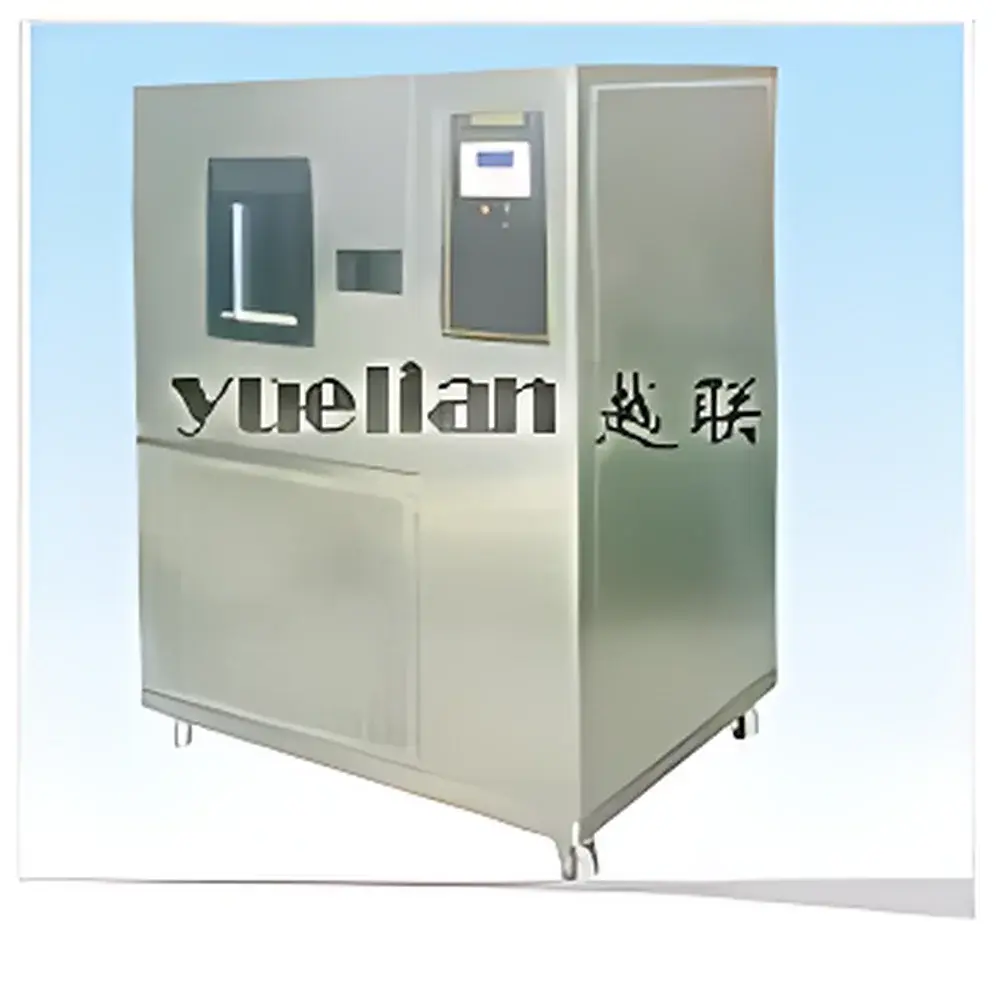
Yuelian YL-2231 Programmable Thermal Cycling Environmental Test Chamber
| Brand | Yuelian |
|---|---|
| Origin | Guangdong, China |
| Model | YL-2231 |
| Temperature Range | -70 °C to +150 °C |
| Internal Volume | 80–800 L (5 standard configurations) |
| Heating Rate | ~20 min (0 °C to 100 °C), ~60 min (-70 °C to 100 °C) |
| Cooling Rate | ~20 min (20 °C to 0 °C), ~90 min (20 °C to -70 °C) |
| Control System | TFT-LCD programmable controller with RS-232 interface, 5 patterns / 50 steps / 999 cycles |
| Construction | Full SUS#304 stainless steel interior and exterior |
| Cooling Configuration | Single-stage air-cooled refrigeration system (≥ -20 °C) |
| Standard Accessories | Two adjustable stainless steel shelves, vacuum-rated observation window, interior LED lighting, anti-fog heater |
| Safety Protections | Over-temperature, compressor overload, over-current, earth leakage detection |
| Power Supply | 1-phase, 220 V, 50 Hz |
Overview
The Yuelian YL-2231 Programmable Thermal Cycling Environmental Test Chamber is an engineered solution for accelerated environmental stress testing of materials, components, and finished products under precisely controlled, time-varying temperature conditions. Based on forced-air convection thermal management and high-stability platinum resistance temperature sensing (PT100 class A), the chamber delivers uniform temperature distribution (±0.5 °C typical deviation across working volume) and repeatable thermal profiles required for reliability validation in electronics, automotive, aerospace, and quality assurance laboratories. It operates across a wide thermal spectrum—from deep cryogenic exposure at -70 °C up to high-temperature conditioning at +150 °C—enabling simulation of real-world thermal shock, storage, and operational environments per IEC 60068-2-1 (cold), IEC 60068-2-2 (dry heat), and MIL-STD-810H Method 502.7.
Key Features
- Programmable multi-segment thermal cycling: Supports up to 5 independent test patterns, each comprising 50 user-defined steps and repeatable for up to 999 full cycles—ideal for HALT/HASS pre-screening and long-term aging studies.
- Dual-stage refrigeration architecture: Optimized for both energy efficiency and thermal response; single-stage air-cooled system for milder low-temperature ranges (≥ -20 °C), and dual-stage cascade refrigeration for stable operation down to -70 °C without liquid nitrogen dependency.
- Full SUS#304 stainless steel construction: Internally and externally welded for corrosion resistance, cleanroom compatibility, and long-term dimensional stability under repeated thermal expansion/contraction.
- High-fidelity temperature control: Microprocessor-based PID controller with PT100 Class A sensors (IEC 60751), integrated air velocity modulation, and real-time deviation compensation to maintain ±0.3 °C setpoint accuracy during steady-state operation.
- Integrated safety redundancy: Independent mechanical over-temperature cut-off, compressor discharge temperature monitoring, earth leakage protection, and phase-loss detection ensure compliance with IEC 61000-6-2/6-4 EMC requirements and UL 61010-1 safety standards.
Sample Compatibility & Compliance
The YL-2231 accommodates diverse sample geometries via five standardized internal volumes (80 L to 800 L), all featuring reinforced vacuum-grade borosilicate observation windows, non-condensing anti-fog heating elements, and adjustable stainless steel shelving rated for ≥15 kg per shelf. Its airflow design meets ISO 16750-4 (road vehicles) and JEDEC JESD22-A104F (temperature cycling) requirements for spatial uniformity and ramp fidelity. The chamber supports integration into GLP/GMP-regulated workflows through optional RS-485 Modbus RTU communication for external data logging and audit-trail-capable SCADA systems compliant with FDA 21 CFR Part 11 when paired with validated software platforms.
Software & Data Management
While the embedded controller provides local program execution and real-time parameter display in English or Chinese, the RS-232 serial interface enables direct connection to host PCs running third-party test sequencing software (e.g., NI LabVIEW, Keysight PathWave, or custom Python-based automation scripts). Optional RS-485 expansion allows daisy-chained multi-chamber synchronization and centralized fleet monitoring. All temperature logs—including setpoints, actual chamber readings, alarm events, and cycle counters—are timestamped and exportable in CSV format for traceability. Firmware updates are performed via USB port using signed binaries to preserve integrity in regulated environments.
Applications
- Electronics reliability: PCB solder joint fatigue evaluation, IC package delamination screening, capacitor ESR drift analysis under thermal cycling stress.
- Automotive component qualification: Testing of ECUs, sensors, and lighting modules per ISO 16750-4 and SAE J2245 thermal endurance protocols.
- Materials science: Polymer crystallinity assessment, elastomer compression set behavior, and adhesive bond strength degradation studies.
- Quality assurance: Incoming inspection of raw materials, outgoing lot release verification, and supplier audit support per ISO/IEC 17025 accredited procedures.
- Research & development: Parameter optimization for thermal interface materials (TIMs), battery cell thermal runaway propagation modeling, and packaging thermal barrier validation.
FAQ
What temperature uniformity can be expected across the working volume?
Typical spatial uniformity is ±0.5 °C at steady state, verified per IEC 60068-3-5 using nine calibrated PT100 probes placed at standardized locations.
Is the chamber suitable for unattended overnight operation?
Yes—equipped with redundant over-temperature protection, automatic power recovery after outage, and configurable audible/visual alarms with remote relay outputs for facility monitoring systems.
Can humidity control be added retroactively?
No—the YL-2231 is a dry-thermal-only platform; humidity functionality requires a separate YL-2231H series model with integrated steam humidification and dehumidification subsystems.
Does the controller support profile editing during active test execution?
Profile modification is disabled during runtime to prevent unintended thermal transients; however, users may pause, save current state, and resume from any step post-edit.
What calibration documentation is provided with shipment?
Each unit ships with a factory-as-tested report including sensor calibration certificates (traceable to NIM China), temperature mapping summary, and refrigeration performance verification at three representative setpoints (-40 °C, 25 °C, +85 °C).



