
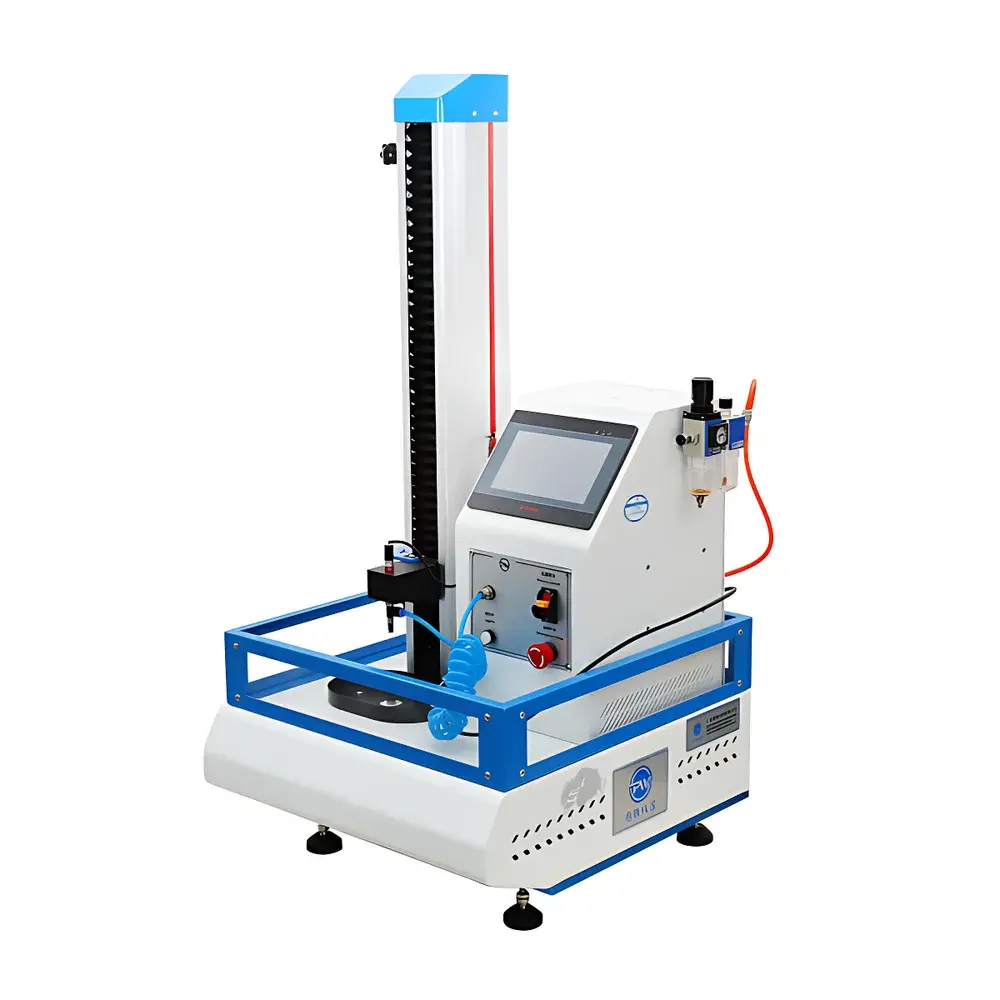
Yuelian PW-IR1000 Foam Impact Energy Tester (Drop Ball Impact System)
| Brand | Yuelian |
|---|---|
| Origin | Guangdong, China |
| Model | PW-IR1000 |
| Drop Height Range | 0–800 mm (motorized vertical adjustment) |
| Ball Mass | Customizable per user specification |
| Sensor Capacity | Configurable based on ball mass and drop height |
| Data Acquisition Rate | 100 kHz |
| Release Mechanism | Electromagnetic solenoid |
| Positioning System | Motorized X-Y alignment with infrared centering sensor |
| Dimensions (L×W×H) | 500 × 300 × 1400 mm |
| Weight | 35 kg |
| Power Supply | 220 V AC |
Overview
The Yuelian PW-IR1000 Foam Impact Energy Tester is a precision-engineered drop-ball impact system designed for quantitative evaluation of dynamic mechanical response in flexible polymeric foams, elastomeric cushions, packaging materials, and energy-absorbing composites. It operates on the fundamental principle of gravitational potential energy conversion: a calibrated steel sphere of defined mass is elevated to a precisely controlled height and released under free-fall conditions onto a horizontally mounted test specimen. The resulting transient force-time profile is captured via high-fidelity load sensing, enabling calculation of peak impact force, impulse, energy absorption capacity, and coefficient of restitution—key metrics for material qualification in automotive seating, medical padding, protective gear, and logistics packaging validation.
Key Features
- Motorized height adjustment mechanism with digital encoder feedback ensures repeatable drop heights from 0 to 800 mm in 1-mm increments, minimizing operator-induced variability.
- Electromagnetic release system provides zero-delay, jitter-free ball detachment synchronized with data acquisition trigger—critical for time-domain fidelity in impact transients.
- Infrared optical centering sensor enables sub-millimeter alignment of impact point relative to specimen centroid, supporting ASTM D3574 Annex B and ISO 18562-3 positional repeatability requirements.
- 100 kHz real-time data acquisition captures microsecond-scale force rise times and oscillatory decay signatures typical of viscoelastic foam deformation, far exceeding standard 1–10 kHz industrial systems.
- Modular load cell configuration allows sensor selection matched to expected peak forces (e.g., 5 kN or 20 kN full-scale), preserving resolution across low-energy (e.g., 0.5 J) and high-energy (e.g., 16 J) test regimes.
- Integrated X-Y specimen positioning stage permits systematic mapping of spatial heterogeneity in foam density or compression set—essential for QC lot acceptance and R&D anisotropy studies.
Sample Compatibility & Compliance
The PW-IR1000 accommodates flat, sheet-type specimens up to 300 mm × 300 mm and thicknesses ranging from 10 mm to 100 mm, with optional clamping fixtures for edge-constrained boundary conditions. It supports standardized test protocols including ASTM D3574 Method B (low-energy impact resilience), ISO 2439 Type A (rebound resilience), and internal OEM specifications for cushioning performance (e.g., SAE J2910 for automotive seat foam). All hardware and firmware comply with IEC 61000-6-2/6-4 electromagnetic compatibility standards. Software architecture supports audit trails, user access levels, and electronic signature functionality aligned with GLP and FDA 21 CFR Part 11 requirements when deployed in regulated environments.
Software & Data Management
The proprietary Yuelian Impact Analysis Suite (v3.2+) runs on Windows OS and provides real-time waveform visualization, automated parameter extraction (peak force, time-to-peak, absorbed energy, rebound ratio), and customizable report generation compliant with ISO/IEC 17025 documentation templates. Raw .bin files are stored with embedded metadata (operator ID, timestamp, calibration certificate ID, environmental conditions). Batch processing enables statistical analysis across multiple specimens—including Weibull distribution fitting for failure probability modeling—and export to CSV, PDF, or XML formats compatible with LIMS integration. Calibration certificates are digitally signed and traceable to NIM (China National Institute of Metrology) accredited standards.
Applications
- Quality control of polyurethane, polyethylene, and thermoplastic elastomer (TPE) foams in Tier-1 automotive supply chains.
- Development of pressure-relieving mattress cores meeting ISO 11948-1 clinical performance thresholds.
- Validation of shock-absorbing packaging inserts per ISTA 3A and ASTM D4169 transport simulation criteria.
- Comparative assessment of recycled vs. virgin foam formulations for sustainability-driven material substitution programs.
- Correlation studies between quasi-static compression modulus (ASTM D3574 Method A) and dynamic impact dissipation efficiency.
FAQ
What standards does the PW-IR1000 support for foam impact testing?
It natively supports ASTM D3574 Method B, ISO 2439 Type A, and GB/T 6670 (Chinese national standard for flexible foam resilience), with configurable test templates for custom internal specifications.
Can the system be calibrated for traceable force measurement?
Yes—load cells are supplied with NIM-traceable calibration certificates; annual recalibration is recommended and supported via Yuelian’s certified service network.
Is remote operation or integration with MES/LIMS possible?
The software includes TCP/IP API endpoints and OPC UA compatibility for factory automation integration, enabling unattended batch testing and centralized data aggregation.
What safety features prevent operator exposure during high-speed impact events?
The system incorporates interlocked acrylic shielding, emergency stop circuitry compliant with ISO 13857, and automatic sensor deactivation if door integrity is compromised.
How is specimen alignment verified before each test?
The infrared centering sensor projects a crosshair onto the specimen surface; alignment confirmation is required prior to test initiation, with positional deviation logged in the audit trail.
Related Products



