
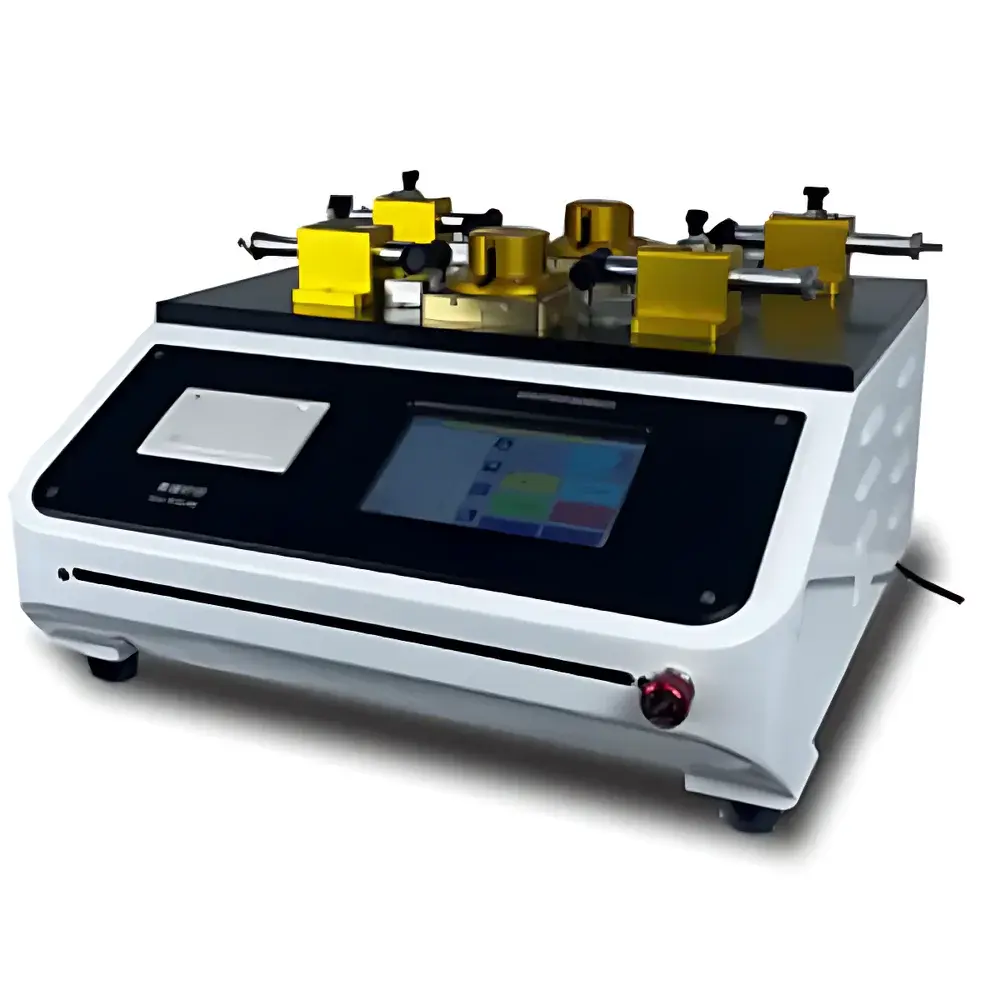
Schopper-type Fold Endurance Tester PW-6623
| Brand | YueLian / PW |
|---|---|
| Origin | Guangdong, China |
| Model | PW-6623 |
| Power Supply | AC 220 V ±10%, 50 Hz (AC 110 V ±10%, 60 Hz optional) |
| Operating Temperature | 10–35 °C |
| Relative Humidity | ≤85% RH |
| Display | 7-inch color touchscreen |
| Max. Specimen Thickness | <0.25 mm |
| Specimen Dimensions | 100 × 15 mm |
| Folding Length | 90 mm |
| Initial Tension | 7.60 ± 0.1 N |
| Maximum Tension | 9.80 ± 0.2 N |
| Folding Rate | 115 ± 10 cycles/min |
| Dimensions (W×D×H) | 500 × 530 × 340 mm |
| Net Weight | ~35 kg |
| Standard Configuration | Main unit with embedded thermal printer |
| Compliance | QB/T 457–2002 |
Overview
The Schopper-type Fold Endurance Tester PW-6623 is an electromechanical instrument engineered for precise, repeatable evaluation of fold endurance in flexible sheet materials under controlled tension and cyclic bending. Based on the classical Schopper principle—where a rectangular specimen is clamped at both ends and subjected to repeated 180° folding over a fixed-radius mandrel—the tester quantifies mechanical fatigue resistance by measuring the number of double folds until specimen failure (e.g., crack formation, fiber separation, or complete rupture). This measurement directly correlates with real-world performance in applications such as packaging carton creasing, banknote durability, label adhesion integrity, and medical packaging seal longevity. The device operates under standardized kinematic conditions: constant folding angle, defined mandrel geometry, regulated tension profile, and programmable cycle rate—ensuring high reproducibility across laboratories and production sites.
Key Features
- Dual independent counting channels (Group A and Group B), enabling parallel testing of two specimens or comparative analysis under identical parameters
- Two operational modes: “Break Mode” (automatically terminates upon specimen failure) and “Count Mode” (executes a preset number of folds regardless of condition)
- Integrated 7-inch color touchscreen interface with intuitive icon-driven navigation, real-time fold counter display, and parameter configuration menus
- Programmable tension control system delivering stable initial tension (7.60 ± 0.1 N) and maximum tension (9.80 ± 0.2 N) throughout the test cycle
- Fixed folding speed of 115 ± 10 cycles per minute, compliant with QB/T 457–2002 and aligned with historical Schopper methodology for inter-laboratory comparability
- Onboard thermal printer for immediate hard-copy output of test ID, specimen dimensions, tension values, fold count, and timestamp—supporting GLP documentation requirements
- Rugged steel frame construction with vibration-dampened base, designed for long-term stability in QC environments with ambient temperature fluctuations between 10–35 °C
Sample Compatibility & Compliance
The PW-6623 accommodates flat, isotropic specimens up to 0.25 mm thickness and 100 × 15 mm nominal dimensions, with effective folding length standardized at 90 mm. It is validated for use with paper (including kraft, coated, and specialty grades), corrugated board liners, nonwoven textiles, thin polymeric films (e.g., PET, OPP, PE), and metallized foils. All mechanical and electrical specifications conform to QB/T 457–2002 “Determination of Folding Endurance of Paper”, the primary Chinese national standard for Schopper-type testing. While not certified to ISO 5626 (which references M.I.T. and Schopper methods separately), the instrument’s geometric and dynamic parameters are traceable to internationally accepted Schopper reference practices. Its design supports audit readiness for internal quality systems referencing ISO 9001, ISO/IEC 17025, and GMP-aligned documentation protocols.
Software & Data Management
The PW-6623 features embedded firmware with local data storage capability (up to 500 test records), each tagged with sequential ID, date/time stamp, operator input fields, and configurable metadata (e.g., material grade, lot number, conditioning RH%). Data export is supported via USB interface to CSV-compatible spreadsheets. Although no PC-based software suite is included, the thermal printout provides tamper-evident, time-stamped results suitable for FDA 21 CFR Part 11–aligned environments when paired with procedural controls (e.g., operator logbooks, calibration logs, and maintenance records). Statistical functions include mean fold count, standard deviation, min/max values, and pass/fail flagging against user-defined thresholds—facilitating SPC charting and trend analysis over time.
Applications
- Quality assurance of folding cartons used in pharmaceutical, food, and cosmetic packaging
- Evaluation of crease line integrity during die-cutting process validation
- Comparative assessment of fiber orientation effects on folding strength in papermaking R&D
- Durability benchmarking of security documents (banknotes, passports, ID cards)
- Pre-screening of laminated film structures prior to thermoforming or pouch sealing trials
- Verification of coating adhesion stability under mechanical flex stress in printed electronics substrates
FAQ
What standards does the PW-6623 comply with?
It is designed and verified according to QB/T 457–2002, the People’s Republic of China Light Industry Standard for paper folding endurance testing.
Can the instrument test specimens thicker than 0.25 mm?
No—maximum allowable specimen thickness is strictly limited to <0.25 mm to maintain consistent mandrel contact geometry and avoid mechanical interference during folding.
Is calibration traceable to national metrology institutes?
Tension transducers are factory-calibrated using NIST-traceable deadweight standards; users must perform periodic verification per internal SOPs or ISO/IEC 17025 requirements.
Does the device support automated data transfer to LIMS?
Not natively—data must be manually exported via USB or recorded from printed reports; integration with external LIMS requires third-party middleware or custom scripting.
What maintenance is required for long-term accuracy?
Monthly inspection of folding arms, mandrel surface finish, and clamp jaw alignment; annual recalibration of load cells and timing circuitry is recommended.
Related Products





