
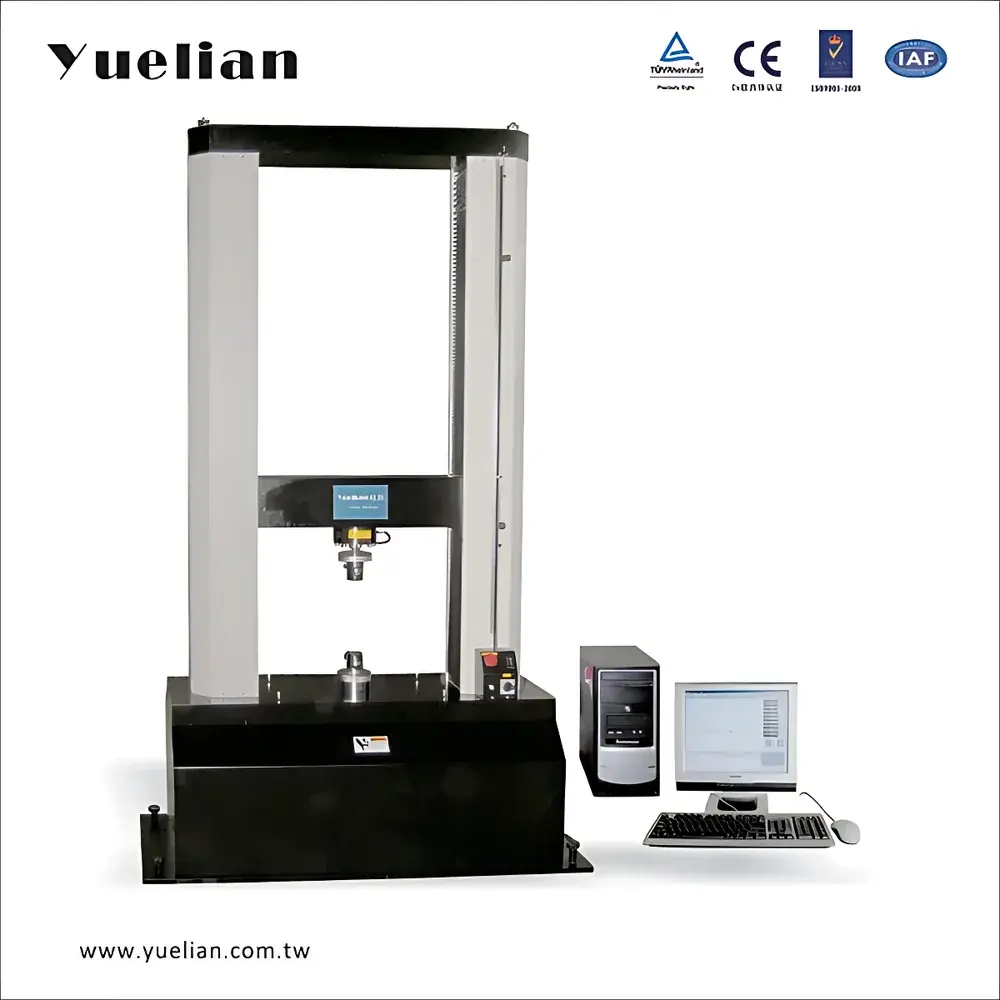
YL-1152 Yuelian Universal Tensile Testing Machine for Cast Iron and Metallic Materials
| Brand | Yuelian |
|---|---|
| Origin | Guangdong, China |
| Model | YL-1152 |
| Instrument Type | Electromechanical Universal Testing Machine |
| Load Capacity Options | 1 kN, 2 kN, 5 kN, 10 kN, 20 kN, 50 kN, 200 kN (dual-range configuration available) |
| Force Resolution | 1/250,000 full scale |
| Force Accuracy | ≤ ±0.5% of reading |
| Displacement Resolution | 0.005 mm |
| Test Speed Range | 0.5–500 mm/min (PC-controlled) |
| Maximum Travel | 1000 mm |
| Test Width | 550 mm |
| Drive System | Servo motor with precision ball screw and timing belt transmission |
| Power Supply | 220 V, 50/60 Hz, 10 A |
| Rated Power | 1800 W |
| Dimensions (W×D×H) | 92 × 75 × 199 cm |
| Weight | ~800 kg |
| Compliant Standards | ISO 7500-1, ASTM E4, EN 10002-1, EN 10002-2, DIN 51221, JIS B7721/B7733, GB/T 228.1, JJG 475 |
Overview
The YL-1152 Yuelian Universal Tensile Testing Machine is an electromechanical static testing system engineered for high-reproducibility mechanical characterization of metallic materials—including gray cast iron, ductile iron, steel alloys, and non-ferrous metals—as well as polymers, composites, elastomers, textiles, and packaging substrates. It operates on the principle of controlled uniaxial force application via servo-driven linear actuation, enabling precise measurement of tensile strength, yield strength, elongation at break, modulus of elasticity, compressive strength, flexural properties, peel resistance, and tear propagation. Designed in accordance with international metrological standards for force verification (ISO 7500-1 Class 1), the system delivers traceable, repeatable results essential for quality assurance laboratories, foundry R&D departments, metallurgical testing centers, and third-party certification bodies conducting routine or specification-driven mechanical evaluation of cast components.
Key Features
- High-precision load cell architecture with ≤ ±0.5% force accuracy and 1/250,000 internal resolution, supporting dual-capacity configurations for extended dynamic range without manual sensor swapping.
- Servo-motor-driven actuation system integrated with preloaded ball screws and synchronous timing belts—ensuring minimal backlash, smooth velocity control, and long-term mechanical stability under cyclic loading.
- Full PC-based operation with intuitive graphical interface; real-time data acquisition, curve plotting (stress–strain, load–displacement), and automated parameter extraction including ultimate tensile strength (UTS), 0.2% offset yield strength, Young’s modulus, reduction in area, and total elongation.
- Comprehensive test mode support: tensile, compression, bending (3-point & 4-point), shear, peel, tear, and stripping—each with programmable ramp-hold-relax profiles and multi-step sequences.
- Integrated safety logic: overload cutoff, emergency stop circuit, specimen fracture detection via load drop threshold, upper/lower displacement limits, and automatic return-to-start positioning post-test.
- Modular夹具 mounting platform accommodating standardized wedge-action, pneumatic, or hydraulic grips; optional accessories include extensometers (contact and non-contact), environmental chambers, and high-temperature fixtures.
Sample Compatibility & Compliance
The YL-1152 accommodates standard ASTM E8/E8M and ISO 6892-1 dog-bone specimens, round bar coupons (up to Ø25 mm), flat sheet strips (max. 550 mm wide × 1000 mm travel), and cast iron tensile bars per ASTM A48, ISO 185, or GB/T 9441. Its mechanical and software architecture conforms to regulatory requirements for data integrity in regulated environments: audit trail logging, user-level access control, electronic signature support, and export-ready reporting compliant with FDA 21 CFR Part 11 when deployed with validated software configuration. Calibration documentation aligns with ISO/IEC 17025 traceability frameworks, and hardware verification satisfies JJG 475–2008 (Chinese national verification regulation) and EN 10002-1:2001 (metallic materials tensile testing — part 1: method of test at ambient temperature).
Software & Data Management
The embedded Windows-based control suite utilizes MS Access relational database architecture for structured storage of raw test data, metadata (operator ID, sample ID, environmental conditions), calibration logs, and report templates. All curves and numerical outputs are exportable in CSV, PDF, and XML formats. Advanced analysis modules support derivative-based yield point detection, hysteresis loop integration, modulus calculation across user-defined strain ranges, and statistical batch comparison (mean, SD, CV%, confidence intervals). The system supports multi-sensor synchronization—e.g., simultaneous load, crosshead displacement, and extensometer strain inputs—with timestamp-aligned acquisition at up to 1 kHz sampling rate. Software validation packages and IQ/OQ documentation are available upon request for GMP/GLP-compliant deployment.
Applications
This machine serves critical roles in foundry process development (e.g., correlating graphite morphology in cast iron with tensile ductility), incoming material inspection of automotive brake calipers or engine blocks, structural component qualification per ASME BPVC Section II, and failure analysis of brittle fracture in gray iron castings. It is routinely employed in academic metallurgy labs for comparative studies of heat-treated vs. as-cast microstructures, and in packaging R&D for evaluating seal strength of laminated films used in industrial casting mold liners. Its versatility extends to ISO 148-1 Charpy impact frame integration for complementary toughness assessment workflows.
FAQ
Does the YL-1152 meet ASTM A48 requirements for cast iron tensile testing?
Yes—the system’s force accuracy, displacement resolution, and test speed control comply with the procedural and instrumentation specifications outlined in ASTM A48/A48M for tensile testing of gray iron, including recommended grip types and strain rate tolerances.
Can the software generate reports compliant with ISO/IEC 17025?
Yes—when configured with audit-trail-enabled firmware and calibrated per accredited procedures, the system supports generation of fully traceable test reports containing uncertainty budgets, calibration certificates, and operator authentication logs.
Is an extensometer required for measuring yield strength in cast iron?
For precise 0.2% offset yield determination per ISO 6892-1 or ASTM E8, a clip-on or video extensometer is recommended, particularly for low-ductility grades where crosshead displacement alone introduces significant error due to machine compliance.
What maintenance intervals are recommended for long-term reliability?
Ball screw lubrication every 500 hours of operation, annual load cell verification against certified deadweights, and biannual inspection of timing belt tension and grip jaw wear are advised per manufacturer service guidelines.
Is remote diagnostics supported?
Yes—the system includes TCP/IP-enabled communication ports and optional remote desktop access (via secure VPN) for technical support and firmware updates without on-site intervention.



