
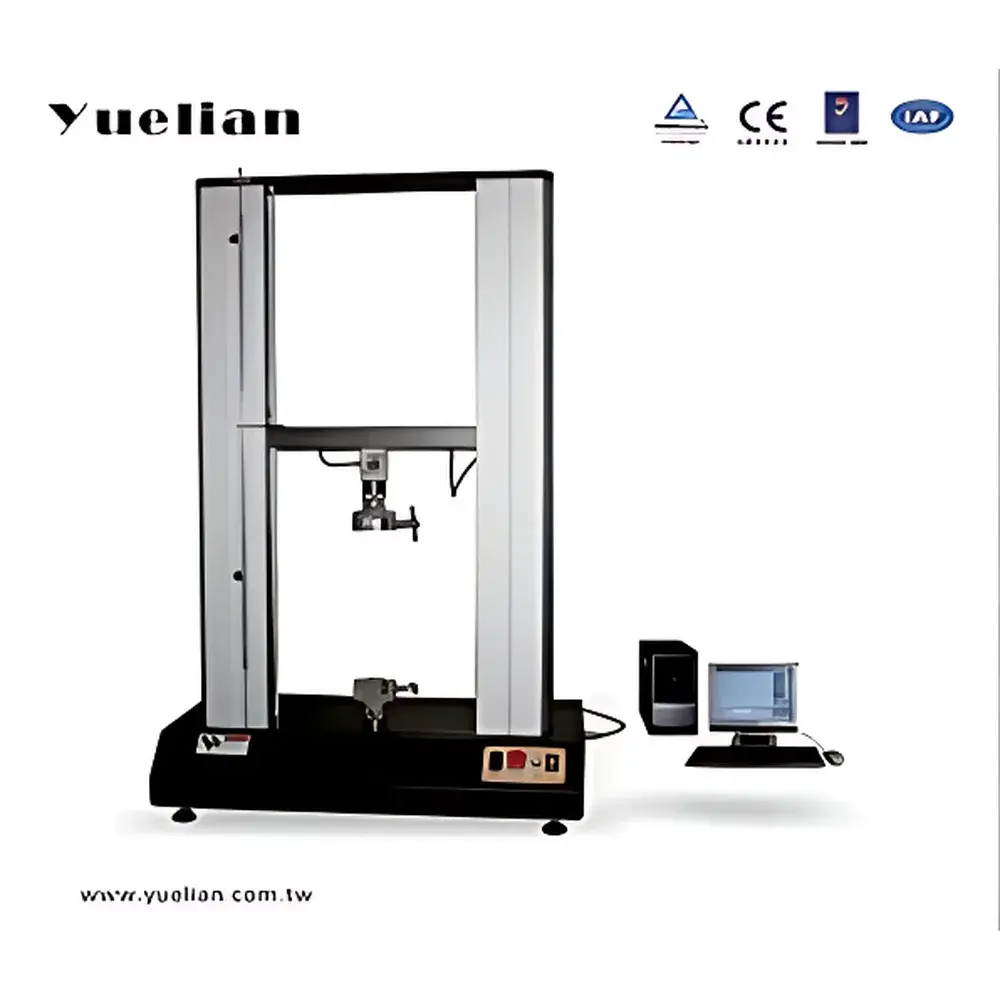
Yuelian YL-1123 Servo-Controlled Tensile Testing Machine (20 kN Capacity)
| Brand | Yuelian |
|---|---|
| Origin | Guangdong, China |
| Model | YL-1123 |
| Instrument Type | Electromechanical Tensile Testing Machine |
| Load Capacity Options | 10 N to 20 kN (dual-range configuration available) |
| Force Resolution | 1/500,000 full scale |
| Force Accuracy | ±0.3% of reading |
| Crosshead Travel | 700 mm |
| Test Width | 420 mm |
| Speed Range | 0.01–1000 mm/min (programmable) |
| Displacement Resolution | 1/500,000 full scale |
| Control Interface | PC-based with USB connectivity |
| Power Supply | 220 V, 50/60 Hz, 10 A |
| Motor Drive | Servo motor with precision ball screw and synchronous belt transmission |
| Dimensions (W×D×H) | 72 × 52 × 130 cm |
| Weight | ~115 kg |
| Compliance Standards | ISO 7500-1, ASTM E4, EN 10002-1, GB/T 228.1, GB/T 2792, ASTM D3330, JIS B7721/B7733, DIN 51221 |
Overview
The Yuelian YL-1123 is a high-precision, servo-controlled electromechanical tensile testing machine engineered for static mechanical characterization of structural and functional materials under uniaxial loading conditions. Designed in accordance with the fundamental principles of universal testing—applying controlled axial force while measuring displacement and load response—the system delivers traceable, repeatable, and metrologically validated data for mechanical property evaluation. Its 20 kN nominal capacity (with scalable lower-range options down to 10 N) supports standardized tensile, compression, flexure, peel, shear, tear, and adhesion tests across diverse material classes including polymers, elastomers, textiles, composites, metallic foils, packaging films, automotive safety components (e.g., seatbelt webbing), and aerospace laminates. The machine’s rigid frame architecture, low-inertia servo drive, and high-resolution encoder feedback ensure minimal compliance error and excellent dynamic stability during ramp-and-hold, creep, or cyclic loading protocols.
Key Features
- High-fidelity force measurement system with ±0.3% accuracy and 1/500,000 internal resolution, compliant with ISO 7500-1 Class 1 requirements
- Programmable crosshead speed from 0.01 to 1000 mm/min, enabling both quasi-static and high-speed rupture analysis
- Precision ball screw and synchronous belt transmission system for smooth, backlash-free motion control and long-term repeatability
- Integrated automatic stop logic: overload cutoff, specimen fracture detection, upper/lower limit enforcement, and emergency manual override
- Modular fixture interface supporting standardized grips (pneumatic, wedge, pin, peel, and custom fixtures) for ISO, ASTM, and GB-compliant sample geometries
- Real-time digital signal acquisition via USB-connected interface board with synchronized sampling at ≥1 kHz
Sample Compatibility & Compliance
The YL-1123 accommodates specimens up to 420 mm wide and 700 mm in active travel length, making it suitable for standard test coupons (e.g., ASTM D638 Type I–V, ISO 527-2, GB/T 1040.2), safety-critical webbing (e.g., ISO 6605 for seatbelt tensile strength), laminated packaging (ASTM F88 peel), and adhesive joints (ISO 4587, GB/T 7124). It meets mechanical verification requirements per ISO 7500-1, calibration traceability per JJG 475, and operational conformity with ASTM E4, EN 10002-1, and GB/T 228.1. All test procedures—including those involving safety restraint systems—can be documented with audit-ready metadata for GLP/GMP environments, supporting FDA 21 CFR Part 11–compliant electronic records when paired with validated software configurations.
Software & Data Management
The proprietary PC-based control and analysis suite provides full test sequence scripting, real-time curve visualization (load vs. displacement, stress vs. strain), and automated parameter extraction—including ultimate tensile strength, yield point (0.2% offset), elongation at break, Young’s modulus, peel strength, and tear resistance. Raw data are stored in MS-ACCESS relational database format with timestamped operator ID, environmental metadata (optional sensor integration), and version-controlled test method templates. Export options include CSV, PDF reports, and XML for LIMS integration. Multi-sensor support allows concurrent acquisition from extensometers, environmental chambers, or video extensometry systems. Software validation documentation and IQ/OQ protocols are available upon request for regulated laboratory deployment.
Applications
- Automotive safety component qualification: seatbelt webbing tensile strength, anchor loop integrity, pretensioner cable pull-out force
- Medical device material validation: suture tensile strength, catheter shaft stiffness, implant fixation strap performance
- Packaging R&D: seal peel strength (ASTM F88), pouch burst pressure, film puncture resistance
- Textile and geotextile certification: warp/weft tensile load, seam slippage, UV-aged fabric degradation
- Electronics manufacturing: flex circuit bond strength, solder joint shear reliability, battery tab pull-off testing
- Academic and industrial materials science: polymer viscoelastic modeling, composite interlaminar shear, metal fatigue precursor analysis
FAQ
What standards does the YL-1123 comply with for seatbelt testing?
It supports ISO 6605, FMVSS No. 209, and GB 14166–2013 test methods through configurable test profiles, load rate control, and specimen alignment fixtures.
Can the system perform ASTM D3330 peel testing without hardware modification?
Yes—standard 180° and 90° peel fixtures are included; angular alignment jigs and constant-rate separation ensure adherence to ASTM D3330 Section 7 requirements.
Is the force transducer calibrated and traceable to national standards?
Each unit ships with a factory calibration certificate traceable to CNAS-accredited laboratories; optional UKAS/NIST-traceable recalibration services are available.
Does the software support multi-user role-based access control?
The current release supports operator-level password protection; full RBAC and 21 CFR Part 11 electronic signature modules are available as licensed add-ons.
What maintenance intervals are recommended for the servo drive and ball screw assembly?
Lubrication and preload verification are advised every 1,000 operating hours or annually—whichever occurs first—per the maintenance log included in the technical manual.



