
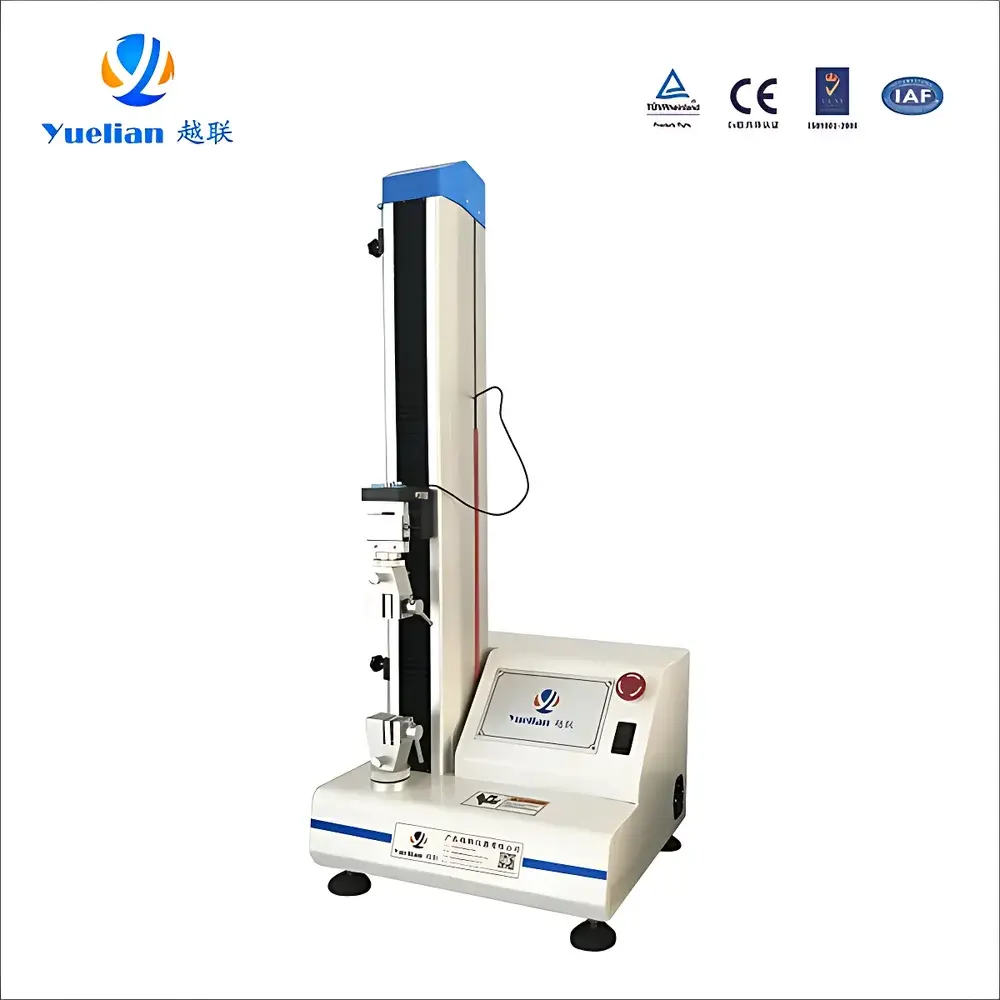
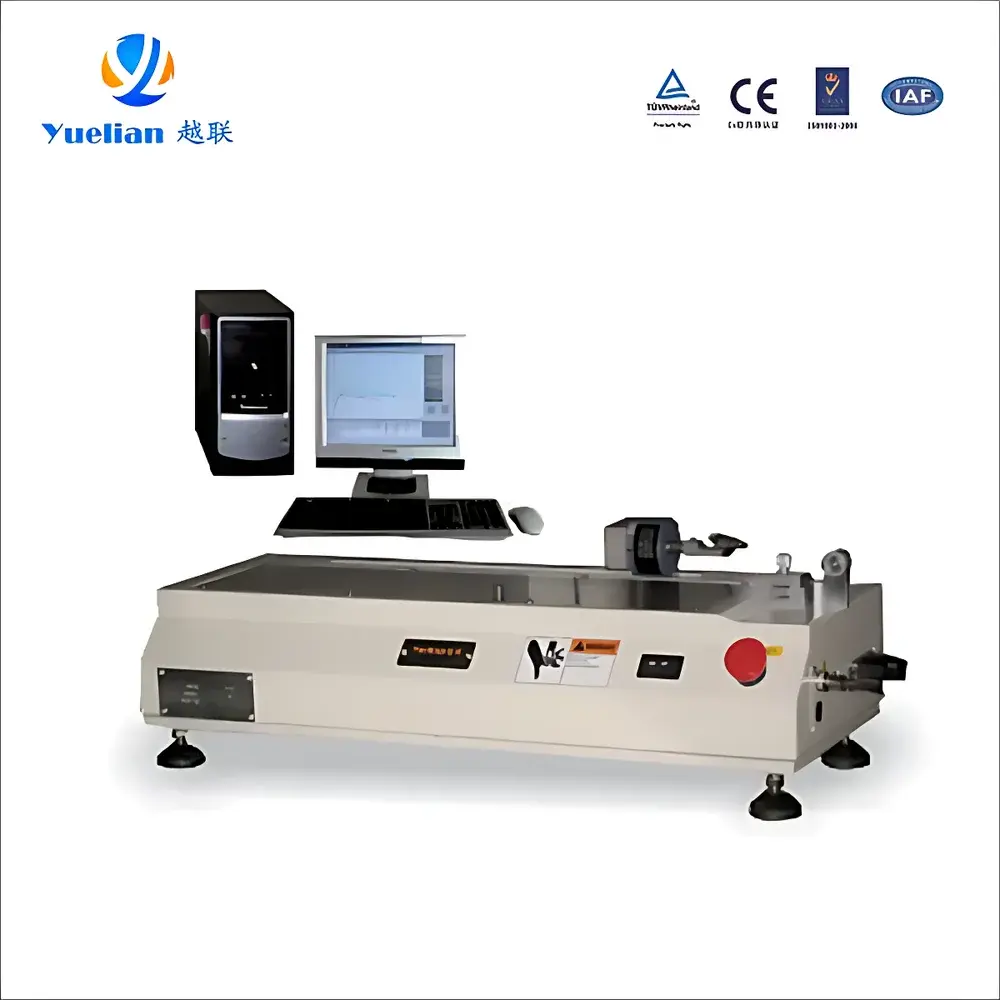
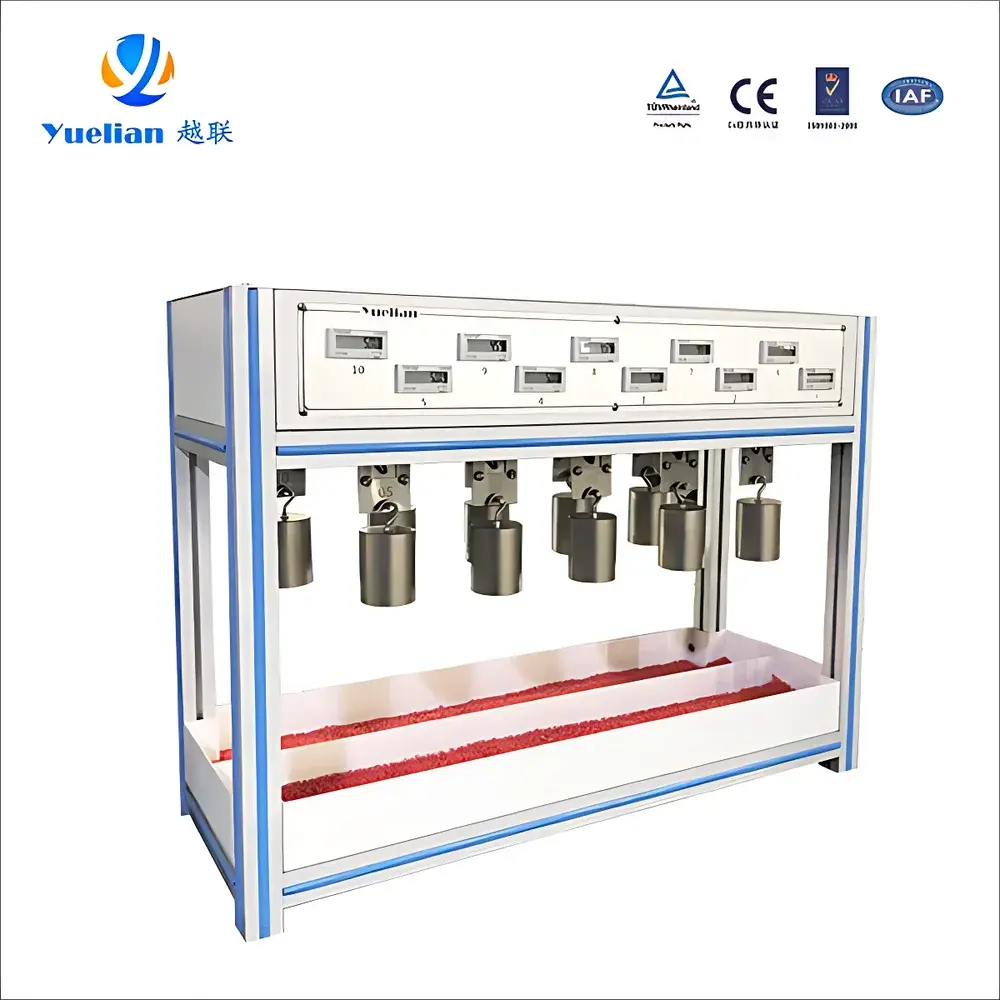
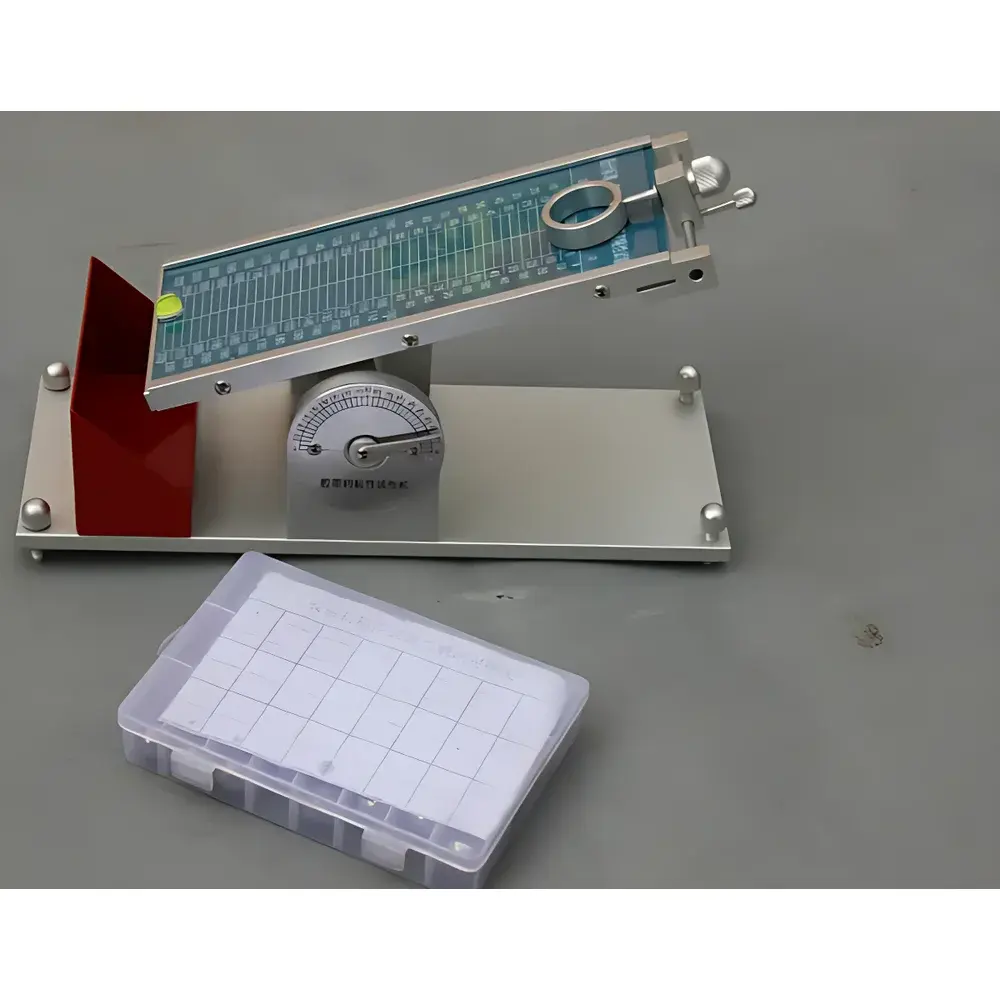
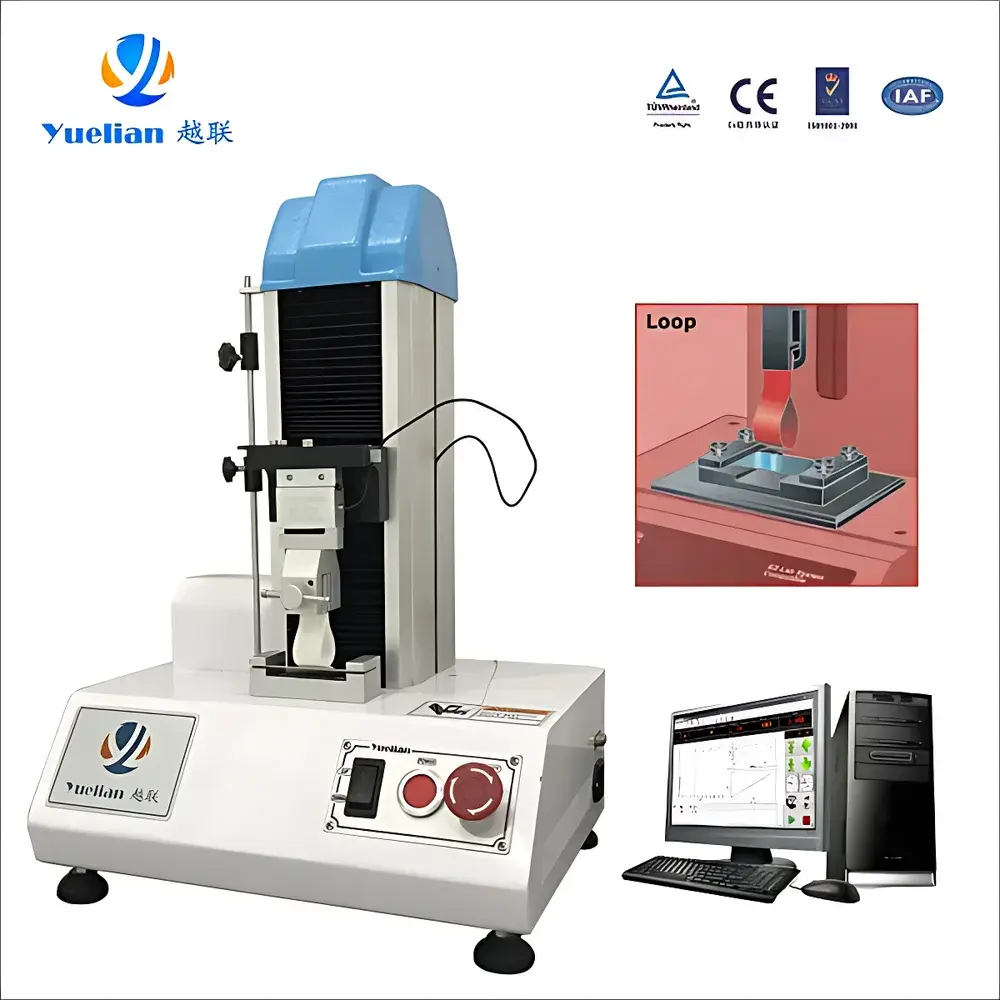
Yuelian YL-S91RF Pharmacopoeia Peel Adhesion Tester
| Brand | Yuelian |
|---|---|
| Origin | Guangdong, China |
| Manufacturer Type | Authorized Distributor |
| Country of Origin | China |
| Model | YL-S91RF |
| Instrument Category | Electronic Peel Test Machine |
| Capacity Options | 10N, 20N, 50N, 100N, 200N, 500N, 1 kN (dual-range configuration available) |
| Force Resolution | 1/500,000 full scale |
| Force Accuracy | ≤ ±0.5% FS |
| Travel Resolution | 0.005 mm |
| Test Stroke | 500 mm |
| Test Width | 55 mm |
| Speed Range | 5–500 mm/min (software-controlled) |
| Power Supply | 220 V, 50/60 Hz, 10 A |
| Motor Type | Stepper motor with precision ball screw and timing belt drive |
| Dimensions (W×D×H) | 40 × 30 × 70 cm |
| Weight | ~28 kg |
| Standard Accessories | One set of peel fixtures, PC-based control software, USB interface cable |
| Compliance Standards | GB/T 2792, ASTM D3330, GB/T 12914, GB 13022, GB/T 1040, GB/T 14344, GB/T 2191, QB/T 2171 |
| Safety Protections | Upper/lower stroke limit switches, overload force cutoff, emergency stop, automatic halt on specimen failure, programmable upper/lower limits, auto-return function |
| Software Features | Multi-test mode support (peel, tensile, bend, shear, tear), real-time force-displacement curve plotting, calculation of average peel force, yield force, modulus, elongation |
Overview
The Yuelian YL-S91RF Pharmacopoeia Peel Adhesion Tester is an electromechanical testing system engineered for precise, repeatable measurement of peel adhesion strength in compliance with international pharmacopoeial and industrial standards. Designed specifically for quality control laboratories in pharmaceutical, medical device, and packaging manufacturing sectors, the instrument operates on the principle of controlled linear displacement to separate a bonded substrate from its adherent at a defined angle (typically 90° or 180°) and constant rate. Its architecture integrates a high-resolution stepper motor drive, precision-ground ball screw transmission, and real-time load cell feedback—ensuring traceable force measurement across a wide dynamic range (10 N to 1 kN). The system meets the mechanical and procedural requirements of key regulatory frameworks including USP , EP 2.9.18, and ChP Appendix XIX B, supporting validated release testing of transdermal patches, surgical tapes, wound dressings, and sterile barrier packaging.
Key Features
- Pharmacopoeia-aligned test configuration: Pre-programmed methods for 90° and 180° peel per USP, EP, and ChP guidelines
- Dual-capacity sensor option enables seamless switching between low-force (e.g., pediatric patch evaluation) and high-force (e.g., structural tape validation) regimes without recalibration
- True 1/500,000 internal force resolution with ≤ ±0.5% full-scale accuracy—certified per ISO 7500-1 Class 0.5
- Software-enforced mechanical safeguards: programmable stroke limits, force ceiling override, emergency stop circuitry compliant with IEC 60204-1
- Modular fixture interface accommodating standardized peel jigs (ASTM D3330 Type I, GB/T 2792 clamp geometry), plus optional custom tooling for irregular substrates
- Real-time synchronization of force, displacement, and time data at ≥1 kHz sampling rate for waveform integrity during transient failure events
Sample Compatibility & Compliance
The YL-S91RF accommodates a broad spectrum of flexible laminates and pressure-sensitive materials—including hydrocolloid wound dressings, silicone-coated release liners, acrylic-based transdermal adhesives, multilayer pouch films, and sterilization wrap composites. All test protocols are fully traceable to referenced standards: GB/T 2792 (Chinese national standard for peel strength), ASTM D3330 (standard test method for peel resistance of pressure-sensitive tape), and ISO 8510-2 (adhesion—peel test at 90°). The system supports GLP and GMP environments through configurable user access levels, electronic signature capability, and audit-log generation meeting FDA 21 CFR Part 11 requirements. Calibration certificates include NIST-traceable force and displacement verification documentation.
Software & Data Management
The embedded Windows-based control suite provides ISO 17025-aligned test execution and reporting. It features multi-channel acquisition synchronized with video capture (optional), automated pass/fail evaluation against user-defined specification limits, and export of raw ASCII or CSV datasets for third-party statistical analysis (e.g., JMP, Minitab). Database architecture leverages Microsoft Access for structured storage of operator ID, environmental conditions (temperature/humidity tags), calibration history, and raw curve metadata. All reports include mandatory fields per ICH Q5E: test date, instrument ID, sensor serial number, environmental parameters, sample identification, and statistical summary (mean, SD, CV%, n-value). Software updates are version-controlled and archived with SHA-256 checksum validation.
Applications
- Quantitative assessment of adhesive performance degradation under accelerated aging (ICH Q1A)
- Batch release testing of topical drug delivery systems per USP Annex 2
- Comparative evaluation of liner-to-adhesive release forces in roll-to-roll converting processes
- Stability-indicating peel testing of barrier films exposed to gamma irradiation or ethylene oxide sterilization
- Development-stage screening of novel bioadhesive formulations using micro-peel configurations (5–20 N range)
- Root cause analysis of delamination failures in combination product packaging (e.g., blister-card assemblies)
FAQ
Does the YL-S91RF support 21 CFR Part 11-compliant electronic records?
Yes—the software includes role-based authentication, biometric or token-based electronic signatures, immutable audit trails, and secure archive export functionality verified per Part 11 Annex A guidance.
Can the system perform both 90° and 180° peel tests without hardware modification?
Yes—angular orientation is achieved via interchangeable fixture mounts; no recalibration is required when switching between standardized peel geometries.
Is third-party calibration certification included with purchase?
Each unit ships with a factory-issued calibration certificate traceable to CNAS-accredited metrology labs, covering force (NIST SRM 2045), displacement (laser interferometer), and timing (atomic clock reference).
What is the recommended maintenance interval for the ball screw and timing belt assembly?
Under continuous QC lab use (≤8 hrs/day), lubrication and tension verification are scheduled every 6 months; full drive train inspection is advised annually per ISO 13849-1 functional safety guidelines.
Can raw test data be exported directly into LIMS platforms?
Yes—CSV and XML formats support direct ingestion into major LIMS vendors (e.g., LabVantage, Thermo Fisher SampleManager) via configurable ODBC drivers and REST API endpoints.



