
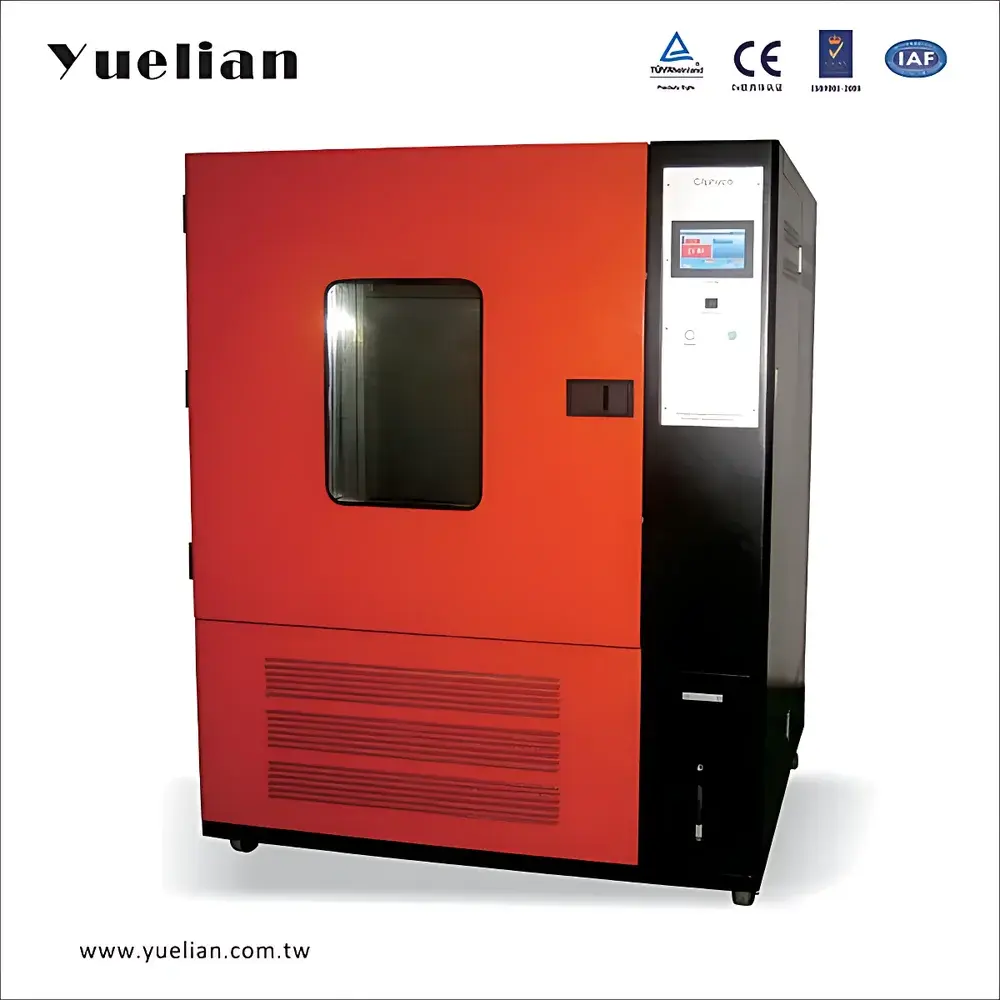
Yuelian TS Series Programmable Temperature and Humidity Environmental Test Chamber
| Brand | Yuelian |
|---|---|
| Origin | Guangdong, China |
| Model | TS Series (TS-80 / TS-150 / TS-225 / TS-408 / TS-800 / TS-1000) |
| Internal Dimensions (W×H×D, cm) | 40×50×40 (80 L) to 100×100×100 (1000 L) |
| Temperature Range | −70 °C to +150 °C |
| Humidity Range | 20–98 % RH (optional low-humidity configuration down to 5 % RH) |
| Temp. Uniformity | ±0.5 °C |
| Humidity Uniformity | ±3 % RH |
| Temp. Stability | ±0.3 °C |
| Humidity Stability | ±2.5 % RH |
| Heating Rate | ~20 min (0 °C → 100 °C), ~60 min (−70 °C → 100 °C) |
| Cooling Rate | ~20 min (20 °C → 0 °C), ~90 min (20 °C → −70 °C) |
| Control System | PID + SSR/SCR bidirectional output with slope logic |
| Programming Capacity | 150 programs × 1500 segments |
| Safety Protection | 15-point real-time monitoring with fault logging and diagnostic guidance |
| Refrigeration | Hermetic air-cooled system (single-stage for ≥−20 °C |
| Humidification | Surface evaporation type with auto-water recovery and dry-run/overheat protection |
| Construction | SUS#304 stainless steel interior & exterior |
| Standard Interfaces | RS-232 serial port, 3 timed I/O ports, 10 timing modes |
| Compliance | Designed per IEC 60068-2-1 (cold), IEC 60068-2-2 (dry heat), IEC 60068-2-78 (damp heat), and ASTM D4332 for conditioning of test specimens |
Overview
The Yuelian TS Series Programmable Temperature and Humidity Environmental Test Chamber is an engineered solution for precise, repeatable simulation of climatic stress conditions in laboratory and industrial quality assurance environments. Based on the principle of controlled thermal convection and vapor-phase humidity regulation, the chamber maintains stable, traceable environmental profiles across wide operational ranges—enabling standardized evaluation of material behavior under defined temperature and relative humidity (RH) loads. Its architecture integrates thermodynamic control logic with mechanical robustness, supporting compliance-driven testing protocols required by electronics manufacturers, automotive component suppliers, pharmaceutical packaging developers, and aerospace material certification labs. The system operates within the full spectrum of accelerated aging, preconditioning, and storage stability testing as specified in international standards including IEC 60068-2, ASTM D4332, and ISO 188.
Key Features
- Intelligent dual-mode climate control: PID + SSR/SCR synchronized bidirectional output ensures minimal overshoot and high reproducibility during ramp-and-soak profiles, supported by embedded slope logic for smooth transitions between setpoints.
- Multi-stage refrigeration architecture: Single-stage hermetic air-cooled system for operation above −20 °C; dual-stage configuration with R404A/R507 refrigerants for extended low-temperature capability down to −70 °C—optimized for oil management and long-term compressor reliability.
- High-fidelity observation interface: Triple-layer anti-sweat viewing window with integrated heating element and high-luminance fluorescent lighting enables continuous visual inspection without condensation interference or thermal distortion.
- Automated water management: Built-in reverse-osmosis–assisted pure water generator eliminates manual refilling; closed-loop humidification circuit recovers and reuses condensed moisture, reducing consumables and operator intervention.
- Industrial-grade programmability: Supports up to 150 independent test programs, each containing 1500 definable segments; allows nested looping (9999 × 999 cycles), segment linking, and partial cycle segmentation for complex multi-phase test sequences.
- Comprehensive safety architecture: Real-time monitoring of 15 critical parameters—including refrigerant pressure, heater current, chamber overtemperature, humidity sensor drift, and water level—triggers automatic shutdown and logs timestamped fault diagnostics with recommended remediation steps.
Sample Compatibility & Compliance
The TS Series accommodates a broad range of sample geometries and mass loads through six standard internal volumes (80 L to 1000 L), all featuring SUS#304 stainless steel chambers and non-outgassing polyurethane/rock wool insulation. Removable adjustable shelves, dual-access test ports, and optional calibrated reference sensors facilitate integration with external measurement systems. The chamber meets structural and performance requirements for environmental stress screening per MIL-STD-810H Method 502.7 (temperature), Method 507.6 (humidity), and JIS C 0021. It supports GLP-compliant data integrity when operated with validated software configurations and audit-trail-enabled controllers. Optional calibration certificates are available traceable to NIM (China National Institute of Metrology) or UKAS-accredited laboratories.
Software & Data Management
Standard RS-232 communication enables direct integration with host PCs running Windows-based test orchestration platforms. The controller firmware supports SCPI-like command sets for remote initiation, parameter upload/download, and real-time data streaming at configurable intervals. Logged data includes chamber setpoint, actual temperature/humidity, system status flags, and alarm history—all timestamped with millisecond resolution. When configured with optional Ethernet or USB interfaces, the unit can be incorporated into centralized LabVantage or LabWare LIMS environments. All stored program files and event logs are exportable in CSV format for statistical process control (SPC) analysis or regulatory submission packages compliant with FDA 21 CFR Part 11 requirements (when paired with appropriate electronic signature and audit trail validation).
Applications
- Electronics reliability: Thermal cycling of PCB assemblies, solder joint fatigue assessment, and moisture sensitivity level (MSL) pre-conditioning per JEDEC J-STD-020.
- Automotive component validation: Climate endurance testing of infotainment displays, battery enclosures, and polymer gaskets under combined thermal-humidity load spectra.
- Pharmaceutical packaging: Accelerated stability studies of blister packs and HDPE containers per ICH Q1A(R2), including long-term and intermediate condition simulations.
- Aerospace materials: Evaluation of composite resin cure retention, adhesive bond strength degradation, and sealant compression set after exposure to tropical or arctic conditioning profiles.
- Building product certification: Testing of insulation materials, sealants, and cladding systems per ASTM C1363 and EN 12524 for hygrothermal performance prediction.
FAQ
What temperature and humidity uniformity specifications are guaranteed across the working volume?
Temperature uniformity is maintained at ±0.5 °C and humidity uniformity at ±3 % RH (measured per IEC 60068-3-5 at nine designated points), verified during factory acceptance testing.
Can the chamber operate continuously at −70 °C and 98 % RH simultaneously?
No—simultaneous extreme low temperature and high humidity operation is thermodynamically constrained; the system enforces interlocked setpoint limits to prevent condensation-induced frost accumulation on evaporator surfaces.
Is the controller compliant with FDA 21 CFR Part 11 for electronic records?
The base controller provides time-stamped audit logs and password-protected user roles; full Part 11 compliance requires optional validation package installation and documented IQ/OQ/PQ execution.
What maintenance intervals are recommended for the refrigeration system?
Compressor oil and filter dryer replacement is advised every 24 months under continuous operation; refrigerant charge verification should occur annually using calibrated manifold gauges and leak detection.
Does the chamber support third-party calibration services?
Yes—NIST-traceable calibration services are available through authorized regional partners, including on-site verification of temperature/humidity sensors, uniformity mapping, and system performance qualification reports.



