
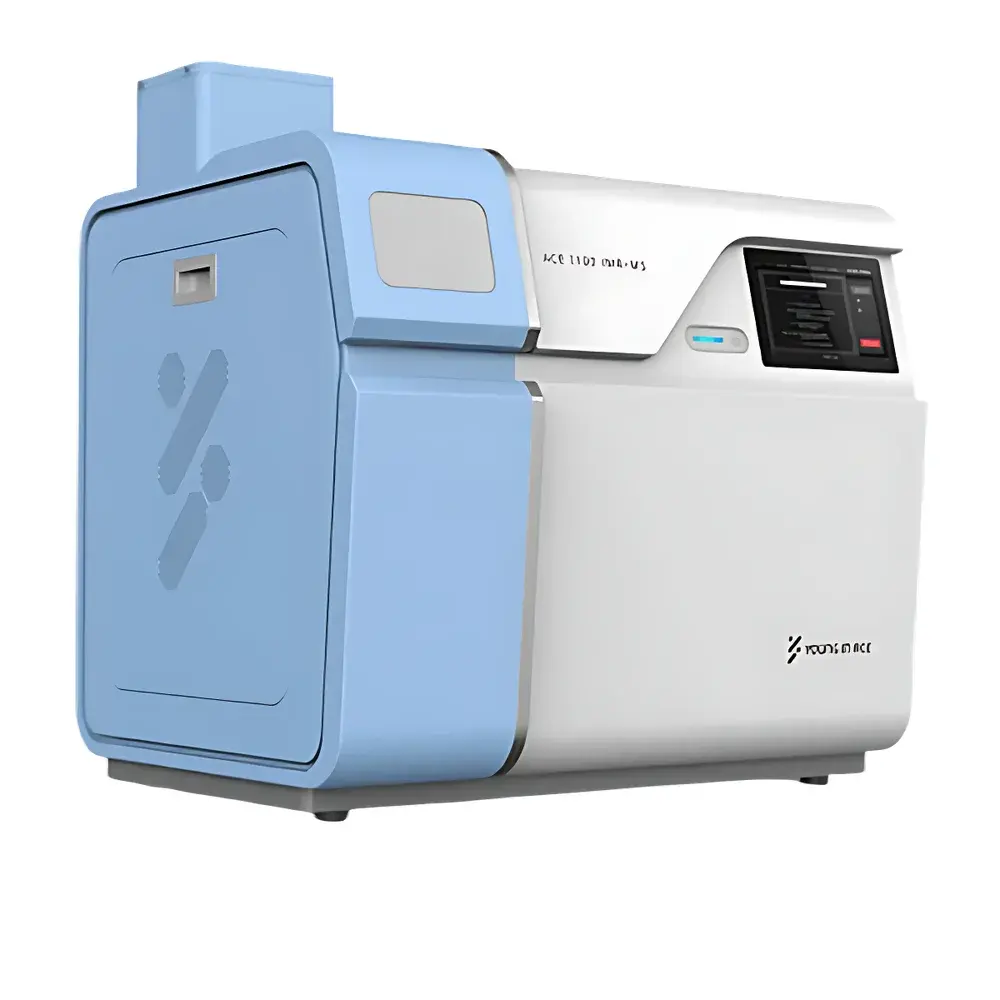
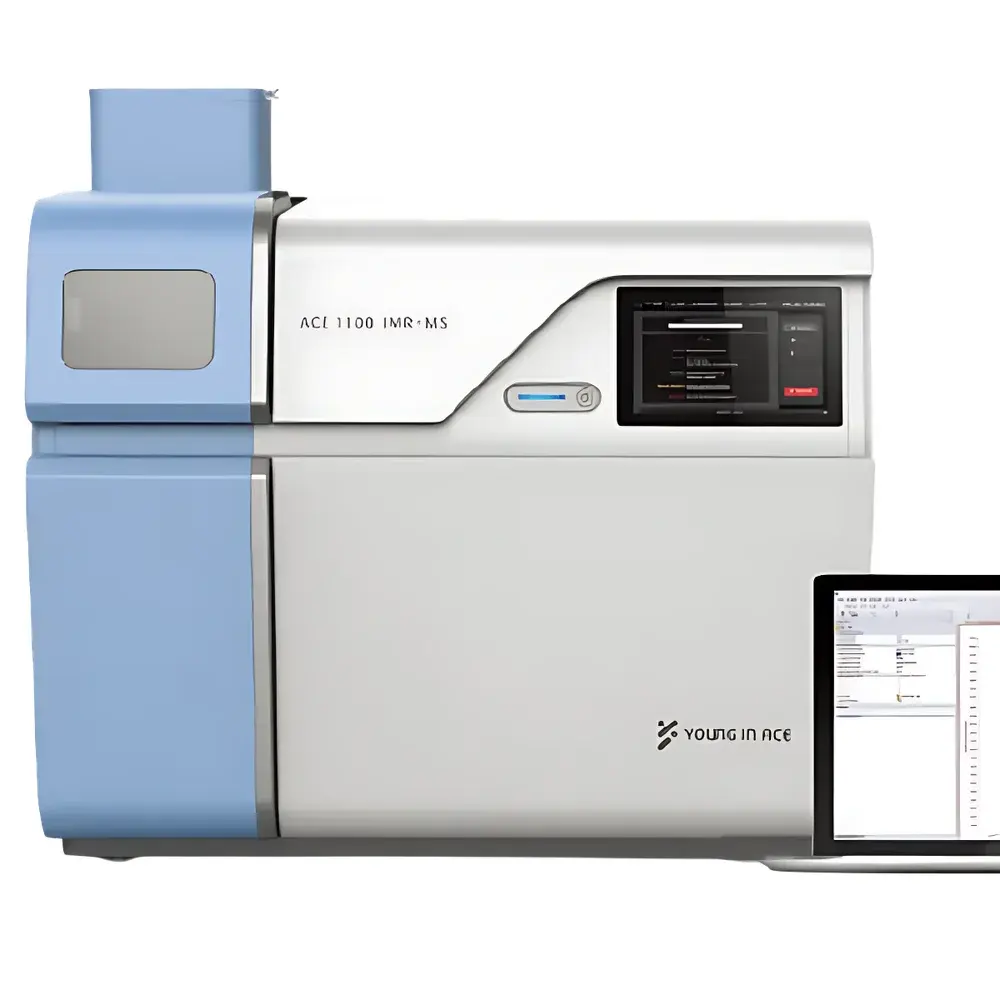
YOUNG IN ACE ACE 1100 Ion-Molecule Reaction Mass Spectrometer (IMR-MS)
| Brand | YOUNG IN ACE |
|---|---|
| Origin | South Korea |
| Manufacturer Type | Authorized Distributor |
| Origin Category | Imported Instrument |
| Model | ACE 1100 |
| Pricing | Available Upon Request |
Overview
The YOUNG IN ACE ACE 1100 Ion-Molecule Reaction Mass Spectrometer (IMR-MS) is a dedicated real-time analytical platform engineered for the direct, soft ionization and quantitative detection of volatile organic compounds (VOCs) and inorganic trace gases. Unlike conventional mass spectrometry workflows requiring prior chromatographic separation (e.g., GC-MS or LC-MS), the ACE 1100 employs a low-energy, controlled ion-molecule reaction environment within a high-vacuum drift tube to generate predominantly intact molecular ions (M⁺• or [M+H]⁺) with minimal fragmentation. This principle enables unambiguous identification and calibration-based quantification without derivatization, solvent extraction, or thermal desorption steps. Its compact architecture, integrated vacuum system, and ambient-pressure sampling interface support both laboratory benchtop deployment and field-configurable operation—making it suitable for continuous emissions monitoring, industrial process control, indoor air quality assessment, and emergency response applications.
Key Features
- Real-time analysis capability: Delivers quantitative VOC concentration data with sub-second duty cycle and typical response times under 30 seconds—contrasting sharply with conventional GC-MS methods requiring 30–40 minutes per sample.
- Direct ambient sampling: Accepts gas-phase samples at near-atmospheric pressure via heated capillary inlet; no pre-concentration traps, cryofocusing, or carrier gas dependency required.
- Dual operational modes: Supports both continuous online monitoring (24/7 autonomous acquisition) and discrete batch analysis with user-defined trigger logic.
- Modular mobility design: Chassis engineered for vehicular integration (e.g., mobile labs, fenceline monitoring units); includes shock-dampened mounting, DC power compatibility (12/24 V), and IP54-rated enclosure options.
- Intuitive dual-interface operation: Embedded touchscreen OS handles instrument control, calibration management, and alarm configuration; external Windows-based PC hosts advanced spectral deconvolution, multivariate regression modeling, and audit-trail-enabled data archiving.
- Soft ionization fidelity: Electron energy tunable between 5–20 eV; optimized for reduced fragmentation and enhanced molecular ion abundance—critical for isomeric differentiation and library-matching reliability.
Sample Compatibility & Compliance
The ACE 1100 is validated for gaseous and vapor-phase analytes with boiling points below 250 °C and vapor pressures exceeding 0.1 Torr at 25 °C—including aldehydes, ketones, aromatics, chlorinated hydrocarbons, sulfur compounds, and light oxygenates. It complies with ISO 16000-6 for indoor air VOC measurement protocols and supports method development aligned with EPA TO-15 and ASTM D5504 for sulfur speciation. Data integrity meets GLP/GMP requirements through configurable audit trails, electronic signatures, and secure user-role permissions. While not FDA 21 CFR Part 11–certified out-of-the-box, the software architecture supports validation packages for regulated environments upon customer-specific qualification.
Software & Data Management
Instrument control and data acquisition are managed by IMR-Control Suite v3.x—a deterministic real-time OS running on an embedded ARM-based controller. Raw transient spectra (m/z 10–300, 0.1 Da resolution) are streamed continuously to external workstations via Gigabit Ethernet. The companion IMR-Analyzer software provides peak integration using Savitzky-Golay smoothing, internal standard normalization, multi-point calibration curve fitting (linear, quadratic, or weighted least-squares), and automated interference correction via reference ion ratios. All processing steps are logged with timestamps, operator ID, and parameter versioning. Export formats include CSV, NetCDF, and mzML—ensuring interoperability with LIMS and enterprise analytics platforms.
Applications
- Continuous stack emission monitoring for petrochemical, semiconductor, and pharmaceutical manufacturing facilities.
- Fenceline VOC surveillance in compliance with EPA LDAR (Leak Detection and Repair) programs.
- Indoor air quality (IAQ) assessment in hospitals, schools, and office buildings per ISO 16000-22.
- Odor source identification and dispersion modeling support for municipal wastewater treatment plants.
- Rapid screening of fuel additives, refrigerants, and solvent residues during R&D and QC release testing.
- Field-deployable environmental forensics during chemical spill incidents or clandestine lab investigations.
FAQ
What types of compounds can the ACE 1100 detect?
It detects volatile and semi-volatile organic compounds (VOCs/SVOCs) with sufficient vapor pressure, including BTEX, formaldehyde, acetaldehyde, acetone, chloroform, and hydrogen sulfide—typically in the pptv to ppmv range.
Does the system require carrier gas or vacuum pumps?
Yes—it operates under high vacuum (10⁻⁶ mbar base pressure) maintained by a turbomolecular pump backed by a dry scroll pump; no carrier gas is needed for ionization or transport.
Can the ACE 1100 be integrated with existing plant DCS or SCADA systems?
Yes—via Modbus TCP or OPC UA protocol gateways; analog 4–20 mA outputs and digital alarm relays are standard.
Is method validation support available?
YOUNG IN ACE provides application notes, certified reference gas protocols, and IQ/OQ documentation templates compliant with ISO/IEC 17025.
What maintenance intervals are recommended?
Ion source cleaning every 3 months under continuous operation; turbomolecular pump oil replacement annually; full system performance verification semiannually using NIST-traceable gas standards.




