
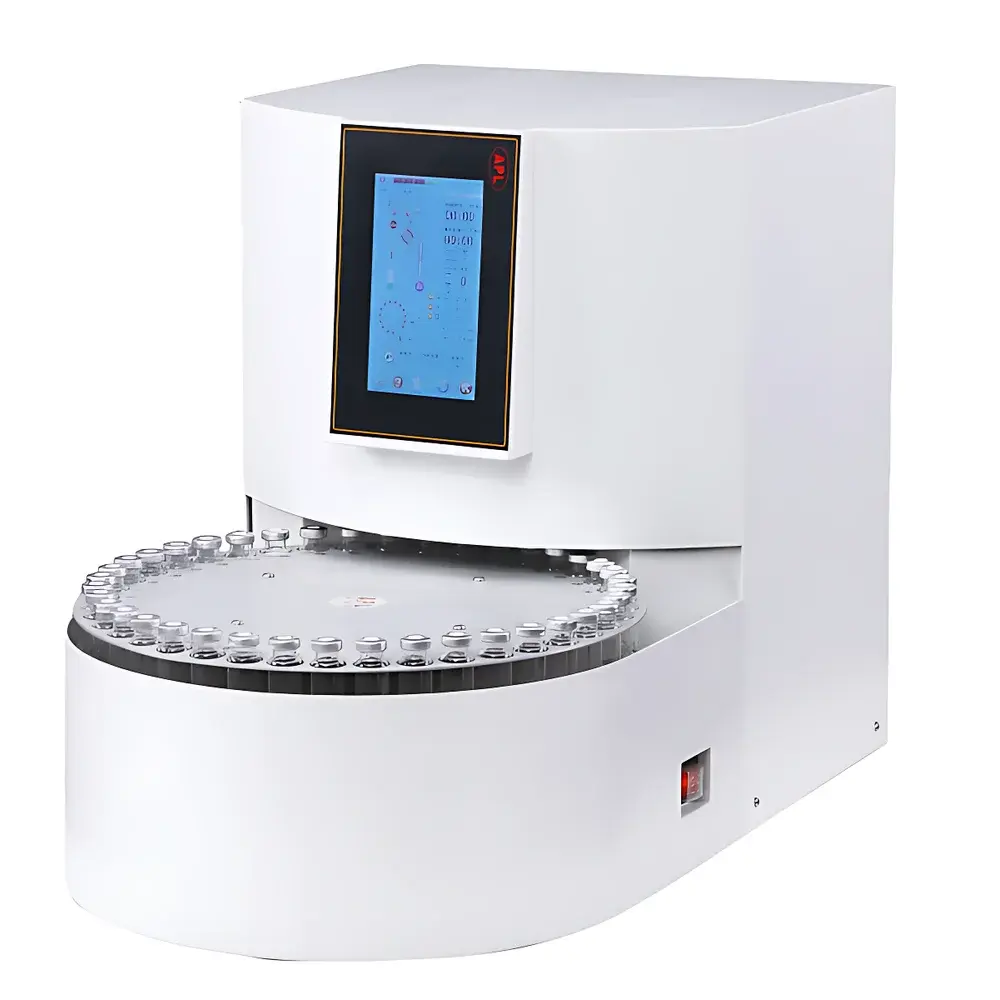
APL APL-HS-Auto40 Fully Automated Static Headspace Sampler
| Brand | APL |
|---|---|
| Origin | Sichuan, China |
| Manufacturer Type | Direct Manufacturer |
| Instrument Type | Static Headspace Sampler |
| Automation Level | Fully Automated |
| Sample Vial Heating Range | Ambient to 260 °C |
| Valve & Transfer Line Temperature Control Range | Ambient to 220 °C |
| Temperature Control Accuracy | ±0.1 °C |
| Loop Volume | 1 mL |
| Vial Capacity | 40 positions |
| Vial Size Compatibility | 20 mL (standard), 10 mL (optional) |
| Precision | RSD ≤1% (200 ppm ethanol in water, n=5) |
| Pressure-Controlled Injection Range | 0–0.4 MPa (adjustable) |
| Purge Flow Rate | 0–400 mL/min (adjustable) |
Overview
The APL APL-HS-Auto40 Fully Automated Static Headspace Sampler is engineered for precise, reproducible volatile compound analysis in conjunction with gas chromatography (GC) systems. It operates on the static headspace principle: sealed sample vials are heated to equilibrium, allowing analytes to partition into the vapor phase above the liquid or solid matrix; a precisely metered volume of this equilibrated headspace gas is then transferred via a thermostatted valve and transfer line directly into the GC injector. Designed for unattended operation, the APL-HS-Auto40 integrates thermal control, pressure-driven sampling, and sequence-based automation to eliminate manual intervention while maintaining analytical integrity across extended batch runs.
Key Features
- Fully automated 40-position carousel with programmable vial indexing and robotic arm-assisted vial handling—enabling overnight and multi-day unattended operation.
- Independent three-zone temperature control: sample incubation oven (ambient to 260 °C), injection valve assembly (ambient to 220 °C), and transfer line (ambient to 220 °C), each with ±0.1 °C stability and 1 °C resolution.
- Pressure-controlled sampling mechanism using a 1 mL fixed-loop configuration; injection volume modulated via adjustable pressurization time and regulated carrier gas pressure (0–0.4 MPa).
- Integrated purge-and-vent system with adjustable flow (0–400 mL/min) to eliminate residual analytes from the sampling loop and valve pathways between injections—critical for minimizing carryover and ensuring inter-sample fidelity.
- Robust stainless-steel fluidic path and high-temperature silicone-free sealing materials compatible with trace-level VOC analysis and routine use in regulated environments.
- Modular design supporting 10 mL and 20 mL crimp-top or screw-cap vials; 20 mL vials supplied as standard per ASTM D3699 and ISO 11843-2 compliance requirements.
Sample Compatibility & Compliance
The APL-HS-Auto40 accommodates aqueous, semi-solid, and solid matrices—including environmental water, pharmaceutical excipients, polymer pellets, food homogenates, and forensic biological specimens. Its thermal stability and inert flow path support method development aligned with USP , ICH Q2(R2), EPA Method 502.2, and ASTM D5502 for residual solvent analysis. The instrument’s repeatable thermal ramping, pressure regulation, and timing synchronization meet GLP/GMP documentation prerequisites when paired with compliant chromatography data systems (CDS). While not inherently 21 CFR Part 11–certified, its audit-trail-ready event logging (time-stamped heating cycles, pressure events, valve actuations, and error flags) facilitates integration into validated workflows requiring electronic record retention.
Software & Data Management
Controlled via APL Headspace Manager™ software (Windows-based), the system supports method creation with granular parameter definition: equilibration time, oven ramp rate, valve heat soak duration, pressurization profile, loop fill time, injection delay, and post-injection purge sequence. All parameters are stored in encrypted .hsm project files with version history. Real-time monitoring displays temperature profiles, pressure transients, and status codes. Export options include CSV-formatted run logs and instrument event timelines compatible with LIMS ingestion. Remote diagnostics and firmware updates are supported over Ethernet; USB backup ensures offline method archiving.
Applications
- Residual solvent quantification in active pharmaceutical ingredients (APIs) and final drug products per ICH Q3C guidelines.
- VOC profiling in drinking water, wastewater, and soil extracts under EPA regulatory frameworks.
- Flavor and fragrance compound release kinetics in packaged foods and beverages.
- Monomer and catalyst residue analysis in polymer synthesis QA/QC laboratories.
- Forensic toxicology screening for volatile substances including ethanol, acetone, and chlorinated solvents.
- Environmental fate studies involving partition coefficient (KH) determination and Henry’s law constant estimation.
FAQ
What vial formats does the APL-HS-Auto40 support?
Standard configuration includes 20 mL crimp-top vials; optional 10 mL vial trays and corresponding method presets are available.
Can the instrument be integrated with third-party GC systems?
Yes—equipped with standard TTL and RS-232/RS-485 interfaces, it synchronizes trigger signals with Agilent, Thermo Fisher, Shimadzu, and PerkinElmer GC platforms.
Is method validation support provided?
APL supplies documented IQ/OQ protocols, system suitability test procedures, and RSD verification data (e.g., ≤1% for 200 ppm ethanol in water, n=5) to assist laboratory validation teams.
How is carryover mitigated between samples?
A programmable high-flow purge cycle (0–400 mL/min) evacuates the sampling loop and valve internal volume after each injection; optional heated transfer line minimizes condensation-related memory effects.
What maintenance intervals are recommended?
Valve seal replacement every 10,000 injections; oven calibration verification annually or per internal SOP; transfer line cleaning recommended after high-boiling-point matrix analysis.




