
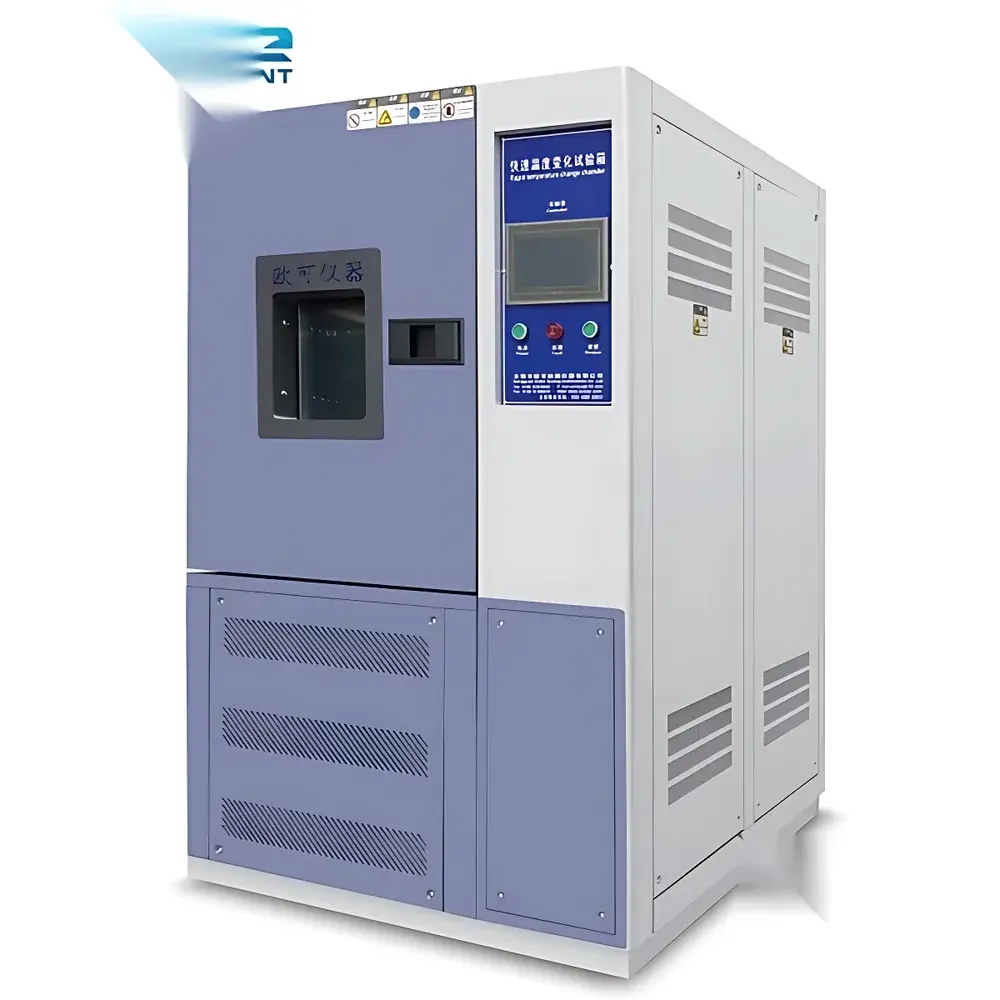
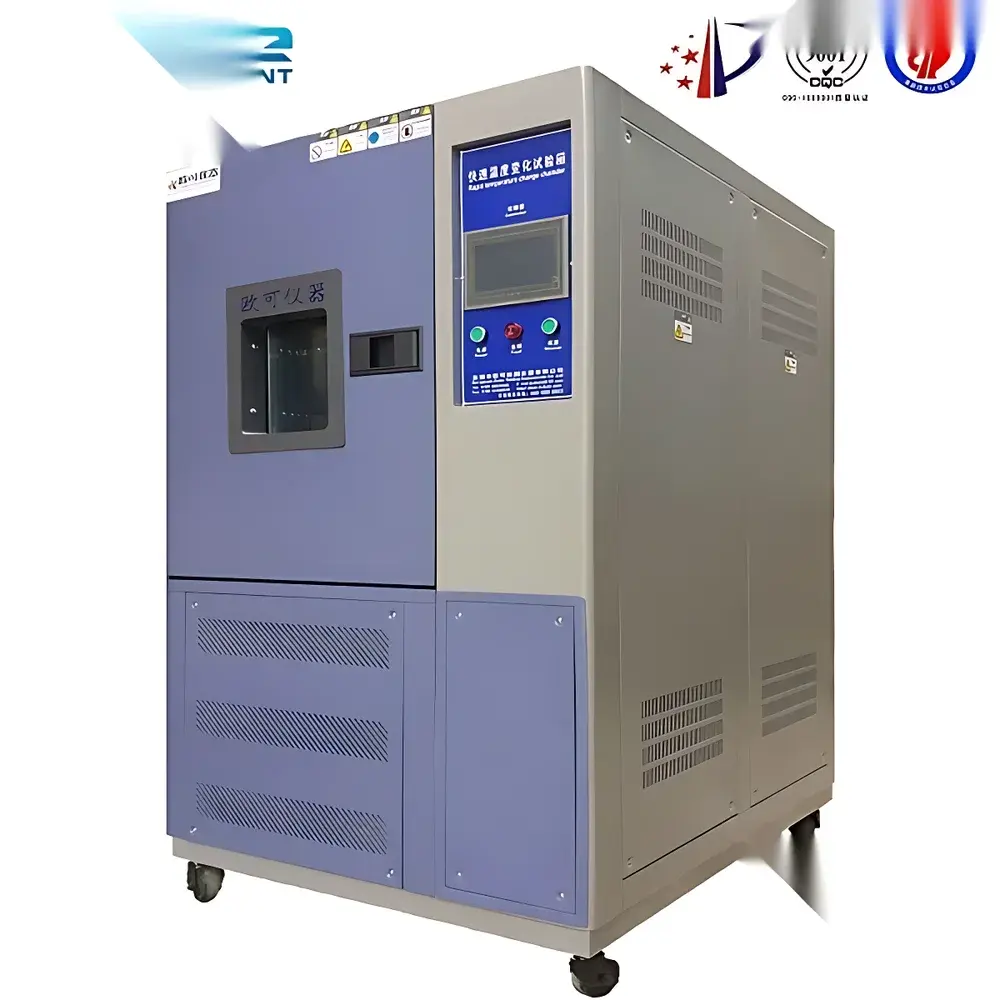
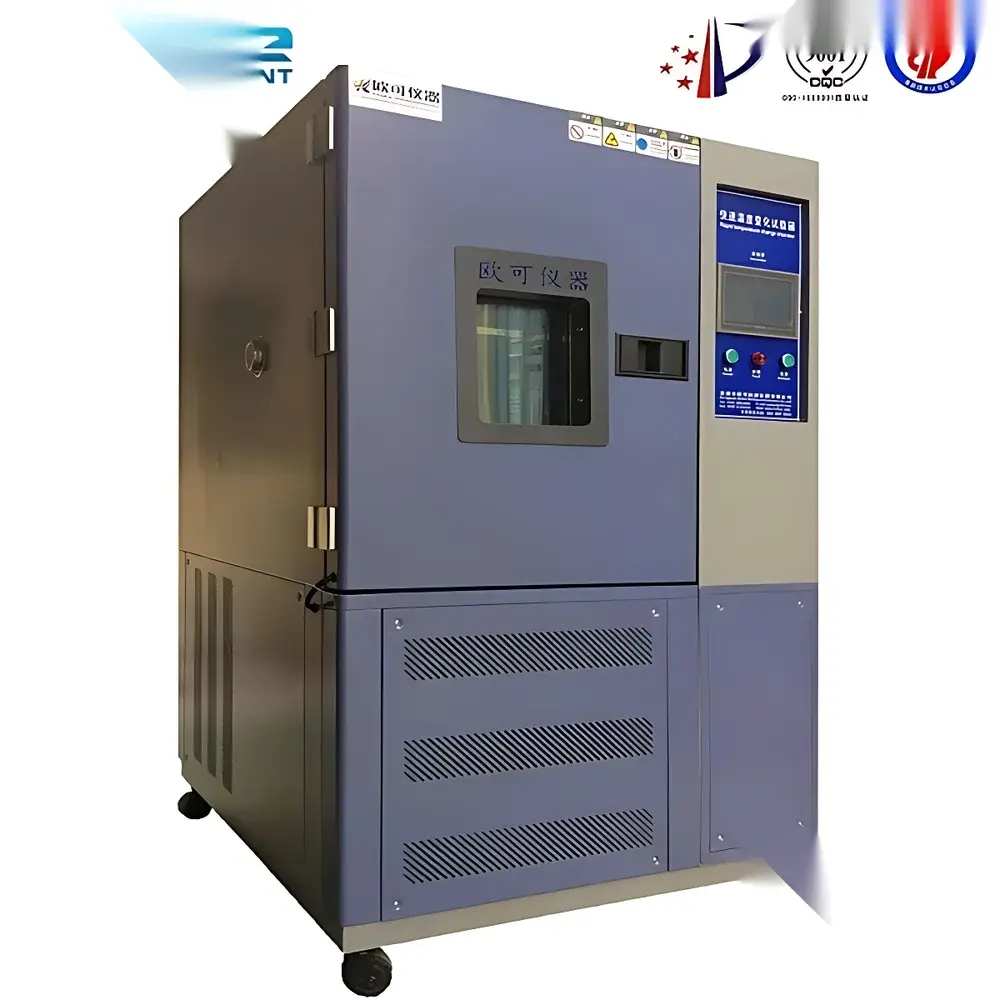
English Product Name
| Brand | Other Brands |
|---|---|
| Origin | Imported |
| Manufacturer Type | Authorized Distributor |
| Price | USD 14,000 (Reference Only) |
| Internal Dimensions (W×H×D) | 50×75×60 cm to 100×100×100 cm |
| Temperature Range | −70 °C to +150 °C |
| Humidity Range | 20–98% RH (optional: 5–98% RH) |
| Rapid Temperature Transition Range | −45 °C to +85 °C or −20 °C to +85 °C |
| Ramp Rates | 5–25 °C/min (customizable) |
| Temperature Uniformity | ±2 °C |
| Temperature Stability | ±0.5 °C |
| Humidity Uniformity | ±3.0% RH (at ≥75% RH) |
| Humidity Stability | ±2.5% RH |
| Construction Material | SUS#304 Stainless Steel |
| Refrigeration System | Hermetic Dual-Stage Compressor with Eco-Friendly Refrigerants (R404A/R23) |
| Controller | 7-inch Touchscreen LCD with English/Chinese Interface |
| Power Supply | AC 380 V ±5%, 50 Hz ±0.5 Hz, 3-phase 5-wire |
Overview
The KS-TH Series Rapid Temperature Transition Environmental Test Chamber is engineered for accelerated thermal stress screening of electronic components, automotive modules, aerospace subsystems, and industrial materials under controlled, repeatable, and highly dynamic temperature conditions. Based on the principle of rapid thermal cycling—inducing cyclic expansion and contraction in test specimens—the chamber applies quantifiable thermal gradients to expose latent design, material, or process defects that may remain undetected under static environmental conditions. Unlike standard thermal shock chambers employing two-zone air or liquid immersion methods, this unit delivers continuous, programmable ramping across its full operating range (−70 °C to +150 °C), enabling compliance-driven thermal transition testing per IEC 60068-2-14 (Change of Temperature) and MIL-STD-810H Method 503.7. Its architecture supports both single-ramp and multi-step profiles with dwell, hold, and rate-controlled transitions—critical for qualification of high-reliability products in R&D, incoming inspection, and production line validation.
Key Features
- Programmable ramp rates from 5 °C/min up to 25 °C/min—selectable in 1 °C/min increments for precise profile replication
- Dual-stage hermetic refrigeration system using environmentally compliant R404A (low-temp stage) and R23 (ultra-low-temp cascade stage), minimizing ozone depletion potential (ODP) and global warming potential (GWP)
- SUS#304 stainless steel interior and insulated double-wall construction ensure long-term corrosion resistance and thermal integrity
- 7-inch capacitive touchscreen controller with real-time graphing, USB data export, and dual-language (English/Chinese) interface—fully configurable via intuitive drag-and-drop profile editor
- Temperature uniformity maintained at ±2 °C (horizontal/vertical plane, 100 mm from walls) and stability at ±0.5 °C over 30-minute dwell periods
- Humidity control integrated with steam generator and solid-state dew-point sensor; optional extended range (5–98% RH) available for hygrothermal stress profiling
- Comprehensive safety suite: over-temperature cut-off, refrigerant pressure monitoring, door interlock, and independent mechanical thermostat backup
Sample Compatibility & Compliance
The KS-TH chamber accommodates a wide range of sample geometries—from PCB assemblies and battery packs to molded plastic housings and sealed sensors—within internal volumes ranging from 225 L to 1000 L. All models comply with structural and performance requirements outlined in GB/T 10589–2008 (Low-Temperature Test Chambers), GB/T 11158–2012 (High-Temperature Test Chambers), and GB/T 10592–2008 (General Specifications for Climate Test Chambers). Testing protocols align with internationally recognized standards including IEC 60068-2-14 (temperature change), ISO 16750-4 (road vehicles—electrical loads), and AEC-Q200 (passive component stress testing). For regulated industries, the controller supports audit-ready operation logs and user-access-level configuration—facilitating GLP/GMP documentation workflows when paired with external data archiving systems.
Software & Data Management
The embedded controller firmware records all operational parameters—including setpoint, actual chamber temperature/humidity, ramp rate, elapsed time, alarm status, and compressor duty cycle—at user-defined intervals (1–60 seconds). Data is stored internally for up to 30 days and exportable via USB 2.0 to CSV format for post-test analysis in MATLAB, Python (Pandas), or statistical process control (SPC) platforms. Optional Ethernet connectivity enables remote monitoring through Modbus TCP or OPC UA protocols. While the base system does not include FDA 21 CFR Part 11-compliant electronic signatures or audit trail encryption, it provides timestamped, immutable log files suitable for internal quality audits and supplier qualification packages. Custom firmware upgrades are available for integration into enterprise MES/QMS environments.
Applications
This chamber serves as a core tool in reliability engineering laboratories for: thermal cycling qualification per JEDEC JESD22-A104 (Temperature Cycling); solder joint fatigue assessment in surface-mount electronics; validation of thermal interface materials (TIMs) under dynamic load; pre-screening of automotive ECUs prior to climatic wind tunnel testing; and accelerated life testing of polymer-based enclosures exposed to diurnal temperature swings. It is routinely deployed in Tier-1 automotive suppliers’ APQP phase gates, medical device design verification (per ISO 14971), and defense subcontractor acceptance testing where thermal robustness directly impacts field failure rates.
FAQ
What is the difference between rapid temperature transition and thermal shock testing?
Rapid temperature transition (RTT) uses a single-chamber, continuously ramped profile to simulate gradual but accelerated environmental shifts—ideal for detecting fatigue-related failures. Thermal shock employs abrupt transfers between extreme hot/cold zones, targeting brittle fracture or delamination. The KS-TH supports RTT only.
Can the chamber be validated per IQ/OQ protocols?
Yes—standard calibration points (−40 °C, 25 °C, 85 °C, 125 °C) are traceable to NIST-certified references. Validation templates and uncertainty budgets are provided upon request.
Is humidity control available across the full temperature range?
Humidity is functional from +10 °C to +85 °C at 20–98% RH. Below +10 °C, condensation limits active humidification; dehumidification remains effective down to −40 °C via refrigerant coil cooling.
Does the controller support custom script-based test sequences?
The native interface supports nested loops, conditional jumps, and variable ramp rates—but does not execute external scripts. For advanced automation, third-party SCADA integration via Modbus is recommended.
What maintenance intervals are recommended?
Compressor oil and filter replacement every 24 months; refrigerant leak check annually; chamber seal inspection quarterly; touchscreen calibration biannually. Full service manuals and spare parts lists are included with shipment.



