
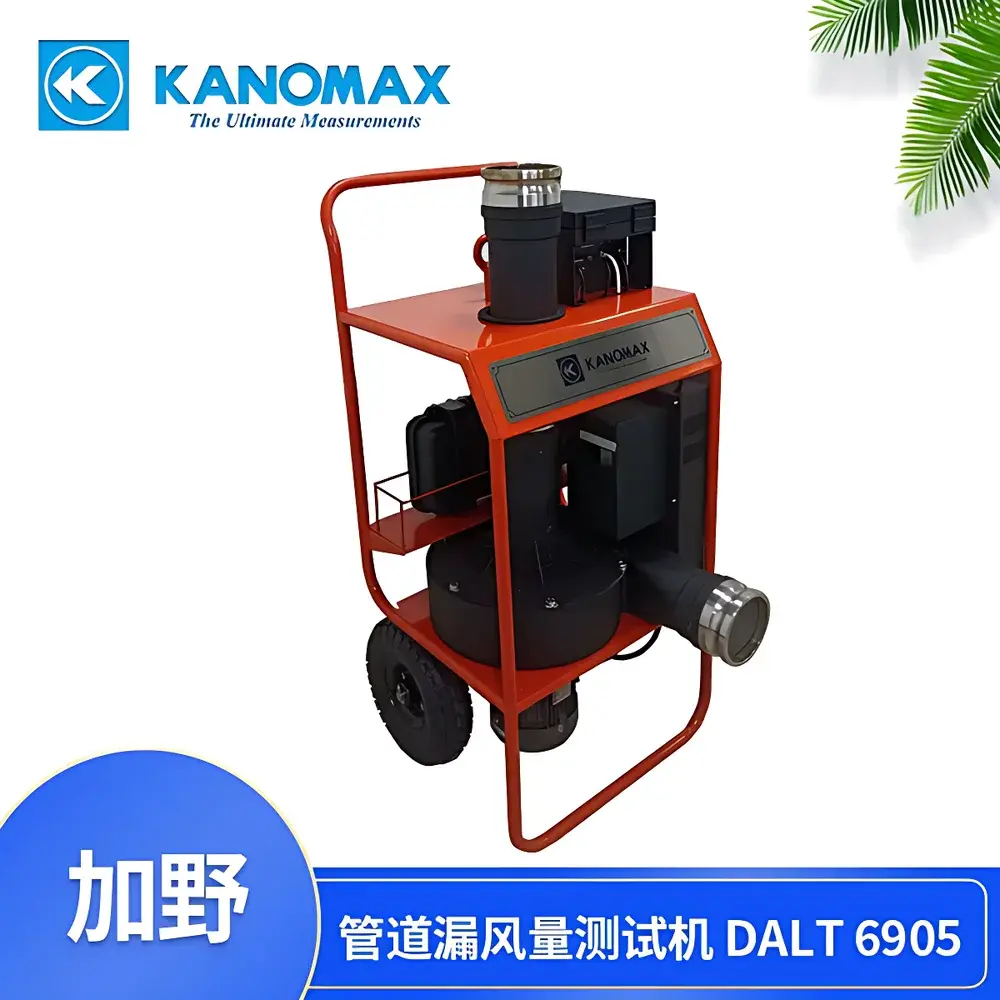
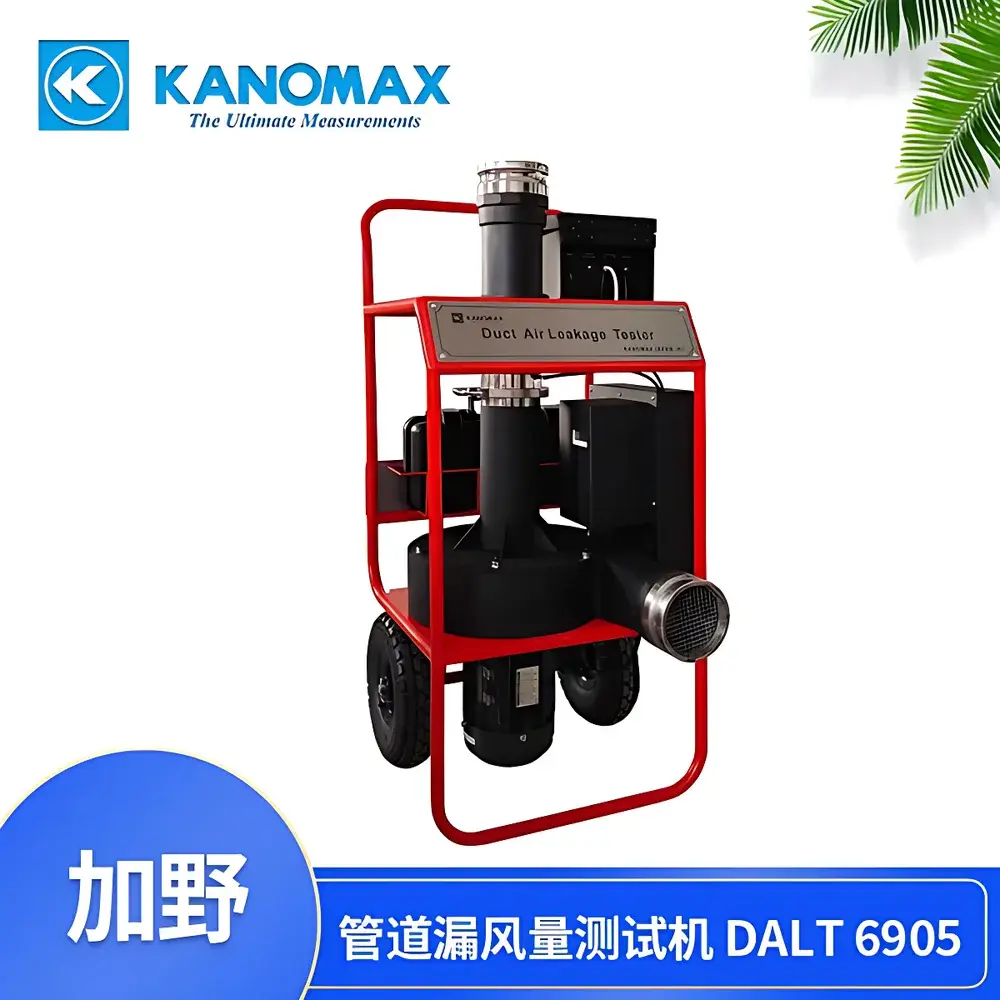
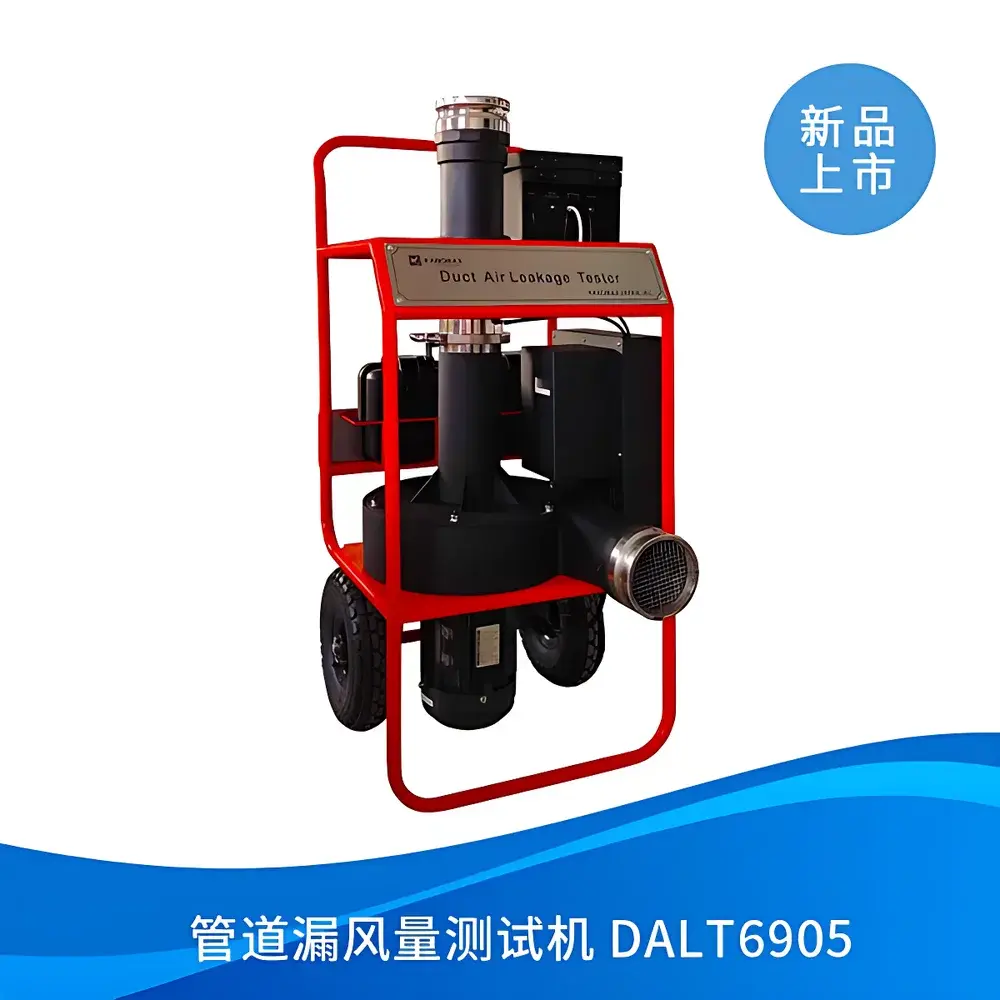
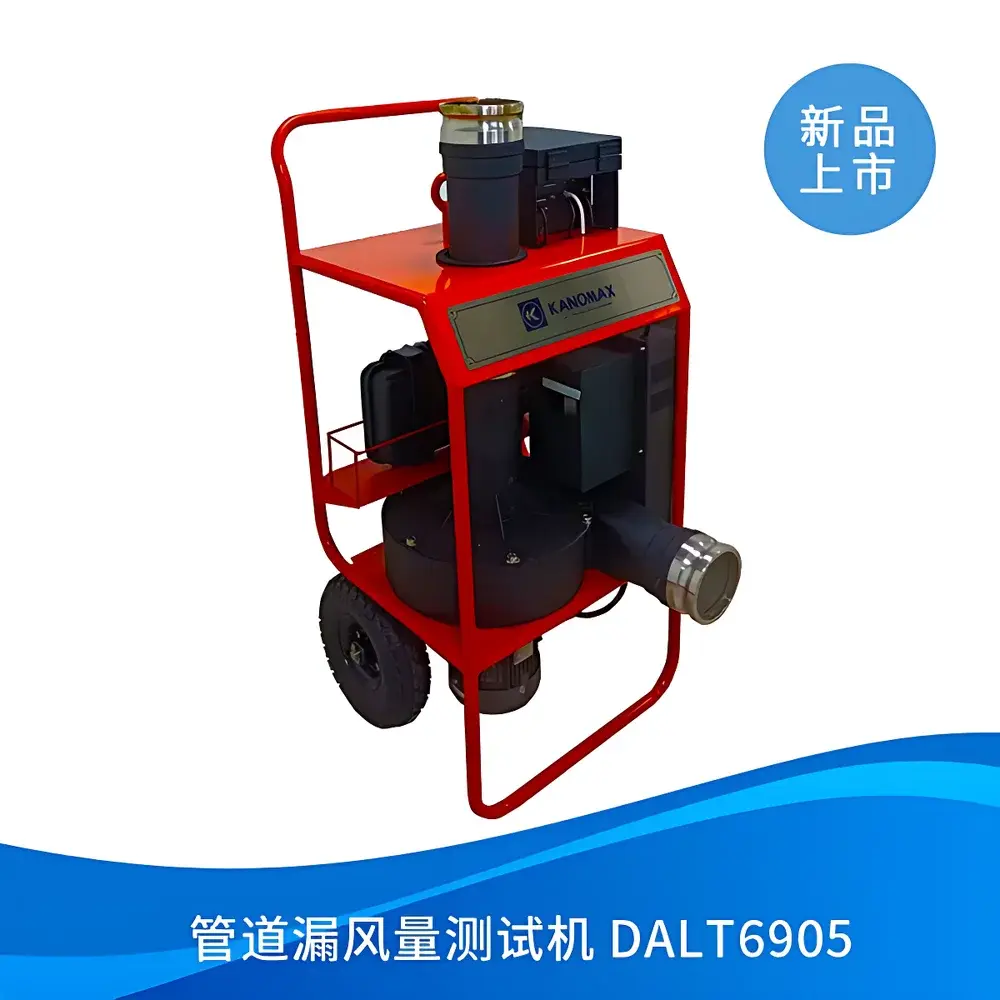
Kanomax DALT6905 Duct Air Leakage Tester
| Brand | Kanomax |
|---|---|
| Model | DALT6905 |
| Flow Range (Large Nozzle) | 70–820 m³/h |
| Flow Range (Small Nozzle) | 4–70 m³/h |
| Accuracy (Flow) | ±2.5% of reading ±0.1 m³/h |
| Resolution (Flow) | 0.01 m³/h |
| Static Pressure Range | ±2500 Pa |
| Accuracy (Pressure) | ±1% of reading ±1 Pa |
| Resolution (Pressure) | 0.1 Pa |
| Temperature Range | 0–60 °C |
| Accuracy (Temperature) | ±0.5 °C |
| Resolution (Temperature) | 0.1 °C |
| Barometric Pressure Range | 70–130 kPa |
| Accuracy (Baro) | ±2% of reading |
| Resolution (Baro) | 0.1 kPa |
| Power Supply | 100–120 V / 200–240 V, 1-phase, 50/60 Hz |
| Net Weight | 59.8 kg |
| Dimensions (W×D×H) | 480 × 627 × 1124 mm |
| Data Storage | 1000 test records |
| Display | 5-inch color LCD touchscreen |
| Compliance Standards | EN 1507:2006, EN 12237:2003, Eurovent 2/2, DW/143, SMACNA, AABC, GB 50243–2003/2016 |
Overview
The Kanomax DALT6905 Duct Air Leakage Tester is a precision-engineered, portable instrumentation system designed for quantitative assessment of air leakage in HVAC ductwork, fire protection ventilation systems, and sealed enclosures. It operates on the principle of calibrated orifice flow measurement under controlled static pressure differential—applying standardized pressurization protocols to determine volumetric leakage rates across duct sections or entire installed systems. Unlike qualitative smoke or pressure decay methods, the DALT6905 delivers traceable, repeatable, and standards-compliant quantitative data essential for commissioning, regulatory compliance verification, and energy performance certification. Its dual-nozzle architecture enables seamless transition between high-flow (70–820 m³/h) and low-flow (4–70 m³/h) regimes without recalibration, supporting both coarse system-level validation and fine-grained segment-level diagnostics.
Key Features
- Two interchangeable nozzles—large and small—mechanically optimized for wide dynamic range coverage; nozzle switching requires no tools and takes under 60 seconds.
- Integrated 5-inch full-color LCD touchscreen interface with intuitive icon-driven navigation, real-time multi-parameter display (leakage flow, static pressure, ambient temperature, barometric pressure), and on-device pass/fail judgment per selected standard.
- Onboard storage for up to 1000 complete test records, each timestamped and geotagged (optional via external GPS module); data export via USB 2.0 to CSV or PDF report templates compliant with ISO/IEC 17025 documentation requirements.
- Compact footprint (480 × 627 × 1124 mm) and net weight of 59.8 kg enable transport in standard SUV cargo compartments—eliminating need for dedicated service vehicles or lifting equipment.
- Robust pressure control system maintains setpoint stability within ±1 Pa during extended tests; supports bidirectional pressurization (positive and negative static pressure up to ±2500 Pa) to simulate operational and fault conditions per EN 1507 and SMACNA criteria.
- Automatic environmental compensation: simultaneous real-time correction of volumetric flow using measured temperature and barometric pressure—ensuring NTP (Normal Temperature and Pressure) referenced results per ASTM E1554 and ISO 5801 conventions.
Sample Compatibility & Compliance
The DALT6905 is validated for use across rigid and flexible duct materials—including galvanized steel, aluminum, fiberglass-reinforced polymer (FRP), and fire-rated flexible connectors—within nominal diameters from 100 mm to 2000 mm. Its modular sealing adapters accommodate rectangular, round, and oval cross-sections without custom fabrication. The instrument’s firmware embeds calculation engines for all major international duct leakage standards: EN 1507:2006 (metallic ducts), EN 12237:2003 (flexible ducts), Eurovent 2/2 (European HVAC commissioning), DW/143 (UK building regulations), SMACNA HVAC Air Duct Leakage Test Manual (USA), AABC National Standards (USA), and GB 50243–2016 (China’s Code for Acceptance of Ventilation and Air Conditioning Engineering). Each test record includes embedded metadata confirming which standard was applied, tolerance class selected (e.g., Class A, B, C), and final compliance status—supporting audit-ready documentation for LEED, BREEAM, or local authority sign-off.
Software & Data Management
No proprietary desktop software is required: all configuration, execution, and reporting occur natively on the device. However, optional Kanomax DuctLink™ PC application (Windows 10/11) enables batch analysis, comparative trending across multiple projects, and automated generation of GLP-compliant reports with electronic signature fields. All stored test data include immutable audit trails—recording operator ID, calibration certificate expiry, firmware version, and timestamped sensor diagnostics. When used in regulated environments (e.g., pharmaceutical cleanroom HVAC qualification), the system supports 21 CFR Part 11-compliant user access controls and electronic record integrity verification upon USB export.
Applications
- Pre-commissioning leakage verification of supply, return, and exhaust duct networks prior to handover.
- Post-installation validation of fire damper and smoke control system integrity under negative pressure conditions.
- Periodic maintenance auditing of aging duct systems to quantify degradation and prioritize remediation.
- Energy efficiency benchmarking per ASHRAE Guideline 12-2020 and ISO 50001 energy management systems.
- Third-party commissioning agent verification for green building certifications (LEED EA Credit, BREEAM HEA 03).
- Research and development of novel duct sealing technologies under controlled laboratory or field conditions.
FAQ
Does the DALT6905 require annual factory recalibration?
Yes—Kanomax recommends annual traceable recalibration against NIST-traceable reference standards. Certificate includes uncertainty budgets per ISO/IEC 17025.
Can it measure leakage in insulated ducts?
Yes—provided the insulation does not impede physical access to duct joints or penetrations; thermal insulation has no effect on airflow measurement accuracy.
Is the device suitable for outdoor testing in variable weather?
It operates reliably at ambient temperatures from 0 °C to 60 °C and barometric pressures from 70 kPa to 130 kPa—covering most global field conditions, including high-altitude sites.
How is traceability maintained for field test reports?
Each test record embeds unique serial numbers for pressure transducers, flow sensors, and temperature probes—all linked to their individual calibration certificates stored in internal memory.
Does it support custom leakage limits beyond published standards?
Yes—users may define custom pass/fail thresholds for flow rate or pressure decay slope, with full audit logging of all parameter modifications.
Related Products







