
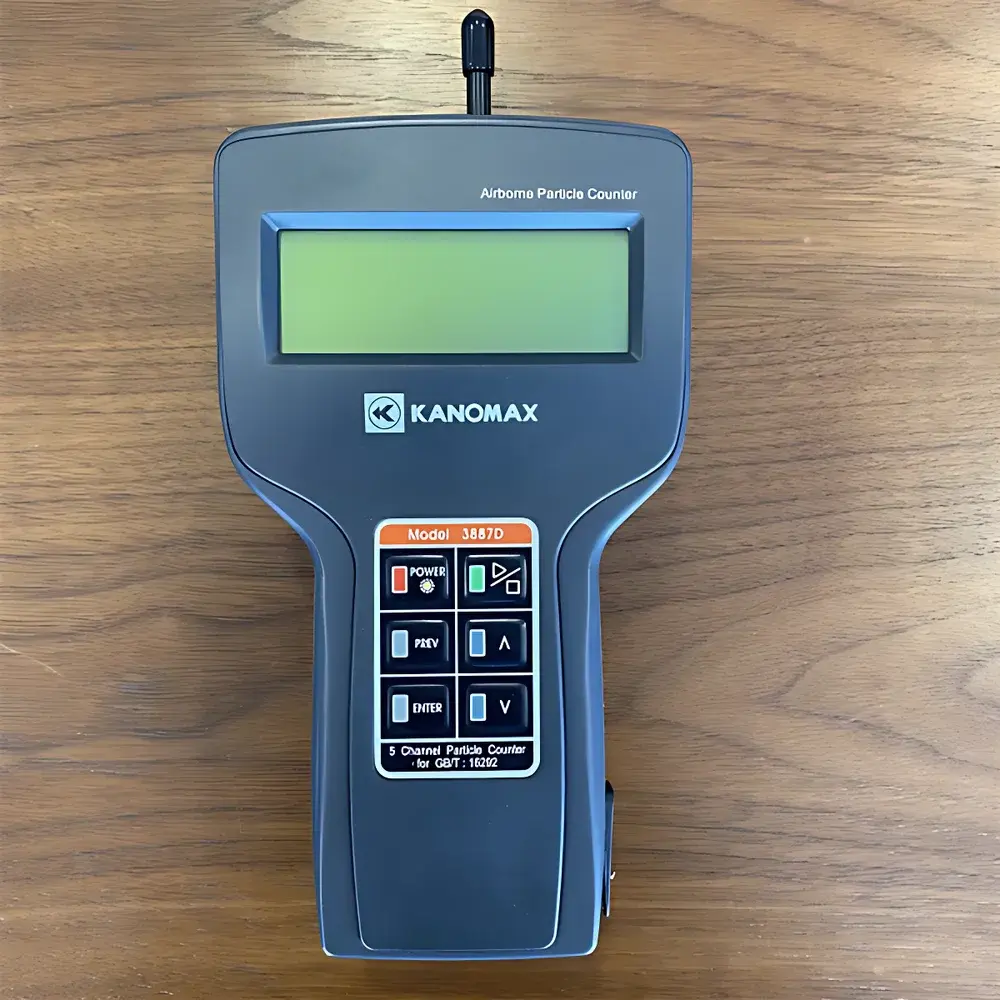
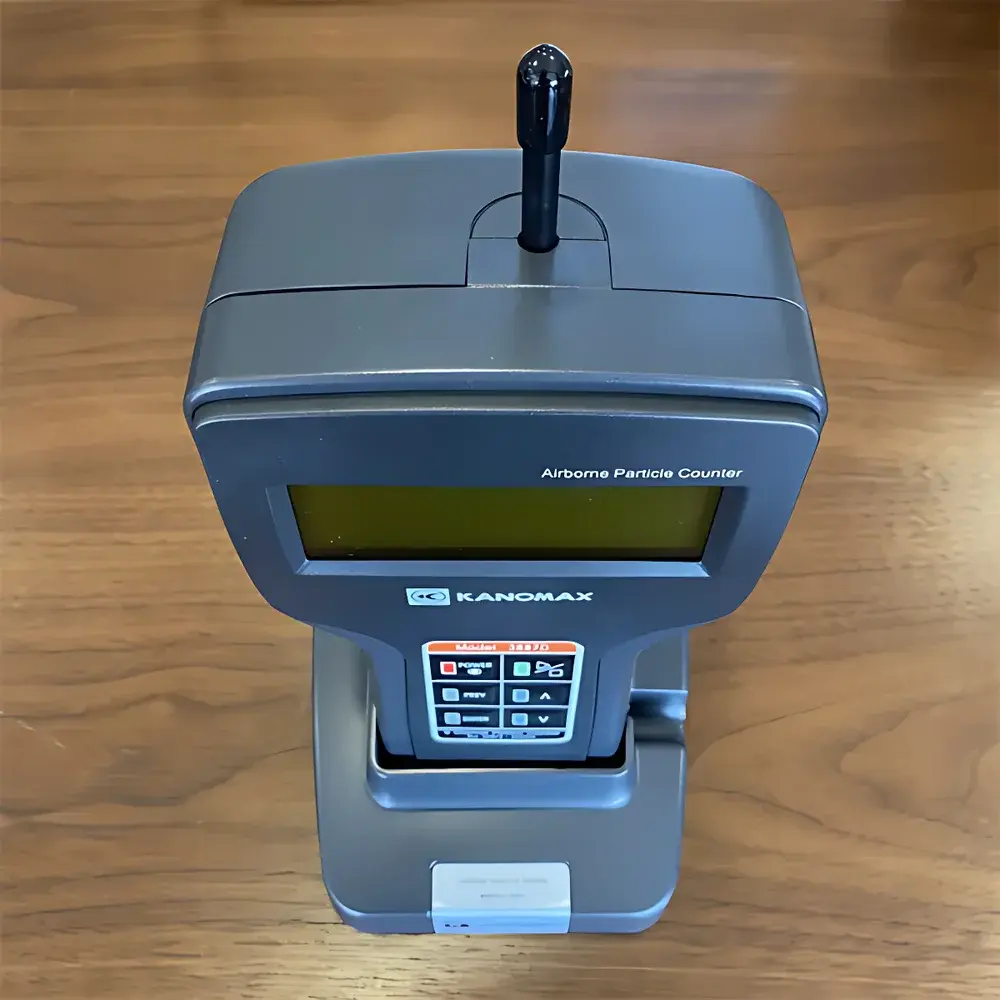
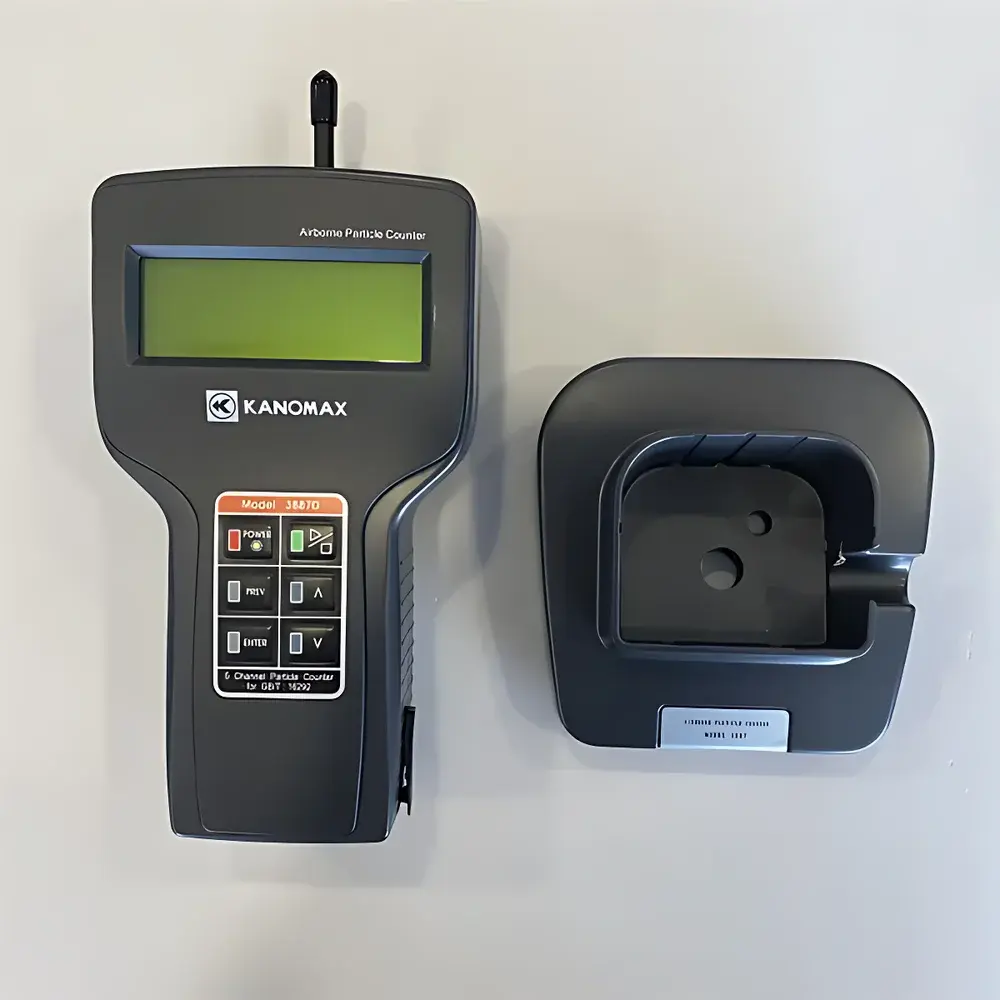
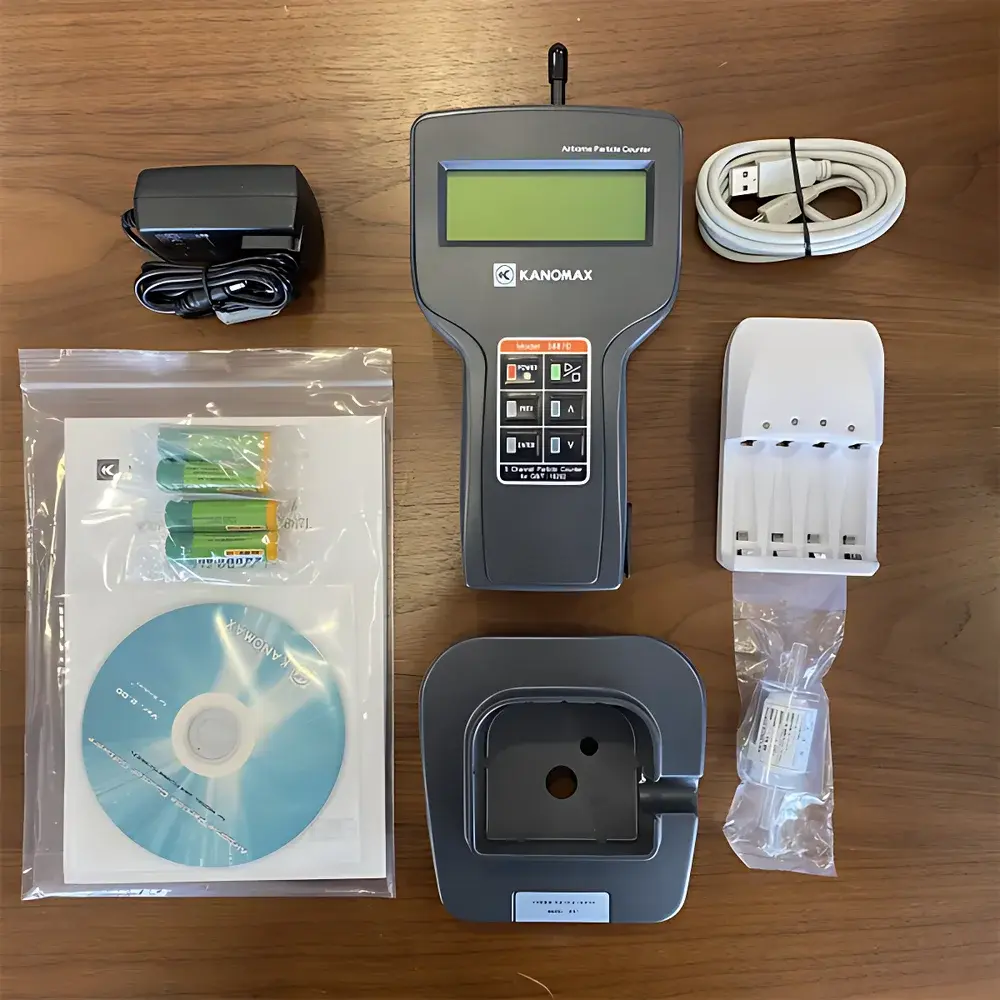
KANOMAX Model 3887D Handheld Airborne Particle Counter for Pharmaceutical Environments
| Brand | KANOMAX |
|---|---|
| Origin | Japan |
| Model | 3887D |
| Instrument Type | Handheld Particle Counter |
| Sampling Flow Rate | 2.83 L/min (0.1 cfm) |
| Detectable Particle Sizes | 0.3, 0.5, 1.0, 3.0, 5.0 µm |
| Data Storage Capacity | 7,000 records |
| Operating Interface | Chinese-language LCD display |
| Sampling Duration Range | 10 sec to 99 min 59 sec |
| Count Alarm Range | 1–70,000,000 particles per cubic foot |
| Power Supply | 4× AA Ni-MH rechargeable batteries (charger included) or AC adapter (100–240 V AC) |
| Dimensions | 108(W) × 68(D) × 196(H) mm |
| Weight | ~680 g (without batteries) |
| Compliance Standards | GB/T 16292–2010, ISO 14644-1:2015, China GMP (2010) Annex 1 |
Overview
The KANOMAX Model 3887D is a handheld optical particle counter engineered for real-time, quantitative monitoring of airborne particulate contamination in controlled pharmaceutical environments. Utilizing a high-sensitivity laser diode light source and precision forward-scatter detection optics, the instrument measures particle concentrations across five calibrated size channels (0.3, 0.5, 1.0, 3.0, and 5.0 µm) at a nominal volumetric flow rate of 2.83 L/min (0.1 cfm). Its design adheres to the physical measurement principles defined in ISO 21501-4 for light scattering airborne particle counters, ensuring traceable and reproducible sizing and counting performance. The 3887D is purpose-built for Grade A–D cleanroom qualification, environmental monitoring during aseptic processing, and routine surveillance in isolators, laminar flow hoods, and filling suites—supporting compliance with Annex 1 of the China Good Manufacturing Practice (GMP) regulations, ISO 14644-1:2015 classification protocols, and national standard GB/T 16292–2010.
Key Features
- Laser-based optical sensing with dual-stage signal amplification for stable detection of sub-micron particles, including the critical 0.3 µm threshold used in Grade A cleanroom verification.
- Configurable multi-mode sampling: single-shot, repeated interval, continuous logging, statistical calculation (e.g., mean, standard deviation), remote-triggered acquisition, and ISO-compliant sequential sampling routines.
- On-device delay start function (programmable up to 99 minutes) eliminates operator-induced turbulence during probe placement, improving measurement fidelity in low-flow or sensitive zones.
- Integrated data management: stores up to 7,000 complete test records—including timestamp, location ID, particle counts per channel, sampling duration, and environmental metadata—with automatic timestamping and sequential indexing.
- Robust mechanical architecture: compact ergonomic housing (108 × 68 × 196 mm), IP54-rated enclosure for dust resistance, and shock-absorbing elastomer grips suitable for glove-compatible operation in sterile environments.
- Dual-power flexibility: operates on four AA Ni-MH rechargeable batteries (with dedicated external charger) or universal AC adapter (100–240 V); battery power supports ≥4 hours of continuous sampling at 1-minute intervals.
Sample Compatibility & Compliance
The 3887D is validated for use with ambient air, compressed gases (via optional isokinetic sampling probe), and filtered process air streams typical of pharmaceutical manufacturing. It meets the metrological requirements for airborne particle monitoring specified in ISO 14644-1:2015 (Classifications of air cleanliness), ISO 14644-2:2015 (Monitoring to prove continued compliance), and China GMP Annex 1 (2010 revision), particularly Sections 4.17–4.22 on environmental monitoring program design. All internal calibration routines are referenced to NIST-traceable polystyrene latex (PSL) standards. The device supports audit-ready reporting formats aligned with GLP/GMP documentation expectations, including user-defined location tags, operator IDs, and configurable pass/fail thresholds per ISO class.
Software & Data Management
Data export is performed via USB 2.0 interface to KANOMAX’s proprietary PC software (Kanomax Data Viewer v3.x), which enables post-acquisition analysis, trend visualization, statistical summary generation (e.g., UCL calculations per ISO 14644-2), and PDF report export compliant with 21 CFR Part 11 requirements when used with appropriate system controls (electronic signatures, audit trail logging, and role-based access). The instrument itself maintains an immutable internal event log—including power cycles, configuration changes, and alarm triggers—with time-stamped entries stored separately from sample data to support regulatory review.
Applications
- Pre-qualification and periodic re-certification of ISO Class 5 (Grade A) laminar airflow workstations and RABS/Isolator systems.
- Environmental monitoring (EM) program execution in sterile manufacturing areas per EU and China GMP Annex 1 requirements.
- Investigation of particle excursions during media fill simulations or process deviations.
- Verification of HVAC filter integrity and room recovery testing after intervention events.
- Supporting risk-based monitoring strategies through spatial mapping of particle concentration gradients across critical zones.
FAQ
Does the 3887D comply with FDA 21 CFR Part 11 for electronic records?
The instrument itself does not enforce electronic signature or audit trail functions internally; however, when paired with validated Kanomax Data Viewer software under a documented computerized system validation (CSV) protocol, it supports Part 11 compliance for data review, approval, and archival.
Can the device measure particles below 0.3 µm?
No—the 3887D is calibrated and verified for reliable detection down to 0.3 µm per ISO 21501-4; smaller particles fall outside its certified measurement range and are not reported.
Is external calibration required annually?
Yes—KANOMAX recommends annual recalibration against PSL reference standards by an ISO/IEC 17025-accredited laboratory to maintain traceability and measurement confidence in regulated settings.
What is the maximum allowable sampling distance from the instrument inlet?
For isokinetic sampling in ducts or compressed gas lines, use the optional 3887-PROBE extension kit; for ambient room monitoring, keep inlet unobstructed and avoid proximity to personnel movement or airflow disturbances within 30 cm.
Does the unit support custom particle size binning?
No—the size channels are factory-fixed to the five standard thresholds (0.3/0.5/1.0/3.0/5.0 µm) and cannot be reconfigured in firmware.
Related Products







