
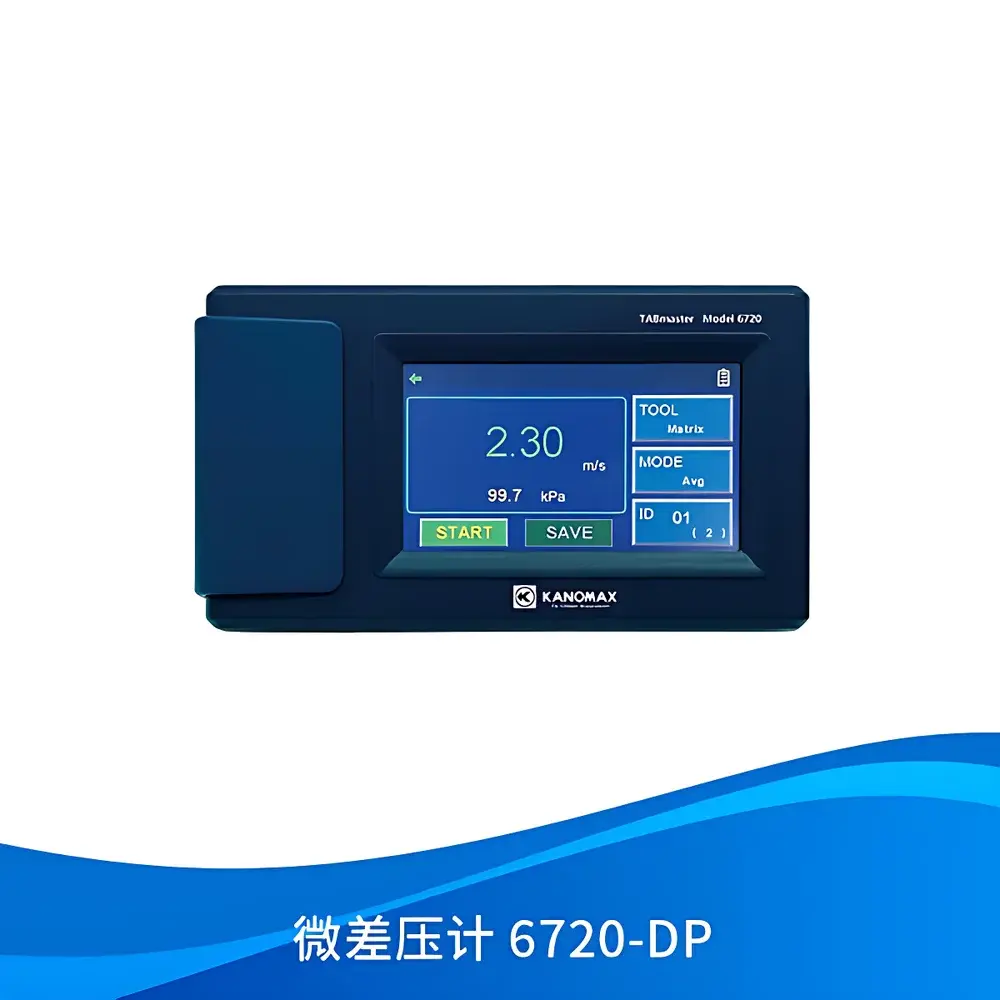
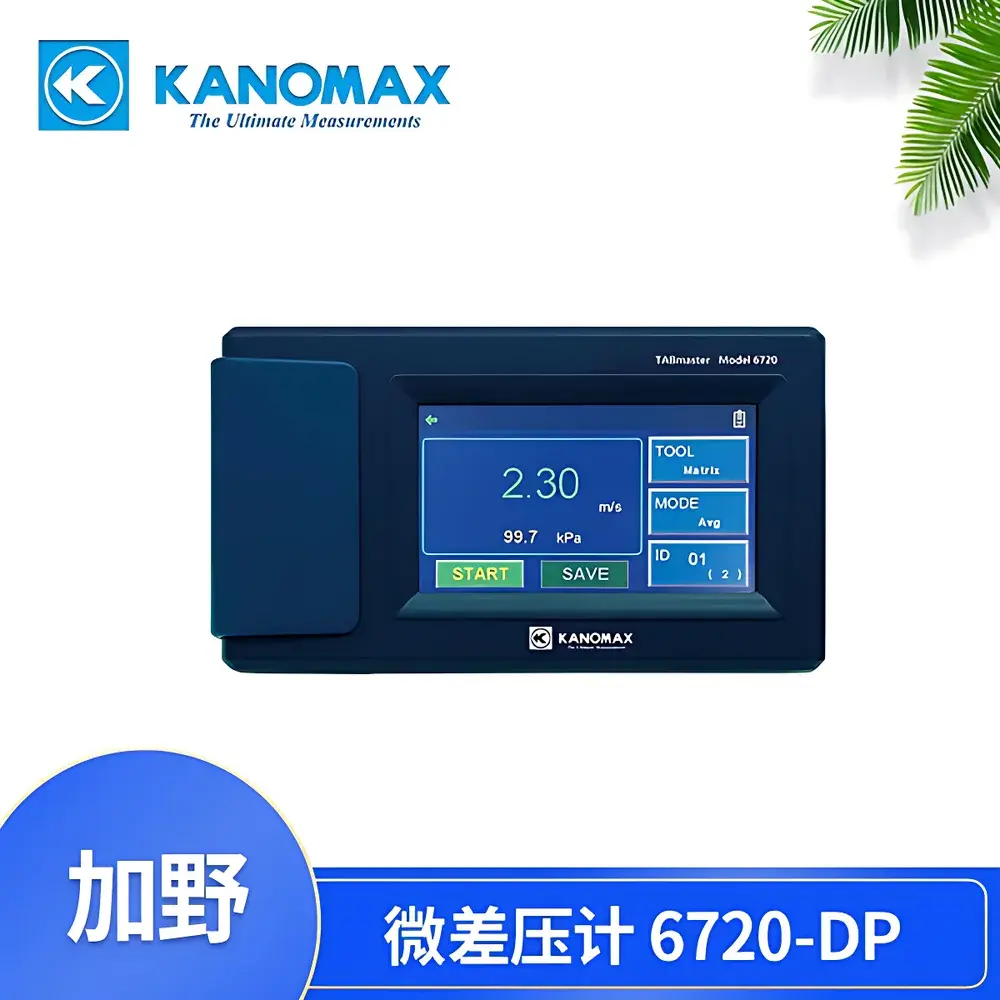
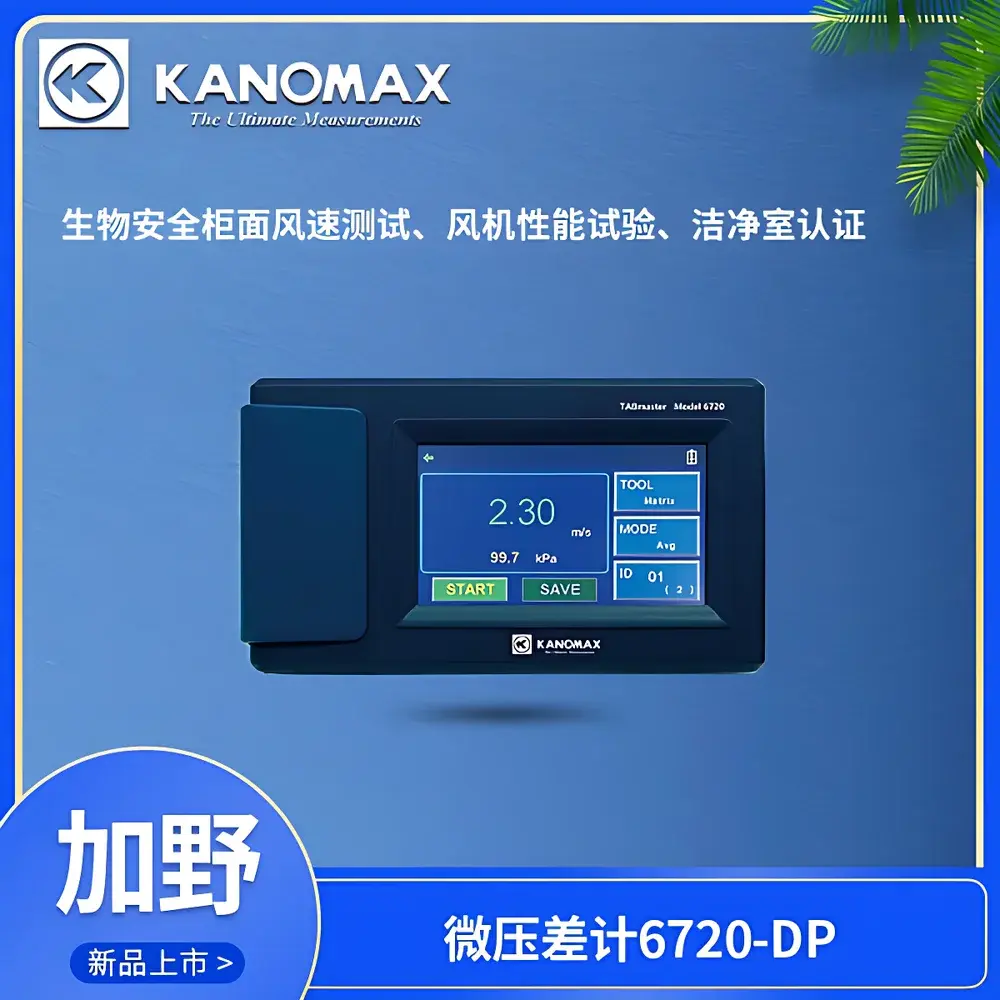
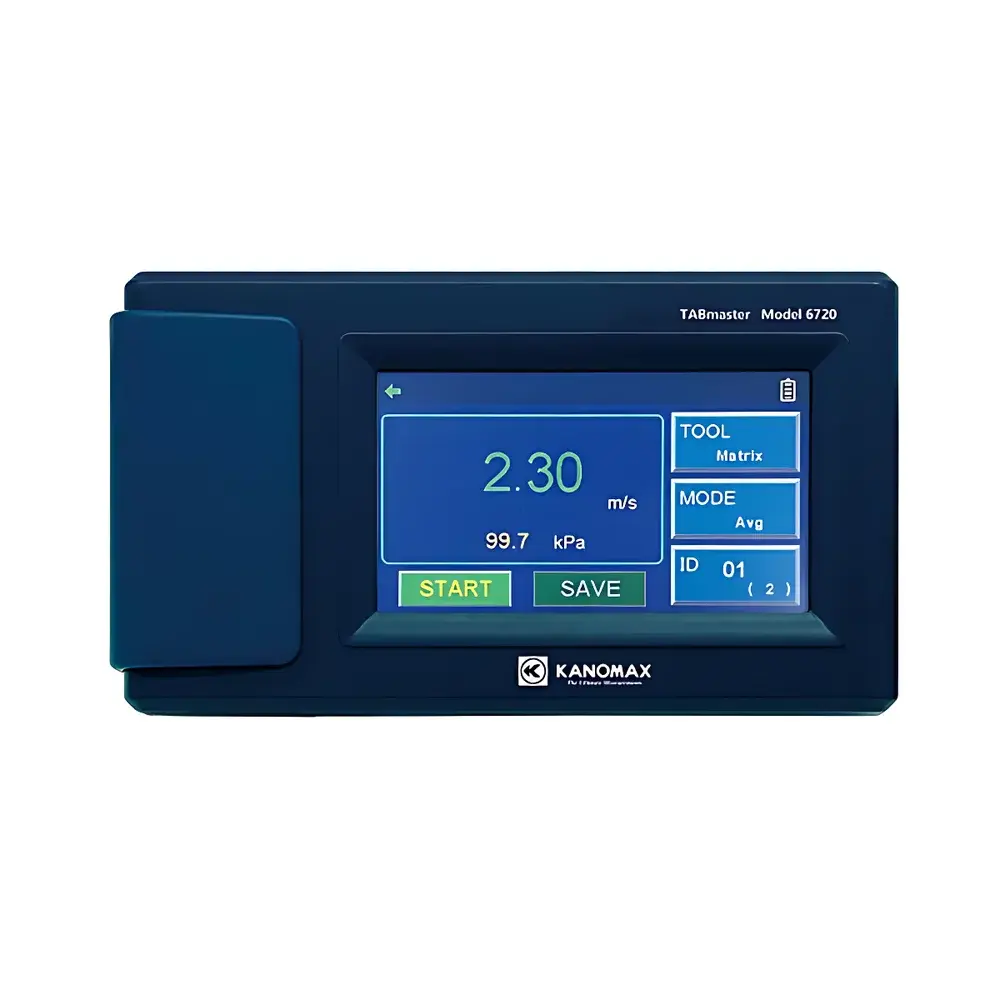
Kanomax 6720-DP Cleanroom Certification Differential Pressure & Air Velocity Meter
| Brand | Kanomax |
|---|---|
| Origin | Japan |
| Model | 6720-DP |
| Instrument Type | Pitot Tube Anemometer |
| Velocity Range | 0.15–40 m/s (Pitot Tube), 0.15–15 m/s (Velocity Matrix) |
| Velocity Resolution | 0.01 m/s |
| Velocity Accuracy | ±3% of reading ±0.05 m/s (>0.25 m/s) |
| Differential Pressure Range | −2500 to +2500 Pa |
| Differential Pressure Accuracy | ±1.5% of reading ±0.25 Pa |
| Differential Pressure Resolution | 0.001 Pa |
| Airflow Range | 40–4300 m³/h |
| Airflow Accuracy | ±3% of reading ±8 m³/h (>85 m³/h) |
| Airflow Resolution | 1 m³/h |
| Operating Temperature | 0–60 °C (non-condensing) |
| Operating Humidity | 0–100 %RH |
| Display | 4.3-inch full-color capacitive touchscreen |
| Data Storage | 8,000 records (device), 10,000 records (mobile app) |
| Battery Life | ~14 hours (4 × AA alkaline) |
| Weight | ~3.6 kg |
Overview
The Kanomax 6720-DP is a high-precision, multi-parameter environmental monitoring instrument engineered for cleanroom certification, HVAC system validation, and containment verification in regulated laboratory and manufacturing environments. It integrates three core measurement modalities—differential pressure, air velocity, and volumetric airflow—within a single handheld platform. Its operation relies on calibrated pitot tube static/dynamic pressure differential sensing for velocity determination (per ISO 14644-3 and ISO 14644-4), coupled with high-stability piezoresistive pressure transducers for differential pressure measurement across barriers such as HEPA filter banks, anterooms, and biological safety cabinet sashes. The device complies with fundamental metrological traceability requirements for cleanroom qualification per ISO 14644-1 and EU GMP Annex 1, supporting both static and dynamic pressure mapping protocols essential for ISO Class 5–8 facility commissioning and periodic requalification.
Key Features
- Simultaneous real-time acquisition of differential pressure (−2500 to +2500 Pa), air velocity (0.15–40 m/s via pitot tube; 0.15–15 m/s via optional velocity matrix probe), and calculated volumetric airflow (40–4300 m³/h)
- 4.3-inch full-color capacitive touchscreen interface with intuitive icon-driven navigation, optimized for gloved operation in controlled environments
- Integrated Bluetooth 4.2 module enabling wireless data streaming to iOS/Android mobile devices and secure pairing with Kanomax’s certified companion application
- Dual storage architecture: onboard non-volatile memory retains up to 8,000 measurement records with timestamp, location tag, and sensor configuration metadata; mobile app extends capacity to 10,000 records with export-ready CSV/Excel formatting
- Configurable K-factor compensation for pitot tube calibration correction, ensuring traceable alignment with NIST-traceable reference standards
- Low-power architecture with automatic sleep mode activation after 5 minutes of inactivity; powered by four standard AA alkaline cells delivering ≥14 hours of continuous operation under typical sampling duty cycles
Sample Compatibility & Compliance
The 6720-DP is designed for use with standardized accessories compliant with international cleanroom testing practice: stainless-steel pitot tubes (ISO 14644-3 Annex B), 16-point velocity matrix probes (for uniformity assessment per ISO 14644-3 Section 6.2), and flexible silicone tubing for remote pressure port connections. Its measurement uncertainty budget meets the performance criteria outlined in ISO/IEC 17025 for accredited laboratories performing cleanroom certification. The instrument supports audit-ready documentation workflows aligned with FDA 21 CFR Part 11 (when used with validated Kanomax software and electronic signature controls), EU GMP Annex 1 (Section 4.29–4.32), and ISO 14644-2 surveillance requirements. All firmware and calibration certificates are maintained under Kanomax’s ISO 9001-certified quality management system.
Software & Data Management
Kanomax’s official mobile application (iOS/Android) provides full instrument control, live graphing, and configurable report generation—including customizable headers, pass/fail thresholds, and annotated measurement maps. Data exports support GLP-compliant audit trails: each record includes operator ID, GPS-assisted location stamp (optional), ambient temperature/humidity (if external sensors connected), and full sensor calibration history. USB-C interface enables direct firmware updates and bulk data transfer to Windows-based validation workstations. Optional Bluetooth thermal printer integration allows on-site hardcopy generation meeting ISO 14644-3 reporting conventions (e.g., tabulated velocity profiles, differential pressure logs, and airflow balance summaries).
Applications
- Cleanroom classification and requalification per ISO 14644-1 and ISO 14644-3
- Biological safety cabinet (BSC) face velocity verification per NSF/ANSI 49 and EN 12469
- Laminar flow hood uniformity testing and velocity profile mapping
- HVAC duct static pressure balancing and supply/exhaust airflow verification
- Pharmaceutical isolator and RABS differential pressure monitoring during operational qualification (OQ)
- Medical device clean manufacturing environment compliance audits
FAQ
What calibration standards does the 6720-DP conform to?
The unit is factory-calibrated against NIST-traceable pressure and velocity standards; calibration certificates include uncertainty budgets per ISO/IEC 17025 and are valid for 12 months under normal operating conditions.
Can the 6720-DP be used for ISO Class 3 or Class 4 cleanrooms?
Yes—its 0.001 Pa resolution and ±0.25 Pa absolute accuracy meet the sensitivity requirements for ultra-low differential pressure monitoring in critical aseptic processing zones, provided appropriate probe selection and environmental stabilization protocols are followed.
Is the Bluetooth communication encrypted?
Data transmission uses AES-128 encryption in conjunction with authenticated device pairing; no raw sensor data is stored on cloud servers unless explicitly enabled by user-configured enterprise deployment policies.
Does the instrument support automated report generation for regulatory submissions?
Yes—the mobile app generates PDF reports compliant with FDA eCTD Module 5.3.2 and EU Annex 1 Appendix 10 templates, including embedded digital signatures, calibration traceability links, and deviation flagging logic.
How is traceability maintained when using optional accessories like extendable poles or custom tubing?
All accessory-specific correction factors (e.g., tubing length-induced delay, pole-induced turbulence) are programmable within the instrument’s K-factor matrix, ensuring measurement integrity remains within stated uncertainty bounds per ISO/IEC 17025 Clause 6.5.







