
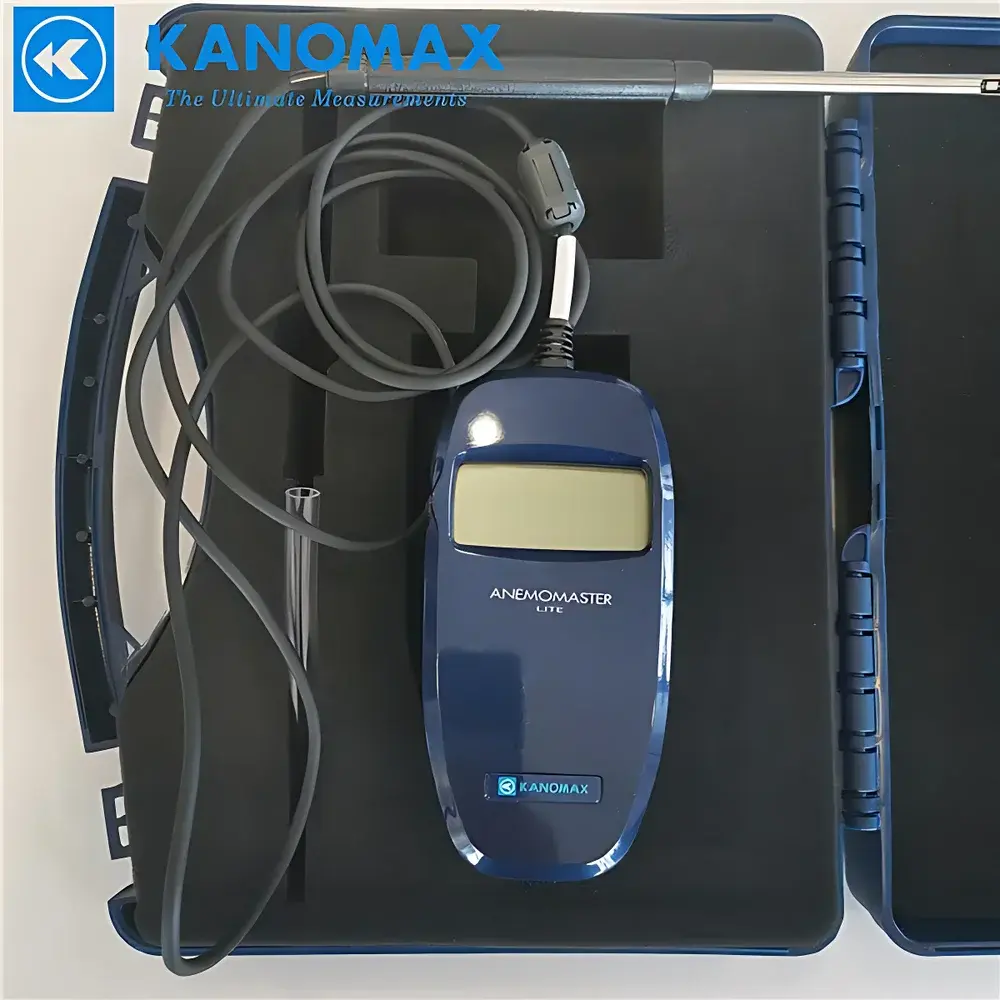
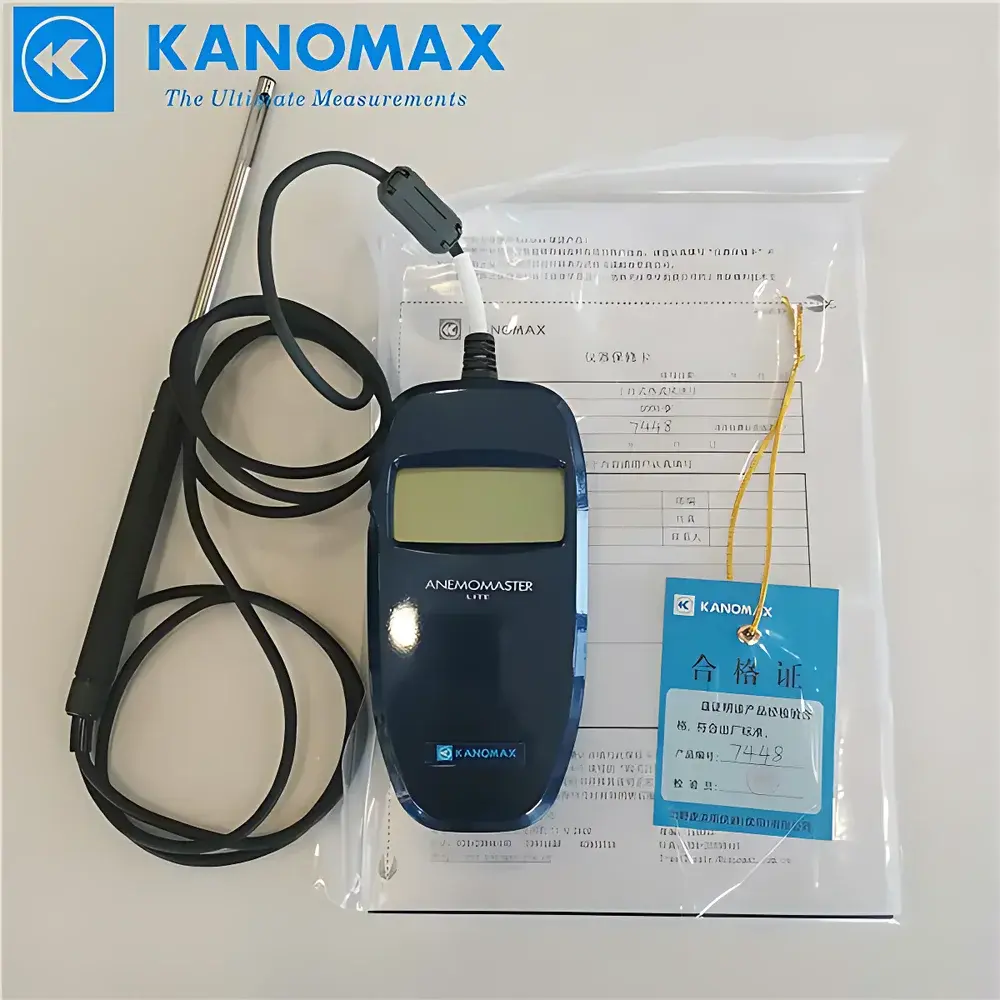
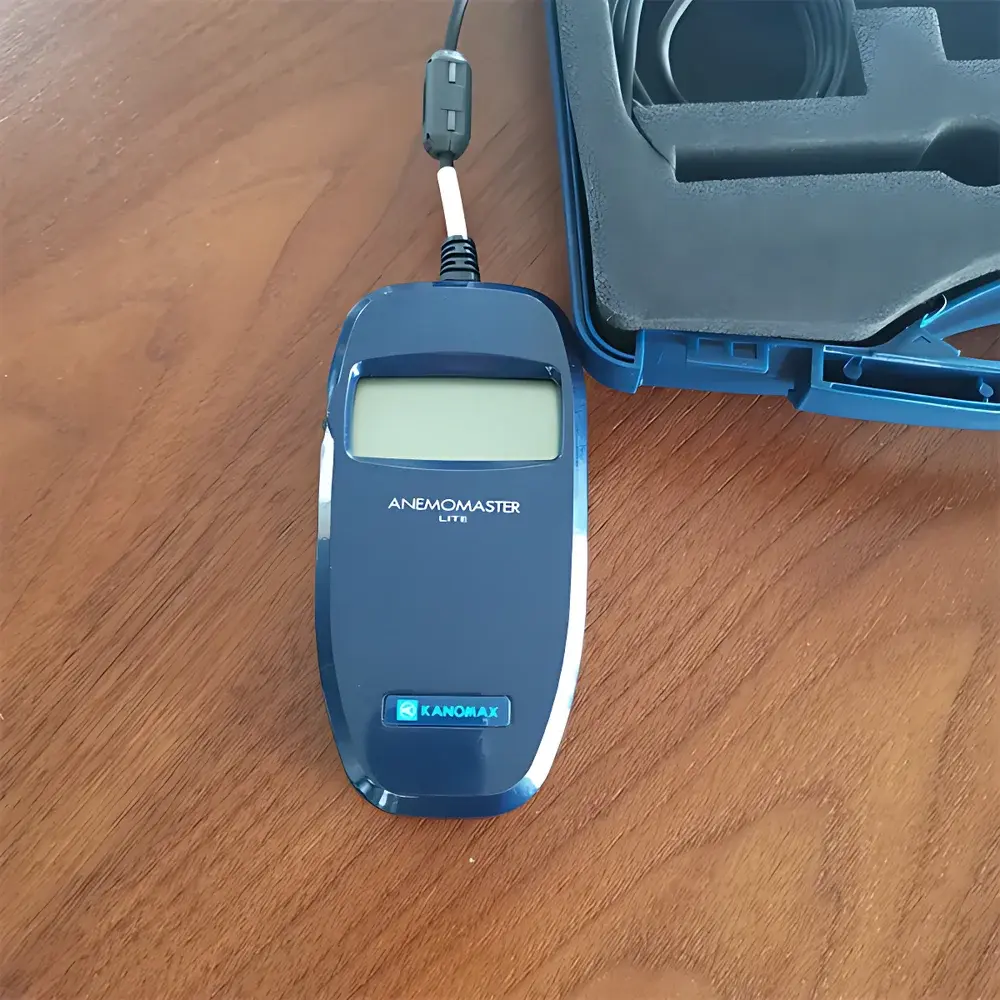
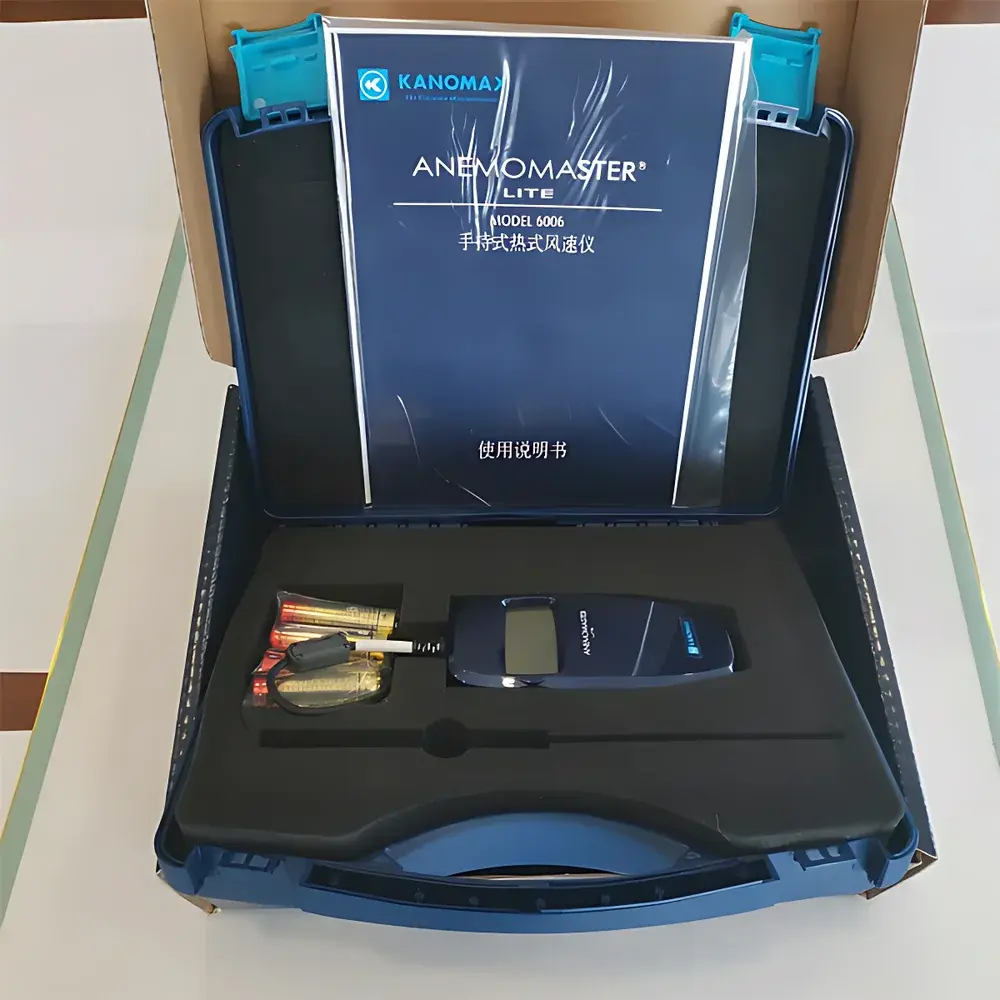
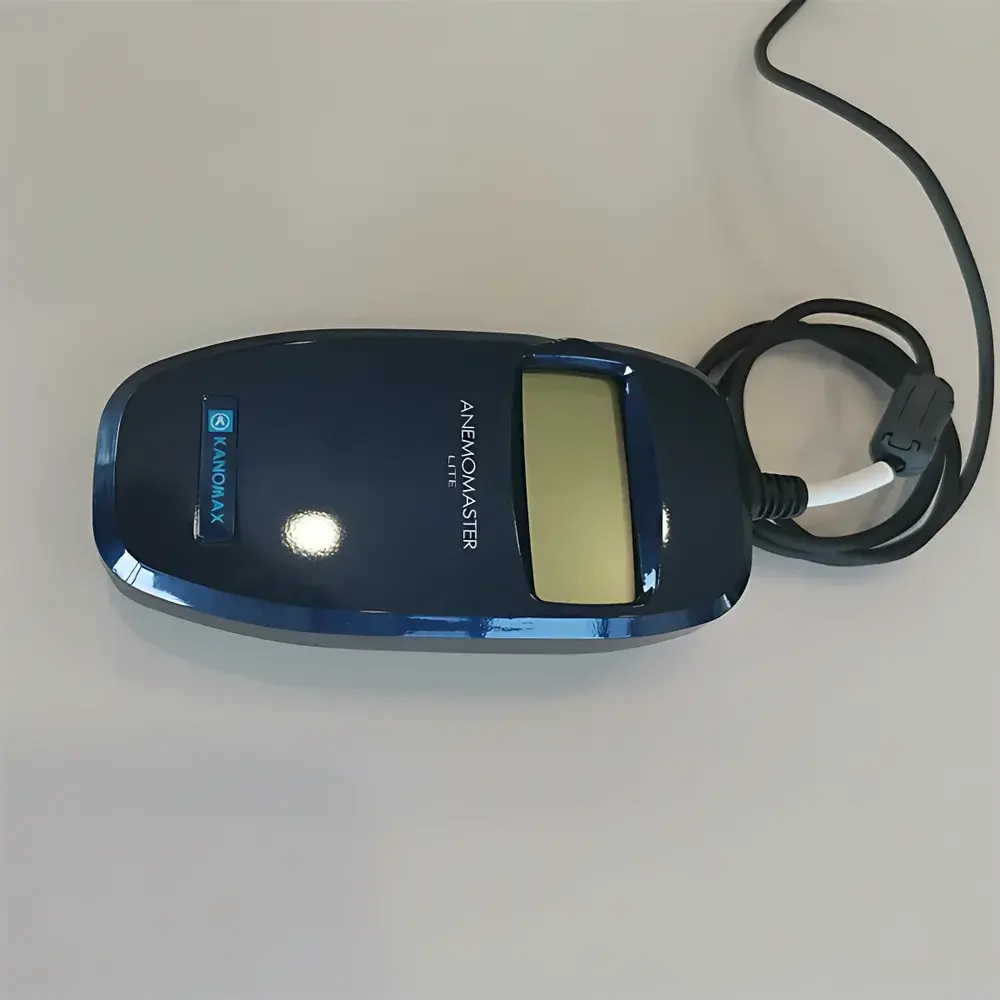
KANOMAX Model 6006 Digital Hot-Wire Anemometer
| Brand | KANOMAX |
|---|---|
| Origin | Japan |
| Model | 6006 |
| Instrument Type | Hot-Wire Anemometer |
| Measurement Range | 0.01–20.0 m/s |
| Resolution | 0.01 m/s (0–9.99 m/s), 0.1 m/s (10.0–20.0 m/s) |
| Accuracy | ±5% of reading (wind speed), ±1°C (temperature) |
| Operating Temperature | −20–70°C (probe), 5–40°C (main unit) |
| Operating Humidity | 20–85% RH |
| Response Time | <1 s (90% for wind speed at 1 m/s), <30 s (90% for temperature) |
| Display | Dual-parameter (wind speed + temperature), battery level (4-segment), averaging mode (FAST/SLOW), unit toggle (m/s/°C ↔ fpm/°F), hold function |
| Probe Dimensions | Ø6.1 mm (Ø10.6 mm with sheath) × 205 mm |
| cable | Ø3.3 mm × ~1.5 m |
| Main Unit Dimensions | 60 × 120 × 30 mm |
| Weight | ~180 g (including batteries) |
| Compliance | Designed for ISO/IEC 17025-aligned environmental monitoring workflows, compatible with GLP documentation practices |
Overview
The KANOMAX Model 6006 Digital Hot-Wire Anemometer is a precision-engineered handheld instrument designed for reliable, real-time measurement of air velocity and ambient temperature in industrial hygiene, HVAC commissioning, cleanroom validation, laboratory ventilation assessment, and indoor air quality (IAQ) studies. Based on constant-temperature anemometry (CTA), the device employs a thermally sensitive platinum wire sensor housed in a compact, interchangeable probe assembly. When exposed to airflow, convective heat loss from the heated wire alters its resistance—this change is precisely converted into a linear wind speed output via a closed-loop feedback circuit with integrated temperature compensation. The built-in temperature compensation circuit ensures stable calibration across the operational range of −20 to +70°C at the probe tip, maintaining metrological integrity without manual recalibration. Its robust architecture, low thermal mass probe, and rapid response (<1 s for 90% step response at 1 m/s) make it suitable for both steady-state and transient airflow characterization in ducts, fume hoods, laminar flow cabinets, and occupied spaces.
Key Features
- Single-button operation interface optimized for field use—minimal training required for technicians and facility engineers.
- Interchangeable hot-wire probes maintain traceable accuracy without requiring system-level recalibration; each probe is individually characterized and factory-matched to the main unit’s analog front-end.
- Dual-parameter display showing simultaneous wind speed and temperature readings with user-selectable units (m/s or fpm; °C or °F) via DIP switch configuration.
- Two averaging modes—FAST (1-second moving average) for dynamic environments and SLOW (5-second moving average) for stabilized measurements—enhancing data repeatability under variable conditions.
- Battery status indicator with four-segment LED provides early warning for scheduled replacement, supporting uninterrupted field deployment.
- Compact ergonomic design (60 × 120 × 30 mm, ~180 g including batteries) enables one-handed operation and extended use during walkthrough surveys.
- Probe construction features stainless-steel sheathing (Ø6.1 mm core / Ø10.6 mm outer diameter) and 1.5 m shielded cable, rated for continuous exposure within −20–70°C and 20–85% RH.
Sample Compatibility & Compliance
The Model 6006 is validated for use with ambient air under standard atmospheric pressure (86–106 kPa). It is not intended for corrosive, explosive, or particulate-laden gas streams without appropriate filtration or probe protection accessories (e.g., optional stainless-steel extension rods or dust-resistant probe caps). While not certified to ATEX or IECEx standards, its electrical design complies with IEC 61010-1:2010 for measurement category CAT II 300 V overvoltage protection. For regulated environments—including pharmaceutical cleanrooms (ISO 14644-1), hospital HVAC systems (ASHRAE 170), and occupational safety assessments (OSHA 1910.94, NIOSH Manual of Analytical Methods)—the instrument supports audit-ready documentation when used with calibrated reference standards and logged measurement protocols aligned with ISO/IEC 17025 clause 7.7 (uncertainty estimation) and GLP principles.
Software & Data Management
The Model 6006 operates as a standalone, self-contained measurement node with no embedded memory or Bluetooth/Wi-Fi connectivity. All data acquisition is manual—users record values directly from the LCD display or employ external logging tools (e.g., digital notebooks, spreadsheet templates, or third-party DAQ systems with analog voltage output adapters, if available). For traceability, KANOMAX provides NIST-traceable calibration certificates (optional purchase) that include uncertainty budgets per ISO/IEC 17025 Annex A.3. The instrument supports periodic verification using portable wind tunnels (e.g., TSI 8000 series) or rotating vane reference anemometers per ASTM D5464–22 Annex A1. Internal firmware does not store historical readings, ensuring compliance with data integrity expectations in GxP-regulated settings where uncontrolled electronic records are prohibited.
Applications
- HVAC system balancing and commissioning—measuring supply/return grilles, diffuser discharge velocities, and duct traverse points.
- Cleanroom airflow uniformity mapping per ISO 14644-3 Annex B and EU GMP Annex 1 §4.32.
- Industrial hygiene assessments—evaluating local exhaust ventilation (LEV) capture velocity at hood faces per HSE HSG258 guidelines.
- Laboratory safety validation—verifying face velocity of chemical fume hoods (ANSI/AIHA Z9.5–2022).
- Indoor environmental quality (IEQ) audits—correlating air movement patterns with thermal comfort metrics (ASHRAE 55–2023).
- Educational laboratories—teaching fundamental fluid mechanics concepts including boundary layer development and convective heat transfer coefficients.
FAQ
Is the Model 6006 suitable for outdoor use in rain or high humidity?
No. Although rated for up to 85% RH, the probe and main unit are not IP-rated for water ingress. Prolonged exposure to condensation or direct precipitation may compromise sensor stability and electronics reliability.
Can the instrument measure gases other than air?
It is calibrated exclusively for dry air at standard temperature and pressure. Use with other gases (e.g., CO₂, nitrogen, or compressed air) introduces unquantified errors due to differing thermal conductivity and specific heat capacity.
Does the 6006 support data export or PC connectivity?
No. It is a dedicated analog-display instrument without serial, USB, or wireless interfaces. Data must be manually transcribed or captured via external imaging/loggers.
What is the recommended calibration interval?
Annual calibration is advised for routine QA/QC applications. In high-use or critical environments (e.g., ISO Class 5 cleanrooms), semiannual verification against a traceable reference standard is recommended per ISO/IEC 17025 clause 7.8.3.
How does the temperature compensation circuit function?
An auxiliary thermistor adjacent to the hot-wire element continuously monitors probe head temperature. The microcontroller dynamically adjusts the bridge excitation voltage to maintain constant wire temperature—effectively decoupling velocity measurement from ambient thermal drift across −20–70°C.







