
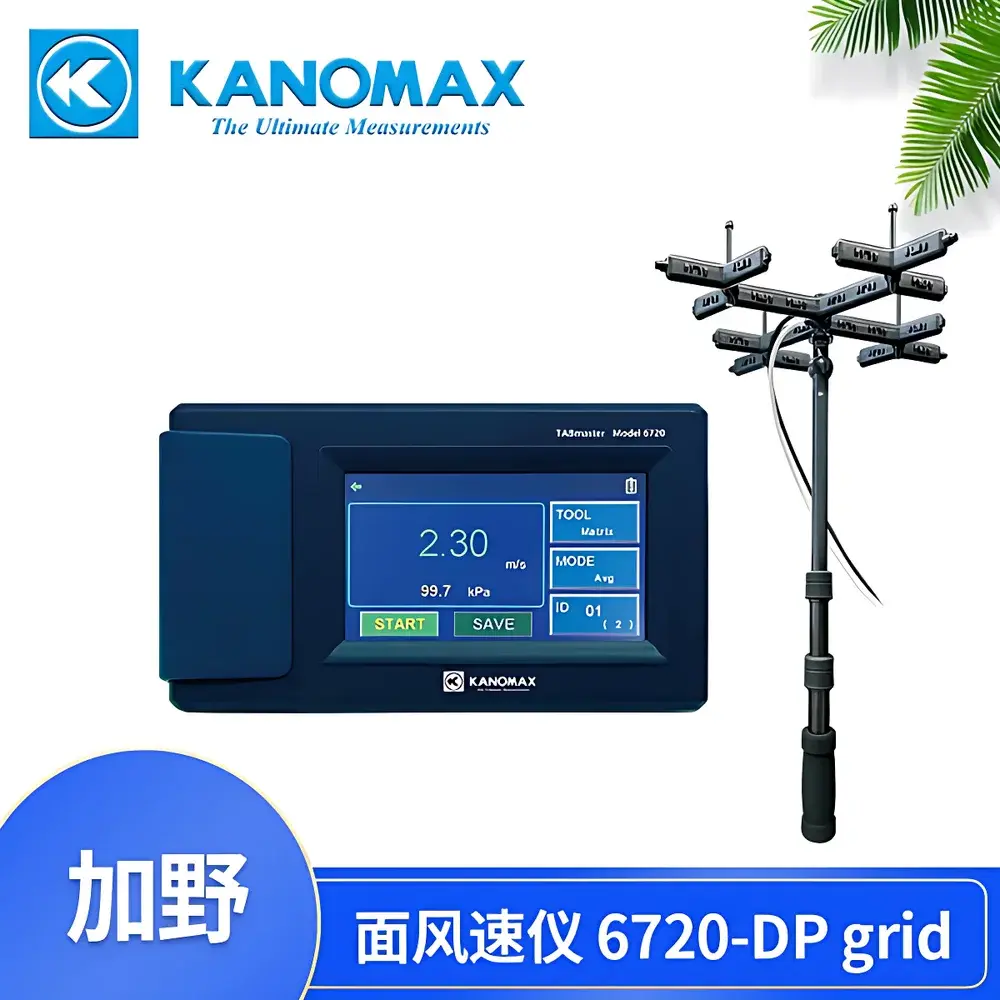
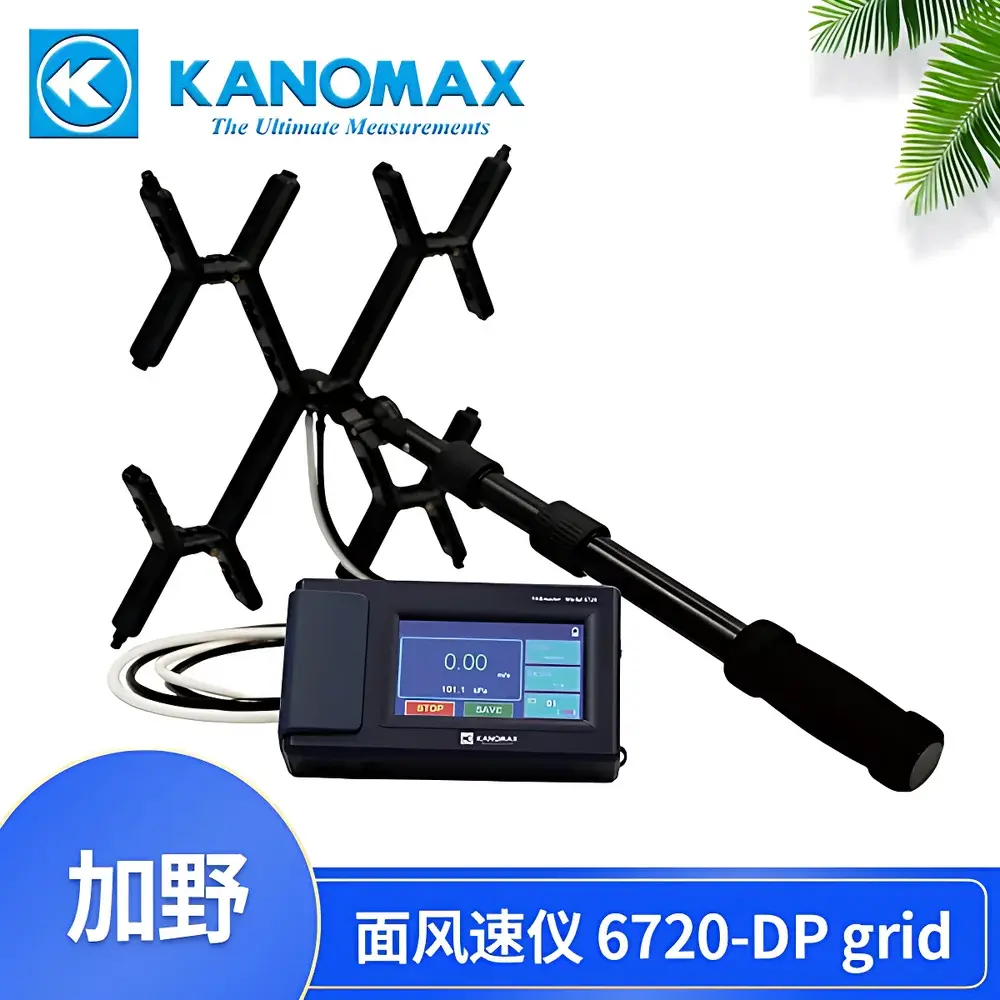
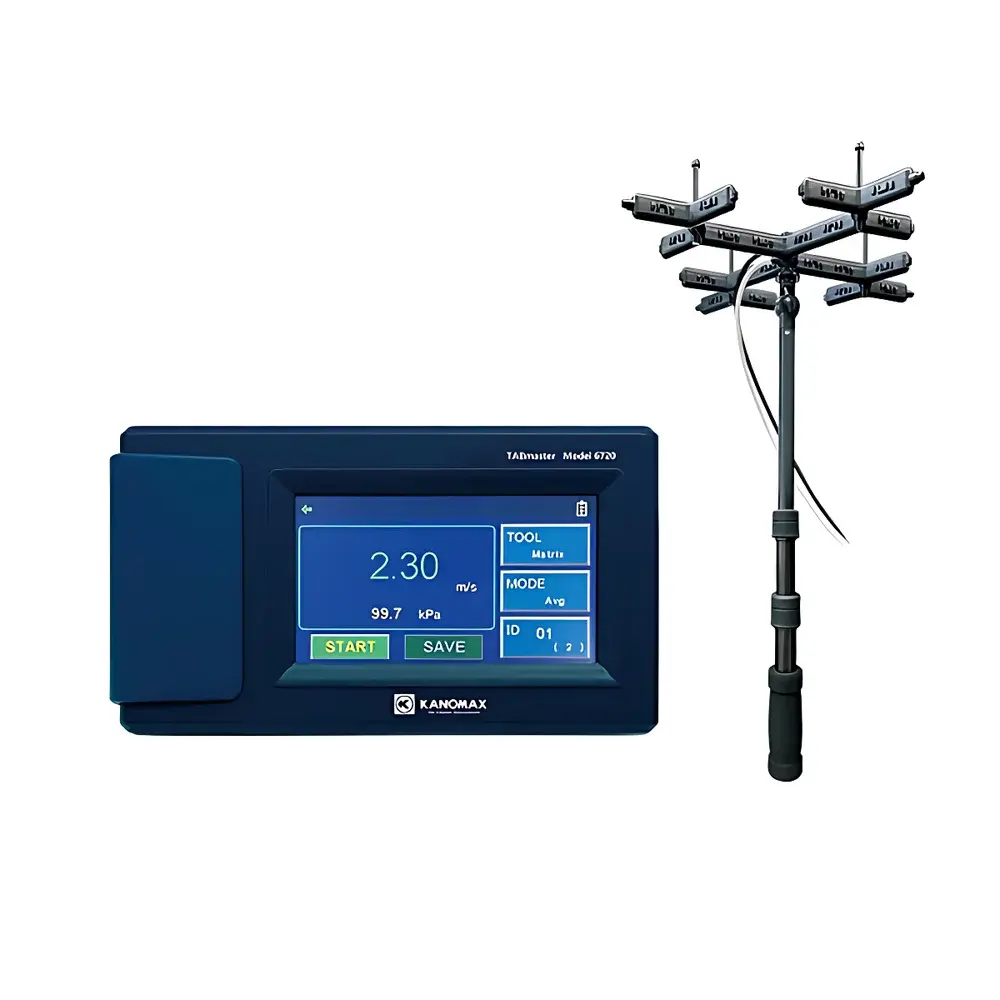
Kanomax 6720-DP Grid Pitot Tube Anemometer with Multi-Point Air Velocity Matrix
| Brand | Kanomax |
|---|---|
| Origin | Japan |
| Model | 6720-DP Grid |
| Instrument Type | Pitot Tube Anemometer |
| Velocity Range | 0.15–40 m/s (Pitot Tube), 0.15–15 m/s (Grid Probe) |
| Differential Pressure Range | −2500 to +2500 Pa |
| Velocity Resolution | 0.01 m/s |
| DP Resolution | 0.001 Pa |
| Velocity Accuracy | ±3% of reading ±0.05 m/s (>0.25 m/s) |
| DP Accuracy | ±1.5% of reading ±0.25 Pa |
| Airflow Range | 40–4300 m³/h |
| Airflow Accuracy | ±3% of reading ±8 m³/h (>85 m³/h) |
| Airflow Resolution | 1 m³/h |
| Operating Temperature | 0–60 °C (non-condensing) |
| Operating Humidity | 0–100 %RH |
| Display | 4.3-inch full-color touchscreen |
| Data Storage | 8,000 records (instrument), 10,000 records (mobile app) |
| Battery Life | ~14 h (4 × AA alkaline) |
| Weight | ~3.6 kg |
| Connectivity | Bluetooth 4.2, USB 2.0 |
Overview
The Kanomax 6720-DP Grid is a high-precision, multi-sensor environmental monitoring instrument engineered for comprehensive airflow characterization in HVAC commissioning, cleanroom validation, duct traverse surveys, and industrial ventilation assessments. Unlike single-point anemometers, this system integrates a calibrated pitot tube with a 16-point velocity grid probe (6720-DP Grid configuration), enabling simultaneous spatial averaging of air velocity across duct cross-sections per ISO 16813 and ASHRAE Guideline 12. The device operates on the fundamental principle of differential pressure measurement: dynamic pressure (ΔP) derived from pitot-static pressure difference is converted to velocity using Bernoulli’s equation, with real-time K-factor compensation applied for probe-specific calibration curves. Its dual-mode capability—switching between discrete pitot point measurement and automated grid-based volumetric flow calculation—ensures traceable, repeatable data acquisition compliant with ISO 5167-3 (nozzle and pitot tube standards) and EN 12599 (ventilation system testing).
Key Features
- Integrated 4.3-inch full-color capacitive touchscreen interface with intuitive icon-driven navigation and real-time graphical display of velocity profiles, DP trends, and airflow histograms
- Dual-sensor architecture: interchangeable use of precision stainless-steel pitot tube (for high-velocity ducts ≥0.25 m/s) and 4×4 velocity matrix probe (optimized for low-velocity laminar zones down to 0.15 m/s)
- Onboard K-factor adjustment function supporting user-defined calibration coefficients per probe geometry and fluid properties—critical for non-standard duct configurations or elevated temperature applications
- Bluetooth 4.2 wireless protocol enabling secure, low-latency pairing with iOS/Android mobile devices running Kanomax’s official field application (validated for FDA 21 CFR Part 11 audit trail readiness)
- Embedded data logging with 8,000 internal memory slots; synchronized cloud-ready export via USB 2.0 or Bluetooth to PC-based Kanomax Data Manager software (supports CSV, PDF report generation, and GLP-compliant metadata tagging)
- Intelligent power management: automatic sleep mode activation after 5 minutes of inactivity; battery status indicator and low-power warning thresholds aligned with IEC 60086-2 specifications for AA alkaline cells
Sample Compatibility & Compliance
The 6720-DP Grid is validated for use in non-corrosive, particle-free air streams within Class A–D cleanrooms (ISO 14644-1), hospital HVAC systems (ASHRAE 170), and pharmaceutical facility exhaust stacks (EU GMP Annex 1). It meets electromagnetic compatibility requirements per EN 61326-1:2013 and carries CE marking under the EU Measuring Instruments Directive (MID) Annex MI-004 for airflow meters. All factory calibrations are NIST-traceable and documented per ISO/IEC 17025:2017; optional UKAS-accredited calibration certificates are available. The instrument’s operating humidity range (0–100 %RH, non-condensing) permits deployment in humidified laboratories and tropical climate validation studies without drift-induced error.
Software & Data Management
Kanomax Data Manager v3.2 (Windows 10/11 compatible) provides full control over instrument configuration, batch report generation, and statistical analysis—including mean velocity, standard deviation, turbulence intensity (%), and ISO 14644-3 recommended uniformity indices. Raw DP and velocity time-series data are stored with embedded timestamps, operator ID fields, and location tags. Audit trails record all parameter changes, file exports, and calibration events in immutable format. Mobile app synchronization supports offline data capture in shielded environments (e.g., MRI suites), with encrypted Bluetooth reconnection upon network restoration. Export formats comply with laboratory information management system (LIMS) ingestion protocols, including ASTM E1461-22 structured metadata headers.
Applications
- HVAC system balancing and TAB (Testing, Adjusting, Balancing) per NEBB Procedural Standards
- Cleanroom airflow visualization and ISO 14644-3 classification (uniformity mapping, directional airflow verification)
- Exhaust hood face velocity validation (ANSI/AIHA Z9.5), fume cupboard containment testing
- Duct traverse surveys requiring multi-point velocity integration (ASTM D5482, ISO 12101-2)
- Pharmaceutical isolator and RABS airflow qualification under EU GMP Annex 1, Section 4.37
- Academic research on thermal plume dynamics and displacement ventilation efficiency
FAQ
What standards does the 6720-DP Grid support for duct traverse measurements?
It complies with ISO 12101-2, ASTM D5482, and ASHRAE Guideline 12 for multi-point velocity sampling, including required minimum probe count, grid spacing, and dwell time per station.
Can the K-factor be modified for custom probes or non-air media?
Yes—the instrument allows manual K-factor entry (range: 0.50–2.00) and stores up to 10 user-defined probe profiles with unique serial identifiers and calibration dates.
Is the Bluetooth connection secure for regulated environments?
Bluetooth pairing uses AES-128 encryption; all transmitted data packets include CRC-32 checksums and are timestamped to prevent replay attacks—fully compatible with FDA 21 CFR Part 11 electronic signature requirements.
How is measurement uncertainty calculated for volumetric flow?
Total uncertainty combines Type A (statistical repeatability) and Type B (calibration certificate, K-factor tolerance, DP sensor accuracy) components per GUM (JCGM 100:2008), yielding expanded uncertainty (k=2) of ≤±4.2% for typical duct conditions.
Does the device support external power during extended field deployments?
Yes—optional DC 5 V input enables continuous operation via USB-C power bank or AC adapter (sold separately), bypassing battery drain while maintaining full functionality including Bluetooth and touchscreen responsiveness.
Related Products







