
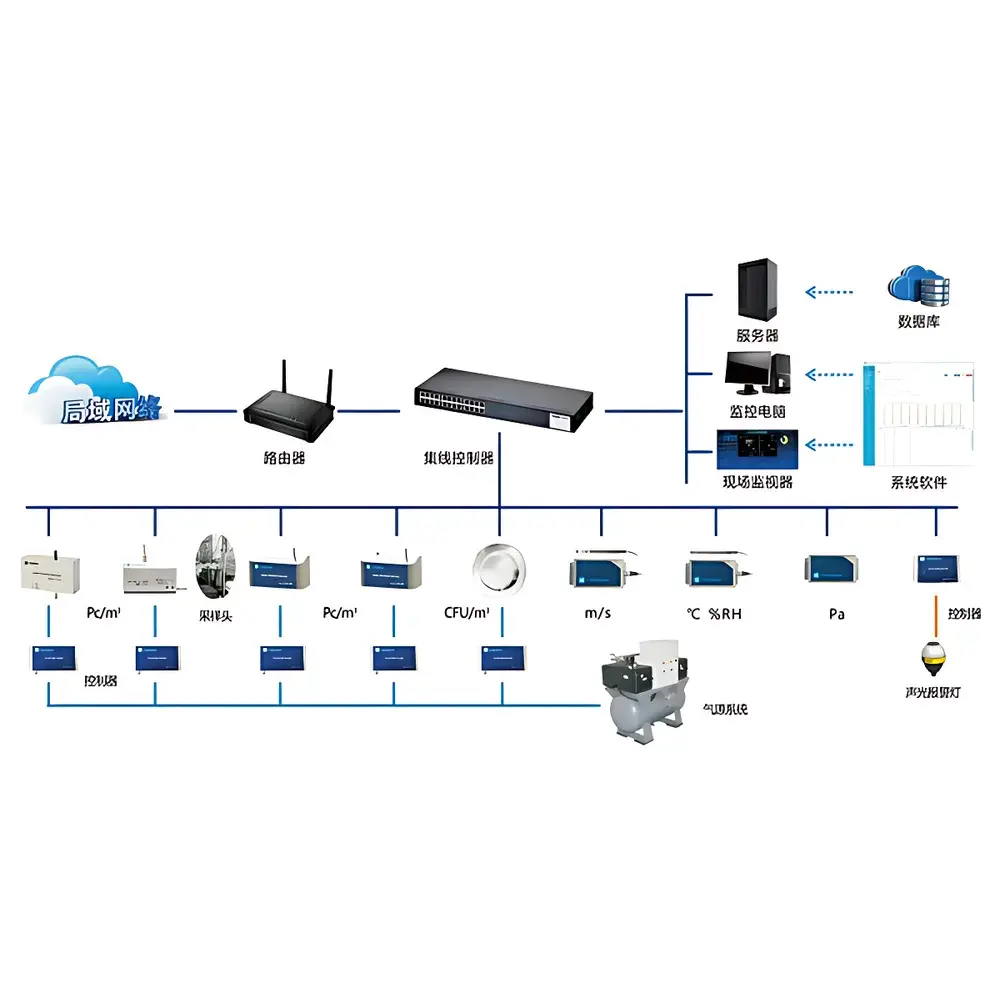
Kanomax CRMS Cleanroom Real-Time Dynamic Monitoring System
| Brand | Kanomax |
|---|---|
| Origin | Liaoning, China |
| Manufacturer Type | Authorized Distributor |
| Regional Category | Domestic (China) |
| Model | CRMS |
| Price Range | USD 14,000 – 28,000 |
| Instrument Type | Online Continuous Monitoring System |
| Flow Rate | High-Flow (1 CFM / 28.3 L/min and 0.1 CFM / 2.83 L/min options) |
| Flow Accuracy | < ±1 count per 5 min |
| Timing Accuracy | ±1 s within 6-min sampling |
| Repeatability | ≤ ±10% FS |
| Particle Size Distribution Error | ≤ ±30% |
| Indication Error | < ±30% FS |
Overview
The Kanomax CRMS (Cleanroom Real-Time Dynamic Monitoring System) is an integrated, multi-point online environmental monitoring platform engineered for continuous, GMP-compliant surveillance of critical controlled environments—including ISO Class 5 (A/B) cleanrooms, aseptic processing isolators, and RABS. Built upon the principles of real-time particle counting (via laser diode-based optical detection), viable airborne microorganism sampling (impaction-based), and simultaneous physical parameter acquisition (air velocity, differential pressure, temperature, relative humidity, noise, and illuminance), the CRMS delivers synchronized, time-stamped data streams from distributed sensors to a centralized server. Its architecture adheres to the fundamental requirements of Annex 1 (EU-GMP), FDA Guidance for Industry on Sterile Drug Products, and ISO 14644–2:2015 for continuous monitoring validation. The system operates under a deterministic sampling strategy—employing isokinetic probes, redundant dry-running vacuum pumps, and Modbus RTU/TCP protocol integration—to ensure representative, auditable, and statistically robust environmental data throughout pharmaceutical manufacturing, biotech fill-finish, and medical device assembly processes.
Key Features
- Modular sensor architecture supporting concurrent monitoring of non-viable particles (0.3–10.0 µm), viable airborne microorganisms (via ISO 14698-1 compliant impaction samplers), and environmental parameters (temperature, RH, air velocity, differential pressure, noise, illuminance)
- Dual-flow particle counters: 0.1 CFM (2.83 L/min) and 1.0 CFM (28.3 L/min) models compliant with ISO 21501-4 and JIS B 9921; long-life laser diode light source with >100,000-hour MTBF
- Redundant dry-running rotary vane vacuum system (dual-pump configuration, auto/manual failover) ensuring uninterrupted sampling continuity during maintenance or pump failure
- Isokinetic sampling probes fabricated from electropolished SUS316 stainless steel; internal PTFE-coated sampling tubing meeting GB 50591-2010 installation requirements
- Real-time volumetric verification: integrated flow controllers and KL31-series sampling controllers guarantee precise 1 m³ cumulative sampling volume per test cycle for microbial enumeration
- Comprehensive alarm hierarchy: configurable alert levels (alert, action, excursion), root-cause tagging, audible/visual notification, and programmable equipment interlock (e.g., halt filling line upon particle excursion)
- Full audit trail capability: timestamped records of user logins, parameter changes, alarm events, data exports, electronic signatures, and system runtime—fully compliant with FDA 21 CFR Part 11 and EU Annex 11 requirements
Sample Compatibility & Compliance
The CRMS supports validated sampling across all ISO 14644-defined cleanroom classes and risk-based operational zones—including A-grade laminar airflow workstations, B-grade background environments, and critical process interfaces (e.g., vial filling lines, lyophilizer loading hatches, sterilizing filter housings). Particle sensors meet ISO 21501-4 calibration traceability standards; viable air samplers satisfy ISO 14698-1 Annex B performance criteria for collection efficiency (>98% at ≥12 m/s impact velocity) and flow stability (±6% at 50 L/min). Environmental sensors are calibrated per ISO/IEC 17025-accredited procedures and reference to NIST-traceable standards. System-level validation includes IQ/OQ/PQ protocols, FAT/SAT documentation, and formal risk assessment aligned with ICH Q9 principles. The CRMS architecture fulfills regulatory expectations outlined in EU-GMP Annex 1 (2022), USP , WHO TRS 961, and China’s GMP 2010 Annex 1.
Software & Data Management
The CRMS software suite provides role-based access control (administrator, QA, operator, IT), configurable alarm thresholds, and automated statistical process control (SPC) reporting—including UCL (Upper Control Limit) calculation per ISO 14644–2. Data visualization includes real-time dashboards, trend charts (time-series, histogram, scatter), and customizable reports (daily/weekly/monthly/annual), exportable in PDF or Excel formats. All raw sensor data—including timestamps, flow rates, counts, and environmental readings—are stored in a relational SQL database with automatic daily backup, version-controlled archiving, and immutable record retention. Electronic signature workflows support 21 CFR Part 11-compliant approval of reports, deviations, and calibration certificates. Audit logs capture every system event with user ID, timestamp, action type, and pre-/post-value—enabling full forensic reconstruction during regulatory inspection or CAPA investigation.
Applications
The CRMS is deployed in regulated life science facilities for continuous environmental qualification of: sterile drug manufacturing suites (aseptic filling, lyophilization, terminal sterilization); biologics and cell/gene therapy cleanrooms; medical device packaging lines; semiconductor fab ambient monitoring; and high-containment research laboratories. Specific use cases include dynamic monitoring of Grade A isolators during batch release testing; real-time particulate trending during HVAC commissioning; microbial load mapping during media fill simulations; and environmental correlation studies linking particle excursions with pressure differentials or personnel movement patterns. Its modular design allows scalable deployment—from single-point validation to enterprise-wide networks spanning multiple buildings and production lines—with seamless integration into MES, SCADA, and LIMS platforms via OPC UA or RESTful API extensions.
FAQ
Does the CRMS support 21 CFR Part 11 compliance?
Yes—the system implements electronic signatures, audit trails, role-based permissions, and data integrity controls required for Part 11 compliance, including secure login, immutable record storage, and signature justification workflows.
Can particle counters be calibrated in situ without removal?
Yes—integrated flow verification and external calibration port compatibility enable field verification using NIST-traceable aerosol generators and reference instruments per JJF 1190–2019 and ISO 21501-4.
What is the maximum number of monitoring points supported?
The CRMS supports up to 256 distributed sensors per server node; additional nodes can be clustered for enterprise-scale deployments exceeding 1,000 measurement channels.
Are the sensors resistant to vaporized hydrogen peroxide (VHP) decontamination cycles?
Yes—particle counters and sampling heads are constructed from VHP-resistant materials (SUS316, PTFE-coated tubing) and validated for repeated exposure to standard VHP sterilization protocols without performance degradation.
How is data integrity ensured during network interruption or power loss?
Each sensor features local data buffering (up to 2,000 records), and the central server maintains redundant RAID-1 storage with UPS-backed operation—ensuring zero data loss during transient outages.
Related Products







