
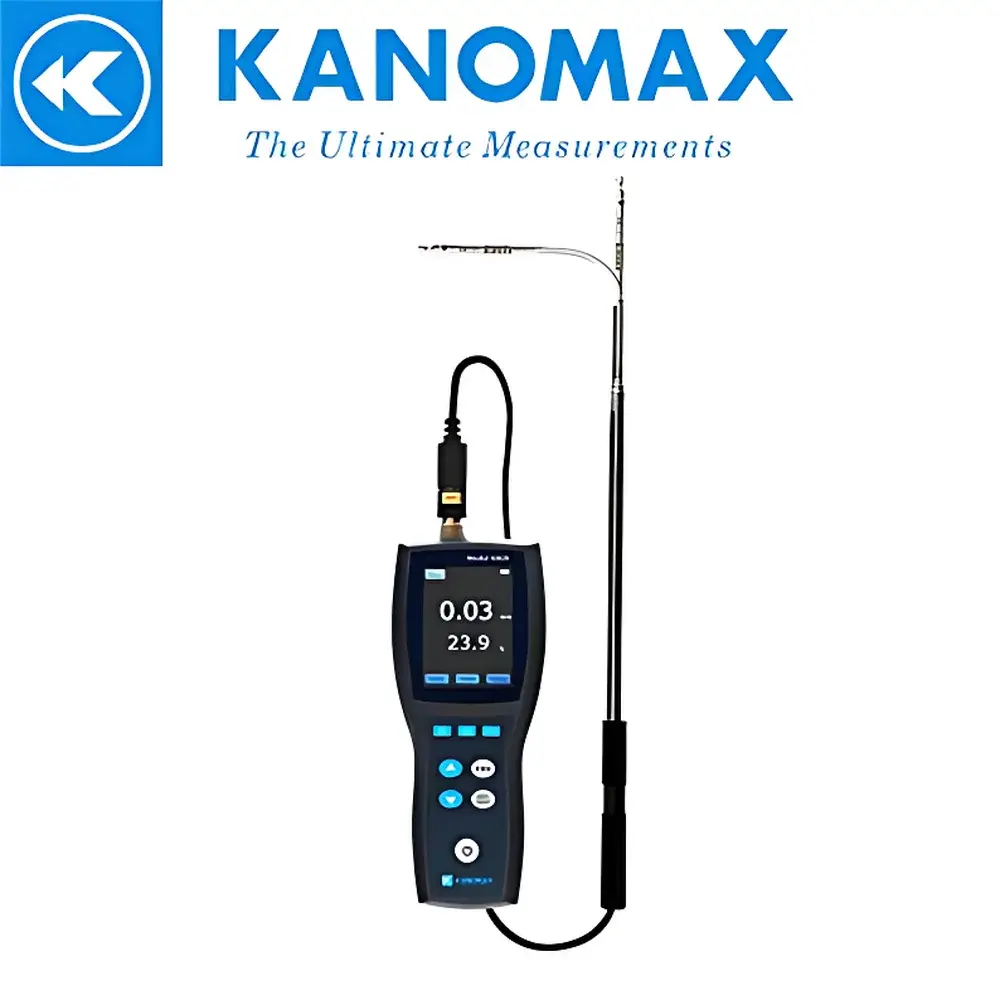
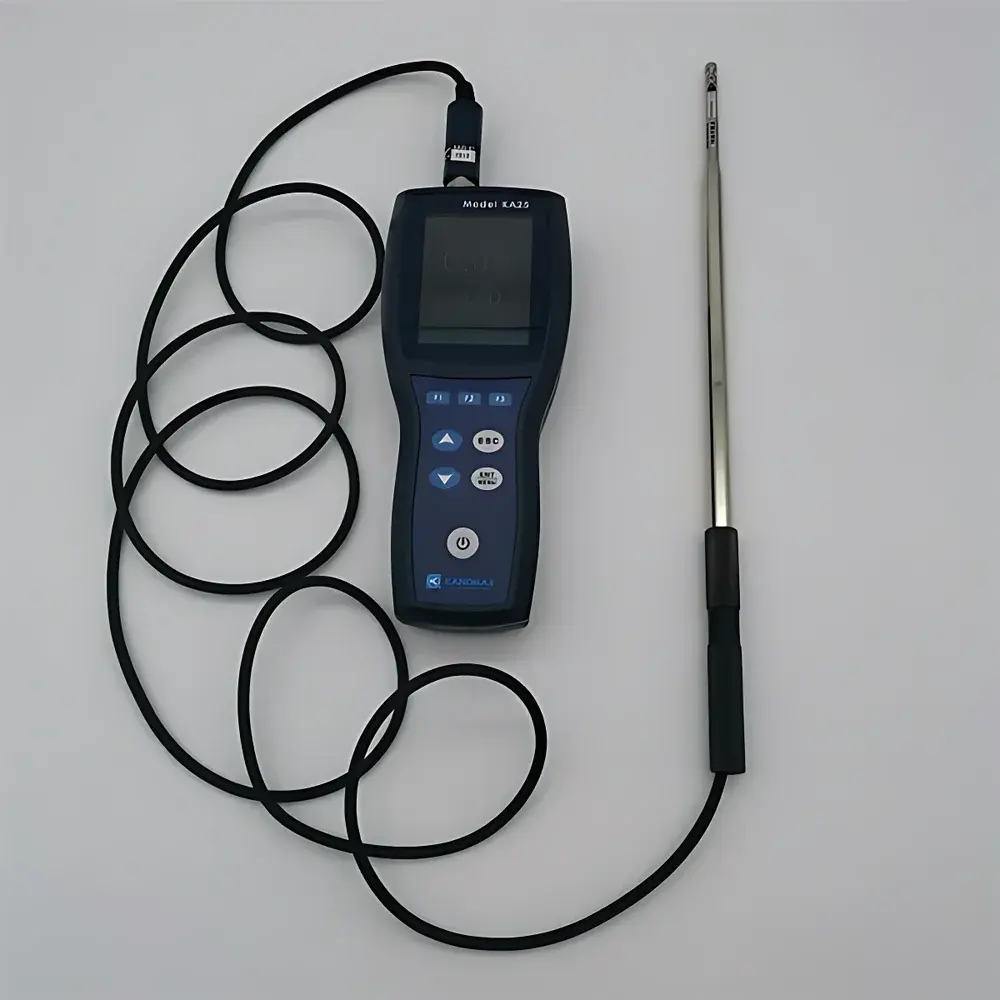
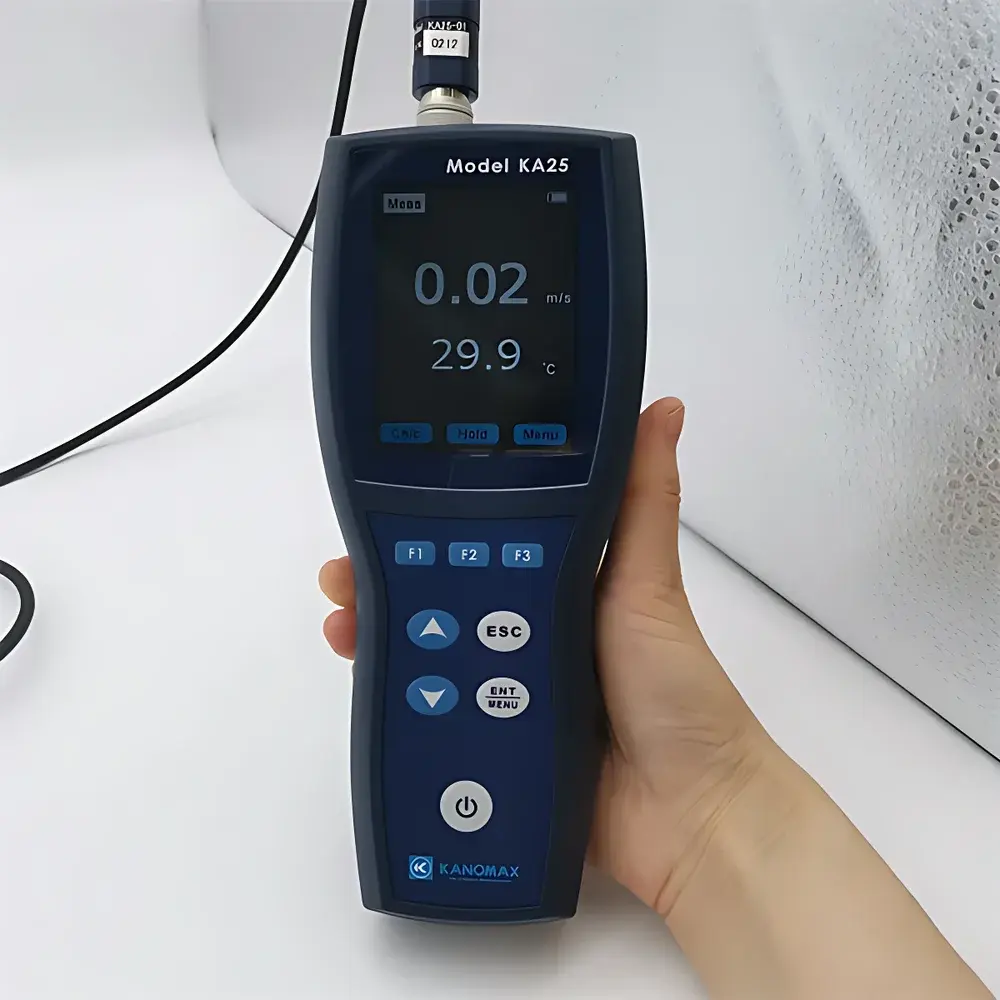
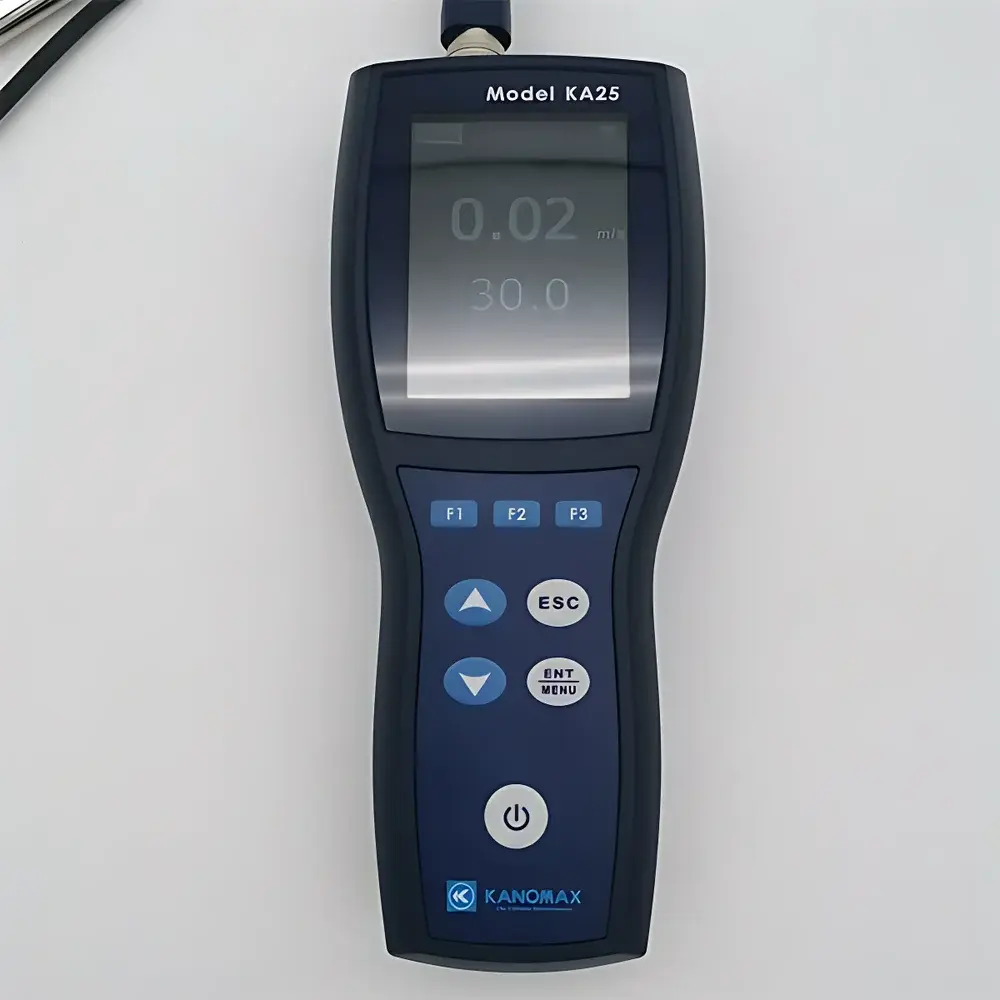
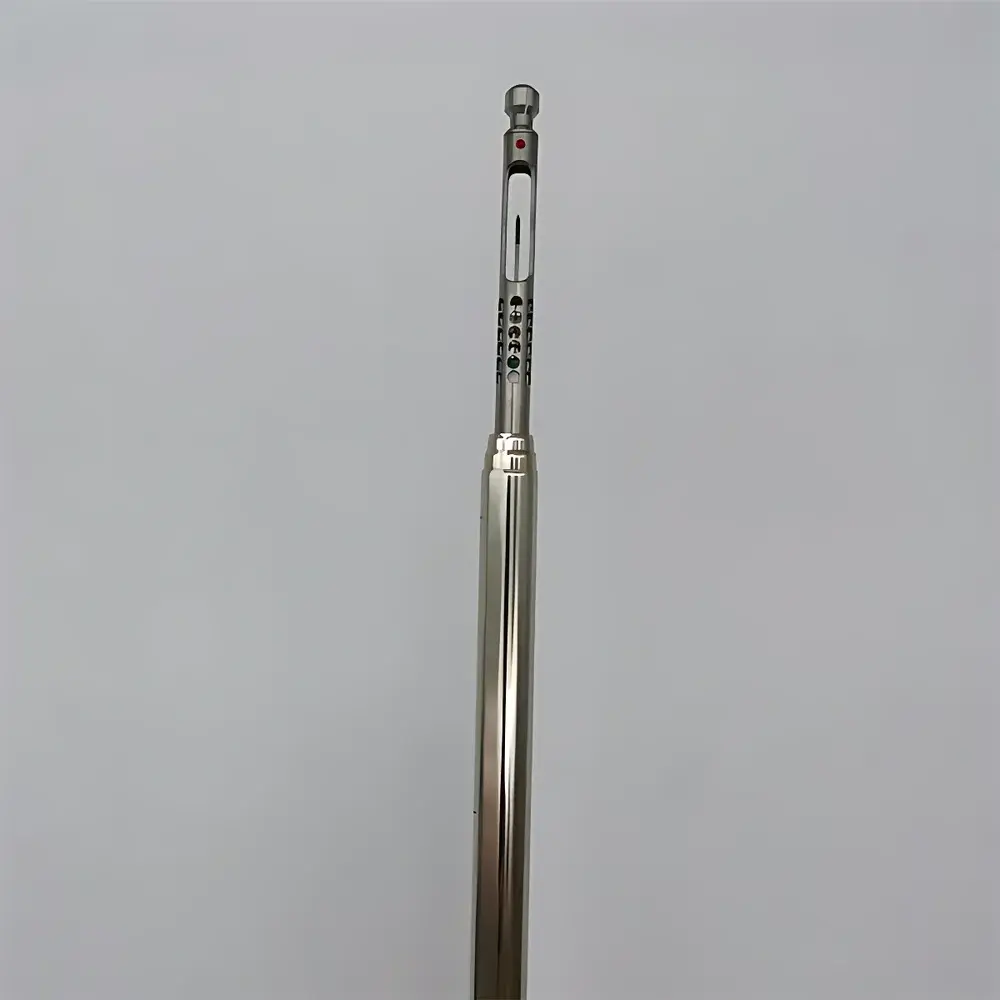
Kanomax KA25 Hot-Wire Anemometer and Air Flow Meter
| Brand | Kanomax |
|---|---|
| Origin | Japan |
| Instrument Type | Hot-Wire Anemometer |
| Velocity Range | 0.01–20.0 m/s |
| Velocity Resolution | 0.01 m/s |
| Velocity Accuracy | ±(3% of reading + 0.03 m/s) |
| Temperature Range | −20 to +70 °C |
| Temperature Accuracy | ±0.5 °C (at v > 0.5 m/s) |
| Temperature Resolution | 0.1 °C |
| Response Time (Velocity) | ~1 s (90% response at 1 m/s) |
| Response Time (Temperature) | ~30 s (90% response at 1 m/s) |
| Air Flow Calculation | Enabled for rectangular & circular ducts (cross-sectional dimensions input required) |
| Power | 4 × AA alkaline batteries (~15 h operation at 1 m/s, 20 °C) |
| Body Dimensions | 200 × 85 × 40 mm |
| Probe Dimensions | Ø6 mm (sensor tip) / Ø14 mm (handle), 294–1060 mm extendable & bendable |
| Cable Length | 2000 mm |
| Operating Environment (Body) | 5–40 °C |
| Storage Temperature | −20 to +60 °C |
| Weight | ~220 g (without batteries) |
| Standard Accessories | Main unit, telescoping/bendable probe, protective carrying case, quick-start manual, batteries |
Overview
The Kanomax KA25 is a portable, handheld hot-wire anemometer engineered for precise, real-time measurement of air velocity and ambient temperature in HVAC commissioning, indoor air quality (IAQ) assessment, cleanroom validation, and industrial ventilation system audits. Based on constant-temperature anemometry (CTA), the KA25 employs a fine platinum-coated tungsten wire sensor maintained at a stable temperature above ambient. As airflow convectively cools the heated element, the instrument dynamically adjusts electrical current to sustain thermal equilibrium—this current change is linearly correlated to mass flow velocity. Unlike cup or vane anemometers, the KA25 delivers high-fidelity response across low-velocity regimes (down to 0.01 m/s), making it suitable for laminar flow characterization, fume hood face velocity verification, and supply/exhaust diffuser balancing where sensitivity and transient fidelity are critical.
Key Features
- High-resolution velocity measurement with 0.01 m/s resolution and traceable accuracy of ±(3% of reading + 0.03 m/s) across the full 0.01–20.0 m/s range
- Integrated Pt1000-class temperature sensor with ±0.5 °C accuracy (valid at v > 0.5 m/s) and 0.1 °C resolution
- Real-time volumetric air flow calculation: user inputs duct geometry (rectangular or circular) and dimensions (0.1–255.0 cm); device computes m³/h automatically
- Telescoping and articulating probe (Ø6 mm sensing tip, Ø14 mm handle) with 294–1060 mm adjustable length and mechanical flexibility for access into confined or irregular ductwork
- Configurable time constant (1 s, 5 s, 10 s, 20 s) to optimize dynamic response versus noise suppression per application requirement
- On-device statistical functions: simultaneous display of minimum, maximum, and average values over user-defined sampling intervals
- Three-level adjustable backlight LCD with intuitive icon-driven interface; data hold, auto power-off (selectable 3/5/10 min), and battery level indicator
- Robust mechanical design: IP54-rated probe housing, lightweight body (220 g without batteries), and shock-absorbing protective carry case included
Sample Compatibility & Compliance
The KA25 is validated for use with clean, dry, non-corrosive air—consistent with ISO 16813:2006 (HVAC design principles) and ASHRAE Guideline 12-2020 (for infection control in HVAC systems). It is not intended for particulate-laden, humidified, or chemically aggressive gas streams. While the instrument itself does not carry formal regulatory certification (e.g., CE, UKCA, or FDA 510(k)), its metrological performance aligns with ASTM D1078-21 (Standard Test Method for Air Velocity Measurement) and supports GLP-compliant field documentation when paired with standardized operating procedures. The probe’s thermal mass and response characteristics meet the criteria for “Class II” anemometers per ISO 7726:1998 (Ergonomics of the thermal environment — Instruments for measuring physical quantities).
Software & Data Management
The KA25 operates as a standalone field instrument with no proprietary PC software or USB connectivity. All measurements—including instantaneous velocity, temperature, calculated air volume, and statistical aggregates—are displayed and retained on-screen during active use. Data persistence is limited to on-device hold mode; no internal memory or export capability is provided. This architecture prioritizes operational simplicity, rapid deployment, and immunity to software compatibility issues—ideal for technicians performing routine duct traverses, filter bank leak checks, or HVAC balancing under time-constrained site conditions. For audit-ready reporting, users are advised to manually record timestamped readings alongside duct geometry inputs and traverse locations in accordance with ISO 17025-compliant field notebooks or validated digital logbooks.
Applications
- HVAC system commissioning and TAB (Testing, Adjusting, Balancing) per NEBB Procedural Standards
- Cleanroom ISO Class verification (air change rate, uniformity, and velocity profiling)
- Fume hood and biosafety cabinet face velocity compliance testing (per ANSI/ASHRAE 110, EN 14175)
- Industrial exhaust stack and local exhaust ventilation (LEV) system performance audits
- Indoor environmental quality (IEQ) surveys including thermal comfort assessments (PMV/PPD estimation support)
- Educational laboratory instruction in fluid mechanics and building science curricula
FAQ
Is the KA25 suitable for measuring airflow in wet or dusty environments?
No. The hot-wire sensor is sensitive to contamination and condensation. Use only in clean, dry air streams. Regular probe cleaning with isopropyl alcohol and lint-free swabs is recommended after exposure to marginal environments.
Can the KA25 be calibrated traceably to national standards?
Yes. Kanomax-certified calibration services are available through authorized service centers, providing NIST-traceable certificates per ISO/IEC 17025. Field verification against a reference anemometer (e.g., rotating vane standard) is advised before critical measurements.
What is the effective measurement distance from the probe tip to duct wall during traverse?
Per ISO 12599:2021, maintain ≥50 mm clearance from duct surfaces to minimize boundary layer interference. The KA25’s slender Ø6 mm probe facilitates adherence to this requirement even in small-diameter ducts.
Does the KA25 comply with FDA 21 CFR Part 11 requirements?
No. As a non-networked, non-auditable field meter without electronic record generation or user authentication, it does not meet Part 11 criteria. It may be used in GxP environments only as a secondary verification tool with manual data transcription and contemporaneous signature.
How often should the probe be recalibrated?
Annual recalibration is recommended for routine QA/QC use. More frequent calibration (e.g., quarterly) is advised in high-use or regulated settings where measurement uncertainty budgets must remain below ±5%.







