
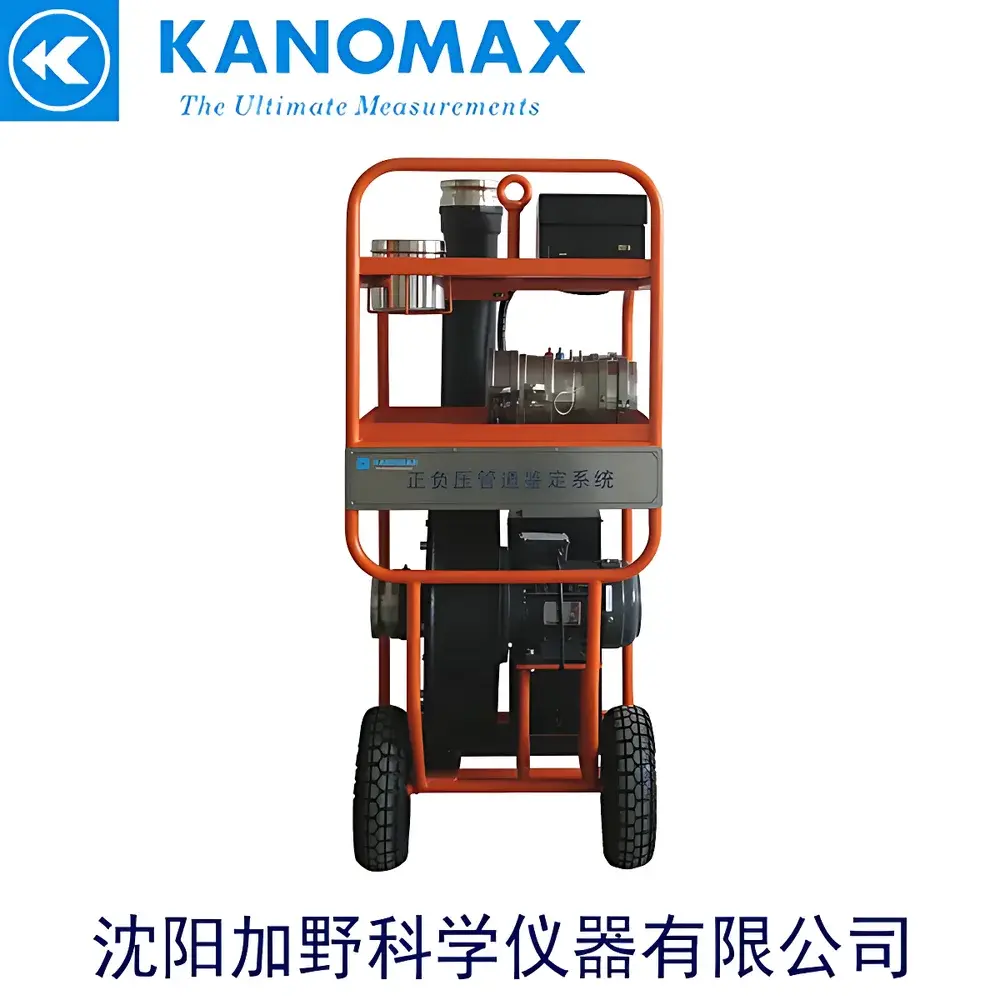
Kanomax DALT6900 Duct Air Leakage Tester
| Brand | Kanomax |
|---|---|
| Origin | Liaoning, China |
| Manufacturer Type | Authorized Distributor |
| Country of Origin | China |
| Model | DALT6900 |
| Flow Range | 36–640 m³/h (nozzle range: 4–36 m³/h) |
| Accuracy | ±2.5% of reading ±0.1 m³/h |
| Resolution | 0.01 m³/h |
| Static Pressure Range | ±2500 Pa |
| Pressure Accuracy | ±1% of reading ±1 Pa |
| Pressure Resolution | 0.1 Pa |
| Temperature Range | 0–60 °C |
| Temp Accuracy | ±0.5 °C |
| Temp Resolution | 0.1 °C |
| Atmospheric Pressure Range | 70–130 kPa |
| Atmos. Acc. | ±2% of reading |
| Atmos. Res. | 0.1 kPa |
| Power Supply | DALT6900-0E: 100–120 V, 1φ, 50/60 Hz, 16 A |
| DALT6900-1E | 220–240 V, 1φ, 50/60 Hz, 10 A |
| Net Weight | ~72 kg |
| Dimensions | 540 × 500 × 1200 mm |
| Data Storage | 1000 test records |
| Display | 4.7-inch color LCD touchscreen |
| Compliance Standards | EN 1507:2006, EN 12237:2002, Eurovent 2/2, DW/143, SMACNA HVAC Air Duct Leakage Testing Standard, GB 50243–2002 |
Overview
The Kanomax DALT6900 Duct Air Leakage Tester is a precision-engineered instrument designed for quantitative measurement of air leakage in HVAC ductwork systems under controlled positive and negative static pressure conditions. Based on the principle of calibrated orifice plate flow measurement—where volumetric airflow is determined by differential pressure across standardized nozzles—the DALT6900 enables compliance verification with internationally recognized duct airtightness standards. It operates as a pressurization/depressurization system that isolates duct sections using temporary sealing and measures the airflow required to maintain a target test pressure, thereby calculating the total leakage rate. This method aligns with the fundamental requirements of building energy codes and commissioning protocols, supporting LEED certification, ASHRAE Guideline 12, and national energy conservation mandates. The instrument is widely deployed in pre-commissioning validation, post-installation QA/QC audits, and third-party inspection workflows across commercial, institutional, and industrial HVAC projects.
Key Features
- Simultaneous positive and negative pressure testing capability, configurable via intuitive touchscreen interface
- Dual-range airflow measurement architecture: high-flow main channel (36–640 m³/h) and low-flow nozzle bank (4–36 m³/h) for enhanced resolution at critical low-leakage thresholds
- Real-time synchronized display of leakage volume (m³/h), static pressure (Pa), ambient temperature (°C), and barometric pressure (kPa)
- Integrated 4.7-inch full-color LCD touchscreen with responsive UI, eliminating external PCs or auxiliary controllers
- Onboard non-volatile memory storing up to 1000 complete test records—including timestamp, pressure setpoint, measured leakage, environmental parameters, and pass/fail status
- Rugged mechanical design optimized for field deployment: compact footprint (540 × 500 × 1200 mm), reinforced chassis, and shock-absorbing transport casters
- Configurable power input options (100–120 V or 220–240 V, single-phase, 50/60 Hz) for global site compatibility
Sample Compatibility & Compliance
The DALT6900 is validated for use on rigid and semi-rigid duct constructions—including galvanized steel, aluminum, fiberglass-reinforced plastic (FRP), and flexible ducts—across rectangular, round, and oval cross-sections. It supports both sectional testing (e.g., individual duct runs, plenums, or air handling units) and whole-system integrity verification. Its measurement methodology satisfies the procedural and performance criteria defined in EN 1507:2006 (flexible ducts), EN 12237:2002 (rigid circular ducts), Eurovent 2/2 (European classification), DW/143 (UK ductwork specification), SMACNA HVAC Air Systems – Duct Construction Standards (2012 edition), and China’s GB 50243–2002 Code for Acceptance of Ventilation and Air Conditioning Engineering. While not inherently FDA- or ISO 17025-accredited, its traceable calibration path and documented uncertainty budget support integration into GLP/GMP-aligned commissioning reports when operated per written SOPs.
Software & Data Management
All test data are stored internally with embedded metadata: date/time stamp, operator ID (manually entered), duct system identifier, test pressure level, ambient conditions, and final pass/fail determination based on user-defined acceptance criteria. Records can be reviewed, exported (via USB flash drive), or deleted directly from the device interface. No proprietary software installation is required; exported files conform to CSV format for seamless import into Excel, LabVIEW, or enterprise CMMS platforms. Audit trail functionality includes automatic logging of all parameter changes and test initiations—supporting basic 21 CFR Part 11 readiness when paired with organizational access controls and electronic signature procedures.
Applications
- Pre-handover airtightness verification of supply, return, and exhaust duct networks in commercial buildings
- Commissioning agent validation of HVAC system efficiency prior to TAB (Testing, Adjusting, and Balancing)
- Periodic maintenance auditing of aging duct infrastructure in hospitals, laboratories, and cleanrooms
- Compliance testing for green building rating systems (e.g., LEED EA Prerequisite 1, BREEAM HEA 3)
- Forensic investigation of unexplained energy overconsumption or thermal comfort complaints
- Training and demonstration tool for HVAC apprenticeship programs and technical colleges
FAQ
What pressure ranges does the DALT6900 support during leakage testing?
The instrument maintains stable static pressure control between –2500 Pa and +2500 Pa, with accuracy of ±1% of reading ±1 Pa.
Can the DALT6900 be used for both round and rectangular ducts?
Yes—its pressurization methodology is geometry-agnostic; sealing is achieved via custom inflatable bladders or mechanical gasket kits compatible with standard duct dimensions.
Is calibration traceable to national standards?
Kanomax provides factory calibration certificates traceable to JCSS (Japan Calibration Service System); users may perform field verification using NIST-traceable manometers and rotameters.
Does the device meet requirements for third-party inspection agencies?
It is routinely specified by provincial construction quality supervision stations and building science institutes in China and meets the minimum technical requirements outlined in GB/T 50378 and ISO 9001-based inspection workflows.
How is data security handled for regulated environments?
While the unit lacks built-in encryption or role-based login, its CSV export format allows integration with validated document management systems that enforce 21 CFR Part 11 or ISO 27001 controls at the enterprise level.
Related Products







