
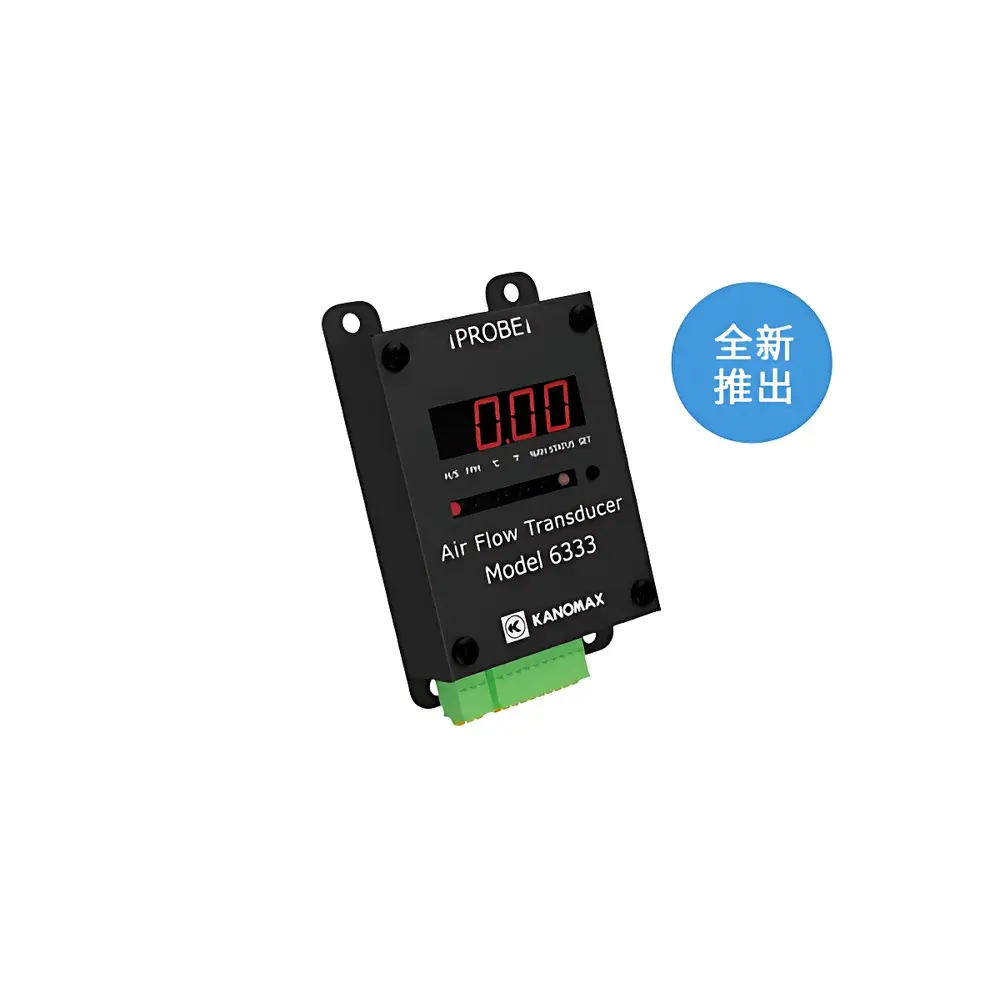
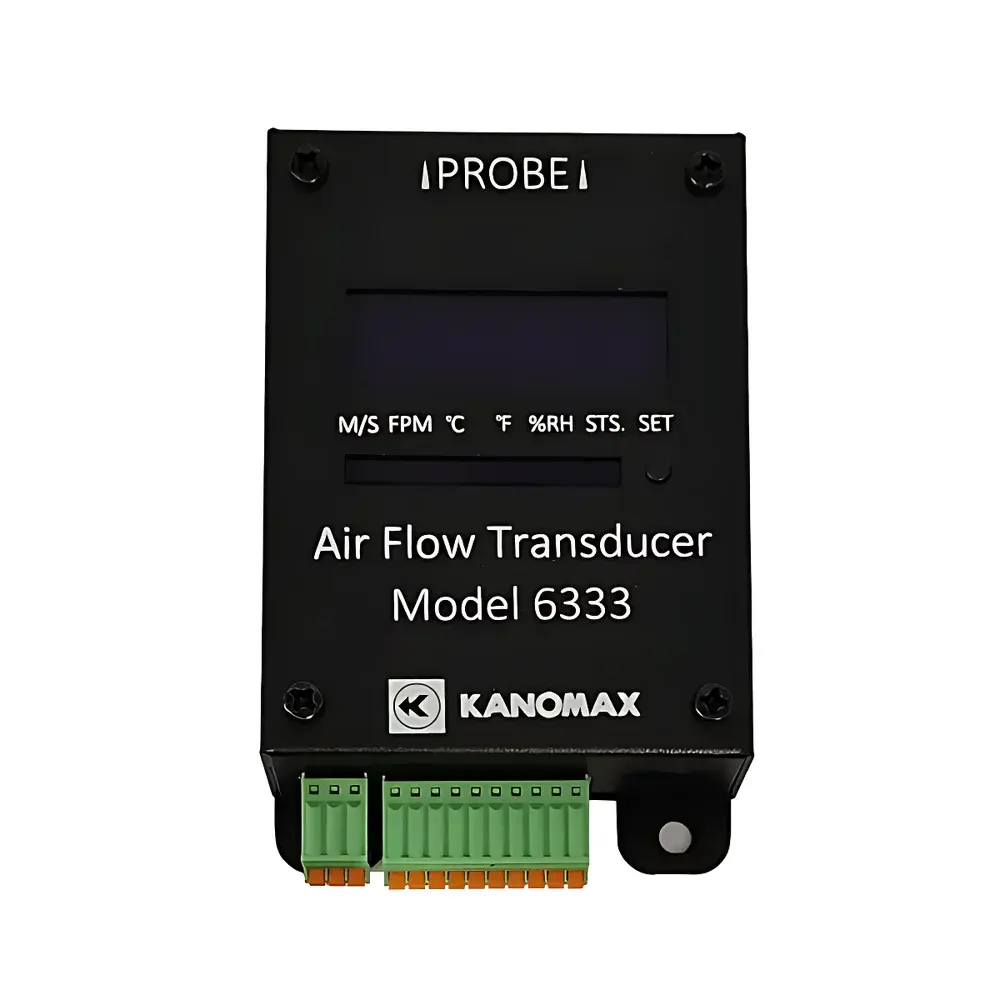
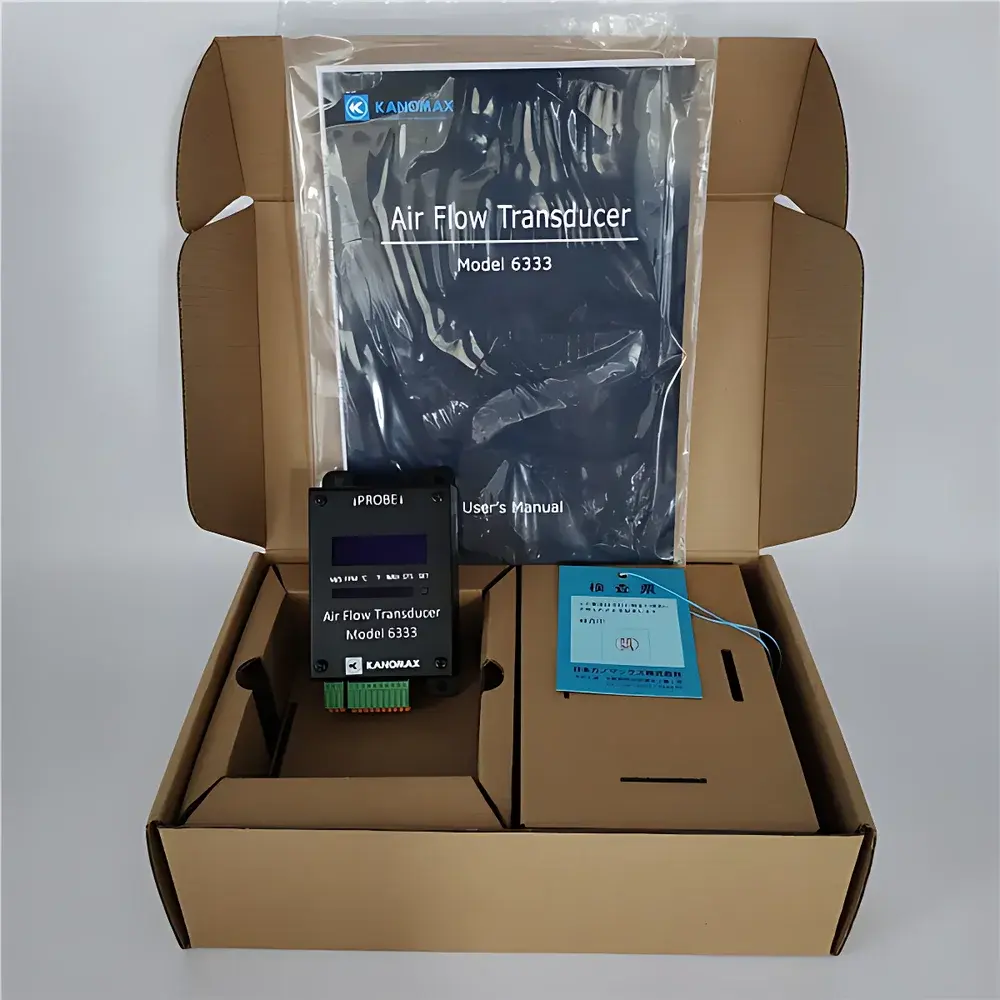
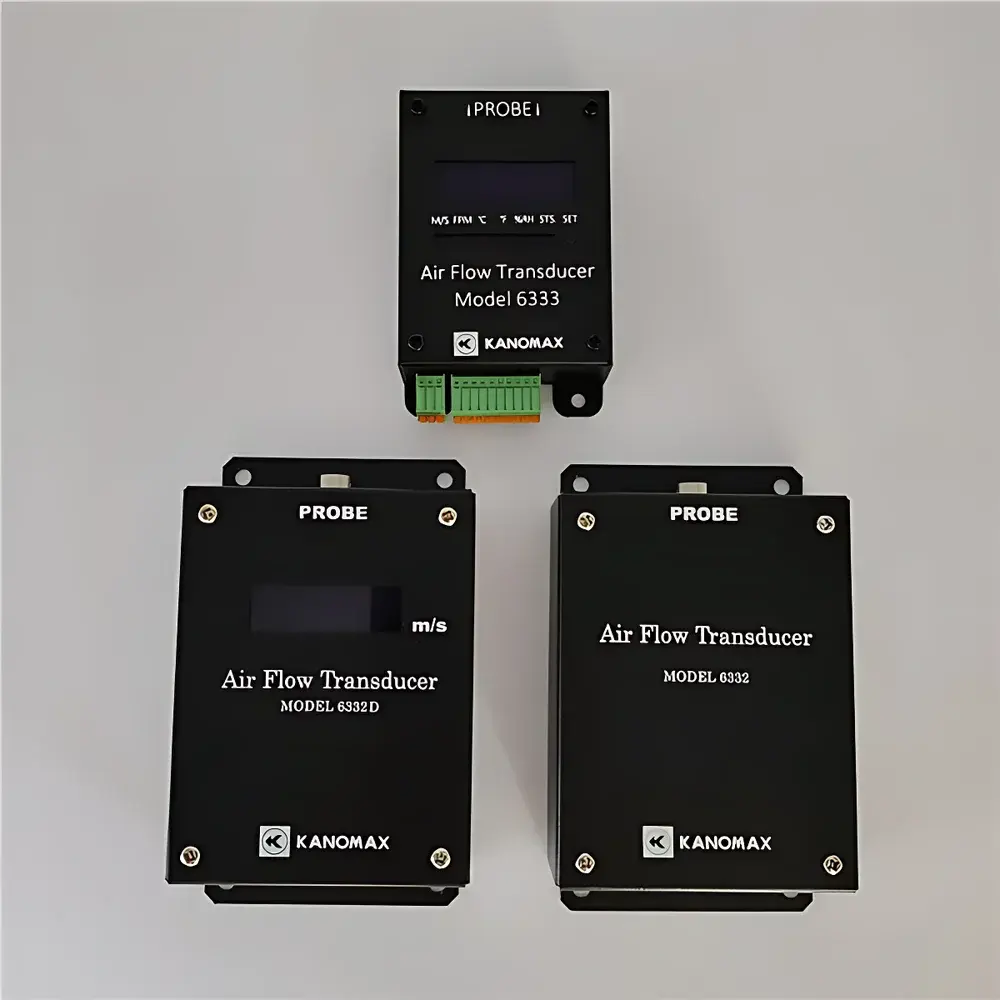
Kanomax MODEL 6333-0C Thermal Anemometer Transmitter
| Brand | Kanomax |
|---|---|
| Origin | Japan |
| Model | MODEL 6333-0C |
| Instrument Type | Thermal Anemometer |
| Resolution | 0.01 m/s (0.01–9.99 m/s), 0.1 m/s (10.0–50.0 m/s) |
| Measurement Range | 0.01–50.0 m/s (depending on probe selection) |
| Accuracy | ±2% of reading or ±0.02 m/s (whichever is greater) |
| Operating Temperature | 0–60 °C |
| Operating Humidity | 2–98% RH (non-condensing) |
| Output Options | 4–20 mA current or 0–5 V voltage (DIP-switch configurable) |
| Digital Interface | RS-485 |
| Power Supply | AC 100–240 V / DC 12–24 V |
| Power Consumption | ~3 W (at DC 12 V, 10 m/s with probe 0976-03) |
| Dimensions | 100 × 60 × 25 mm (W × D × H) |
| Weight | 200 g |
| Probe Compatibility | 15 interchangeable thermal probes (e.g., 0972-00, 0975-31, 0976-05) |
| Temperature Compensation | Built-in for all probe types |
| Response Time | ≤1 s (90% response at 1 m/s, ambient conditions) |
| Probe Max Temp Rating | Up to 120 °C (model-dependent) |
| Software Support | Optional Kanomax MODEL 6333-40 PC software (Windows 10, multilingual: EN/JP/CN) |
Overview
The Kanomax MODEL 6333-0C is a modular thermal anemometer transmitter engineered for high-fidelity, long-term environmental monitoring of air velocity, temperature, and relative humidity in industrial, HVAC, cleanroom, and laboratory settings. Unlike fixed-sensor anemometers, the 6333-0C decouples signal conditioning and communication electronics from the sensing element—enabling field-reconfigurable measurement capability via 15 standardized, thermally compensated probe variants. Its operating principle relies on constant-temperature anemometry (CTA), where a heated sensor element’s thermal dissipation correlates precisely with local airflow velocity. This method ensures stable zero-point behavior down to 0.01 m/s and maintains linearity across a full 0.01–50.0 m/s dynamic range—critical for laminar flow validation, duct balancing, and low-velocity containment verification per ISO 14644-3 and ASHRAE Standard 110. The transmitter’s compact housing (100 × 60 × 25 mm) and dual power input (AC/DC) support permanent wall-mounting, mobile deployment—including vehicle-based air quality surveys—and integration into distributed building management systems (BMS).
Key Features
- Modular architecture supporting 15 interchangeable thermal probes—including directional and omnidirectional variants—with full mechanical and electrical interoperability.
- Sub-meter-per-second resolution: 0.01 m/s minimum detectable velocity (0.01–9.99 m/s range), enabling precise characterization of ultra-low airflow in biosafety cabinets and pharmaceutical isolators.
- Integrated temperature compensation across all probes ensures consistent accuracy regardless of ambient drift; response time ≤1 second (90% step response at 1 m/s, 25 °C).
- High-temperature probe options (e.g., MODEL 0976-05) rated to 120 °C enable continuous monitoring in exhaust ducts, ovens, and thermal process lines without recalibration.
- Dual analog output configuration: user-selectable 4–20 mA or 0–5 V via onboard DIP switches—supporting simultaneous transmission of up to three parameters (velocity, temperature, RH) over separate channels.
- RS-485 digital interface compliant with Modbus RTU protocol for scalable multi-node deployment; up to four 6333-0C units may be daisy-chained for synchronized 4-point spatial profiling.
- Robust enclosure rated for operation at 0–60 °C and 2–98% RH (non-condensing); IP-rated probe housings available for harsh environments.
Sample Compatibility & Compliance
The MODEL 6333-0C accommodates diverse sampling geometries through its probe ecosystem: micro-probes (e.g., 0975-31, Ø1.6 mm) for insertion into narrow ducts or laminar flow hoods; vaneless directional probes (0972-00) for unobtrusive ceiling-mounted monitoring; and high-temp stainless-steel probes (0976-05) for furnace exhaust validation. All probes meet IEC 60529 (IP54 equivalent for probe bodies) and are traceably calibrated per ISO/IEC 17025 requirements. When paired with optional MODEL 6333-40 software, data acquisition complies with FDA 21 CFR Part 11 for electronic records and signatures—featuring audit trails, user access control, and immutable timestamped export to Excel (.xlsx). System-level validation documentation supports GLP and GMP adherence in regulated manufacturing facilities.
Software & Data Management
The optional Kanomax MODEL 6333-40 Windows 10 application provides real-time visualization of velocity, temperature, and RH as synchronized time-series plots, statistical overlays (min/max/avg), and configurable alarm thresholds. Data logging intervals are programmable from 100 ms to 24 hours; all datasets include metadata (probe ID, calibration date, operator tag) and export natively to Excel without proprietary codecs. The software supports multilingual UI (English, Japanese, Simplified Chinese) and enables batch processing of historical files for trend analysis—essential for ISO 14644-1 classification reports and HVAC commissioning protocols. Firmware updates and probe parameter configuration (e.g., scaling factors, offset correction) are performed directly through the GUI, eliminating need for external programming tools.
Applications
- HVAC system commissioning and TAB (Testing, Adjusting, Balancing) per SMACNA and NEBB standards.
- Cleanroom airflow uniformity mapping and ISO Class verification (ISO 14644-3 Annex B).
- Pharmaceutical facility environmental monitoring (EM) programs—especially for Grade A/B zones requiring ≤0.05 m/s precision near critical surfaces.
- Industrial process exhaust monitoring (e.g., spray booths, fume hoods) where temperature-compensated velocity data informs safety interlock logic.
- Mobile air quality assessment in transportation studies, including vehicle cabin ventilation efficiency testing.
- Research-grade boundary layer analysis in wind tunnels and aerodynamic test rigs.
FAQ
Can the MODEL 6333-0C measure humidity independently of airflow?
Yes—when equipped with a compatible tri-parameter probe (e.g., 0975-31), it simultaneously outputs velocity, temperature, and RH with independent calibration certificates.
Is probe interchangeability supported without recalibration?
Yes—the transmitter auto-detects probe type via embedded EEPROM and applies pre-stored sensitivity coefficients; no manual recalibration is required upon swap.
What is the maximum cable length between transmitter and probe?
Standard shielded cables support up to 40 m (MODEL 1580-35); extended runs require active signal conditioning per IEC 61000-4-5 surge immunity guidelines.
Does the unit support Modbus TCP or only Modbus RTU?
The native interface is RS-485 Modbus RTU; Ethernet gateway integration requires third-party protocol converters.
How is traceability maintained during field use?
Each probe carries a unique serial number linked to its NIST-traceable calibration certificate; the 6333-40 software logs this ID with every data point.







