
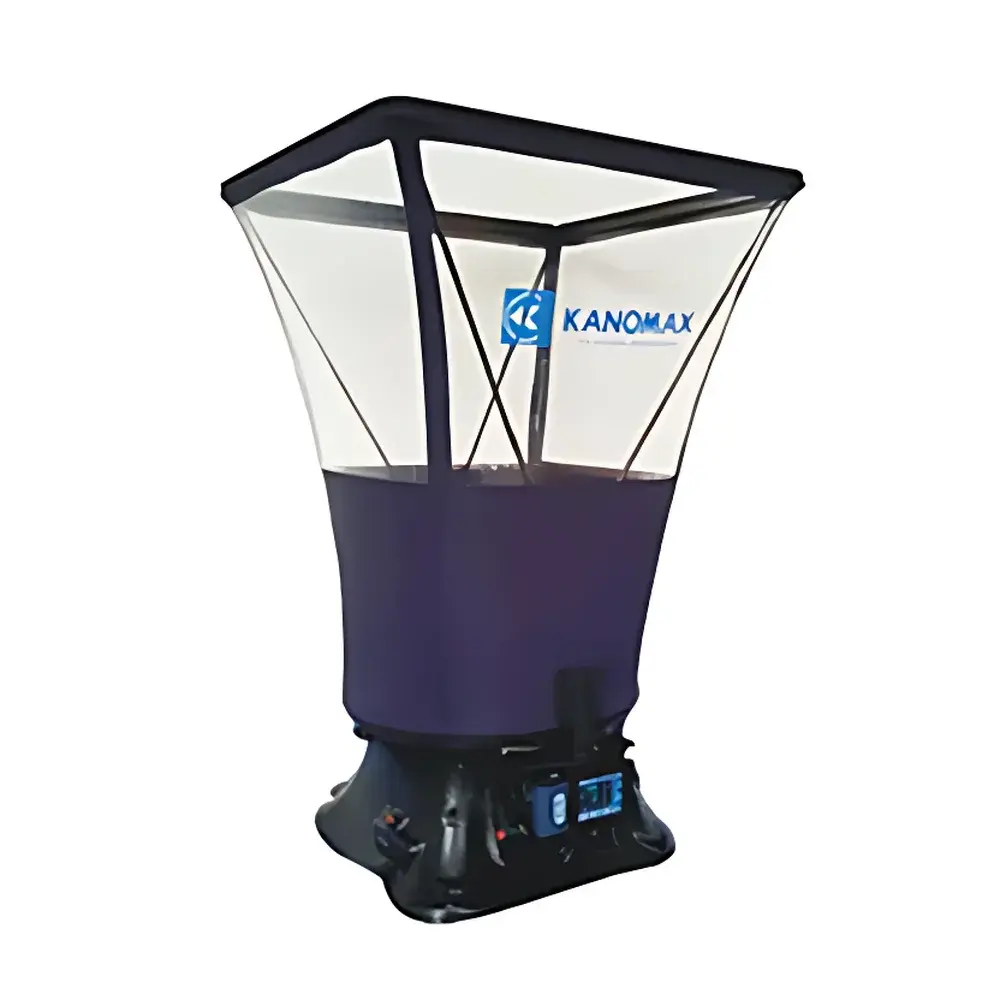
Kanomax 6705/6710/6715 Smart Air Flow Hood
| Brand | Kanomax |
|---|---|
| Origin | Japan |
| Model | 6705 / 6710 / 6715 |
| Air Flow Measurement Principle | Pitot-static pressure differential |
| Air Flow Range | Up to 3,000 m³/h (model-dependent) |
| Differential Pressure Range | ±2500 Pa |
| Pressure Accuracy | ±1.5% of reading ±0.25 Pa |
| Bluetooth Connectivity | Yes (Android & iOS compatible) |
| Hood Angle Adjustment | 0–30° tilt |
| Hood Sizes | Standard 610×610 mm |
| Display | Backlit LCD with real-time m³/h readout |
| Data Output | Bluetooth wireless transmission to mobile device |
| Compliance | Designed for HVAC commissioning and ISO 14644-3 / ISO 14644-4 compliant cleanroom airflow verification |
Overview
The Kanomax 6705/6710/6715 Smart Air Flow Hood is a precision-engineered instrument for direct, real-time volumetric air flow measurement at supply and exhaust grilles, HEPA filter outlets, biological safety cabinets (BSCs), and HVAC terminal devices. Unlike conventional anemometers requiring point-wise velocity mapping and manual area integration, this hood employs a calibrated Pitot-static pressure sensing principle across an integrated multi-point sampling grid within the conical hood structure. The device converts dynamic and static pressure differentials—measured simultaneously at multiple locations—into a single, representative volumetric flow rate (m³/h), eliminating interpolation errors and operator dependency. Its design adheres to fundamental fluid mechanics principles for laminar-to-turbulent transition compensation in low-velocity ducted flows, ensuring traceable accuracy under typical commercial and industrial HVAC operating conditions (0.15–8.0 m/s face velocity). The unit is purpose-built for commissioning, routine maintenance, and regulatory compliance verification in environments governed by ISO 14644-3 (cleanroom testing), ASHRAE Guideline 12, and FDA-recommended airflow validation protocols for pharmaceutical manufacturing.
Key Features
- Integrated multi-point Pitot-static sensor array ensures high reproducibility across varying flow profiles—no manual traverse or averaging required.
- Modular hood system with standardized 610×610 mm base configuration; optional interchangeable hoods (e.g., 305×305 mm, 915×915 mm, custom dimensions) maintain geometric similarity and calibration integrity per ANSI/ASHRAE Standard 111.
- 30° articulating hood body enables ergonomic positioning and unobstructed line-of-sight through transparent polycarbonate viewing window—critical for verifying full perimeter seal against grille or diffuser surfaces.
- Dual-function 6715主机 integrates differential pressure measurement (±2500 Pa range, ±1.5% rdg ±0.25 Pa accuracy) and optional Pitot tube connectivity for standalone duct velocity profiling.
- Bluetooth 5.0 wireless interface supports real-time remote operation and data logging via Kanomax’s dedicated Android/iOS application—eliminating ladder use during ceiling-mounted outlet testing.
- Automatic backpressure compensation algorithm activates above 1500 m³/h to correct for flow restriction-induced depression; compensation performed using included mechanical baffle kit per ISO 14644-3 Annex B guidance.
Sample Compatibility & Compliance
The instrument is validated for use with rectangular, square, and circular supply/exhaust openings ranging from 0.09 m² to 0.84 m² (per standard hood size constraints). Minimum effective opening area must be ≥15% of hood inlet area to avoid edge-effect turbulence and ensure laminar flow development upstream of the sensor plane. It meets functional requirements for ISO 14644-3 Annex B (airflow uniformity and volume verification), EU GMP Annex 1 (grade A/B/C/D room qualification), and USP environmental monitoring workflows. While not a certified metrology standard, its pressure transducer is factory-calibrated against NIST-traceable references, and field verification procedures align with ASTM D1078 and ISO/IEC 17025-compliant laboratory practices.
Software & Data Management
The companion mobile application provides timestamped data capture, on-device calculation of average flow, standard deviation, and coefficient of variation (CV%). Export formats include CSV and PDF reports with embedded instrument ID, operator name, test location, date/time, and environmental notes. Audit trail functionality records all parameter changes, measurement start/stop events, and calibration status flags—supporting GLP/GMP documentation requirements. No cloud storage is enabled by default; all data resides locally on the paired device unless explicitly exported. Firmware updates are delivered via secure OTA channels with version-controlled release notes.
Applications
- HVAC system balancing and TAB (Testing, Adjusting, and Balancing) per ASHRAE Guideline 12 and NEBB Procedural Standards.
- Cleanroom certification per ISO 14644-3, including unidirectional airflow verification at HEPA/ULPA filter banks in semiconductor fabs and aseptic processing suites.
- Biological safety cabinet (Class I/II/III) inflow and downflow velocity validation per NSF/ANSI 49 and EN 12469.
- Exhaust hood face velocity surveys in laboratories and pharmaceutical R&D facilities.
- Energy audit pre- and post-retrofit airflow quantification for LEED EA Credit 1 compliance reporting.
FAQ
What hood size should I select for a given grille?
Select a hood whose inlet area is no more than three times the grille’s longest dimension and whose area is ≥15% larger than the grille opening—ensuring minimal flow distortion and boundary layer interference.
Is backpressure compensation mandatory for all measurements?
Compensation is only required when measured flow exceeds 1500 m³/h; below this threshold, raw readings are metrologically valid per ISO 14644-3 Annex B.
Can the device measure static pressure in ducts independently?
Yes—the 6715 model includes dual-port differential pressure inputs compatible with standard flexible tubing for static pressure mapping in supply/return ducts per ASHRAE Fundamentals Chapter 21.
Does the Bluetooth connection support simultaneous multi-device pairing?
No—only one mobile device may be actively connected at a time to prevent data collision and ensure deterministic command-response latency.
How often does the unit require recalibration?
Kanomax recommends annual factory recalibration or after any physical impact exceeding 50 g-force; interim verification using NIST-traceable manometer checks is advised before critical qualification runs.







