
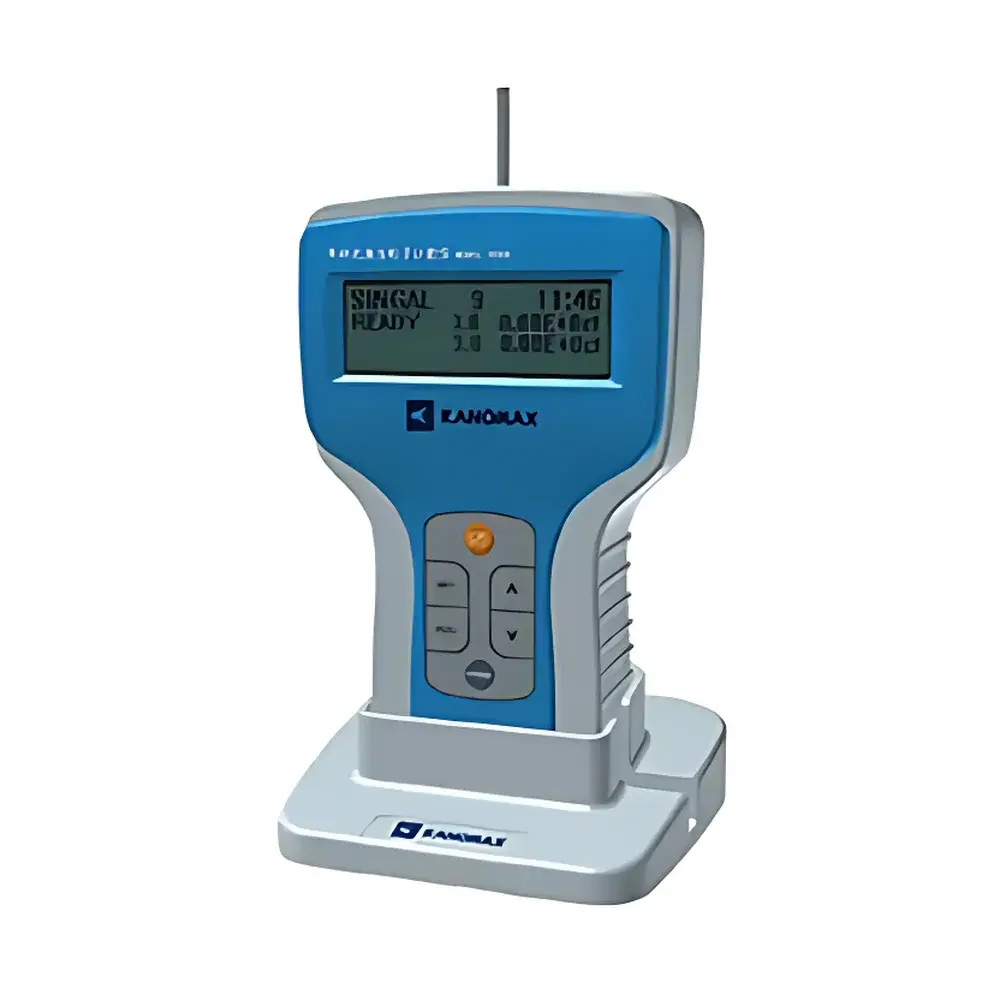
KANOMAX 3887 Handheld Laser Particle Counter
| Brand | KANOMAX |
|---|---|
| Origin | Japan |
| Model | KANOMAX 3887 |
| Flow Rate | 2.83 L/min |
| Particle Size Channels | 0.3, 0.5, and 5.0 µm (user-selectable) |
| Flow Accuracy | < ±1 particle per 5 min |
| Timing Accuracy | < ±1 s over 6-min sampling |
| Repeatability | ≤ ±10% FS |
| Size Distribution Error | ≤ ±30% |
| Indication Error | ≤ ±30% FS |
| Compliance | GB/T 16292–2010, ISO 14644-1, China GMP (2010) |
| Data Storage | High-capacity internal memory with statistical analysis |
| Power Management | Auto-save on power interruption |
| Display | Backlit LCD with English interface |
Overview
The KANOMAX 3887 is a compact, battery-powered handheld laser particle counter engineered for rapid, on-site airborne particulate monitoring in cleanrooms, pharmaceutical manufacturing environments, hospital isolation rooms, and HVAC validation workflows. It operates on the principle of single-particle light scattering—where particles drawn through a focused He-Ne or diode laser beam generate scattered light pulses proportional to their size—and converts these optical signals into real-time concentration data (particles/m³) across three user-selectable size thresholds: 0.3 µm, 0.5 µm, and 5.0 µm. Designed to meet stringent regulatory expectations for environmental monitoring, the instrument delivers traceable, reproducible measurements aligned with international cleanroom classification standards including ISO 14644-1:2015, GB/T 16292–2010, and the People’s Republic of China’s Good Manufacturing Practice (GMP) requirements for sterile pharmaceutical production. Its fixed flow rate of 2.83 L/min—equivalent to 0.1 ft³/min—ensures compatibility with standard cleanroom mapping protocols and facilitates direct comparison with historical datasets generated by legacy and modern particle counters.
Key Features
- Three selectable particle size channels (0.3 µm, 0.5 µm, 5.0 µm) optimized for detecting sub-micron contamination and viable particle surrogates
- Integrated backlit LCD display with full English-language UI, enabling intuitive operation without language barriers
- High-stability volumetric flow control system with verified accuracy of < ±1 particle deviation per 5-minute sampling interval
- Precision timing circuitry ensuring < ±1 second deviation over a standard 6-minute sampling cycle—critical for ISO-compliant data acquisition
- Robust internal memory supporting thousands of sample records, each timestamped and tagged with location ID, operator code, and test mode
- Auto-save functionality preserves unsaved data during unexpected power loss, maintaining audit trail integrity
- Configurable pre-delay function (0–60 seconds) minimizes operator-induced turbulence at sample inlet prior to measurement initiation
- Compliance-ready test modes: GBMODE (for Chinese national standards), GMP (aligned with Annex 1 and China GMP 2010), and ISO (for ISO 14644-1 Class verification)
Sample Compatibility & Compliance
The KANOMAX 3887 is validated for use in non-hazardous, ambient-pressure indoor air environments with temperature range 10–35 °C and relative humidity ≤ 70% RH (non-condensing). It is not rated for explosive atmospheres, corrosive gases, or high-humidity condensation-prone locations. All calibration and performance verification procedures follow KANOMAX’s traceable methodology, with factory calibration referenced to NIST-traceable polystyrene latex (PSL) spheres. The device supports GLP- and GMP-aligned documentation practices: each stored record includes operator ID, sampling duration, flow confirmation flag, and pass/fail status against user-defined action limits. While not inherently 21 CFR Part 11 compliant due to lack of electronic signature architecture, its data export format (CSV via USB) enables integration into validated LIMS or ELN systems that enforce electronic record controls.
Software & Data Management
Data retrieval is performed via standard USB 2.0 interface using KANOMAX-provided PC software (Windows-compatible), which parses raw logs into tabular reports with summary statistics (mean, SD, max/min), trend charts, and ISO class pass/fail evaluation per sampling point. Exported files contain uneditable metadata headers—including firmware version, serial number, and calibration expiration date—to support regulatory review. The onboard statistical engine computes cumulative and differential counts, calculates 95% UCL (Upper Confidence Limit) for ISO 14644-1 compliance reporting, and flags outliers based on user-configurable thresholds. All stored data retain original timestamps synchronized to internal RTC (Real-Time Clock) with drift compensation.
Applications
- Cleanroom certification and routine monitoring (ISO Class 5–8, A–D grades per EU GMP Annex 1)
- Filter integrity verification (HEPA/ULPA) via upstream/downstream particle challenge testing
- Environmental qualification of isolators, laminar flow hoods, and RABS enclosures
- Pharmaceutical aseptic process simulation (media fill) environmental support
- Hospital infection control audits in operating theatres and ICU ventilation zones
- Facility commissioning and requalification after maintenance or renovation
FAQ
Does the KANOMAX 3887 require annual recalibration?
Yes. KANOMAX recommends annual factory recalibration using PSL reference standards to maintain metrological traceability and ensure continued conformance with ISO 21501-4 and GB/T 16292–2010.
Can the instrument measure particles smaller than 0.3 µm?
No. The optical design and detection threshold are optimized for ≥0.3 µm; sub-0.3 µm particles fall below reliable signal-to-noise discrimination limits.
Is the 2.83 L/min flow rate adjustable?
No. Flow is fixed and non-variable to preserve counting efficiency consistency and regulatory comparability.
What file format is used for data export?
CSV (comma-separated values) with UTF-8 encoding, compatible with Excel, Python pandas, and most LIMS platforms.
Does the device support remote triggering or network connectivity?
No. It operates as a standalone field instrument with no Wi-Fi, Bluetooth, or Ethernet interfaces—designed for controlled, low-interference measurement environments.
Related Products







