
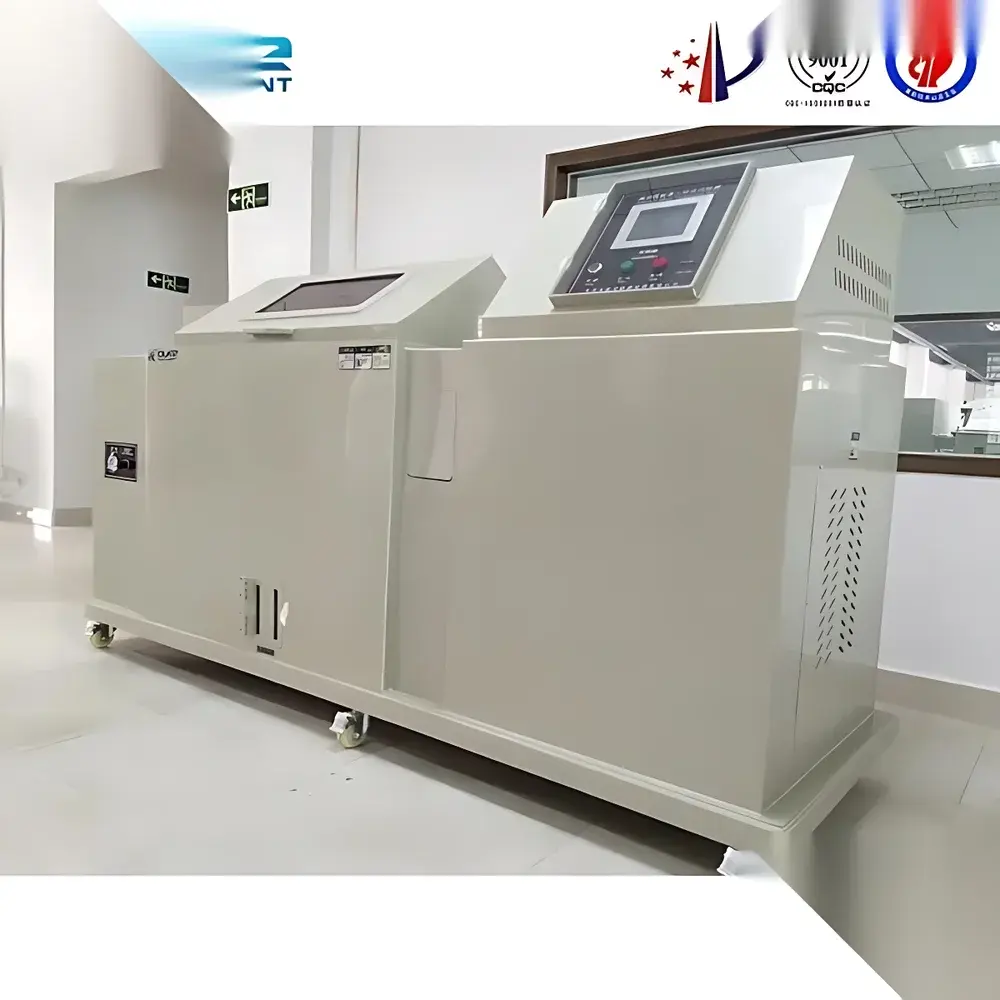
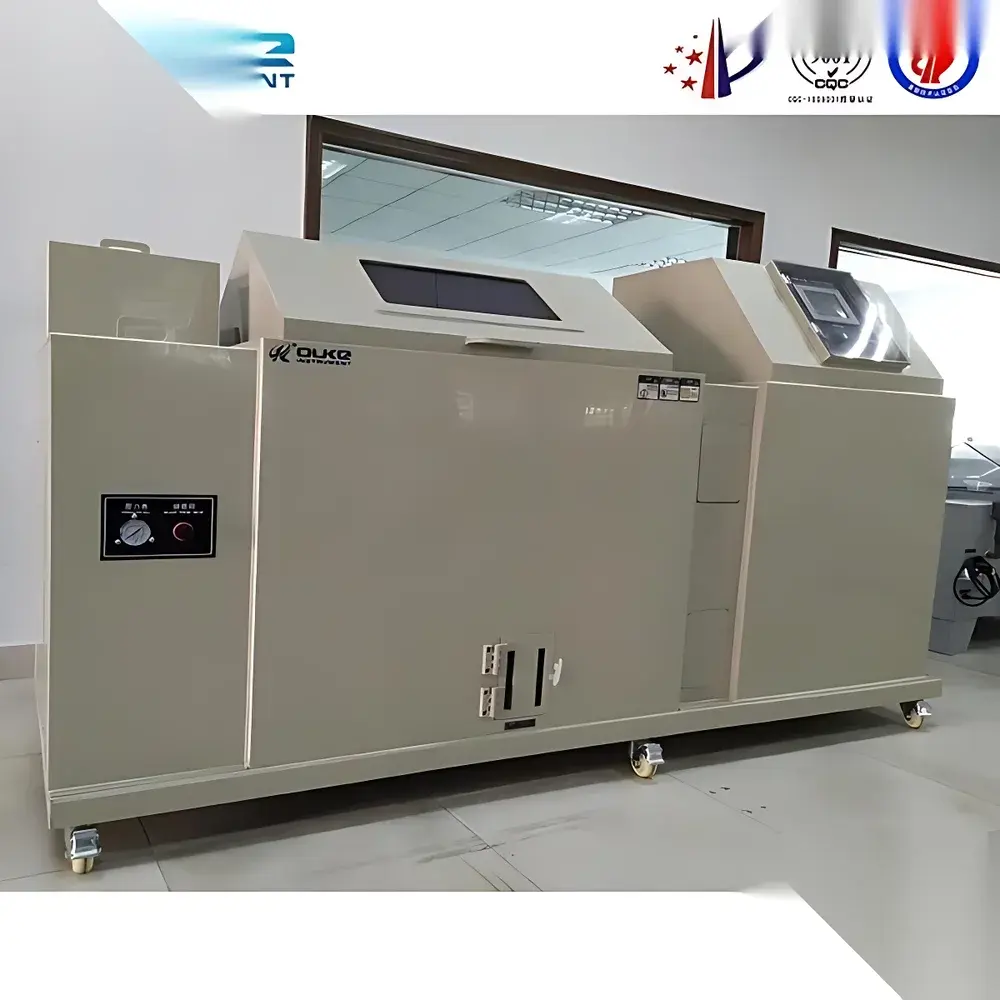
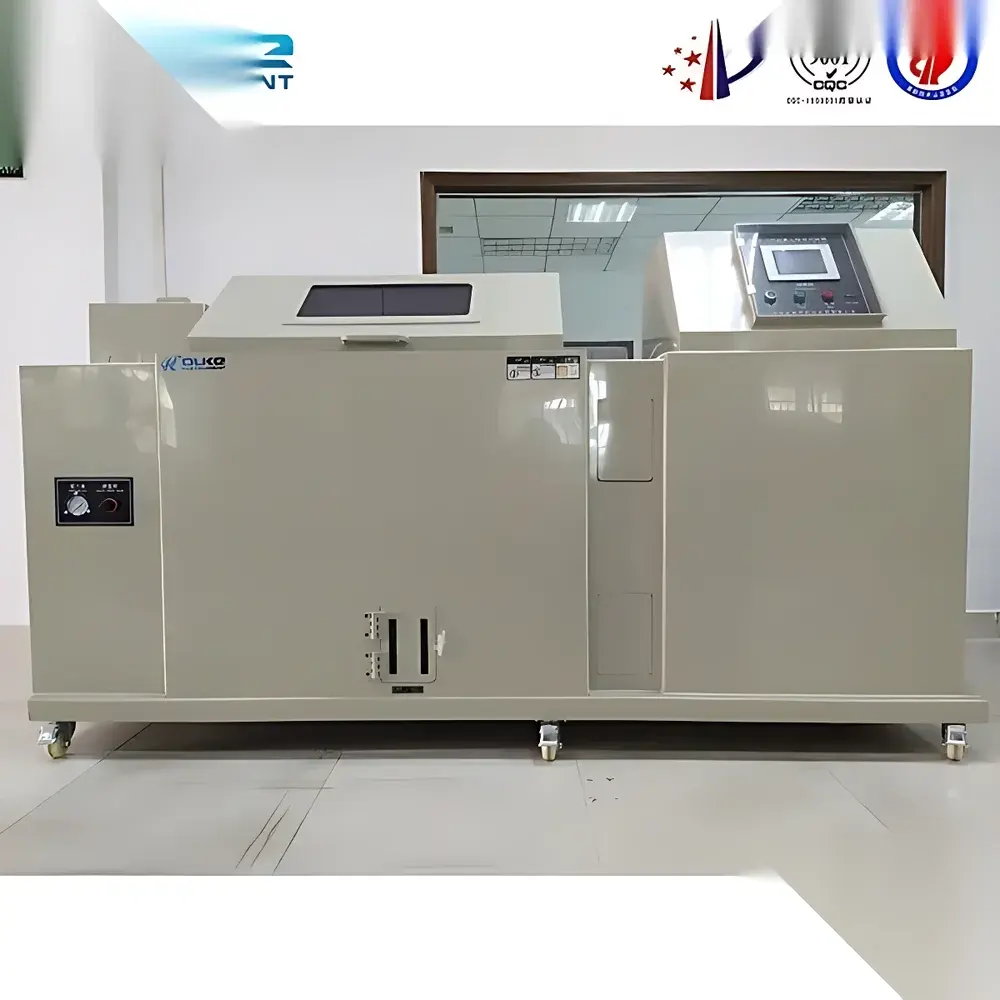
Cuba-Train High-Temperature, High-Humidity, and High-Salinity Environmental Test Chamber
| Brand | OEM / Custom-Built |
|---|---|
| Origin | Imported |
| Manufacturer Type | Authorized Distributor |
| Price | USD 21,000 (FOB) |
| Compliance Standards | GB/T 2423.17–1993, IEC 60068-2-11, ASTM B117, MIL-STD-810H, DIN 50021 |
| Temperature Range | +10°C to +65°C |
| Humidity Range | 30–98% RH |
| Salt Fog Concentration | 5% NaCl (by weight), pH 6.5–7.2 |
| Chamber Sealing | Water-Sealed Lid Design |
| Construction Material | Fiberglass-Reinforced Polymer (FRP) Monocoque Body |
| Internal Accessories | Stainless Steel V-Type Sample Racks, Dual Precision Nozzles, Calibrated Funnel Assembly |
| Safety Protections | Overtemperature, Low-Water Level, Leakage Current, Short-Circuit, Overcurrent, End-of-Test Auto-Shutdown |
Overview
The Cuba-Train High-Temperature, High-Humidity, and High-Salinity Environmental Test Chamber is an engineered solution for accelerated corrosion and environmental aging evaluation of materials and components subjected to combined stress conditions—specifically elevated temperature, saturated humidity, and aggressive saline aerosol exposure. Designed in accordance with the fundamental principles of electrochemical corrosion acceleration under controlled atmospheric simulation, this chamber integrates calibrated salt fog generation, precise thermohygrometric regulation, and robust chemical-resistant construction to replicate real-world tropical coastal, marine, and rail infrastructure service environments—including those encountered by rolling stock operating in Cuba’s high-salinity, high-temperature, and high-humidity climate zones. Its operational architecture complies with the core test methodology defined in ASTM B117 (Salt Spray Testing), while supporting extended multi-stress protocols aligned with IEC 60068-2-52 (cyclic salt mist/dry/humidity) and MIL-STD-810H Method 509.10. The chamber does not perform electrochemical impedance spectroscopy or mass loss quantification directly; rather, it provides a standardized, reproducible environment for subsequent failure mode analysis per ISO 9223 or ASTM G85 Annex A5.
Key Features
- Fiberglass-reinforced polymer (FRP) monocoque chamber body—seamless, non-porous, and chemically inert to 5% NaCl solution, eliminating leakage risk and ensuring long-term structural integrity under continuous corrosive exposure.
- Dual-mode control system: Digital PID temperature controller (DHC series) with platinum RTD sensor (±0.5°C accuracy), SSR solid-state output, and integrated pressure-tank humidification based on Henry’s Law—enabling stable 95–98% RH at 35–50°C without condensation on test specimens.
- Adjustable salt fog delivery: Two precision ceramic nozzles with flow-regulated compressed air supply (70–170 kPa), calibrated spray angle and deposition rate (1.0–2.0 mL/80 cm²/h), compliant with ASTM B117 uniformity requirements.
- Water-sealed lid design prevents vapor and aerosol escape, maintains chamber integrity during prolonged cyclic operation, and eliminates need for gasket replacement or silicone-based sealing compounds.
- Comprehensive safety suite: Independent overtemperature cutoff (mechanical backup), low-water-level detection in brine reservoir and saturator tank, ground-fault circuit interruption (GFCI), and auto-shutdown upon test completion or power anomaly.
- Modular configuration: Supports standalone salt spray (ASTM B117), steady-state damp heat (IEC 60068-2-3), or sequential/cyclic combinations—enabling flexible qualification testing per automotive OEM specifications (e.g., VW TL 226, GMW 14872).
Sample Compatibility & Compliance
The chamber accommodates standard test specimens up to 2000 mm (L) × 1200 mm (W) × 600 mm (H), with stainless steel V-type sample racks ensuring optimal orientation (15°–30° from vertical) per ASTM B117. All internal fixtures—including nozzles, funnels, and support structures—are fabricated from AISI 316 stainless steel, copper-free brass, or fluoropolymer-coated aluminum to prevent galvanic coupling. Test validity is maintained through periodic verification using certified reference coupons (e.g., copper-clad steel per ISO 9227) and traceable calibration of temperature, humidity, and pH sensors against NIST-traceable standards. Full compliance documentation—including factory calibration reports, material certificates (EN 10204 3.1), and conformity statements to GB/T 2423.17–1993, IEC 60068-2-11, and DIN 50021—is supplied with each unit.
Software & Data Management
While the base configuration features a standalone DHC controller with local data logging (10,000-point memory, USB export), optional Ethernet-enabled PLC integration supports remote monitoring, alarm notification via SMTP/SNMP, and audit-trail-capable data archiving compliant with FDA 21 CFR Part 11 requirements. Logged parameters include chamber temperature, saturation tank temperature, relative humidity, elapsed test time, and fault event timestamps—all timestamped with UTC synchronization. Raw data exports are provided in CSV format for post-processing in MATLAB, JMP, or Minitab; no proprietary software lock-in is imposed.
Applications
This chamber serves critical validation functions across transportation, defense, and energy sectors: accelerated corrosion screening of railway brake calipers, couplers, and undercarriage fasteners per UIC 801-2; qualification of maritime electronics enclosures under IEC 60945; evaluation of solar PV mounting hardware for coastal installations; and durability assessment of battery enclosures for electric rolling stock operating in tropical climates. It is routinely deployed in third-party test labs accredited to ISO/IEC 17025 and supports evidence generation for ISO 9001:2015 clause 8.5.1 (control of production and service provision) and AS9100D 8.5.2 (identification and traceability).
FAQ
Can this chamber perform cyclic corrosion testing (CCT) per ISO 16701 or ASTM G85 Annex A5?
Yes—when equipped with optional programmable controller and auxiliary dry/humidity modules, it supports fully automated multi-phase cycles including salt spray, humid storage, drying, and recovery phases.
Is the 5% NaCl solution prepared automatically or manually?
Solution preparation is manual; users must pre-mix reagent-grade NaCl and deionized water (conductivity <2 µS/cm) to specification. An optional automatic brine mixing station is available as an add-on.
What maintenance intervals are recommended for long-term reliability?
Weekly inspection of nozzle clogging and pH stability; monthly cleaning of saturator tank and pressure regulator; annual recalibration of RTD and humidity sensor by an ISO/IEC 17025-accredited lab.
Does the chamber meet GLP or GMP environmental qualification requirements?
Yes—the water-sealed design, traceable calibration chain, and configurable audit trail (with optional software) satisfy key elements of GLP (OECD 1998) and GMP (EU Annex 15) for equipment qualification (IQ/OQ/PQ).
Can test specimens be monitored in situ without opening the chamber?
No optical viewport is included in standard configuration; however, a borosilicate glass observation window with double-seal and anti-fog coating is available as a factory option.



