
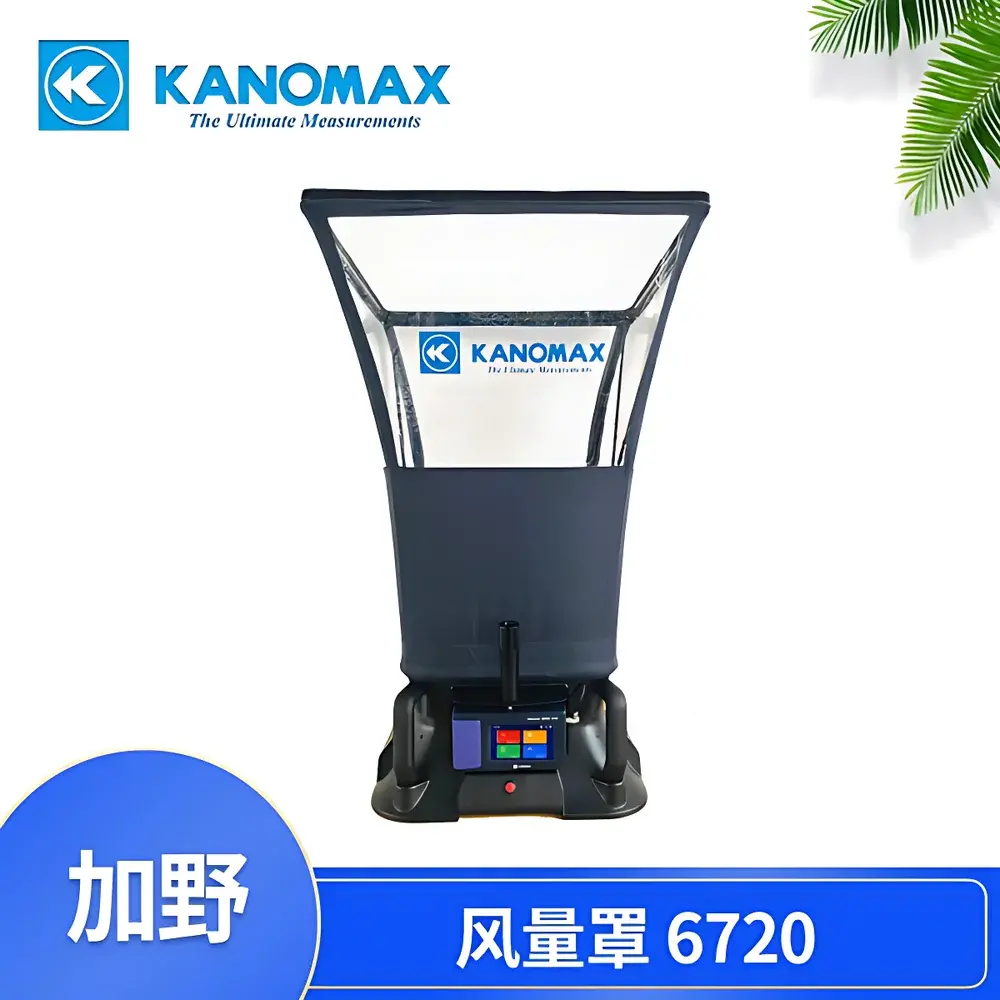
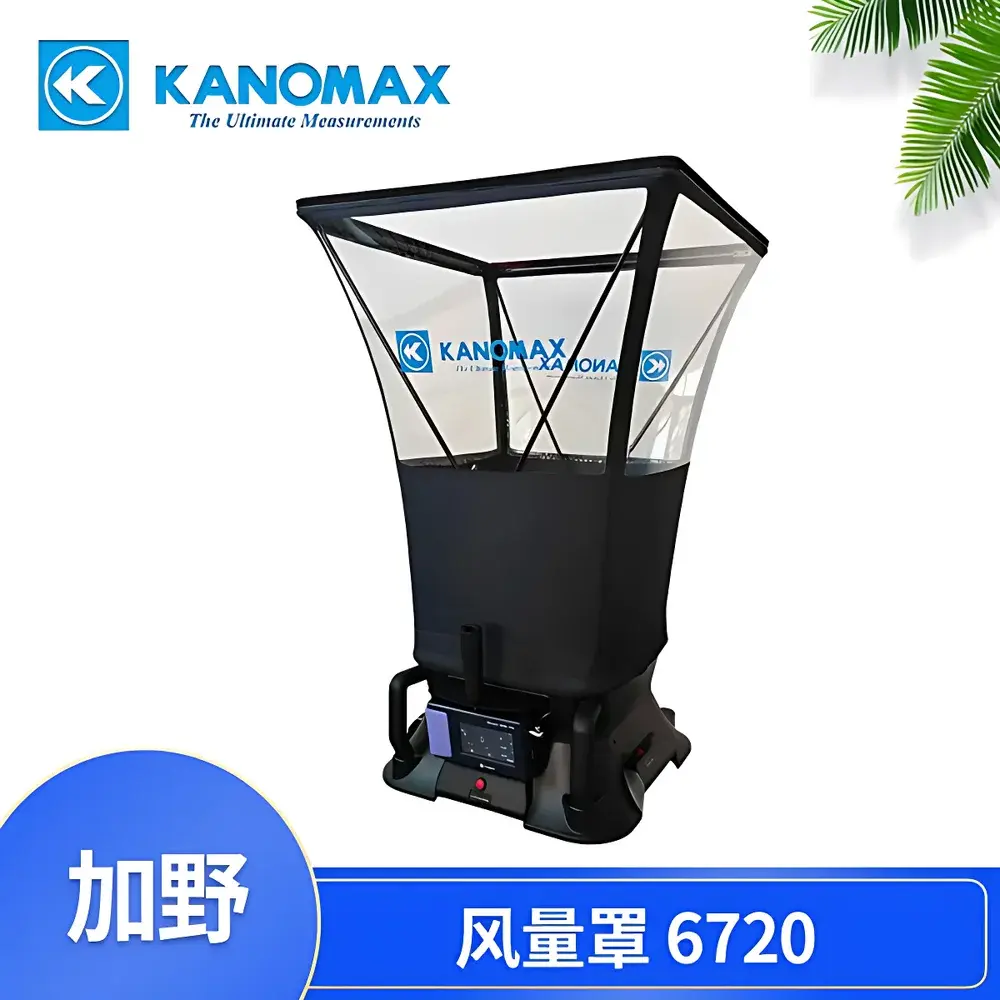
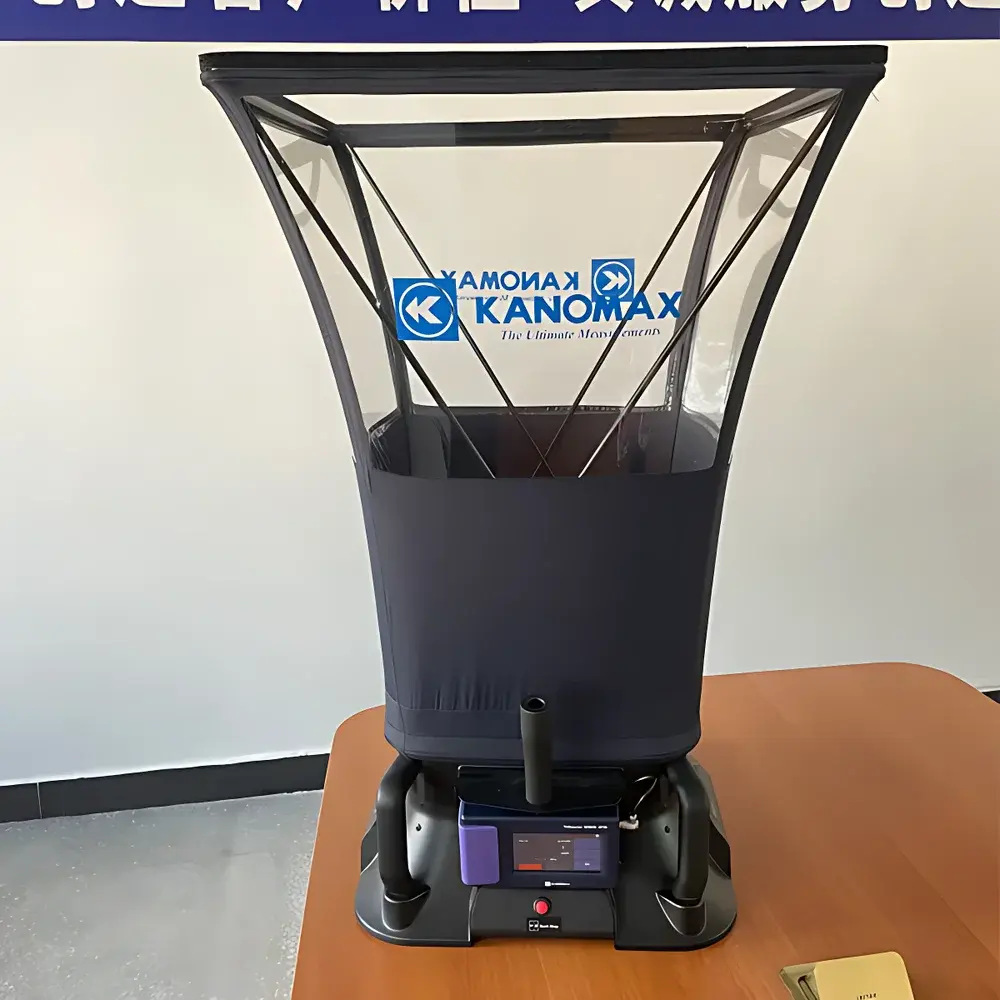
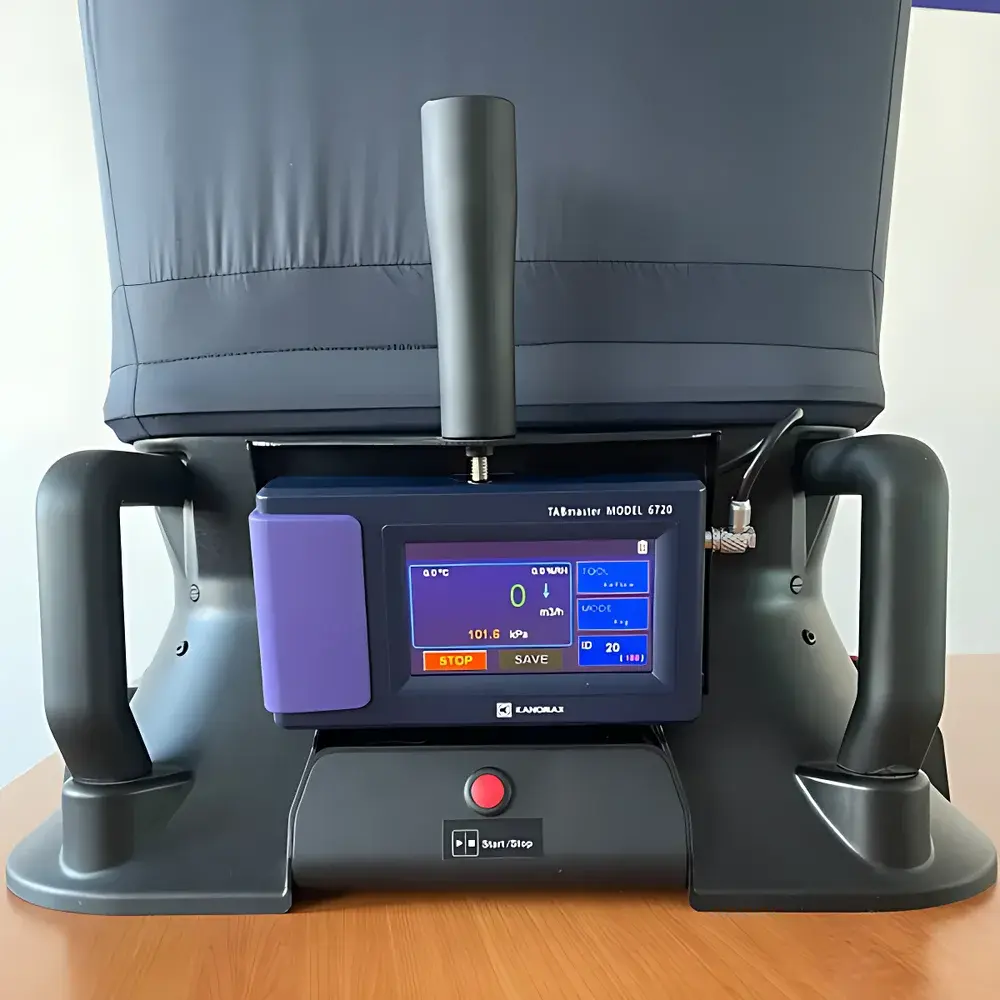
Kanomax Model 6720 Portable Air Flow Hood System
| Brand | Kanomax |
|---|---|
| Origin | Japan |
| Model | 6720 |
| Air Flow Range | 40–4300 m³/h |
| Accuracy | ±3% of reading ±8 m³/h |
| Air Velocity Range (with Pitot tube) | 0.15–40 m/s |
| Air Velocity Range (with matrix sensor) | 0.15–15 m/s |
| Velocity Accuracy | ±3% of reading ±0.05 m/s |
| Differential Pressure Range | −2500 to +2500 Pa |
| DP Accuracy | ±1.5% of reading ±0.25 Pa |
| Temperature Range | 0–60 °C |
| Temp Accuracy | ±0.5 °C |
| Humidity Range | 0–100 %RH |
| RH Accuracy | ±3 %RH (10–90 %RH) |
| Operating Environment | 0–60 °C, 0–100 %RH |
| Display | 4.3-inch full-color touchscreen LCD |
| Data Storage | 8,000 measurements (instrument), 10,000 (mobile app) |
| Power | 4 × AA batteries (≈9 h), DC 5 V adapter |
| Weight | 3.6 kg |
| Standard Hood Size | 610 × 610 mm |
| Optional Hood Sizes | 610 × 1220 mm, 305 × 1220 mm, 500 × 500 mm, 915 × 915 mm, 915 × 610 mm, 800 × 1400 mm |
| Key Functions | Backpressure compensation, inlet/exhaust mode detection, atmospheric pressure & temperature correction, real-time Bluetooth data transmission, USB export, on-device clock & battery indicator |
Overview
The Kanomax Model 6720 Portable Air Flow Hood System is an integrated, field-deployable instrument engineered for high-accuracy volumetric airflow quantification in HVAC, cleanroom, and laboratory containment applications. It operates on the principle of spatially averaged velocity measurement across a defined capture area—using either a removable 16-point thermal anemometer matrix or an optional Pitot-static probe—combined with real-time differential pressure sensing and environmental parameter correction. Unlike single-point anemometers, the 6720 applies ISO 17025-aligned measurement traceability by incorporating backpressure compensation, atmospheric pressure normalization, and temperature-dependent air density correction algorithms. This ensures compliance with ASHRAE Standard 111, ISO 14644-3, and EU GMP Annex 1 requirements for airflow verification in critical environments such as biosafety cabinets (BSCs), fume hoods, and supply/exhaust grilles.
Key Features
- Simultaneous multi-parameter acquisition: airflow volume (m³/h), face velocity (m/s), differential pressure (Pa), ambient temperature (°C), and relative humidity (%RH) — all displayed in real time on a 4.3-inch capacitive touchscreen.
- Modular sensor architecture: detachable 16-point velocity matrix enables rapid reconfiguration; optional Pitot tube support extends high-velocity range up to 40 m/s with traceable calibration.
- Backpressure compensation algorithm actively corrects for static pressure buildup behind the hood, eliminating systematic underestimation common in non-compensated hoods during low-impedance exhaust testing.
- Transparent acrylic viewing window allows visual confirmation of hood-to-grille seal integrity prior to measurement—critical for minimizing leakage-induced uncertainty per ISO 14644-3 Annex B.
- Bluetooth 4.2 LE interface supports bidirectional communication with iOS/Android devices running the official Kanomax AirFlow Manager app, enabling remote configuration, live data streaming, and timestamped report generation.
- Onboard storage retains 8,000 complete measurement records with metadata (date/time, K-factor, hood size, mode flag); app-side storage extends capacity to 10,000 entries with CSV/Excel export capability via USB or Bluetooth.
Sample Compatibility & Compliance
The Model 6720 accommodates a wide range of duct and grille geometries through six standardized interchangeable hood sizes—from compact 500 × 500 mm for terminal HEPA filter testing to oversized 800 × 1400 mm for large-volume air handling units. Its sealed perimeter design and glass-fiber reinforced support frame ensure minimal air bypass (<0.5% leakage at 250 Pa differential) when properly seated. The system meets IEC 61000-4 electromagnetic immunity standards and conforms to RoHS 2011/65/EU material restrictions. For regulated environments, audit-ready data logs include operator ID, location tag, calibration certificate ID, and GLP-compliant electronic signatures when used with the app’s role-based access control. All firmware and calibration routines are validated against NIST-traceable reference standards, supporting FDA 21 CFR Part 11 compliance when paired with appropriate IT governance protocols.
Software & Data Management
The Kanomax AirFlow Manager mobile application provides full instrument control without requiring PC dependency. Users configure K-factors, select inlet/exhaust mode, toggle units (CFM/L/s/m³/h), and apply custom averaging windows (instantaneous, 15-s rolling, or full-cycle mean). Measurement reports include min/max/mean/accumulated values per point and overall, with automatic pass/fail flags based on user-defined thresholds aligned with ISO 14644-1 class limits or ASHRAE 62.1 ventilation rates. Raw datasets export with embedded metadata (GPS coordinates optional), supporting integration into LIMS or CMMS platforms via standard CSV or XML schemas. Firmware updates are delivered over-the-air and logged with version hash and installation timestamp.
Applications
- HVAC commissioning and balancing: quantitative verification of supply/exhaust airflow distribution across VAV boxes, diffusers, and terminal units.
- Cleanroom certification: Class 5–8 airflow uniformity mapping per ISO 14644-3, including recovery time and directional airflow assessment.
- Biosafety cabinet performance testing: inflow and downflow velocity validation per NSF/ANSI 49 and EN 12469.
- Pharmaceutical facility qualification: IQ/OQ documentation of air change rates in Grade A/B/C/D zones under EU GMP Annex 1.
- Energy audit support: baseline airflow profiling for retrocommissioning and demand-controlled ventilation optimization.
- Academic and industrial lab safety: routine verification of fume hood face velocity stability and sash position correlation.
FAQ
Does the Model 6720 require annual recalibration?
Yes. Kanomax recommends annual traceable recalibration against NIST-certified flow standards, particularly after impact events or exposure to condensation or particulate-laden airstreams.
Can the 6720 measure airflow in recirculating systems?
No. It is designed exclusively for net airflow measurement at openings where air enters or exits a controlled space—not for in-duct or closed-loop recirculation analysis.
Is the Bluetooth connection encrypted?
Data transmission uses AES-128 encryption; pairing requires manual device authorization to prevent unauthorized access to measurement logs.
What is the K-factor, and how is it determined?
The K-factor is a dimensionless correction coefficient accounting for hood geometry, sensor placement, and turbulence effects. It is preloaded for each standard hood size and may be refined using Kanomax’s certified calibration rig per ISO/IEC 17025 procedures.
How does the system handle high-humidity environments above 90% RH?
While operational up to 100% RH, accuracy degrades beyond 90% RH due to condensation risk on thermal sensors; Kanomax advises limiting extended use to ≤90% RH and performing post-use desiccation.







