
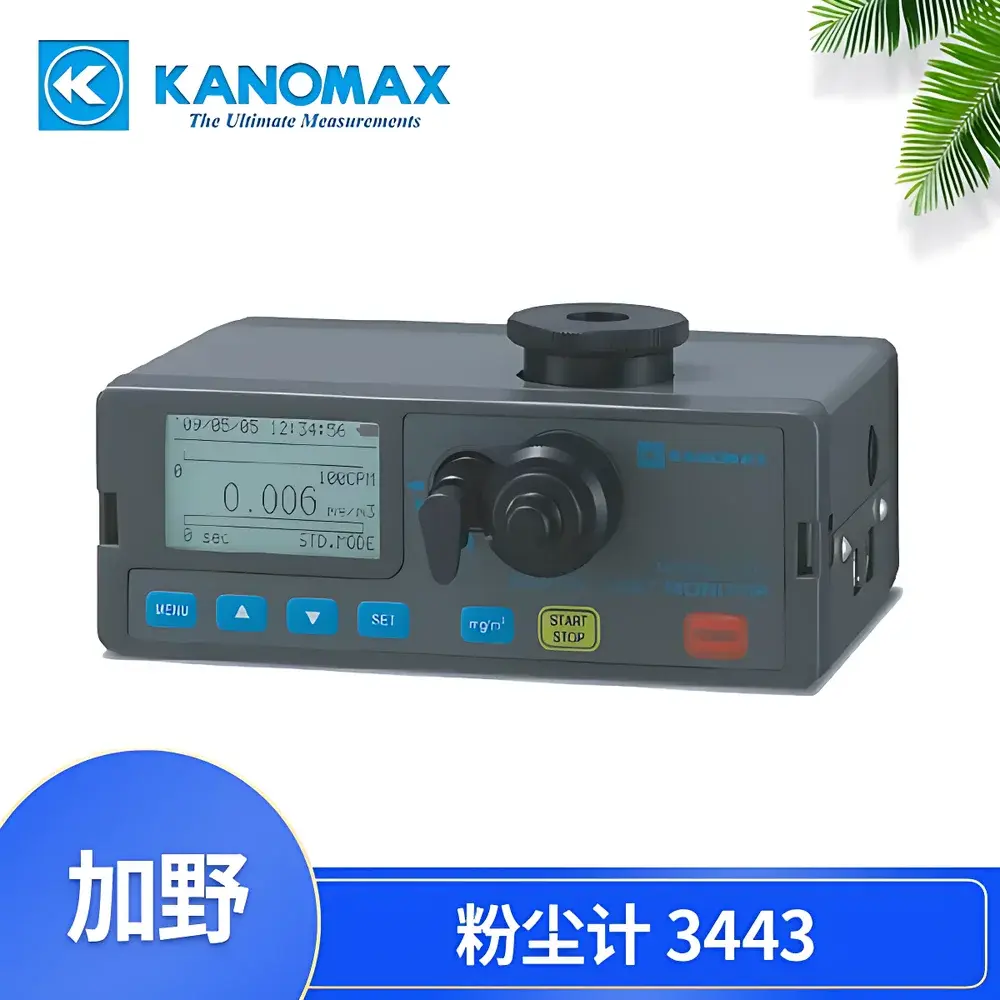
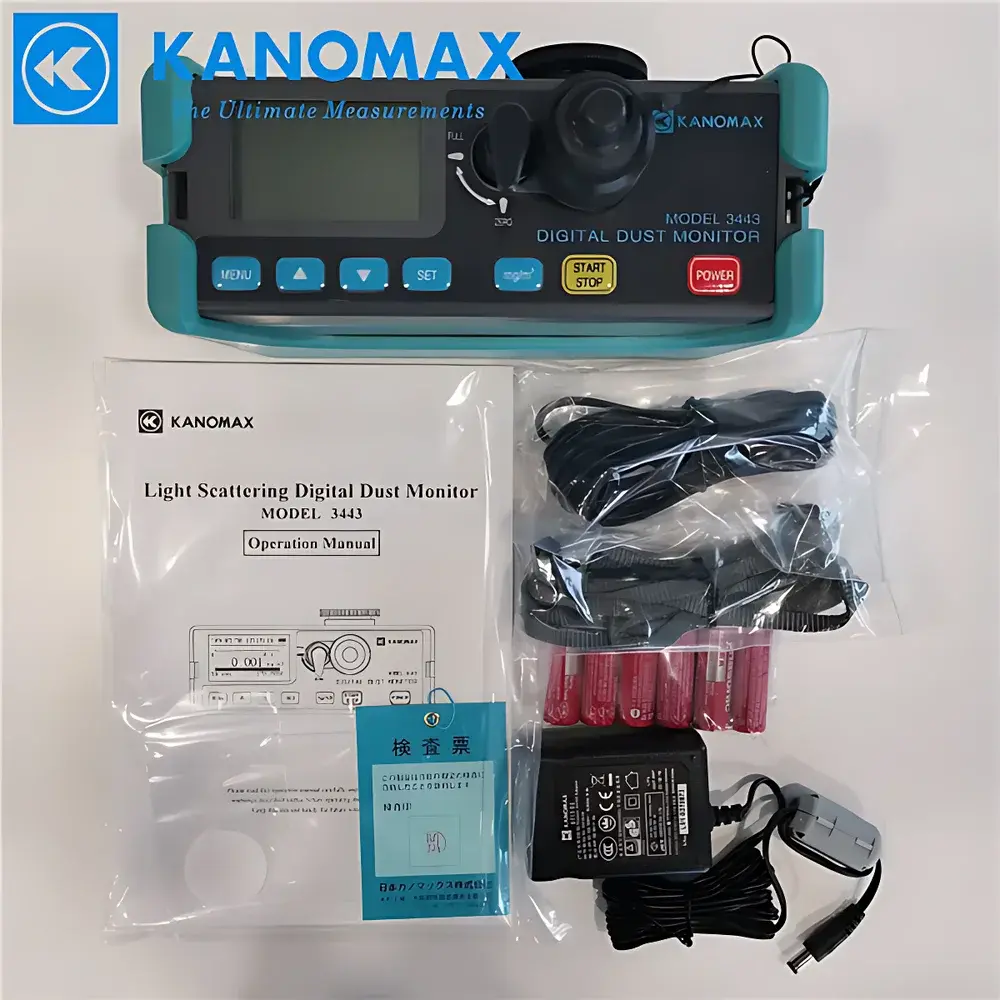
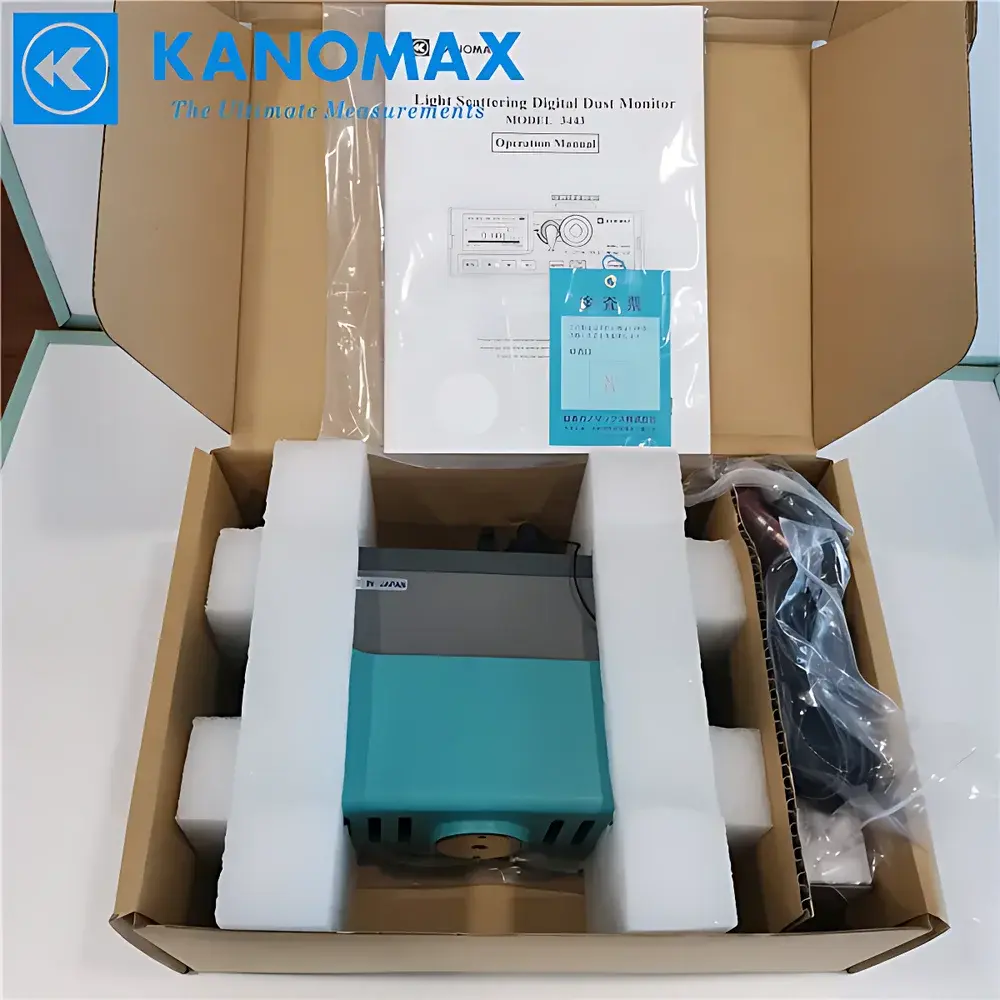
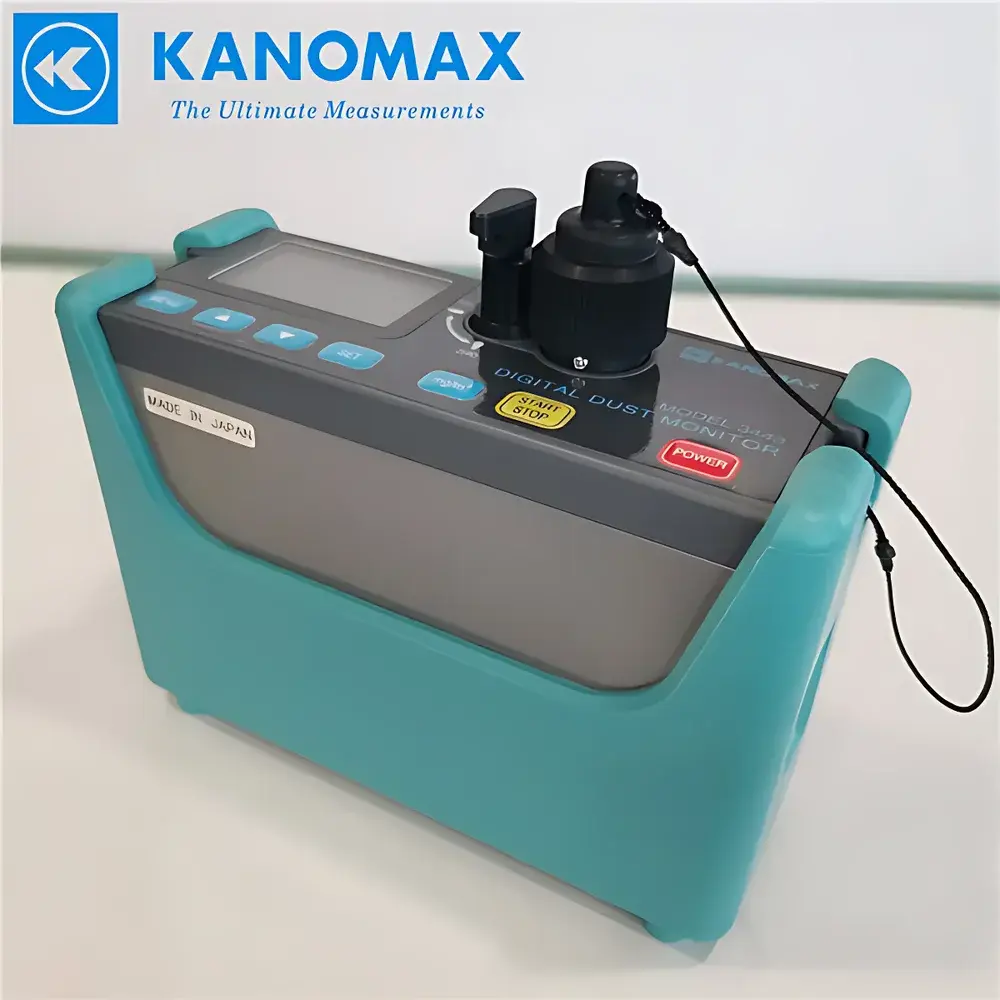
Kanomax Model 3443 Laser Scattering Dust Monitor
| Brand | Kanomax |
|---|---|
| Origin | Japan |
| Model | 3443 |
| Measurement Principle | Laser Light Scattering |
| Particle Size Range | 0.1–10 µm |
| Measurement Range | 0.001–10.000 mg/m³ |
| Data Storage Capacity | 100,000 records |
| Communication Interface | USB |
| Analog Output | 0–1 V (corresponding to 0–1,000 CPM or 0–10,000 CPM) |
| Dimensions | 162 mm (W) × 60 mm (D) × 109 mm (H) |
| Weight | Approx. 1.3 kg (including rechargeable battery) |
| Safety Classification | Non-explosion-proof |
Overview
The Kanomax Model 3443 Laser Scattering Dust Monitor is a portable, high-precision environmental monitoring instrument engineered for real-time quantitative measurement of airborne particulate mass concentration in occupational and ambient air settings. Based on the well-established principle of laser light scattering—where incident laser radiation interacts with suspended particles and generates scattered intensity proportional to particle size and concentration—the Model 3443 delivers rapid, repeatable mass concentration readings across the respirable and thoracic fraction range (0.1–10 µm aerodynamic diameter). Its optical design complies with Japanese Ministry of Health, Labour and Welfare (MHLW) PM10 reference methodology requirements, enabling direct comparability with regulatory compliance benchmarks. The device features an integrated pump with flow-controlled aspiration, ensuring consistent sampling volume and minimizing inlet bias under variable environmental conditions.
Key Features
- Compact, ergonomic housing (162 × 60 × 109 mm) and lightweight construction (~1.3 kg with rechargeable Li-ion battery) optimized for extended field use and handheld operation.
- Dual-range analog output (0–1 V) configurable for either 0–1,000 CPM or 0–10,000 CPM signal scaling, facilitating seamless integration into building management systems (BMS), data loggers, or PLC-based control networks.
- Onboard memory capable of storing up to 100,000 timestamped measurement records—including instantaneous values, min/max extremes, and arithmetic mean over user-defined intervals—without external power or host connection.
- USB 2.0 interface compliant with CDC/ACM class protocols, enabling direct communication with Windows- and macOS-based PCs for data export, firmware updates, and configuration via Kanomax’s proprietary PC software suite.
- Internal calibration traceability supported through factory-applied NIST-traceable reference aerosols (e.g., Arizona Test Dust, PSL spheres), with optional annual recalibration services available through Kanomax-certified service centers.
Sample Compatibility & Compliance
The Model 3443 is validated for continuous monitoring of non-hazardous, non-corrosive, non-oily aerosols in indoor air, workplace environments, and ambient outdoor locations. It meets JIS Z 8901:2017 (Testing dusts for industrial hygiene) and aligns with ISO 7708:1995 (Air quality — Particle size fraction definitions for health-related sampling) for PM10 mass assessment. While not intrinsically safe or explosion-proof, its non-sparking electronics and low-power operation make it suitable for general-purpose industrial hygiene applications outside Class I, Division 1 hazardous locations. Device firmware and data handling architecture support audit-ready documentation per GLP and ISO/IEC 17025 laboratory quality management system requirements.
Software & Data Management
Kanomax provides dedicated PC software compatible with Windows 10/11 and macOS 12+ for comprehensive data review, statistical analysis (e.g., time-weighted average, short-term exposure limit evaluation), and report generation in PDF or CSV format. All stored records include UTC timestamps, battery voltage status, and pump flow rate logs. Software supports user-defined alarm thresholds with visual and audible alerts, and enables batch export of raw CPM counts alongside calculated mg/m³ values using selectable density assumptions (e.g., 1.0 g/cm³ for mineral dust, 1.4 g/cm³ for coal dust). Audit trails—including operator ID, parameter changes, and data export events—are retained within the software database to satisfy FDA 21 CFR Part 11 electronic record integrity expectations where applicable.
Applications
- Occupational health monitoring in construction, mining, foundry, and pharmaceutical manufacturing facilities per OSHA 1910.1000 and ACGIH TLV® guidelines.
- Indoor air quality (IAQ) assessments in schools, hospitals, offices, and cleanroom support areas to verify HVAC filtration efficiency and identify infiltration sources.
- Real-time feedback during dust suppression trials, baghouse performance validation, and local exhaust ventilation (LEV) commissioning tests.
- Field validation of fixed-site ambient PM10 monitoring networks as part of EPA Method PS-11 or EN 12341-compliant QA/QC protocols.
- Research-grade particle exposure studies requiring portable, calibrated instrumentation with high temporal resolution (1-second update interval).
FAQ
Does the Model 3443 require periodic zero calibration in the field?
Yes—while factory-calibrated, users should perform a zero check using certified zero-air filters before each critical measurement session, especially after prolonged storage or transport-induced vibration.
Can the instrument measure PM2.5 separately from PM10?
No—the Model 3443 reports total mass concentration across the 0.1–10 µm detection range; it does not provide size-fractionated outputs. For PM2.5/PM10 differentiation, Kanomax recommends the Model 3887 cascade impactor-coupled system.
Is the USB interface compatible with Linux operating systems?
The device enumerates as a standard CDC ACM serial device; however, official Kanomax software is not provided for Linux. Command-line data retrieval is possible using libusb and documented ASCII protocol commands.
What is the recommended maintenance interval for the optical chamber?
Visual inspection and gentle cleaning with nitrogen gas or lens-grade tissue are advised every 200 operational hours or monthly—whichever occurs first—to prevent scatter signal drift due to dust accumulation.
Does the Model 3443 meet ISO 17025 accreditation requirements for accredited laboratories?
When operated under documented procedures, with traceable calibration certificates and maintained environmental controls (temperature, humidity), the Model 3443 may serve as a reference monitor within ISO/IEC 17025-accredited testing scopes—subject to individual laboratory validation and uncertainty budgeting per ISO/IEC 17025:2017 Clause 7.6.
Related Products







