
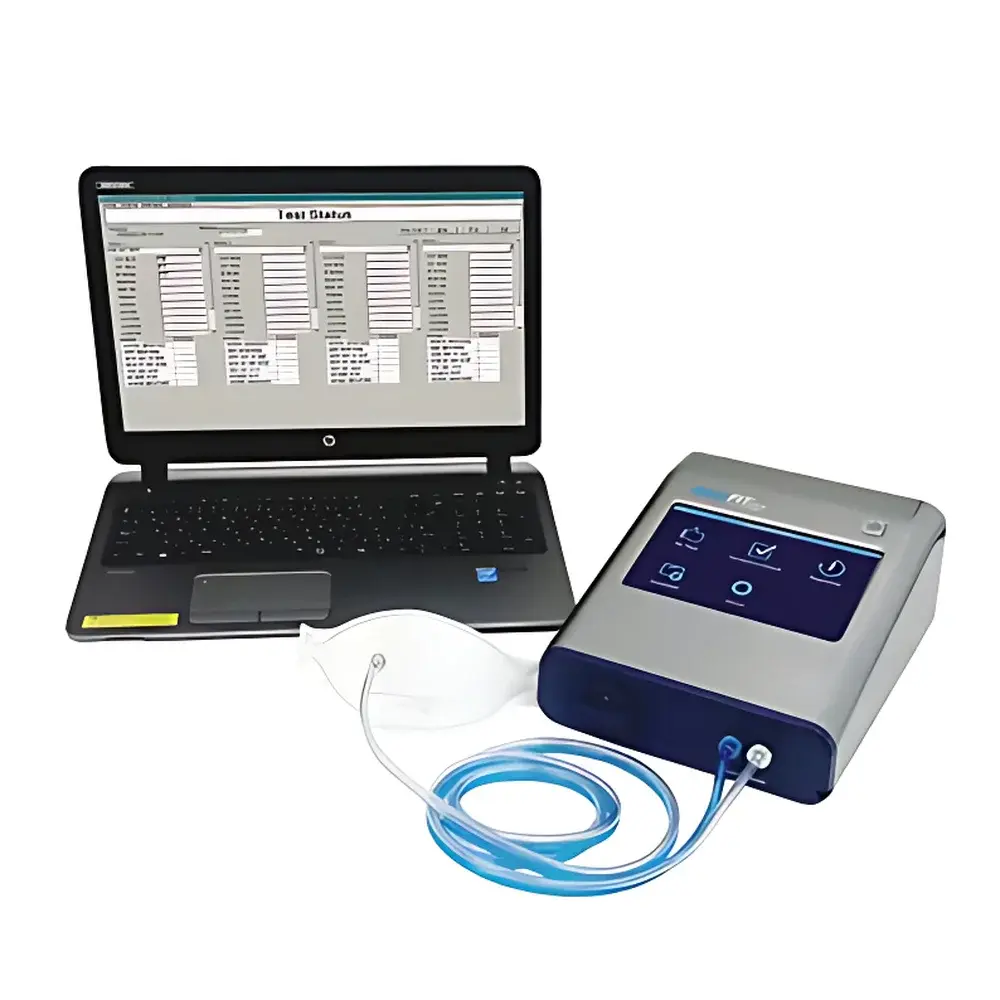
Kanomax AccuFIT 9000 Respirator Fit Testing System
| Brand | Kanomax |
|---|---|
| Origin | Japan |
| Model | AccuFIT 9000 |
| Particle Concentration Range | 0–100,000 particles/cm³ |
| Particle Size Range | 0.02–1.0 µm |
| Sampling Flow Rate | 100 cm³/min |
| Total Flow Rate | 700 cm³/min |
| Fit Factor Measurement Method | Direct (Cout/Cin) |
| Test Aerosol | 99.5% ethanol + analytical-grade isopropanol |
| Display | 7-inch full-color touchscreen |
| Communication Interfaces | USB (Host ×2, Device ×1), Ethernet ×1, Wi-Fi enabled |
| Operating Temperature | 15–35 °C |
| Power Supply | AC 110–240 V, 50/60 Hz |
| Dimensions | 208 × 117 × 262 mm |
| Weight | 2.1 kg |
| Supported Languages | English, French, Spanish, Portuguese, Chinese |
| Multi-unit Control | Up to 4 units simultaneously via single PC |
| Data Export Format | Microsoft Excel |
| Compliance | GB 2626–2019, GB 19083–2010, OSHA 1910.134, CSA Z94.4, ANSI/ASSP Z88.10 |
Overview
The Kanomax AccuFIT 9000 Respirator Fit Testing System is a precision-engineered, quantitative fit testing instrument designed for objective assessment of respirator-to-face seal integrity in occupational health, clinical, and regulatory compliance settings. It operates on the principle of ambient aerosol condensation nuclei counting (CNC), measuring the ratio of particle concentration outside (Cout) to that inside the respirator (Cin)—commonly expressed as the Fit Factor (FF). This real-time, direct measurement method eliminates subjective pass/fail judgments and provides traceable, numerical validation of respirator performance under actual wear conditions. Unlike qualitative methods (e.g., saccharin or irritant smoke tests), the AccuFIT 9000 delivers quantitative data required by OSHA 1910.134, CSA Z94.4, and China’s GB 2626–2019 and GB 19083–2010 standards—where minimum total fit factors of ≥100 are mandated for medical and industrial particulate respirators.
Key Features
- Quantitative CNC-based measurement with high-resolution particle detection across 0.02–1.0 µm size range, optimized for polydisperse challenge aerosols generated from ethanol/isopropanol mixture
- Integrated dual-flow architecture: precise 100 cm³/min sampling flow for respirator interior monitoring, plus 700 cm³/min total system flow for stable aerosol generation and chamber equilibrium
- 7-inch full-color resistive touchscreen interface supporting five languages (English, French, Spanish, Portuguese, Chinese) for global deployment in multilingual workplaces
- Multi-instrument network capability: one Windows-based PC can control up to four AccuFIT 9000 units simultaneously via USB Host or Ethernet, enabling high-throughput testing in large-scale respiratory protection programs
- Robust communication suite including three USB ports (two Host, one Device), Gigabit Ethernet, and optional Wi-Fi module for remote configuration, firmware updates, and centralized data logging
- Compliance-ready design: built-in audit trail support, timestamped test records, and Excel-formatted export ensure alignment with GLP/GMP documentation requirements and FDA 21 CFR Part 11 principles where electronic records are subject to review
Sample Compatibility & Compliance
The AccuFIT 9000 supports quantitative fit testing across a broad spectrum of negative-pressure respirators, including disposable filtering facepiece respirators (e.g., N95, KN95, KP95, P3, HEPA-rated), half-mask elastomeric respirators, and full-facepiece respirators. Its aerosol generation and sampling geometry are validated for use with both flat-fold and molded cup-style designs. The system meets mandatory regulatory thresholds defined in key international standards: minimum overall fit factor ≥100 per GB 19083–2010; pass criteria of TIL (Total Inward Leakage) ≤8% for KN95/KP95 and ≤2% for KN100/KP100 per GB 2626–2019; and OSHA-defined pass levels (FF ≥100 for half-masks, FF ≥500 for full-facepieces). All test protocols adhere to ISO 16900-1:2019 (Respiratory protective devices — Methods of test — Part 1: Determination of inward leakage) and ANSI/ASSP Z88.10-2019 Annex B.
Software & Data Management
The AccuFIT 9000 operates standalone or integrates seamlessly with Kanomax’s dedicated PC software (Windows 10/11 compatible), which provides full test sequence automation—including pre-test calibration verification, real-time FF visualization, motion artifact detection, and post-test statistical summary. Each test record includes operator ID, subject ID, respirator model, test date/time, ambient temperature/humidity (optional sensor input), and raw particle count logs at 1-second intervals. Data exports directly to .xlsx format with embedded metadata headers compliant with laboratory information management system (LIMS) ingestion protocols. Audit log entries capture all user actions—including parameter changes, test aborts, and calibration events—supporting internal quality audits and external regulatory inspections under ISO/IEC 17025 or CAP accreditation frameworks.
Applications
- Occupational health departments conducting annual or pre-placement respirator fit testing for healthcare workers, construction personnel, pharmaceutical manufacturing staff, and hazardous materials responders
- Hospital infection control units validating surgical N95 and medical-grade KN95 respirators against GB 19083–2010 fluid resistance and fit factor requirements
- Respirator manufacturers performing R&D validation and batch release testing in accordance with GB 2626–2019 Type II and Type I classification criteria
- Third-party certification laboratories providing accredited fit testing services under CNAS (China National Accreditation Service) or A2LA (American Association for Laboratory Accreditation)
- Academic research on facial anthropometry, respirator design optimization, and inhalation toxicology exposure modeling
FAQ
What aerosol agent does the AccuFIT 9000 use, and why is it preferred over sodium chloride or corn oil?
The system uses a controlled mixture of 99.5% ethanol and analytical-grade isopropanol, atomized to generate a stable, monodisperse-like ambient aerosol in the 0.02–1.0 µm range. This composition avoids hygroscopic growth artifacts seen with NaCl and eliminates residue buildup associated with oily challenge agents—ensuring consistent CNC detector response and extended maintenance intervals.
Can the AccuFIT 9000 perform both qualitative and quantitative fit tests?
No—it is exclusively a quantitative fit testing platform. Qualitative methods require separate sensory-based kits (e.g., Bitrex® or saccharin); the AccuFIT 9000 delivers only objective, numerically traceable fit factor data per OSHA and ISO requirements.
Is calibration required before each test session?
A quick zero-check using the included zero-count filter is recommended prior to daily use. Full factory calibration is performed annually or after any impact event, traceable to NIST-certified reference instruments.
Does the device meet FDA or CE marking requirements?
While not a medical device per FDA 21 CFR 866.2300, the AccuFIT 9000 complies with IEC 61010-1 safety standards and carries CE marking for EMC and low-voltage directive conformity. Its software architecture supports 21 CFR Part 11-compliant electronic signatures when deployed in regulated GxP environments.
How is subject motion handled during testing?
The system incorporates real-time motion artifact detection algorithms that monitor signal variance in Cin and Cout. Excessive deviation triggers audible alerts and flags affected time segments in the final report, ensuring only physiologically stable breathing cycles contribute to the final fit factor calculation.







