
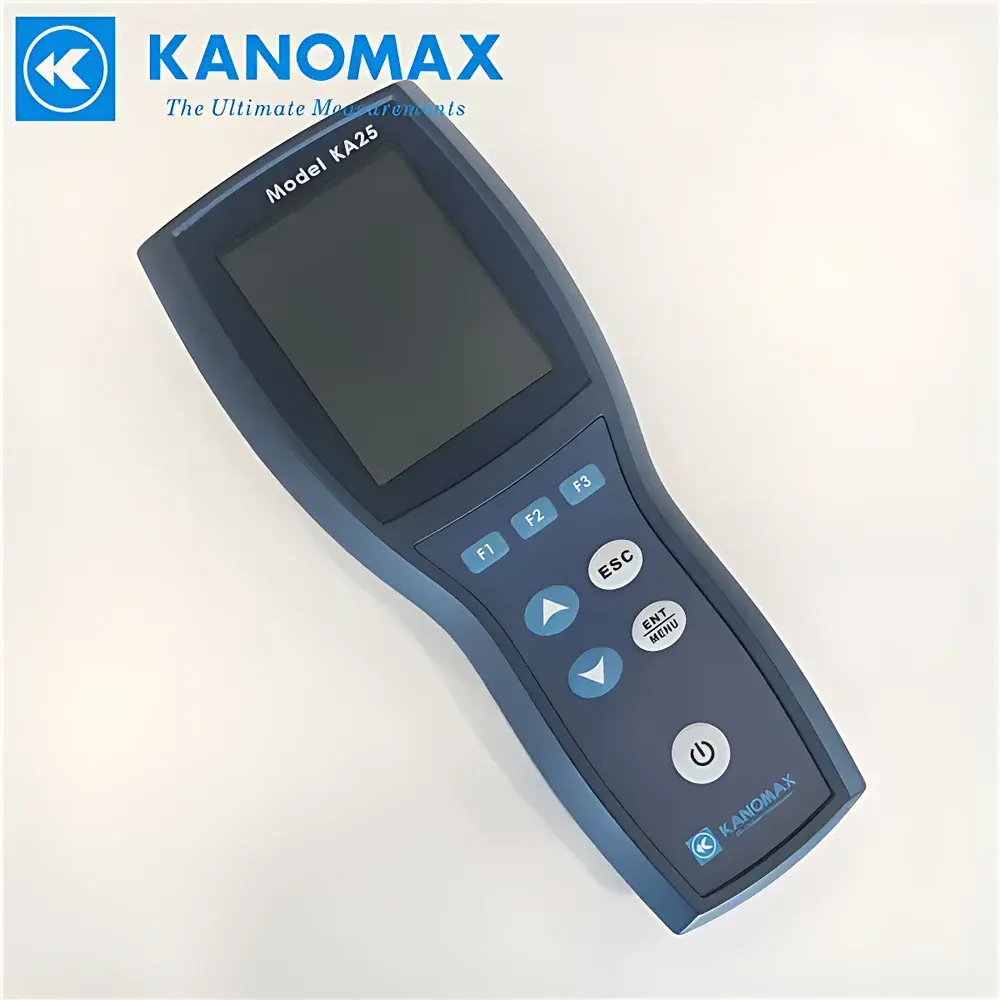
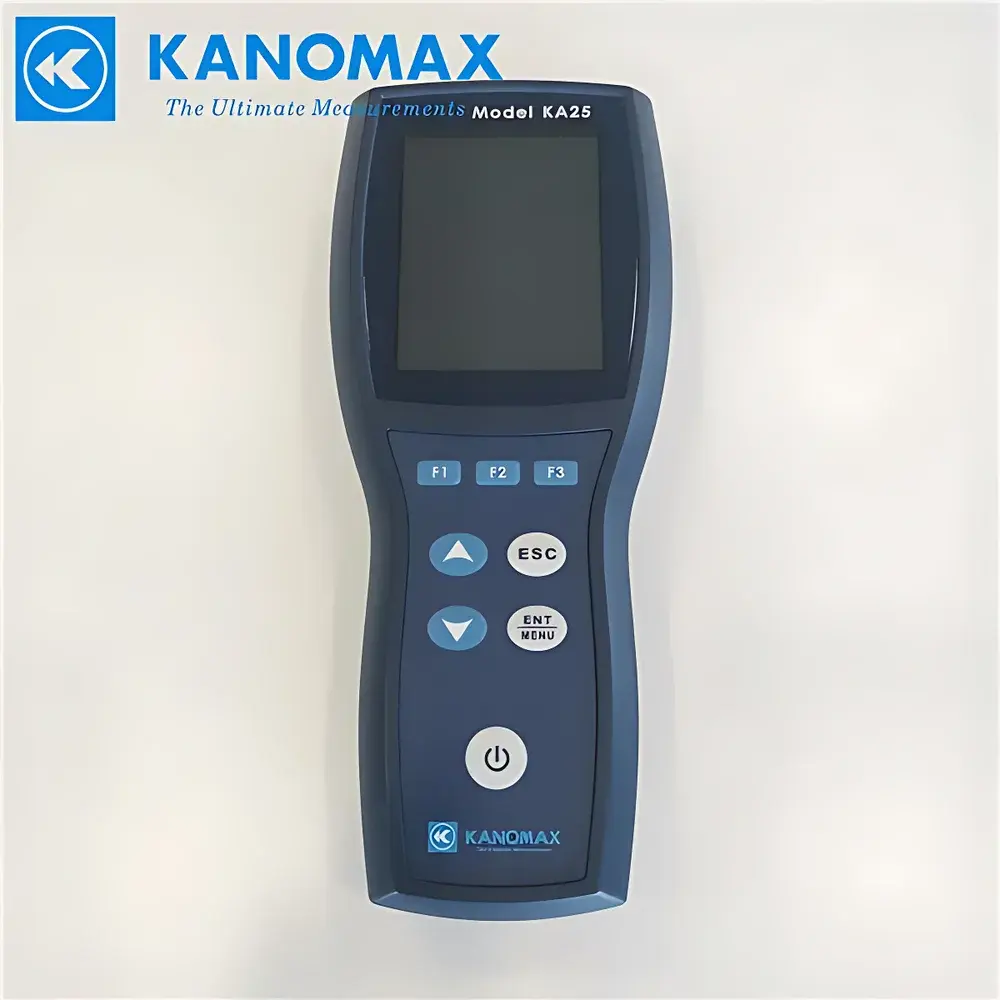
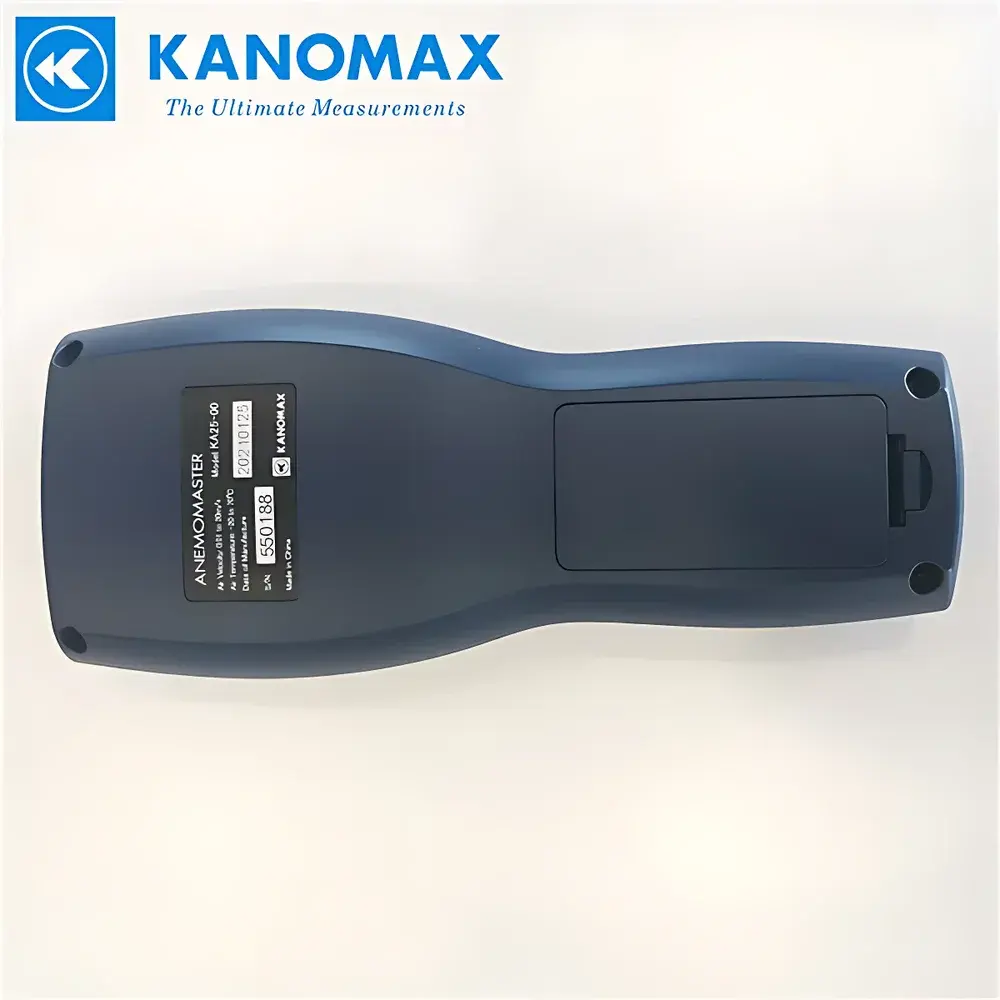
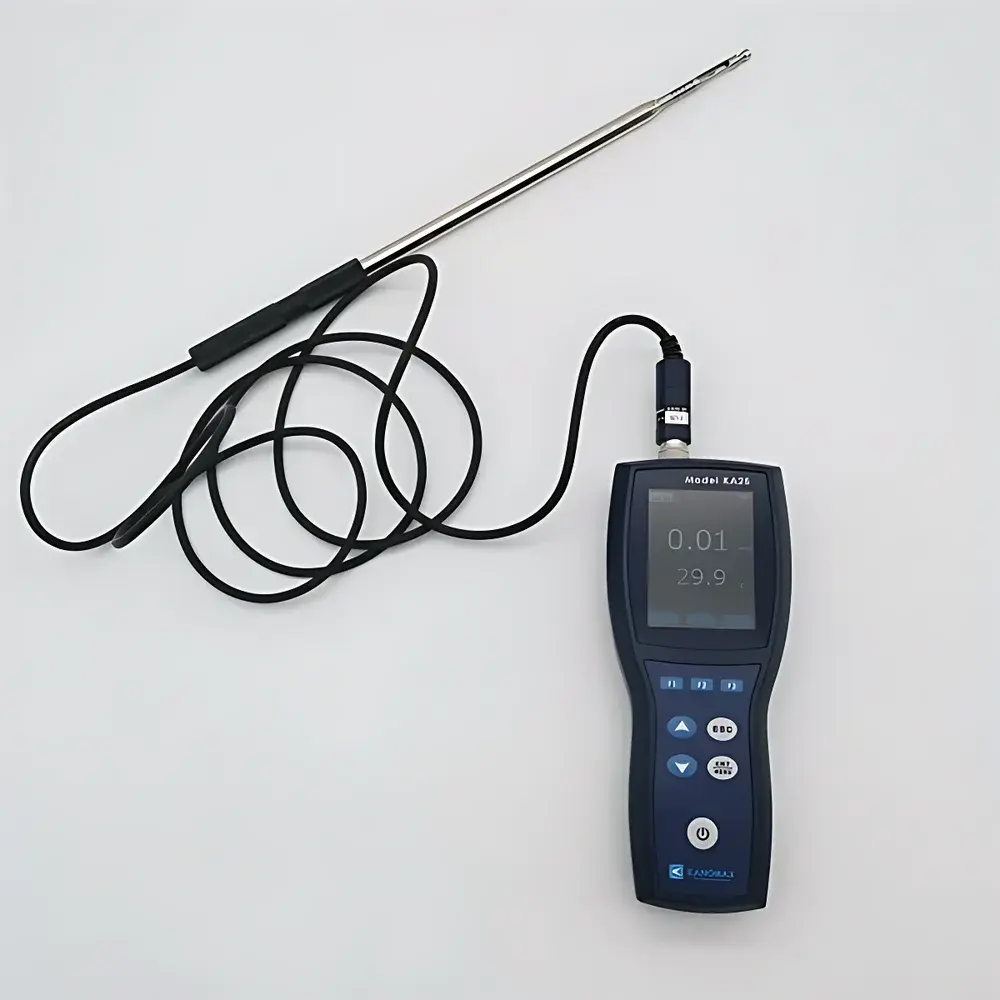
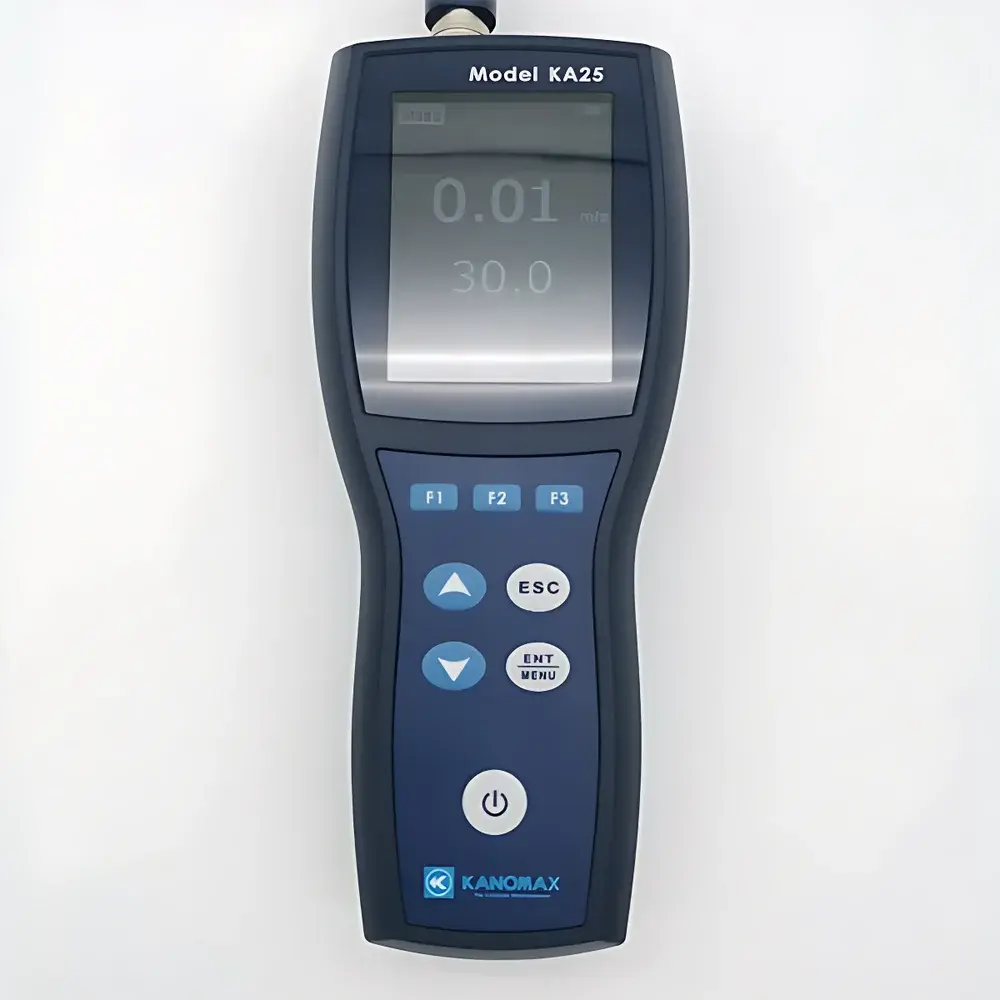
Kanomax KA25 Digital Thermal Anemometer
| Brand | Kanomax |
|---|---|
| Origin | Japan |
| Model | KA25 |
| Instrument Type | Thermal Anemometer |
| Resolution | 0.01 m/s |
| Measurement Range | 0.01–20.0 m/s |
| Accuracy | ±(3% of reading + 0.03 m/s) |
| Operating Temperature | −20 to 70 °C |
| Operating Humidity | 2–98% RH |
| Temperature Accuracy | ±0.5 °C (at wind speed > 0.5 m/s) |
| Temperature Resolution | 0.1 °C |
| Response Time (Wind Speed) | ~1 s (90% response at 1 m/s) |
| Response Time (Temperature) | ~30 s (90% response at 1 m/s) |
| Air Volume Calculation | Enabled (rectangular & circular ducts, dimensions 0.1–255.0 cm) |
| Data Hold, Min/Max/Avg Statistics, Adjustable Time Constant (1/5/10/20 s), Auto Power-Off (3/5/10 min), Backlit LCD (3-level), Power | 4 × AA alkaline batteries (~15 h operation), Unit Weight: ~220 g (without batteries), Probe Dimensions: Ø6 mm (sensor) / Ø14 mm (handle) × 294–1060 mm, Cable Length: 2000 mm, Body Dimensions: 200 × 85 × 40 mm |
Overview
The Kanomax KA25 Digital Thermal Anemometer is a precision-engineered handheld instrument designed for reliable, real-time measurement of air velocity and temperature in HVAC commissioning, indoor air quality (IAQ) assessments, cleanroom validation, and industrial ventilation audits. Based on constant-temperature anemometry (CTA), the KA25 employs a thermally sensitive micro-sensor whose heat dissipation correlates directly with local airflow velocity—enabling high-resolution detection down to 0.01 m/s across a broad dynamic range (0.01–20.0 m/s). Its thermal sensing architecture eliminates moving parts, ensuring long-term stability and resistance to mechanical wear under repeated field use. Integrated temperature measurement (−20.0 to 70.0 °C) supports simultaneous environmental profiling, while built-in duct geometry recognition allows direct volumetric airflow calculation (m³/h) without external software or manual conversion—critical for rapid compliance checks against ASHRAE Standard 111, ISO 16813, or EN 13779.
Key Features
- Thermal anemometry principle with platinum-resistance sensor for high sensitivity and low drift
- Simultaneous wind speed and ambient temperature acquisition with dual-channel digital processing
- Real-time air volume computation for rectangular and circular ducts (dimension input range: 0.1–255.0 cm)
- Configurable time constant (1 s / 5 s / 10 s / 20 s) to optimize response dynamics for turbulent vs. laminar flow conditions
- On-device statistical functions: minimum, maximum, and average values over user-defined sampling intervals
- Three-level adjustable backlight LCD with intuitive icon-driven interface and battery-level indicator
- Ergonomic telescoping and bendable probe (Ø6 mm sensing tip, Ø14 mm handle, 294–1060 mm extended length) for access to confined or irregular duct geometries
- Auto power-off with selectable timeout (3 / 5 / 10 minutes) and data-hold function for transient measurements
- Rugged, portable design (220 g, no batteries) with IP54-rated probe housing and protective carrying case included
Sample Compatibility & Compliance
The KA25 is calibrated and validated for use with clean, non-corrosive, particle-free ambient air—making it suitable for laboratories, pharmaceutical cleanrooms (ISO Class 5–8), hospital HVAC systems, and office building IAQ surveys. It is not intended for use in saturated steam, explosive atmospheres, or environments containing oil mist, condensate, or abrasive particulates (>1 µm). The instrument complies with IEC 61000-4 electromagnetic compatibility standards and meets general safety requirements per IEC 61010-1 for hand-held electrical measurement equipment. While not certified to FDA 21 CFR Part 11, its data logging capabilities (manual hold + visual trace) support GLP-aligned documentation when paired with controlled observation protocols and handwritten audit trails.
Software & Data Management
The KA25 operates as a standalone field instrument with no embedded memory or PC connectivity. All measurement data remain visible only on the LCD during active use; values can be manually recorded or photographed for traceability. The absence of internal storage or wireless transmission aligns with security-sensitive environments where data sovereignty and air-gapped instrumentation are required (e.g., classified facilities or regulated manufacturing zones). For archival purposes, users may integrate KA25 readings into validated electronic lab notebooks (ELNs) or LIMS platforms via structured manual entry—ensuring full audit trail integrity under ISO/IEC 17025 or GMP Annex 11 guidelines.
Applications
- HVAC system balancing and airflow verification in commercial and institutional buildings
- Cleanroom air change rate (ACH) validation per ISO 14644-3 and EU GMP Annex 1
- Exhaust hood face velocity testing (e.g., fume hoods, biosafety cabinets) per ANSI/ASHRAE 110
- Indoor air quality baseline studies and occupant thermal comfort assessments (PMV/PPD modeling inputs)
- Filter leakage scanning support through upstream/downstream velocity profiling
- Industrial process ventilation monitoring—including drying ovens, paint booths, and powder coating lines
- Educational laboratory instruction for fluid mechanics and environmental engineering curricula
FAQ
What is the recommended calibration interval for the KA25?
Kanomax recommends annual calibration against NIST-traceable standards in accordance with ISO/IEC 17025-accredited laboratories. Field verification using zero-air and reference velocity sources (e.g., calibrated wind tunnel or rotating vane standard) is advised before critical measurements.
Can the KA25 measure airflow in wet or humid environments?
Yes—the probe is rated for operation up to 98% RH. However, prolonged exposure to condensation or liquid ingress may affect sensor accuracy and longevity. Avoid submersion or direct water contact.
Is the probe interchangeable with other Kanomax models?
The KA25 probe uses a proprietary connector and is not cross-compatible with KA32, KA41, or older analog probes. Replacement probes must be ordered as Kanomax P/N KA25-PROBE.
Does the KA25 meet ISO 5801 or AMCA 210 duct testing requirements?
While the KA25 provides accurate point-velocity data, full duct traverse compliance per ISO 5801 requires multi-point grid mapping and integration software—not supported natively. It serves best as a verification tool within broader standardized test plans.
How does temperature compensation affect wind speed accuracy?
The KA25 applies real-time thermal offset correction based on concurrent temperature readings. At wind speeds above 0.5 m/s, combined uncertainty remains within ±0.5 °C for temperature and ±(3% rdg + 0.03 m/s) for velocity—validated across its full operating temperature range (−20 to 70 °C).
Related Products







