
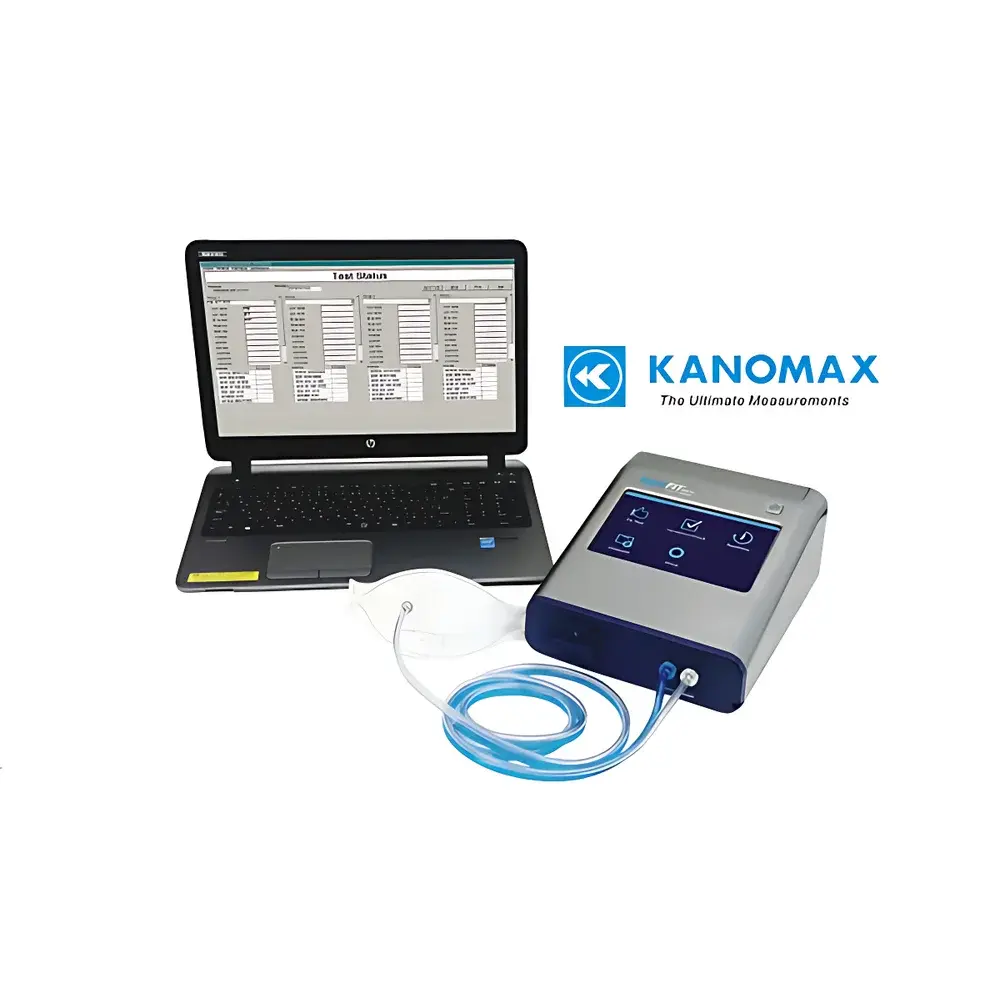
Kanomax AccuFIT 9000 Respirator Fit Testing System
| Brand | Kanomax |
|---|---|
| Origin | Japan |
| Model | AccuFIT 9000 |
| Compliance | GB 2626–2019, GB 19083–2010, OSHA 29 CFR 1910.134, CSA Z94.4, NIOSH-approved fit test protocols |
| Test Method | Controlled Negative Pressure (CNP) / Ambient Aerosol Condensation Nucleus Counting (CNC) |
| Supported Respirator Types | Disposable particulate respirators (N95, KN95, KP95, N100, KN100), half-face and full-face elastomeric respirators, powered air-purifying respirators (PAPRs) |
| TIL (Total Inward Leakage) Evaluation Basis | Per-test subject (10-subject panel), per-operation (5 operations × 10 subjects), pass thresholds per standard (e.g., KN95/KP95: TIL < 8% for ≥8 of 10 subjects) |
| Interface Options | USB 2.0, Ethernet, Wi-Fi (IEEE 802.11 b/g/n), multi-language UI (English, Chinese, Japanese, Korean, Spanish) |
| Software Control | Standalone operation or PC-synchronized control (up to 4 units per host) |
Overview
The Kanomax AccuFIT 9000 is a precision-engineered respirator fit testing system designed to quantitatively evaluate the total inward leakage (TIL) of particulate-filtering and gas/vapor-filtering respirators under real-world wearing conditions. It employs the Ambient Aerosol Condensation Nucleus Counter (CNC) method—a standardized, real-time, particle-counting technique that measures ultrafine ambient aerosols (typically 20–100 nm) both outside and inside the respirator facepiece during normal breathing cycles. Unlike qualitative methods (e.g., saccharin or irritant smoke), the AccuFIT 9000 delivers objective, numerical TIL values traceable to ISO 16900-1:2016 and aligned with OSHA 29 CFR 1910.134 Appendix A, CSA Z94.4–22, and China’s GB 2626–2019 and GB 19083–2010 regulatory frameworks. Its dual-sensor architecture—comprising an external environmental probe and an internal facepiece sampling line with heated isokinetic sampling—ensures minimal condensation artifact and high reproducibility across diverse climatic conditions (15–30°C, 30–70% RH). The system is not a filtration efficiency tester; rather, it assesses the functional integrity of the respirator-to-face seal—the most critical determinant of actual user protection.
Key Features
- Real-time CNC-based TIL measurement with sub-10 nm detection sensitivity and <±5% inter-unit repeatability (per ISO 16900-3 verification protocol)
- Comprehensive respirator compatibility: certified for disposable filtering facepiece respirators (FFRs) including N95, KN95, KP95, N100, and P3-class masks, as well as reusable half-mask and full-face elastomeric respirators and PAPRs
- Dual operational modes: fully autonomous standalone testing with integrated color touchscreen interface, or synchronized PC-controlled operation via Kanomax FitTest Pro software
- Multi-language graphical user interface supporting English, Simplified Chinese, Japanese, Korean, and Spanish—configured without firmware reload
- Network-ready architecture with native USB 2.0, 10/100BASE-T Ethernet, and IEEE 802.11 b/g/n Wi-Fi connectivity; enables centralized fleet management and remote calibration status monitoring
- Scalable deployment: one host PC can concurrently manage up to four AccuFIT 9000 units with independent subject queues, time-stamped audit logs, and synchronized report generation
Sample Compatibility & Compliance
The AccuFIT 9000 is validated for use with all respirator classes requiring quantitative fit testing under occupational health and safety regulations. It meets the technical performance requirements of ISO 16900-1:2016 (Part 1: Test methods for determining fit), ANSI/ASSP Z88.10–2022 (Method 3 – Ambient Aerosol CN Counting), and the respirator certification annexes of GB 2626–2019 (China) and GB 19083–2010 (medical-grade surgical N95 equivalents). For medical applications, its TIL pass criteria align with the mandatory threshold of ≥100 fit factor (FF) or ≤1% TIL for KN95/KP95 respirators—verified across a minimum 10-subject panel per GB 2626–2019 Clause 6.5.2. All test sequences include built-in leak-check routines, flow-rate validation (40–90 L/min breathing simulation), and automatic environmental aerosol background subtraction. Device firmware and calibration certificates are maintained in accordance with ISO/IEC 17025:2017 laboratory quality management principles.
Software & Data Management
Kanomax FitTest Pro software (v3.2+) provides GxP-aligned data governance for regulated environments. It supports 21 CFR Part 11-compliant electronic signatures, role-based access control (administrator, operator, reviewer), and immutable audit trails recording every test initiation, parameter modification, result export, and user login event. Test reports are generated in PDF/A-1b format with embedded digital signatures, full metadata (subject ID, respirator model/lot, test date/time, ambient conditions, raw particle counts, calculated FF/TIL), and optional integration with LIMS via HL7 or CSV export. All data files are encrypted at rest using AES-256 and may be archived to network-attached storage or cloud repositories meeting HIPAA or GDPR retention policies. Software updates are delivered through signed firmware packages verified via SHA-256 hash integrity checks.
Applications
The AccuFIT 9000 serves as a primary quantitative fit testing platform in clinical infection control programs, industrial hygiene departments, emergency response units, and third-party conformity assessment laboratories. In hospitals, it verifies the seal integrity of GB 19083–2010-compliant medical N95 respirators prior to high-risk aerosol-generating procedures. In manufacturing and construction, it validates compliance with OSHA-mandated annual respirator fit testing for workers exposed to silica, welding fumes, or organic vapors. Fire departments deploy it for SCBA facepiece verification under thermal stress conditions (with optional heated sampling line kit). Academic research labs utilize its high-temporal-resolution particle counting capability for facial anthropometry studies, respirator design iteration, and comparative leakage pathway analysis using computational fluid dynamics (CFD) correlation datasets.
FAQ
Does the AccuFIT 9000 require challenge aerosols or generated particles?
No—it exclusively uses ambient airborne nanoparticles present in typical indoor environments, eliminating the need for artificial aerosol generators, consumables, or associated safety protocols.
Can it test respirators certified to both NIOSH and GB standards?
Yes—the instrument’s TIL calculation engine applies configurable pass/fail logic per selected standard (e.g., OSHA FF ≥100 vs. GB 2626–2019 TIL ≤8% for KN95), with no hardware modification required.
Is calibration traceable to national metrology institutes?
Yes—factory calibration is NIST-traceable for flow sensors and CPC gain response; on-site verification kits (including reference aerosol generators and calibrated flow meters) are available under Kanomax Calibration Service Agreement.
What is the minimum recommended subject cohort size for compliance reporting?
Per GB 2626–2019 and ISO 16900-1, a minimum of 10 human test subjects is required for statistical validity of respirator model qualification; the AccuFIT 9000 stores full individual datasets for each subject within a single test session.
How is data integrity preserved during network transmission?
All Ethernet and Wi-Fi communications use TLS 1.2+ encryption; device-to-PC synchronization employs digitally signed JSON payloads with HMAC-SHA256 message authentication codes to prevent tampering or replay attacks.
Related Products







