
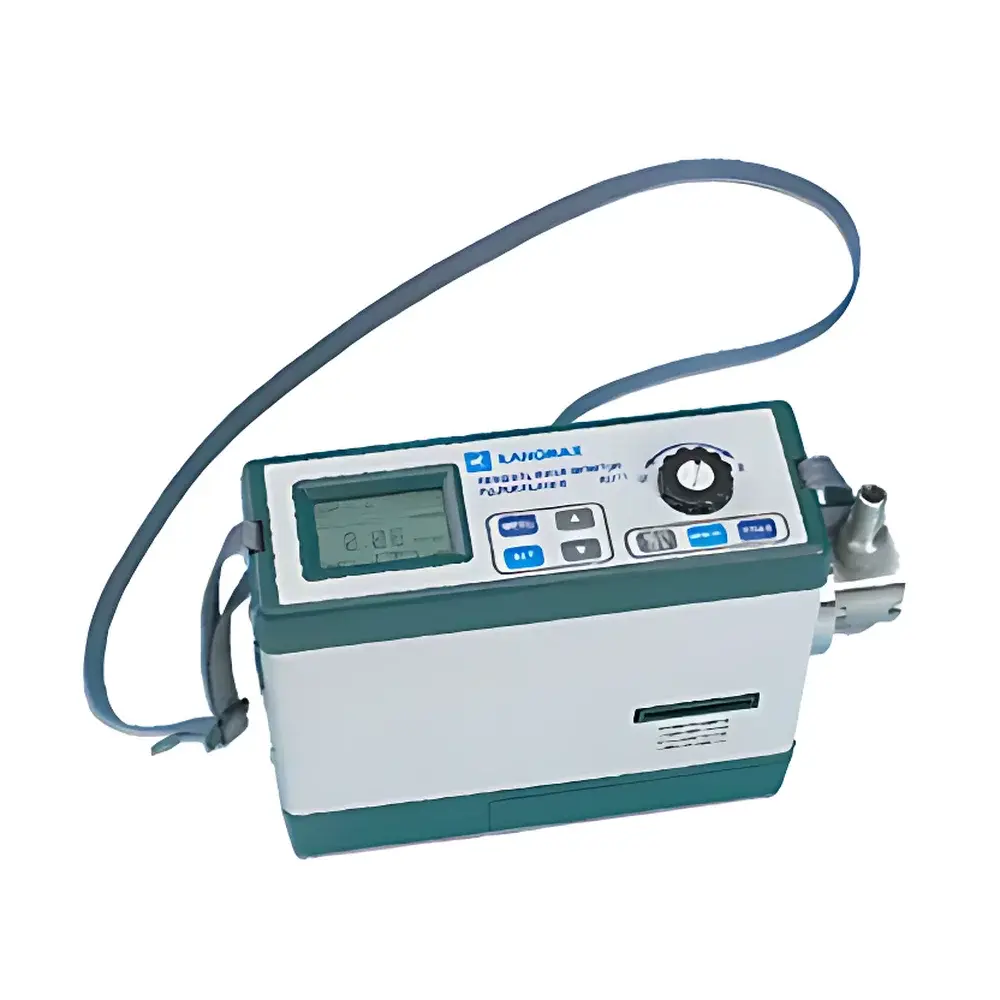
Kanomax KD11 Piezoelectric Microbalance PM2.5 Dust Monitor
| Brand | Kanomax |
|---|---|
| Origin | Japan |
| Model | KD11 |
| Measurement Principle | Tapered Element Oscillating Microbalance (TEOM™-style piezoelectric resonant frequency shift) |
| Safety Rating | Non-explosion-proof |
| Measurement Range | 0.01–10.00 mg/m³ |
| Resolution | 0.01 mg/m³ |
| Accuracy | ±10% of reading |
| Relative Error | ≤ ±2% |
| Data Storage Capacity | 500 records |
| Communication Interface | RS-232C |
| Configurable Sampling Interval | 10–3600 seconds (preset options: 24 s, 120 s) |
| Cleaning Alert | Auto-notification upon crystal mass loading threshold exceedance |
Overview
The Kanomax KD11 is a compact, laboratory- and field-deployable piezoelectric microbalance dust monitor engineered for continuous, real-time quantification of airborne particulate mass concentration—specifically targeting PM2.5 and PM10 fractions. Unlike optical scattering or beta attenuation methods, the KD11 employs a tapered quartz crystal oscillator operating at its fundamental resonant frequency; particulate deposition on the crystal surface induces a measurable, linear frequency shift proportional to accumulated mass per unit area. This principle—rooted in the Sauerbrey equation—enables direct gravimetric measurement without reliance on particle optical properties or density assumptions. The instrument is calibrated using NIST-traceable aerosol standards and is suitable for ambient air quality monitoring, occupational hygiene assessments, indoor air quality (IAQ) verification, and process exhaust screening where regulatory-grade gravimetric equivalence is required.
Key Features
- Piezoelectric resonant sensor with high-stability AT-cut quartz crystal for repeatable mass-sensitive detection
- Real-time output of PM2.5 and PM10 equivalent mass concentrations (mg/m³) with 0.01 mg/m³ resolution
- Configurable sampling duration from 10 seconds to 3600 seconds, supporting both rapid spot checks and extended averaging protocols
- Onboard memory storing up to 500 timestamped measurement records with date/time stamping
- RS-232C serial interface compliant with EIA/TIA-232 standards, enabling direct connection to PCs or data loggers
- Integrated cleaning alert system: triggers visual/audible notification when crystal loading exceeds pre-defined mass threshold, ensuring measurement integrity
- Tool-free crystal module design for rapid, contamination-free replacement or cleaning—no solvent immersion required
- Compact, portable housing rated IP20 for indoor and controlled-environment use; non-explosion-proof classification limits deployment to non-hazardous locations
Sample Compatibility & Compliance
The KD11 is compatible with ambient air, filtered workplace air, and conditioned HVAC duct streams. It does not require inlet heating, impactors, or virtual impactors for size-selective sampling; instead, it relies on an integrated cyclone (model-specific accessory, sold separately) to physically separate PM10 or PM2.5 fractions upstream of the sensor. While the KD11 itself is not certified to ISO 12103-1 or EN 12341 as a standalone reference method, its measurement methodology aligns with the physical principles underpinning gravimetric reference samplers (e.g., EPA Method PS-1, ISO 7708). Data generated may serve as indicative or trend-monitoring input within QA/QC programs compliant with OSHA 29 CFR 1910.1200 (HCS), ACGIH TLV® assessment frameworks, or ISO 16000-18 for indoor air investigations. Device firmware and data handling support audit-ready operation under GLP conditions when paired with validated communication software.
Software & Data Management
Kanomax provides dedicated Windows-compatible communication software (KD11 Utility Suite v3.x or later) for bidirectional data exchange. The software enables full download of stored records—including raw frequency shift values, calculated concentrations, timestamps, and sampling interval metadata. Export formats include CSV and plain-text for integration into LIMS, statistical analysis platforms (e.g., JMP, Minitab), or regulatory reporting templates. All data transfers are logged with operator ID, session time, and action type (e.g., “data export”, “memory clear”)—supporting basic traceability requirements. While the KD11 does not natively comply with FDA 21 CFR Part 11 electronic signature or audit trail mandates, its data export workflow can be embedded within validated SOPs for regulated environments where raw data archival and reviewer sign-off are managed externally.
Applications
- Ambient air quality monitoring networks requiring low-maintenance, mid-tier particulate mass tracking
- Occupational exposure assessment in manufacturing, construction, and mining support zones
- Indoor air quality baseline studies in schools, hospitals, and office buildings
- Filter efficiency validation and baghouse leak detection in industrial ventilation systems
- Research-grade exposure chamber characterization and aerosol generation calibration
- Educational laboratories demonstrating real-time gravimetric aerosol measurement principles
FAQ
Does the KD11 meet U.S. EPA Federal Reference Method (FRM) or Federal Equivalent Method (FEM) requirements?
No—the KD11 is not EPA-designated as an FRM or FEM device. It serves as a performance-equivalent indicator instrument for screening and trend analysis, not regulatory compliance measurement.
Can the KD11 measure PM1.0 or ultrafine particles (<100 nm)?
No. Without a dedicated diffusion battery or electrostatic classifier upstream, the KD11—like all tapered element microbalances—lacks inherent size selectivity below ~2.5 µm aerodynamic diameter.
Is the crystal sensor replaceable by the user?
Yes. The quartz crystal assembly is a field-replaceable module; Kanomax supplies calibrated spare crystals (part no. KD11-CRYSTAL) with individual calibration certificates.
What maintenance intervals are recommended?
Crystal cleaning is triggered by the onboard alert; routine inspection of inlet nozzle and cyclone (if used) is advised every 72 operational hours in high-dust environments.
Does the device support analog output or Ethernet connectivity?
No. The KD11 offers RS-232C only; external protocol converters (e.g., RS-232 to Modbus RTU) may be integrated via third-party gateways.
Related Products







