

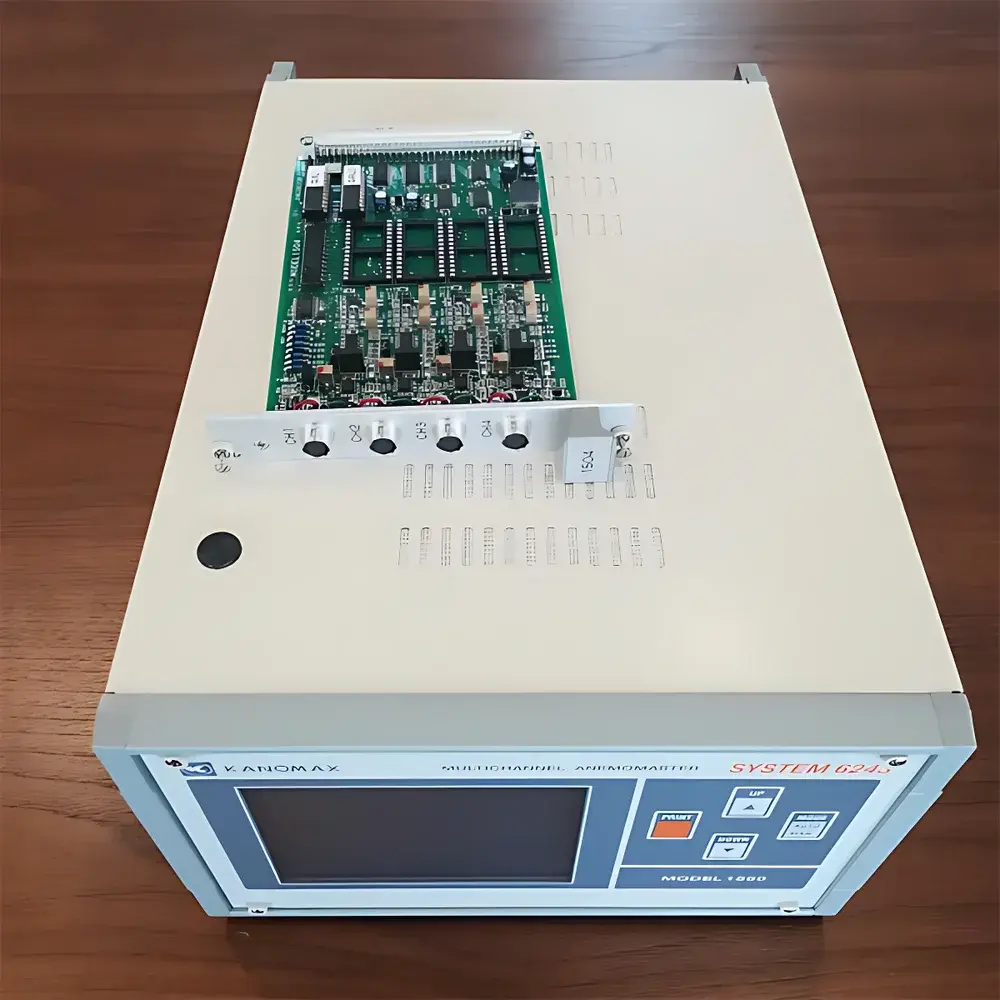
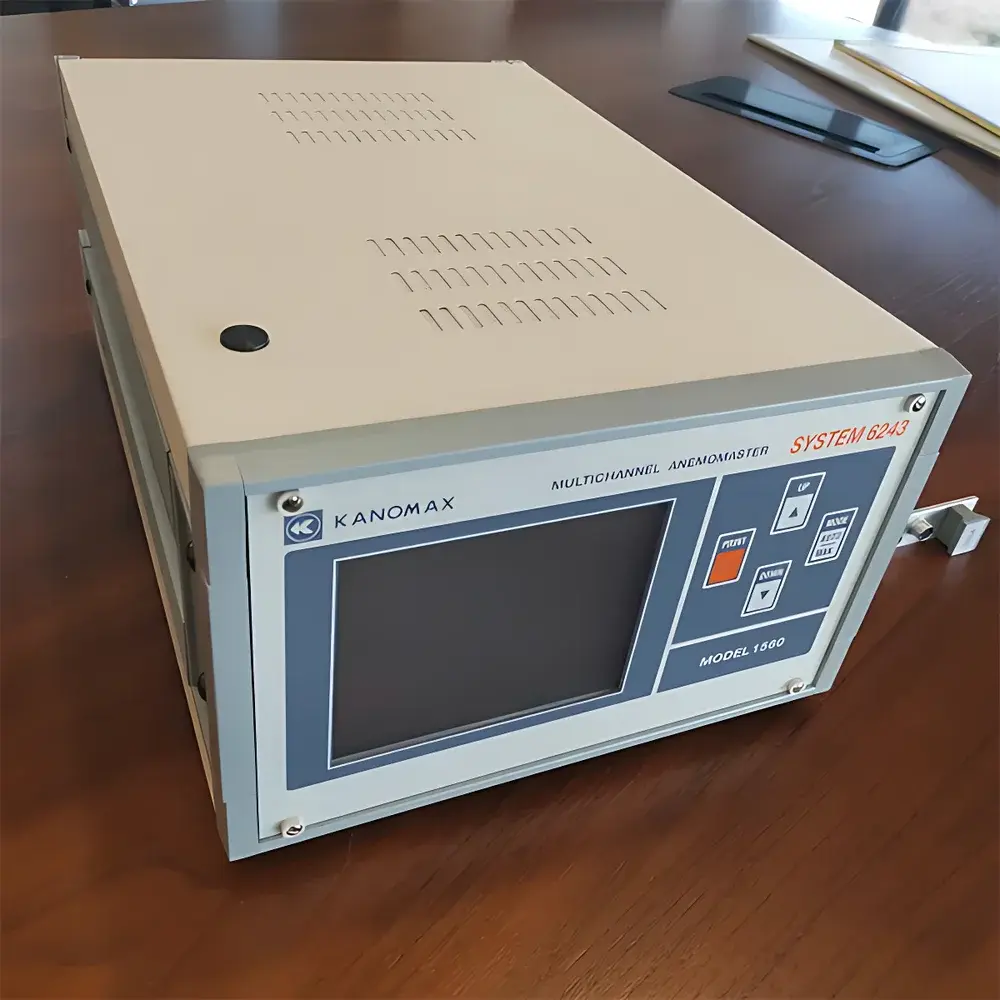
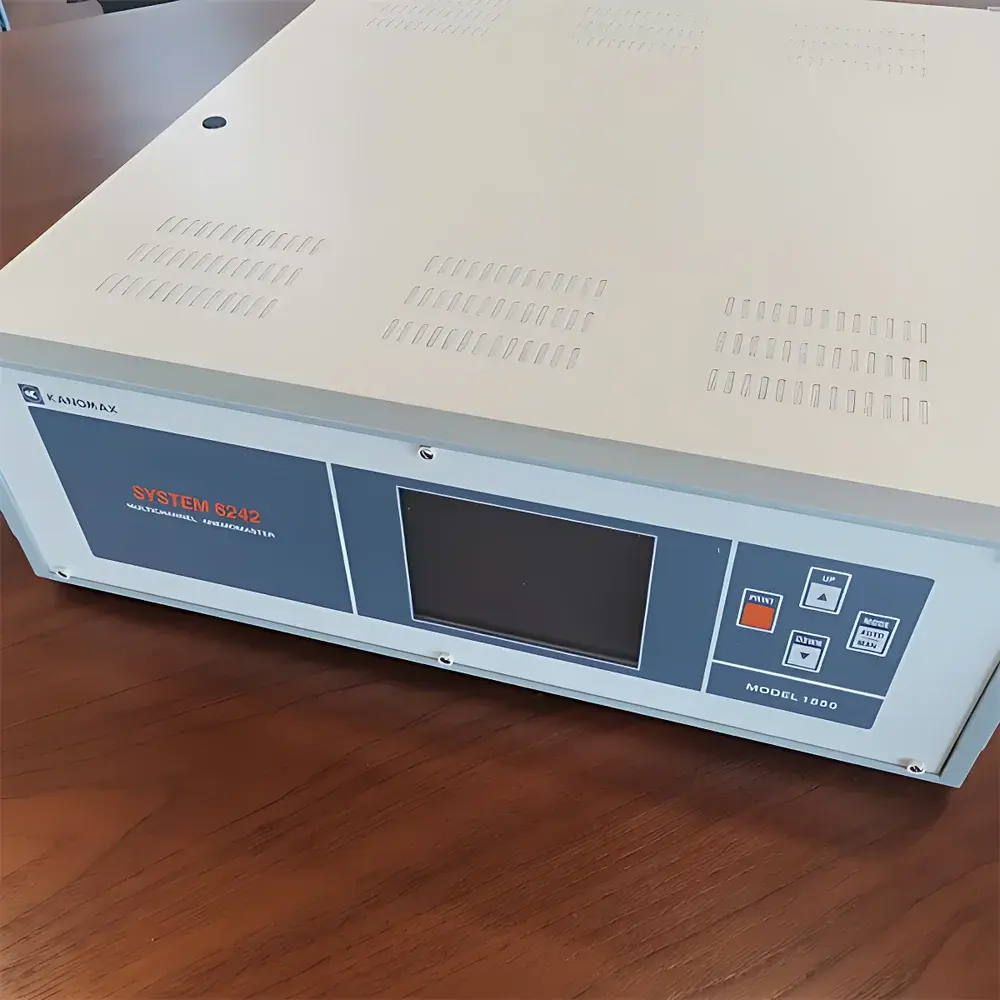
Kanomax 6242/6243 Multi-Point Thermal Anemometer System
| Brand | Kanomax |
|---|---|
| Origin | Liaoning, China |
| Manufacturer Type | Authorized Distributor |
| Country of Origin | China |
| Model | 6242/6243 |
| Instrument Type | Thermal Anemometer |
| Resolution | 0.01 m/s |
| Measurement Range | Probe-Dependent (see probe specifications) |
| Accuracy | ±0.5% FS |
| Operating Temperature | 0–70 °C |
| Operating Humidity | 0–100% RH |
| Pressure Range | 0 to ±5 kPa |
| Pressure Accuracy | ±0.03 kPa (0–2 kPa), ±0.10 kPa (2–5 kPa) |
| Analog Output | 0–5 V (configurable: 0–2.5 V, 0–10 V) |
| Output Accuracy | ±0.5% FS |
| Communication Interface | RS-232C |
| Power Supply | AC 100–240 V, 50/60 Hz |
| Dimensions (Model 1550 / 1560) | 430 × 140 × 500 mm / 226 × 140 × 325 mm |
| Weight (Model 1550 / 1560) | 10 kg / 5 kg |
| Channel Scalability | Up to 320 channels via cascading (1550 base unit supports 16 modules |
Overview
The Kanomax 6242/6243 Multi-Point Thermal Anemometer System is a modular, high-channel-count environmental monitoring platform engineered for simultaneous, synchronized measurement of air velocity, temperature, relative humidity, and differential/static pressure across multiple spatial locations. Based on constant-temperature anemometry (CTA), the system employs thermistor- or hot-film-based probes that respond to convective heat transfer changes induced by airflow—enabling stable, low-noise velocity detection even at sub-meter-per-second ranges. Its architecture centers on two interchangeable mainframe units: the 1550 chassis (16-slot module capacity) and the 1560 chassis (6-slot capacity), both supporting plug-and-play sensor modules and enabling scalable deployment from laboratory benchtop validation to large-scale HVAC commissioning, cleanroom qualification, and industrial ventilation audits. Designed for traceable, repeatable data acquisition in regulated environments, the system adheres to fundamental metrological principles aligned with ISO/IEC 17025 calibration frameworks and supports integration into GLP-compliant workflows.
Key Features
- Modular hardware architecture: Independent selection and mixing of thermal anemometer, thermocouple, capacitive RH, and piezoresistive pressure modules within a single chassis
- High channel density: Up to 16 analog input channels per 1550 mainframe; up to 6 per 1560; up to 320 total channels via daisy-chained configuration using standardized RS-232C interconnects
- Precision analog signal conditioning: 16-bit ADC resolution with programmable gain and digital filtering to minimize noise in low-velocity measurements (down to 0.01 m/s resolution)
- Probe-agnostic calibration support: Each connected probe retains its unique calibration coefficient set, automatically loaded via module EEPROM during initialization
- Robust environmental rating: Operates continuously within 0–70 °C ambient temperature and 0–100% RH non-condensing conditions—suitable for both indoor and controlled industrial enclosures
- Configurable analog output: Standard 0–5 V output (±0.5% FS accuracy) with optional scaling to 0–2.5 V, 0–10 V, or 5 V full-scale for PLC or DCS interfacing
Sample Compatibility & Compliance
The 6242/6243 system accommodates a broad range of Kanomax-certified probes—including 3D vane anemometers, retractable pitot-static tubes, and ultra-low-flow thermal probes—each validated per probe-specific ISO 16813 or ASTM D1078 performance criteria. While the mainframe itself is not CE-marked as a standalone medical device, it meets IEC 61000-6-3 (EMI emission) and IEC 61000-6-2 (immunity) standards for industrial environments. All firmware and calibration records are timestamped and user-assignable, supporting audit readiness for FDA 21 CFR Part 11-compliant data integrity requirements when used with validated software configurations. Pressure modules comply with EN 61326-1 for electrical safety in measurement applications.
Software & Data Management
The system operates with Kanomax’s proprietary WinLog software (Windows OS), which provides real-time multi-channel visualization, statistical analysis (mean, min/max, standard deviation, turbulence intensity), and time-series export in CSV, Excel, and PDF formats. The software implements role-based access control, electronic signature capture for report approval, and full audit trail logging—including parameter changes, calibration events, and user logins—meeting core ALCOA+ (Attributable, Legible, Contemporaneous, Original, Accurate, Complete, Consistent, Enduring, Available) data governance expectations. Raw binary data files include embedded metadata (probe ID, calibration date, sampling rate, environmental timestamps), enabling post-acquisition reprocessing without loss of provenance.
Applications
- HVAC system balancing and duct traverse surveys per ASHRAE Guideline 111
- Cleanroom air change rate verification and ISO 14644-3 airflow uniformity mapping
- Pharmaceutical facility environmental monitoring (Grade A–D zones) per EU GMP Annex 1
- Industrial fume hood face velocity validation and containment testing
- Wind tunnel boundary layer profiling and fan array performance characterization
- Academic research in fluid dynamics, building aerodynamics, and indoor air quality modeling
FAQ
What is the maximum number of measurement points supported in a single system?
Up to 320 independent measurement channels can be achieved by cascading up to five 1550 mainframes (16 modules × 5 = 80 slots), each populated with multi-sensor modules—for example, a 4-channel thermal anemometer module yields 320 velocity points.
Can the system perform real-time calculation of volumetric flow rate?
Yes—when paired with geometric duct cross-section data and configured with appropriate averaging algorithms (e.g., log-linear traverse weighting), WinLog computes integrated flow (m³/h) directly from velocity profiles.
Is NIST-traceable calibration documentation included with probe purchase?
Each certified probe ships with a factory calibration certificate referencing NIST-traceable standards; full recalibration services—including uncertainty budgets—are available through Kanomax-authorized calibration labs.
Does the system support remote monitoring over Ethernet or TCP/IP?
The native interface is RS-232C; Ethernet connectivity requires an external serial-to-Ethernet converter—no built-in TCP/IP stack or web server is provided in the 6242/6243 platform.
How is channel synchronization maintained across cascaded mainframes?
All mainframes synchronize sampling clocks via hardware trigger lines routed through the RS-232C daisy chain, achieving sub-millisecond inter-channel timing alignment across the entire system.







