
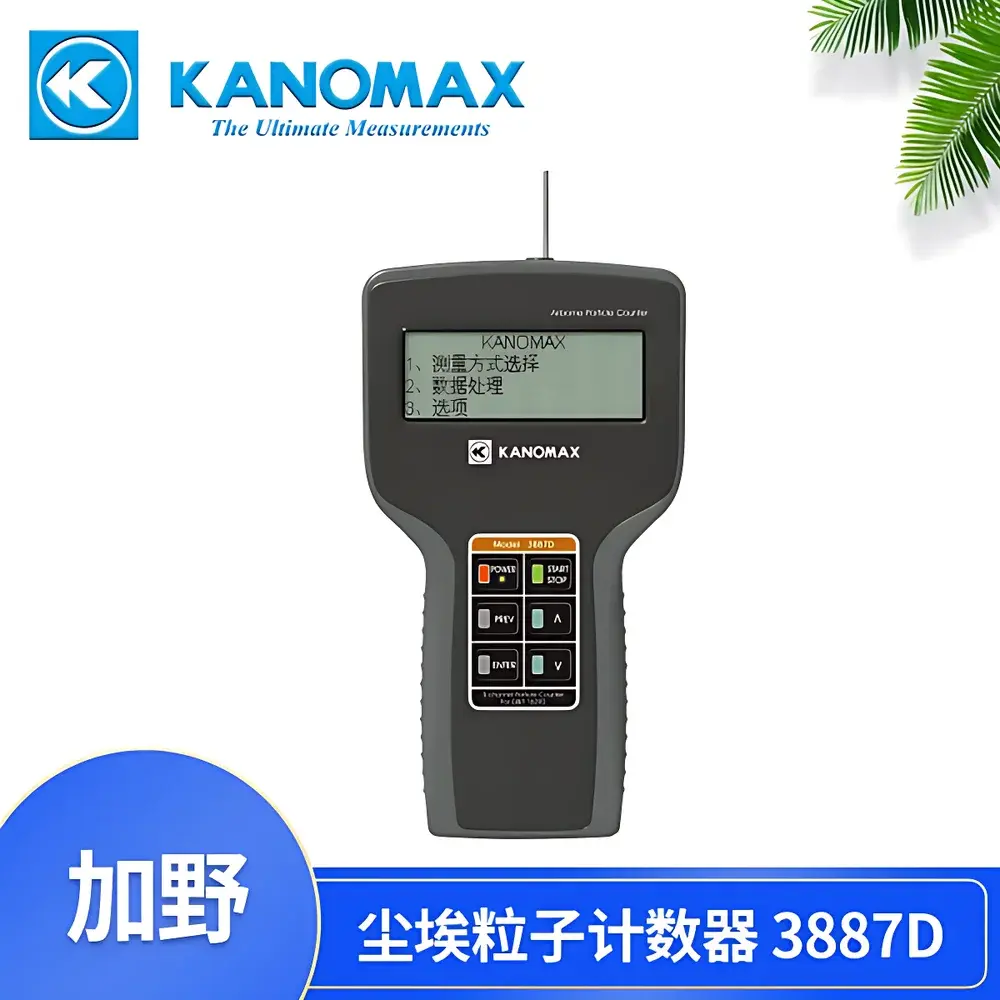
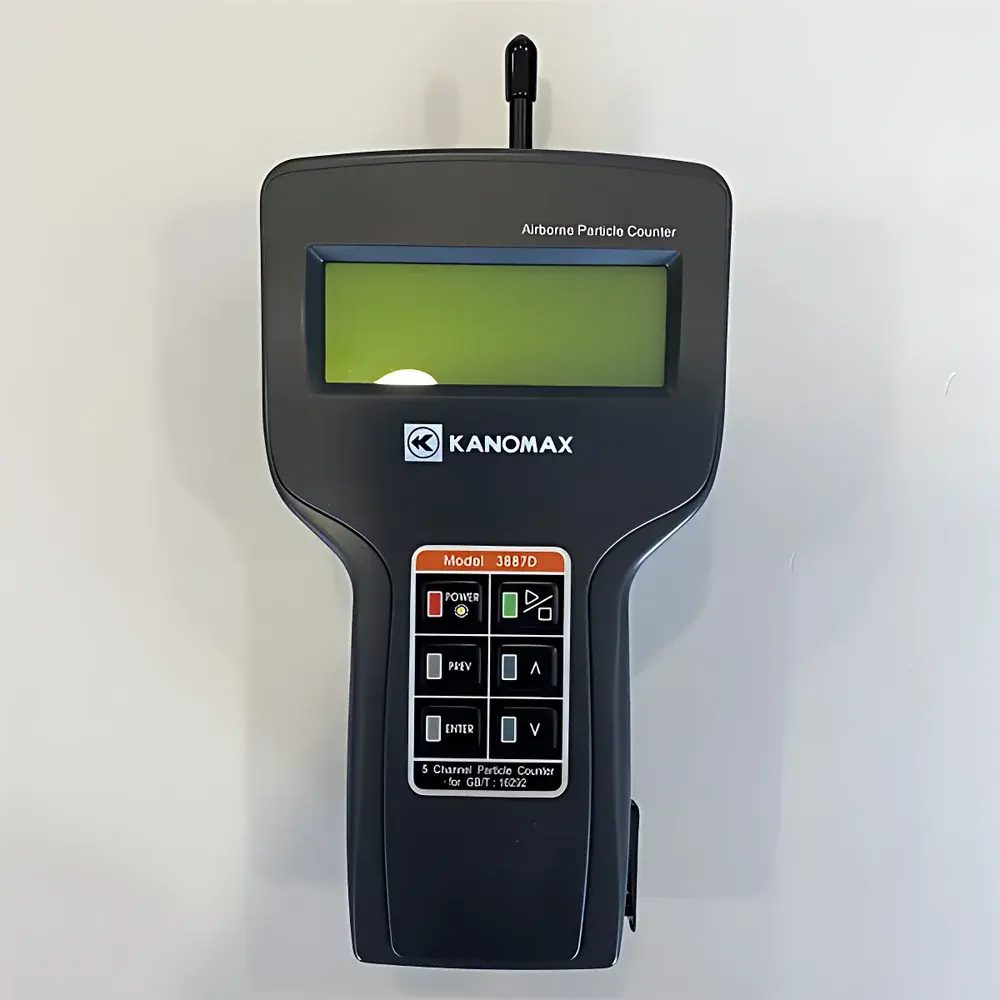
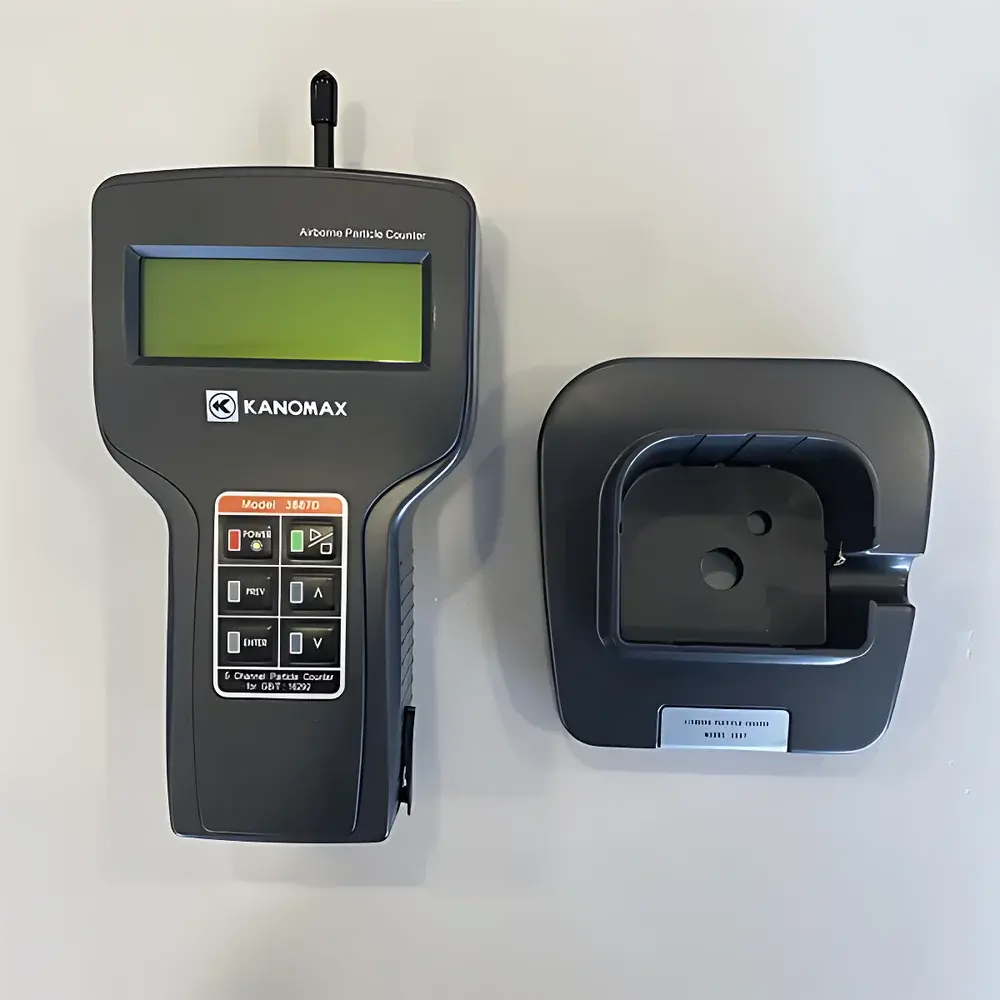
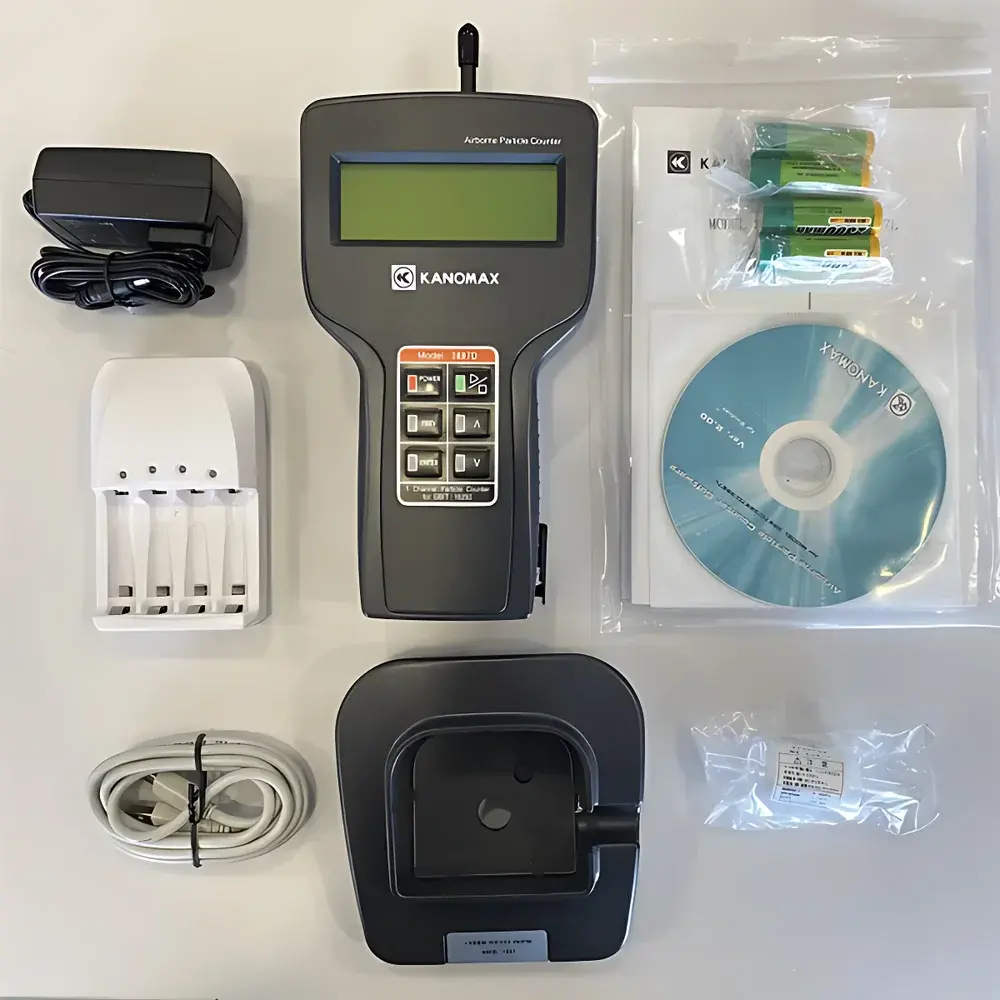
Kanomax 3887D Portable Laser Particle Counter
| Brand | Kanomax |
|---|---|
| Origin | Japan |
| Model | 3887D |
| Instrument Type | Handheld |
| Flow Rate | 2.83 L/min (0.1 cfm) |
| Flow Accuracy | < ±1 particle/5 min |
| Timing Accuracy | < ±1 s over 6-min sampling |
| Repeatability | ≤ ±10% FS |
| Size Distribution Error | ≤ ±30% |
| Indication Error | ≤ ±30% FS |
| Particle Size Channels | 0.3, 0.5, 1.0, 3.0, 5.0 µm |
| Sampling Duration | 10 sec – 99 min 59 sec |
| Data Storage Capacity | 7,000 records |
| Power Supply | 4 × AA Ni-MH batteries or AC adapter (100–240 V AC) |
| Dimensions | 108(W) × 68(D) × 196(H) mm |
| Weight | ~680 g (without batteries) |
| Compliance | GB/T 16292–2010, ISO 14644-1, China GMP (2010) Annex 1 |
Overview
The Kanomax 3887D Portable Laser Particle Counter is a compact, battery-powered optical particle counter engineered for high-fidelity airborne particulate monitoring in cleanrooms, pharmaceutical manufacturing environments, hospital isolation rooms, and HVAC validation workflows. It operates on the principle of single-particle light scattering—where aerosolized particles pass through a focused 650 nm laser beam, generating scattered light pulses proportional to particle cross-sectional area. These pulses are classified into five discrete size channels (0.3, 0.5, 1.0, 3.0, and 5.0 µm) using calibrated photodetector thresholds and real-time pulse-height analysis. With a certified volumetric flow rate of 2.83 L/min (0.1 cfm), the instrument meets the minimum sampling volume requirements defined in ISO 14644-1 for Class 5–8 cleanroom classification and aligns with the statistical sampling protocols mandated by China’s GMP Annex 1 and GB/T 16292–2010. Its portable architecture enables rapid point-of-use verification without requiring fixed installation or external vacuum sources.
Key Features
- True handheld form factor (680 g) with ergonomic grip and integrated display—designed for extended field use and operator mobility.
- Five-channel simultaneous counting with user-selectable size thresholds; supports both discrete-size reporting and cumulative distribution outputs.
- High-stability flow control system maintaining < ±1 particle deviation per 5-minute interval—critical for low-concentration environments where statistical confidence depends on precise volumetric delivery.
- On-device timing accuracy of < ±1 second over 6-minute sampling cycles ensures synchronization with regulatory time-based protocols (e.g., ISO 14644-1 Annex B).
- Robust data integrity architecture: automatic power-fail recovery stores active sampling state and resumes measurement post-interruption without data loss.
- Configurable test modes including Single, Repeat, Continuous, Calculate (for concentration averaging), Remote (RS-232), and ISO-compliant sequential sampling—enabling full audit trail alignment with GLP/GMP documentation practices.
- Internal memory capacity of 7,000 complete sample records—including timestamp, location ID, particle counts per channel, and operator-defined metadata.
Sample Compatibility & Compliance
The Kanomax 3887D is validated for use with ambient air, compressed gases (with optional desiccant filter), and HEPA-filtered supply air streams. It does not support aggressive solvents, corrosive vapors, or high-humidity (>80% RH) unconditioned sampling without pre-drying. The device complies with international cleanroom certification standards including ISO 14644-1:2015 (Class 5–8), GB/T 16292–2010 (Chinese pharmaceutical cleanroom standard), and Annex 1 of China’s Good Manufacturing Practice for Pharmaceutical Products (2010 revision). While not FDA 21 CFR Part 11–certified out-of-the-box, its logging structure—featuring immutable timestamps, operator IDs, and non-editable raw count data—supports retrospective validation under regulated quality systems when paired with controlled procedural documentation.
Software & Data Management
Data export is performed via RS-232 serial interface to Kanomax’s proprietary KAN-PC software (Windows-compatible), which generates compliant reports aligned with ISO 14644-1 tabular formats and GMP Annex 1 summary tables. Raw datasets include full metadata: sampling duration, flow confirmation flag, battery voltage at acquisition, and internal sensor diagnostics. The software supports batch export to CSV for integration into LIMS or ELN platforms. Audit trail functionality includes user login tracking, report generation logs, and version-controlled firmware update history—all accessible within the software interface. No cloud connectivity or remote firmware updates are implemented, preserving data sovereignty and network security in regulated facilities.
Applications
- Cleanroom classification and routine monitoring per ISO 14644-1 and national GMP requirements.
- Filter integrity testing (pre- and post-HVAC filter change verification).
- Pharmaceutical aseptic processing environment qualification (ISO 5 hood mapping, filling line background monitoring).
- Hospital operating room and isolation ward environmental surveillance during construction or renovation activities.
- Microelectronics fabrication facility contamination source tracing and airflow pattern validation.
- Validation of laminar flow cabinets, isolators, and gloveboxes under EU GMP Annex 1 and PIC/S guidelines.
FAQ
Does the 3887D support real-time data streaming to a central monitoring system?
No—it outputs data only via RS-232 in batch mode after sampling completion. Real-time telemetry requires external hardware integration (e.g., PLC gateway with serial-to-Modbus converter).
Can the device be used in explosive atmospheres?
No. It lacks ATEX, IECEx, or UL hazardous location certification and must not be deployed in Class I Division 1 or Zone 0/1 environments.
Is calibration traceable to NIST or JCSS standards?
Yes. Factory calibration uses PSL (polystyrene latex) reference particles certified to JCSS Traceability (Japan Calibration Service System); users receive a calibration certificate with uncertainty budget per ISO/IEC 17025.
What is the recommended recalibration interval?
Annually under normal use conditions; semi-annually if operated >4 hours/day in high-particulate environments or following mechanical shock events.
Does the instrument meet USP requirements for particulate matter in injectables?
No—USP applies to liquid-phase particle analysis using light obscuration; the 3887D measures airborne particles only and is not applicable to parenteral solution testing.
Related Products







