
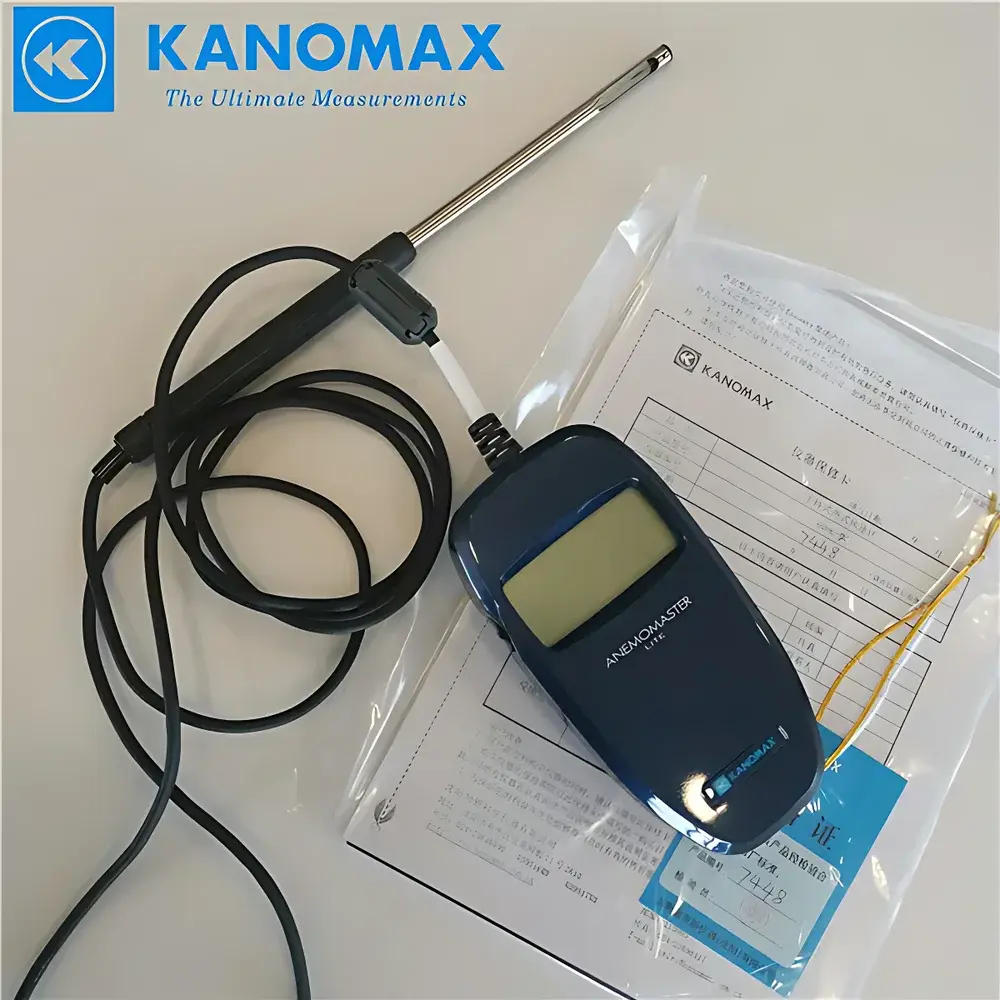
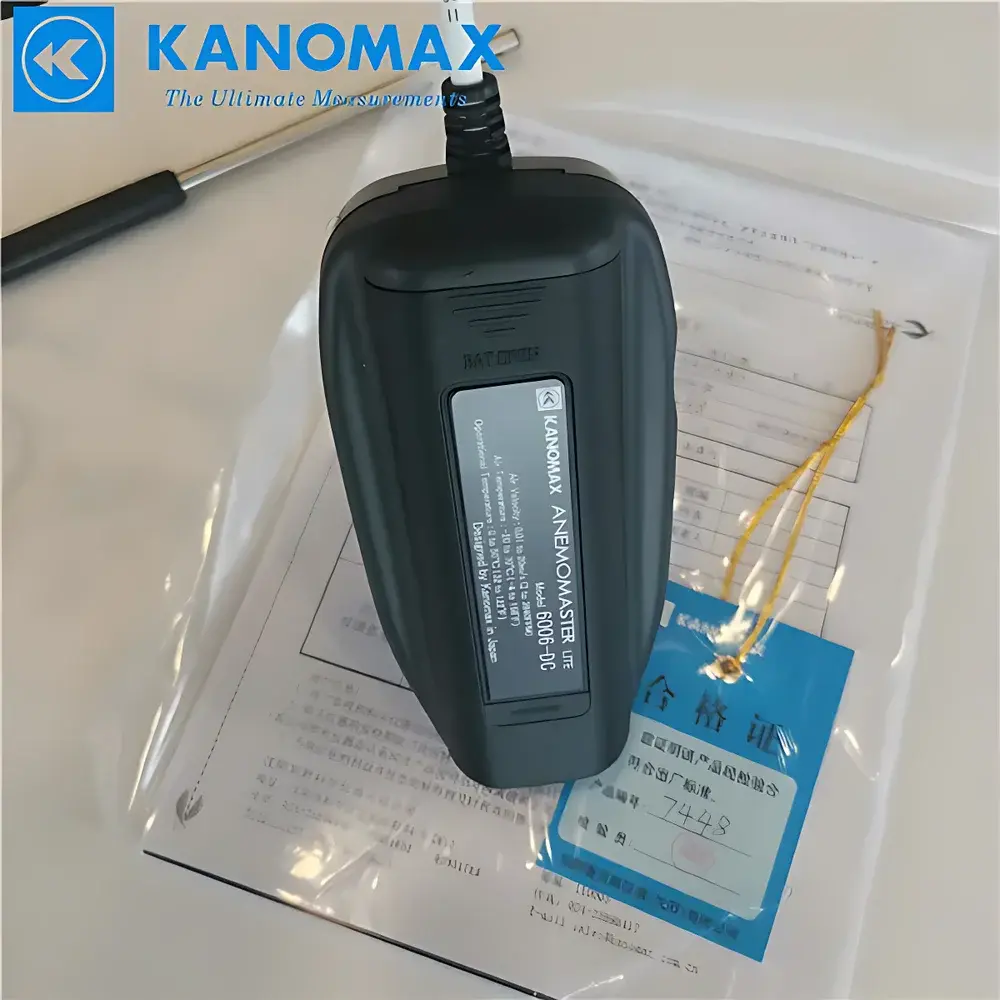
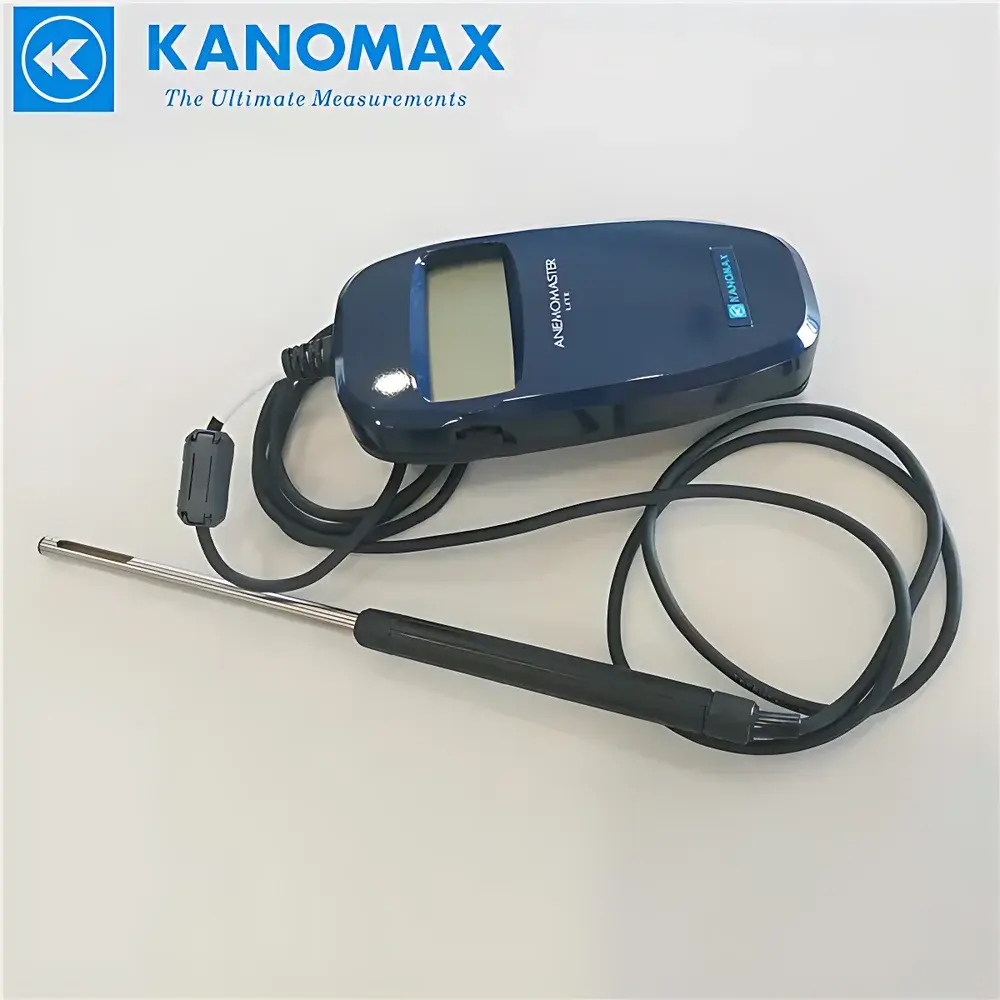
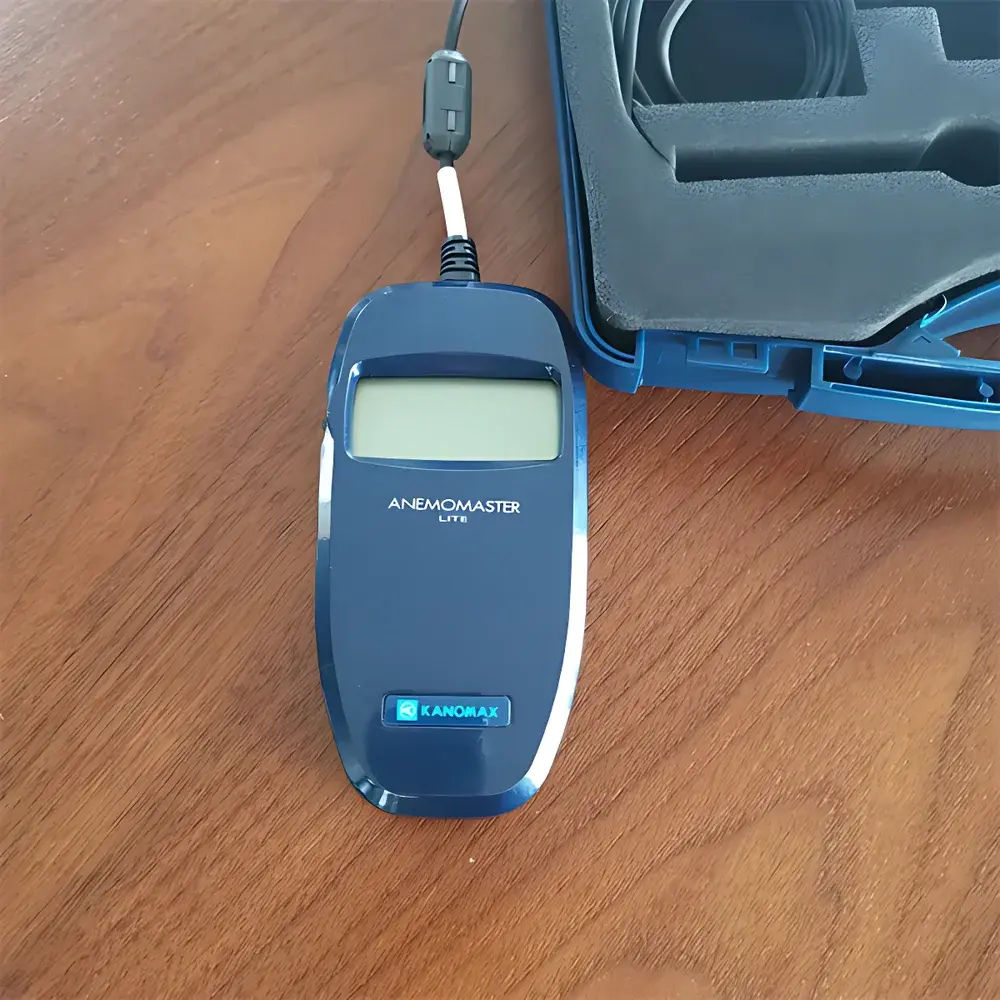
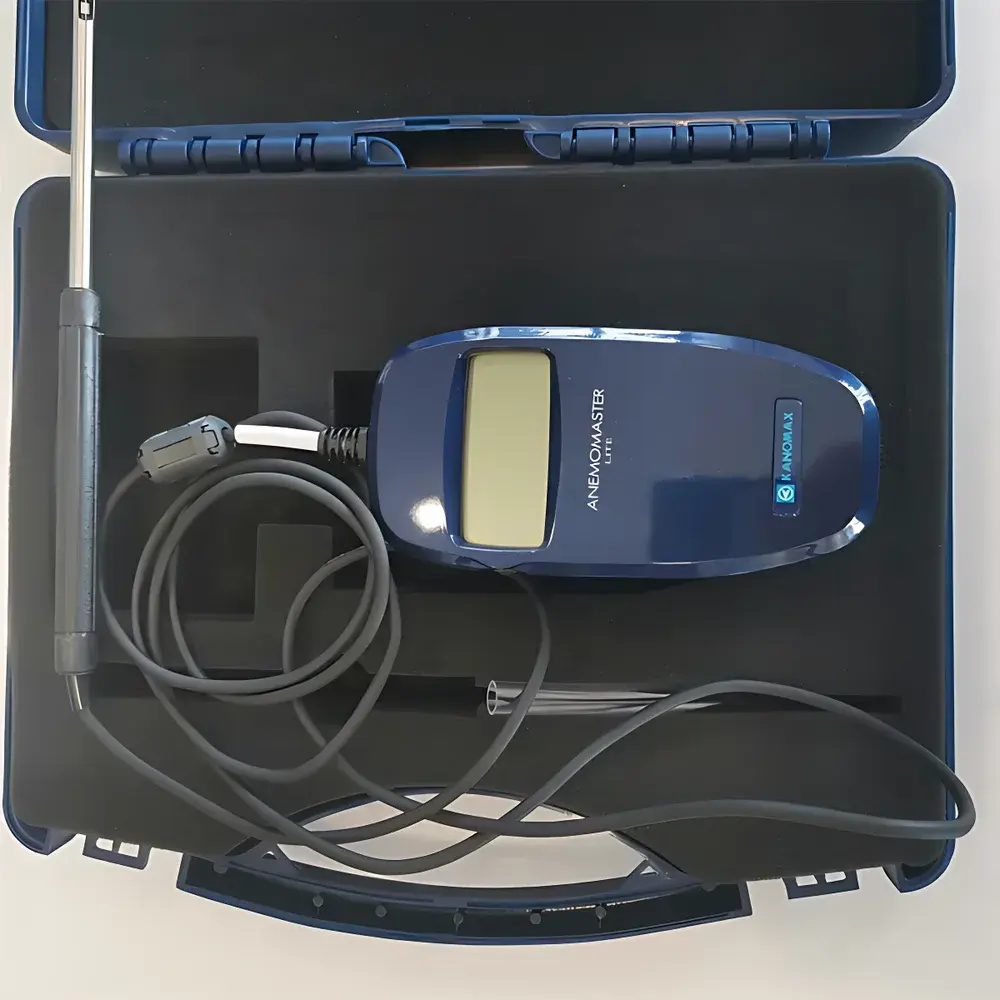
KANOMAX 6006 Portable Thermal Anemometer
| Brand | KANOMAX |
|---|---|
| Origin | Japan |
| Model | 6006 |
| Instrument Type | Thermal Anemometer |
| Measurement Range | 0.01–20.0 m/s |
| Resolution | 0.01 m/s (0–9.99 m/s), 0.1 m/s (10.0–20.0 m/s) |
| Accuracy | ±5% of reading (wind speed), ±1°C (temperature) |
| Operating Temperature | −20–70°C (probe), 5–40°C (main unit) |
| Operating Humidity | 20–85% RH |
| Response Time | <1 s (90% for wind speed at 1 m/s), <30 s (90% for temperature) |
| Display | Dual-parameter (wind speed & temperature), 4-level battery indicator, FAST/SLOW averaging (1 s / 5 s), unit toggle (m/s/°C ↔ fpm/°F), hold function |
| Probe Dimensions | Ø6.1 mm (Ø10.6 mm at tip) × 205 mm |
| Cable | Ø3.3 mm × ~1.5 m |
| Main Unit Dimensions | 60 × 120 × 30 mm |
| Weight | ~180 g (including batteries) |
| Compliance | Designed for ISO/IEC 17025-aligned field verification and HVAC commissioning workflows |
Overview
The KANOMAX 6006 Portable Thermal Anemometer is a precision-engineered handheld instrument designed for reliable, real-time measurement of air velocity and ambient temperature in environmental monitoring, HVAC system commissioning, cleanroom validation, and industrial ventilation assessment. Based on constant-temperature anemometry (CTA), the device employs a thermally sensitive platinum resistance sensor embedded in a slender, aerodynamically optimized probe. As airflow passes over the heated sensing element, convective heat loss is quantified and converted into a linear wind speed output—enabling high-fidelity detection down to 0.01 m/s with minimal flow disturbance. Its compact form factor, integrated temperature compensation circuitry, and dual-parameter display make it suitable for field use where portability, repeatability, and traceable performance are critical.
Key Features
- Single-button operation interface—intuitive navigation for power, hold, unit switching, and averaging mode selection without menu diving.
- Interchangeable probe design—maintains calibrated accuracy across multiple probes, supporting routine calibration verification and field replacement without recalibration downtime.
- Wide dynamic range: 0.01–20.0 m/s wind speed and −20–70°C temperature—validated for use in ductwork, fume hoods, laminar flow cabinets, and outdoor microclimate surveys.
- Integrated thermal compensation circuit—ensures stable accuracy across 10–40°C ambient conditions, minimizing drift due to self-heating or ambient thermal gradients.
- Dual averaging modes: FAST (1-second moving average) for transient flow capture and SLOW (5-second moving average) for stabilized readings in turbulent or low-velocity environments.
- Multi-unit display capability—switch between metric (m/s, °C) and imperial (fpm, °F) units via DIP switch, supporting international reporting standards and facility-specific documentation requirements.
- Battery status indicator (4-segment LED)—provides immediate visibility of remaining operational capacity, critical for extended field deployments.
Sample Compatibility & Compliance
The KANOMAX 6006 is optimized for measuring air under standard atmospheric conditions (101.3 kPa, dry to moderately humid air). It is not intended for corrosive, particulate-laden, or high-velocity gas streams exceeding 20.0 m/s. The probe’s stainless-steel housing and sealed sensor junction ensure robustness in typical indoor and sheltered outdoor environments. While not certified to IEC 61000-4 electromagnetic immunity standards, its analog signal path and low-power architecture minimize susceptibility to common electrical noise in HVAC mechanical rooms. For regulatory compliance contexts—including ASHRAE Standard 110, ISO 14644-3 cleanroom testing, and FDA-referenced HVAC qualification—the instrument supports documented calibration traceability to NIST-traceable reference anemometers. Its operating specifications align with general requirements for GLP-compliant environmental monitoring per ISO/IEC 17025 Clause 5.5.2 (equipment verification).
Software & Data Management
The KANOMAX 6006 operates as a standalone field instrument with no onboard data logging or USB/Bluetooth connectivity. All measurements are displayed in real time on the integrated LCD and must be manually recorded or transcribed. This architecture prioritizes reliability, battery longevity (>100 hours on two AA alkaline cells), and immunity to firmware-related failure modes—making it ideal for audit-ready workflows where electronic data integrity controls (e.g., FDA 21 CFR Part 11) are managed externally via validated paper-based or LIMS-integrated recording procedures. Optional accessories—including extension rods and spare probes—are mechanically compatible and retain full metrological equivalence when used within specified environmental limits.
Applications
- HVAC system balancing and air change rate verification in laboratories, hospitals, and pharmaceutical manufacturing suites.
- Cleanroom ISO Class monitoring per ISO 14644-1, including unidirectional airflow velocity profiling at supply diffusers and return grilles.
- Fume hood face velocity surveys meeting ANSI/ASHRAE 110 and EN 14175 requirements.
- Industrial exhaust stack screening and local exhaust ventilation (LEV) performance checks.
- Educational demonstrations of fluid dynamics principles, boundary layer behavior, and thermal convection effects.
- Field validation of computational fluid dynamics (CFD) model outputs in architectural engineering projects.
FAQ
Is the KANOMAX 6006 suitable for outdoor wind speed measurement?
Yes—within its specified operating temperature (−20–70°C) and humidity (20–85% RH) ranges—but note that the probe is not weatherproof; prolonged exposure to rain or direct solar loading may affect thermal equilibrium and accuracy.
Can the unit be calibrated in-house?
While users may perform functional checks using zero-flow and reference velocity sources, formal calibration requires traceable comparison against a certified reference anemometer in a controlled wind tunnel or calibrated jet; KANOMAX recommends annual third-party calibration per ISO/IEC 17025.
What is the significance of the “FAST/SLOW” averaging function?
FAST mode (1-second averaging) captures rapid fluctuations useful for identifying turbulence intensity or transient events; SLOW mode (5-second averaging) suppresses short-term noise, yielding more representative mean values for compliance reporting.
Does the instrument meet FDA 21 CFR Part 11 requirements?
No—the 6006 lacks electronic audit trail, user authentication, or secure data export capabilities; however, it is routinely deployed in FDA-regulated facilities when paired with paper-based SOPs and manual entry into validated electronic systems.
How does the temperature compensation circuit improve measurement stability?
By dynamically adjusting the sensor’s heating current based on ambient temperature feedback, the circuit mitigates thermal drift caused by changes in air density and sensor self-heating—preserving accuracy across the 10–40°C calibration envelope.
Related Products







