
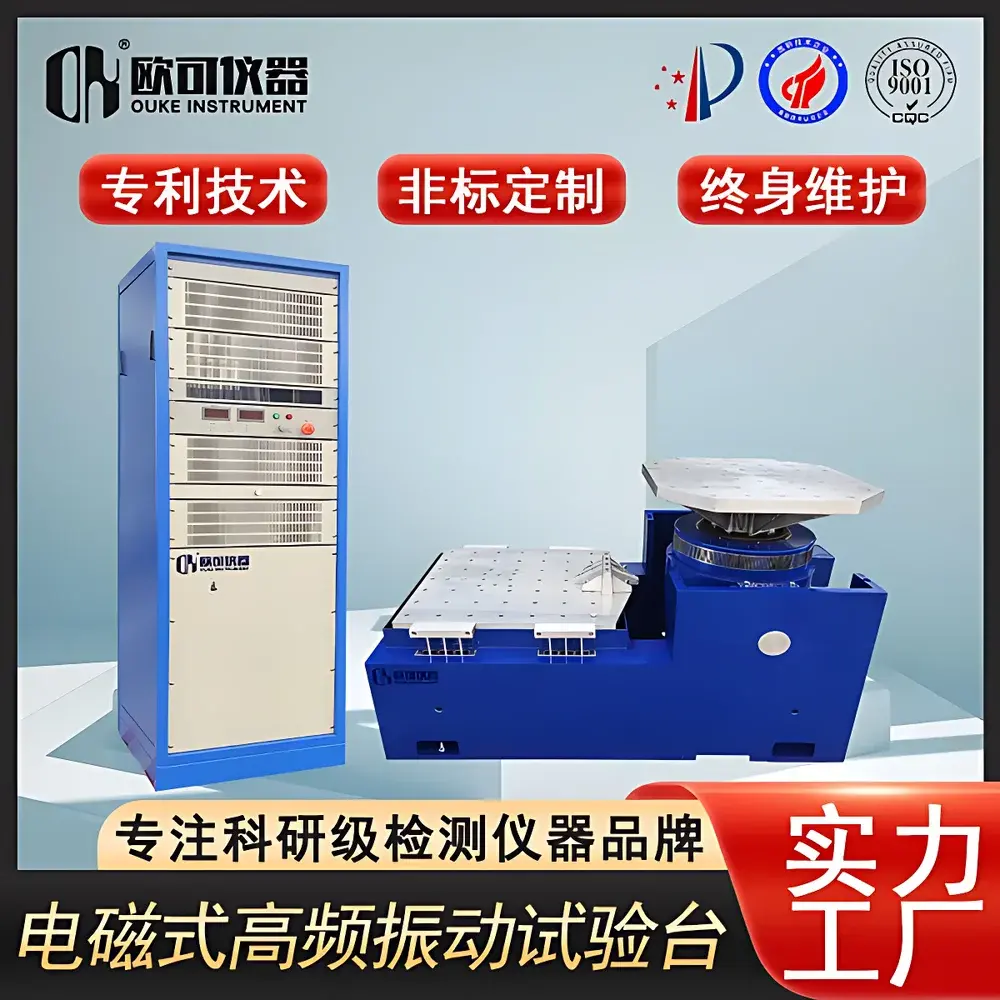
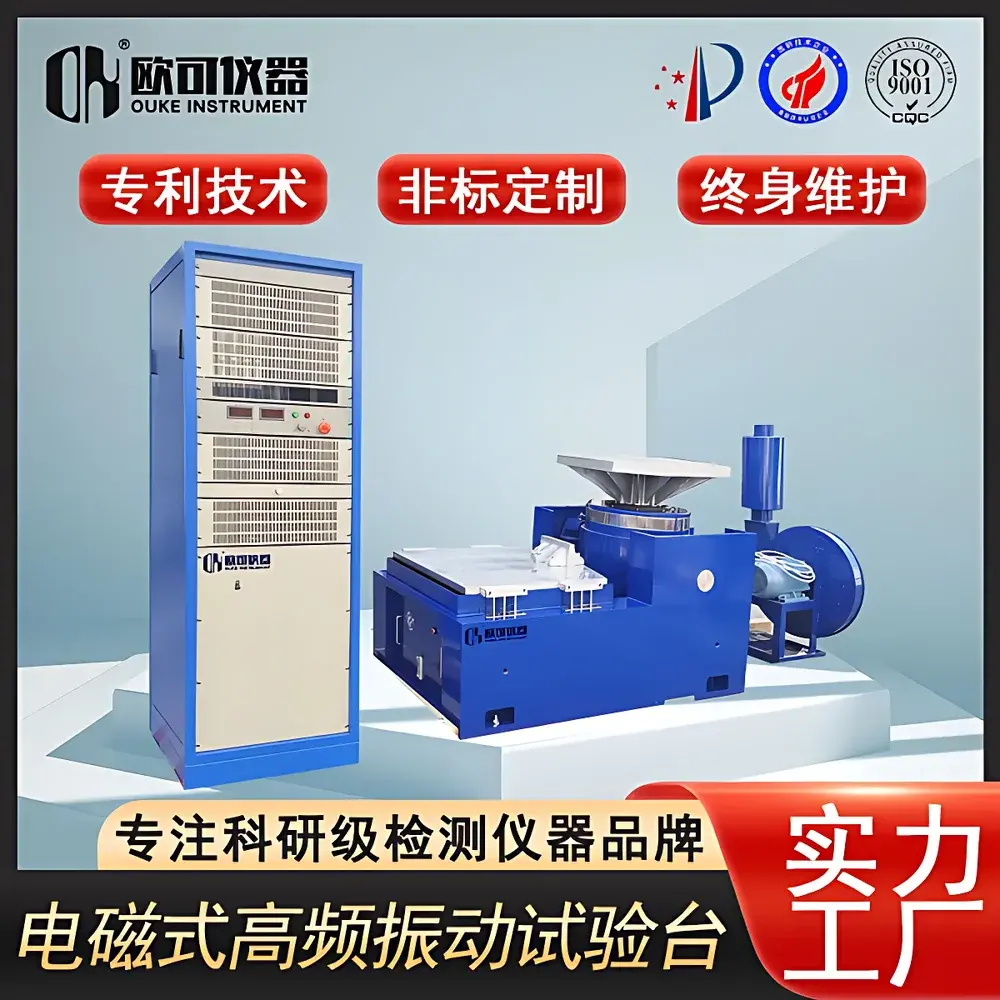
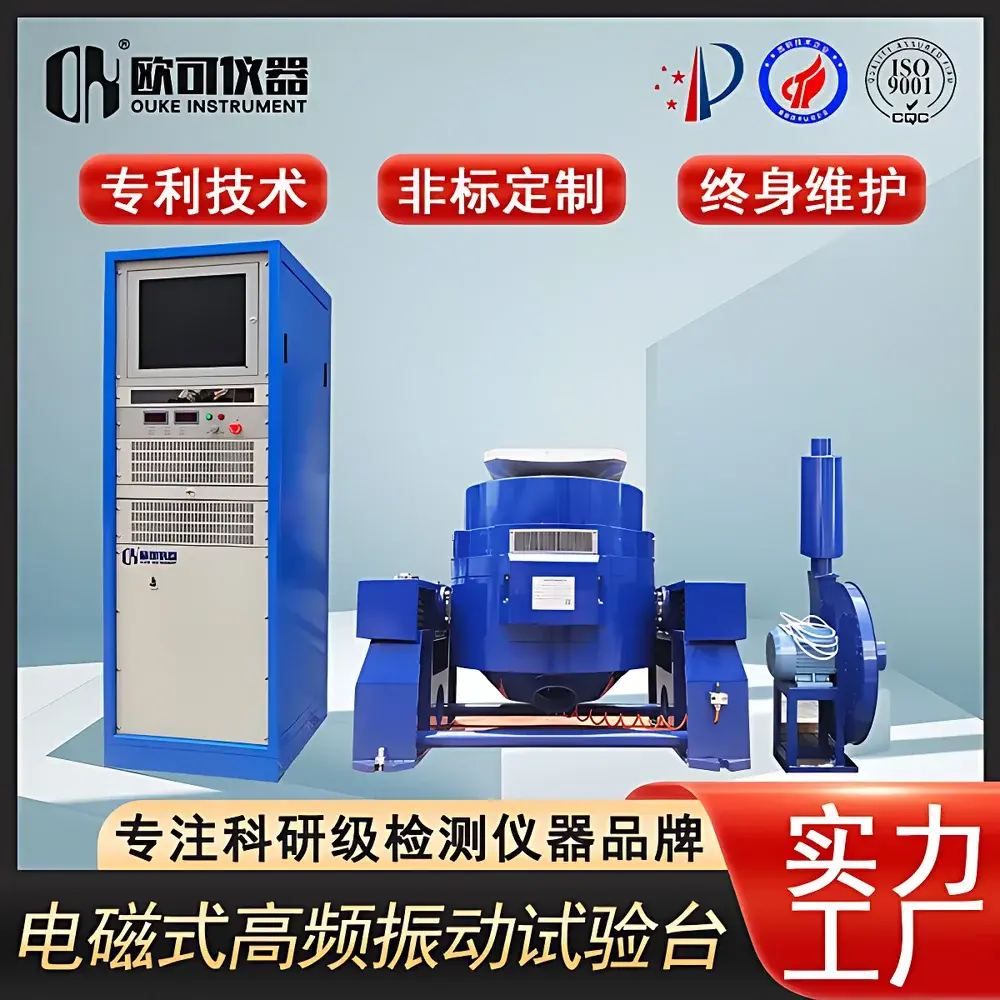
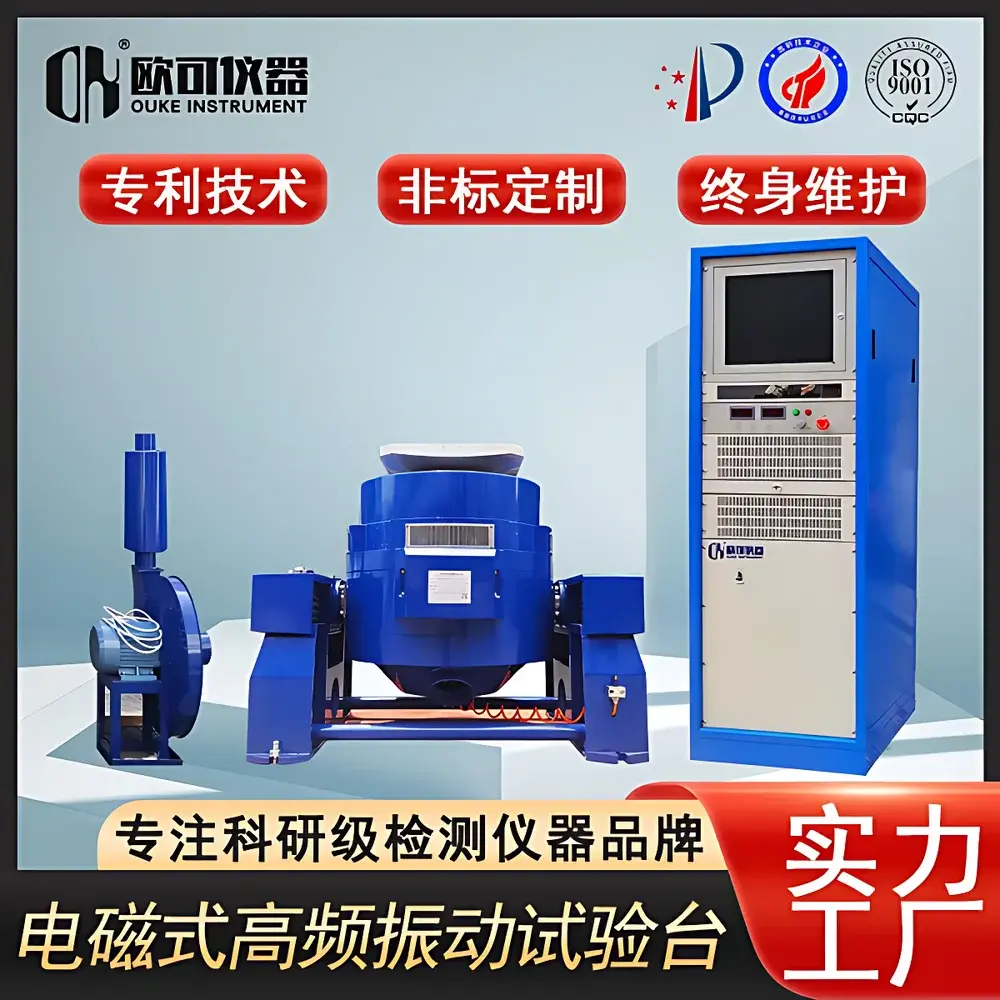
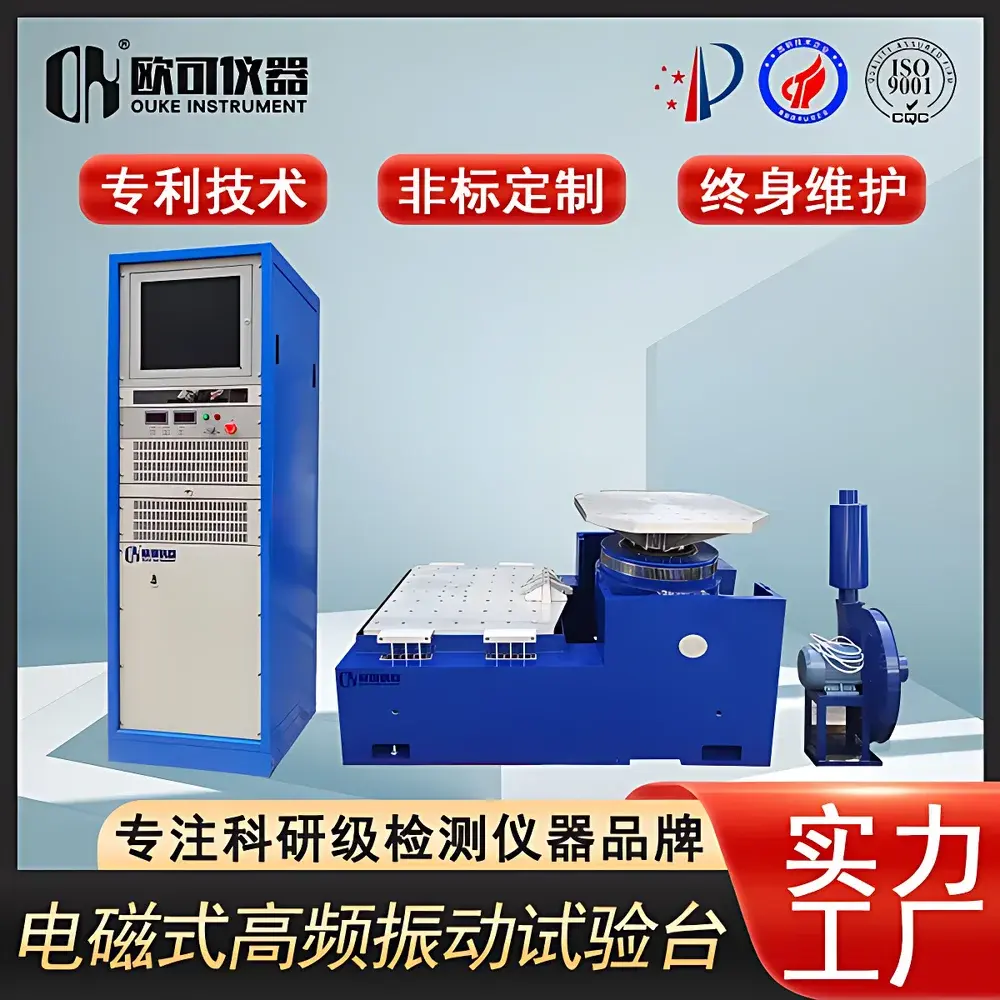
OK-ES-2 Electromagnetic Vertical-Horizontal Vibration Shaker
| Brand | OK Instruments |
|---|---|
| Origin | Guangdong, China |
| Manufacturer Type | Direct Manufacturer |
| Instrument Type | Electromagnetic Vibration Shaker |
| Model | OK-ES-2.000 |
| Rated Thrust | 1.98 kN |
| Frequency Range | 5–5000 Hz |
| Max. Test Load | 70 kg |
| Table Dimensions | 300 × 300 × 30 mm |
| Max. Acceleration | 10 g |
| Drive Power | 4.2 kW |
| Peak-to-Peak Amplitude Range | 0–4 mm |
| Acceleration Range | 10–750 m/s² |
| Waveform | Sine |
| Control Resolution | 0.01 Hz (display), ±0.1 Hz (accuracy) |
| Operating Voltage | 380 V ±10% |
| Compliance | ISO 5344, ASTM D999, IEC 60068-2-6, GB/T 2423.10 |
Overview
The OK-ES-2 Electromagnetic Vertical-Horizontal Vibration Shaker is a precision-engineered electromagnetic shaker system designed for laboratory and industrial vibration testing of components, subassemblies, and finished products. Based on Lorentz-force actuation principles, it delivers high-fidelity sinusoidal excitation across a broad frequency spectrum (5–5000 Hz) with precise control over acceleration, displacement, and velocity profiles. Its dual-axis capability supports both vertical and horizontal vibration modes—enabling compliance with international test standards including ISO 5344 (vibration test machines), IEC 60068-2-6 (sinusoidal vibration), ASTM D999 (shipping container vibration simulation), and GB/T 2423.10 (Chinese national standard for vibration testing). The shaker’s rigid magnesium-alloy table surface provides inherent magnetic shielding, minimizing electromagnetic interference (EMI) with sensitive instrumentation during concurrent measurement—critical for EMI-sensitive electronics qualification and aerospace component validation.
Key Features
- Electromagnetic actuation architecture delivering high linearity, low harmonic distortion, and exceptional phase fidelity across the full operating bandwidth
- Dual-mode operation: independent vertical and horizontal vibration configurations via interchangeable mounting interfaces and auxiliary worktables (450 × 450 × 46 mm optional)
- Digital PID-controlled frequency generator with real-time parameter synchronization—no manual intervention required during test execution
- Programmable multi-segment test sequences: up to 30 user-defined steps per program, each specifying frequency, dwell time, sweep rate, and amplitude profile
- Continuous amplitude adjustment (0–4 mm p-p) with integrated amplitude prediction algorithm for rapid setup and repeatability assurance
- Active thermal management system featuring low-noise cooling fans and optimized heat dissipation pathways—ensuring stable output during extended duty cycles
- EMI-suppressed control circuitry with reinforced shielding and filtered power input—validated for operation in mixed-signal lab environments
- Modular mechanical design: decoupled base isolation system eliminates need for anchor bolts; compliant with ISO 10816-1 for vibration severity assessment
Sample Compatibility & Compliance
The OK-ES-2 accommodates test specimens up to 70 kg mass on its standard 300 × 300 mm platform (with optional 450 × 450 mm horizontal/vertical extension tables). Its 1.98 kN rated thrust and 10 g peak acceleration capability support structural integrity verification of automotive ECUs, avionics enclosures, PCB assemblies, and medical device housings. The system meets mechanical and electrical safety requirements per IEC 61000-6-2 (immunity) and IEC 61000-6-4 (emission), and is fully compatible with GLP-compliant test documentation workflows. All firmware and controller logic adhere to deterministic real-time response constraints, enabling traceable test execution under FDA 21 CFR Part 11–aligned audit trail configurations when integrated with validated data acquisition software.
Software & Data Management
The shaker integrates with OK-VibControl™ v3.2—a Windows-based test sequencing and monitoring application supporting IEEE 1588 PTP time synchronization for distributed test setups. The software enables waveform visualization (real-time FFT, time-domain plots), automated report generation (PDF/CSV), and configurable pass/fail thresholds per test segment. Built-in data logging records all control parameters—including actual vs. setpoint acceleration, frequency deviation, and thermal status—at ≥1 kHz sampling rate. Exported datasets conform to ASTM E1782 (data format for mechanical testing) and include embedded metadata (operator ID, calibration timestamp, environmental conditions) for full traceability in ISO/IEC 17025-accredited laboratories.
Applications
- Resonance screening and modal analysis of electronic modules and sensor housings
- Transport simulation per ISTA 3A and ASTM D4169 for packaging validation
- Reliability stress screening (RSS) of solder joints and MEMS devices
- Vibration fatigue life assessment of battery packs and power converters
- Qualification testing of military-grade connectors and ruggedized displays (MIL-STD-810H Method 514.8)
- Calibration reference source for accelerometers and vibration sensors (traceable to NIM-certified standards)
FAQ
What is the maximum payload capacity for vertical versus horizontal orientation?
The rated 70 kg load applies to both orientations; however, for horizontal operation above 200 Hz, dynamic imbalance mitigation requires symmetrical mass distribution and optional counterweight kits.
Does the system support closed-loop acceleration control?
Yes—when paired with a calibrated IEPE accelerometer and OK-VibControl™’s feedback module, the system executes real-time acceleration regulation with ≤±1.5% amplitude error across 10–2000 Hz.
Is the controller compliant with FDA 21 CFR Part 11 for electronic records?
The controller itself is not standalone Part 11 compliant, but OK-VibControl™ v3.2 offers optional 21 CFR Part 11 add-on licensing—including electronic signatures, audit trails, and role-based access control—for regulated pharmaceutical and medical device testing.
What calibration documentation is provided at shipment?
Each unit ships with a factory calibration certificate traceable to China National Institute of Metrology (NIM), covering thrust output, frequency accuracy, and amplitude linearity across five reference points within the 5–5000 Hz range.
Can the shaker be integrated into an environmental chamber?
Yes—the standard model features IP20-rated enclosure and non-corrosive internal materials; chamber integration requires optional feedthrough adapters and thermal expansion compensation mounts (part number: OK-ES-2-CHM-KIT).
Related Products



