
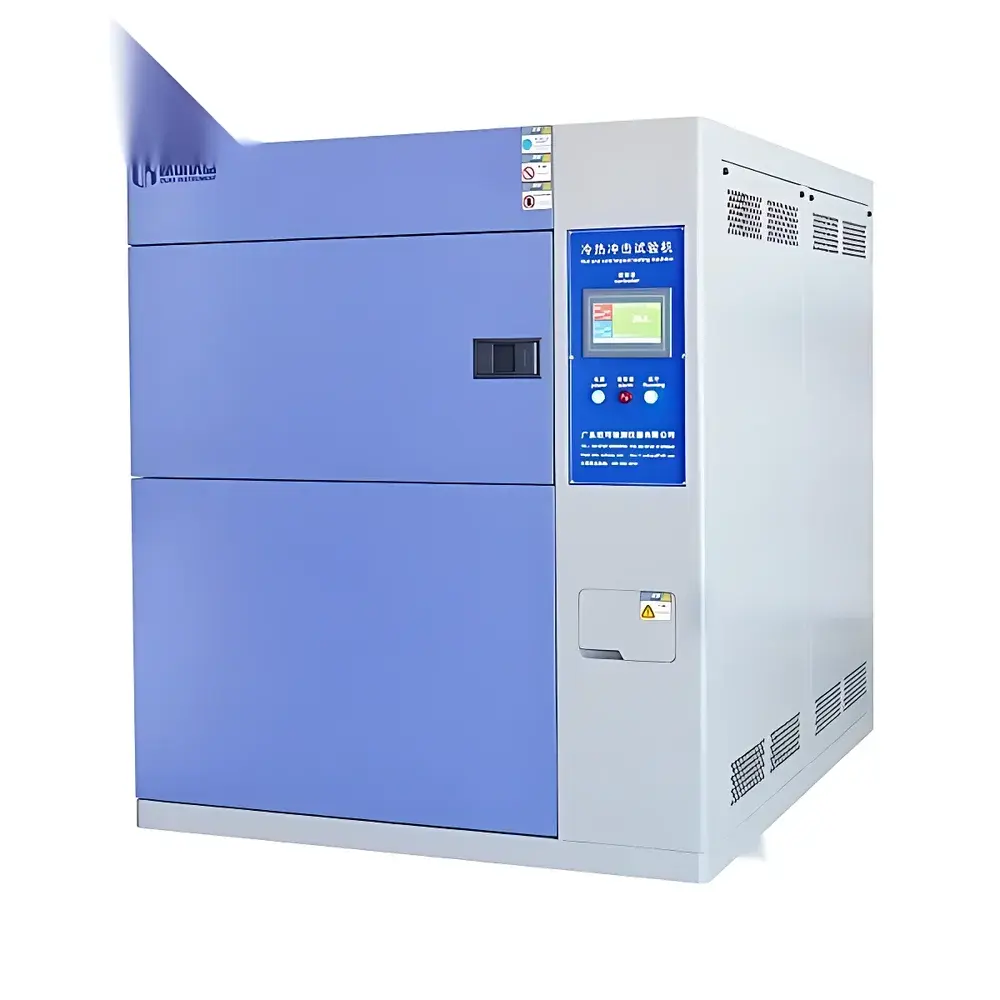
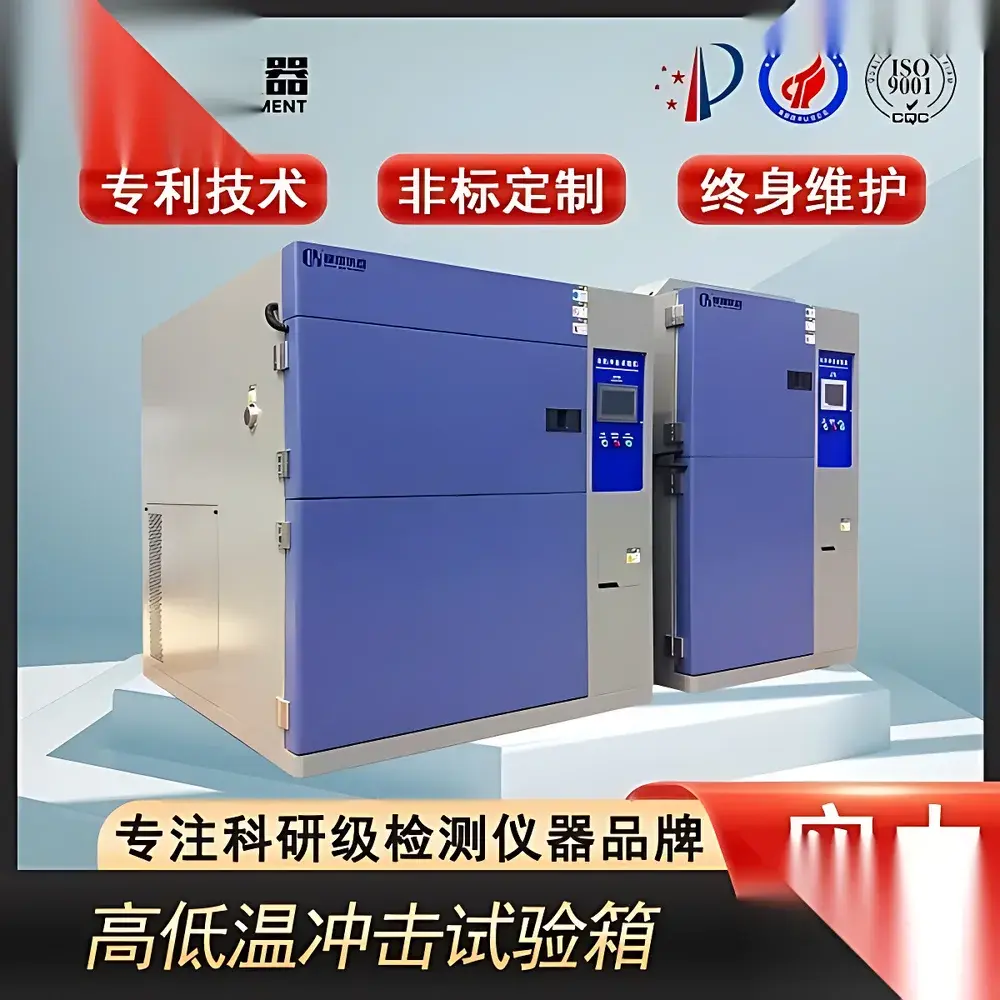
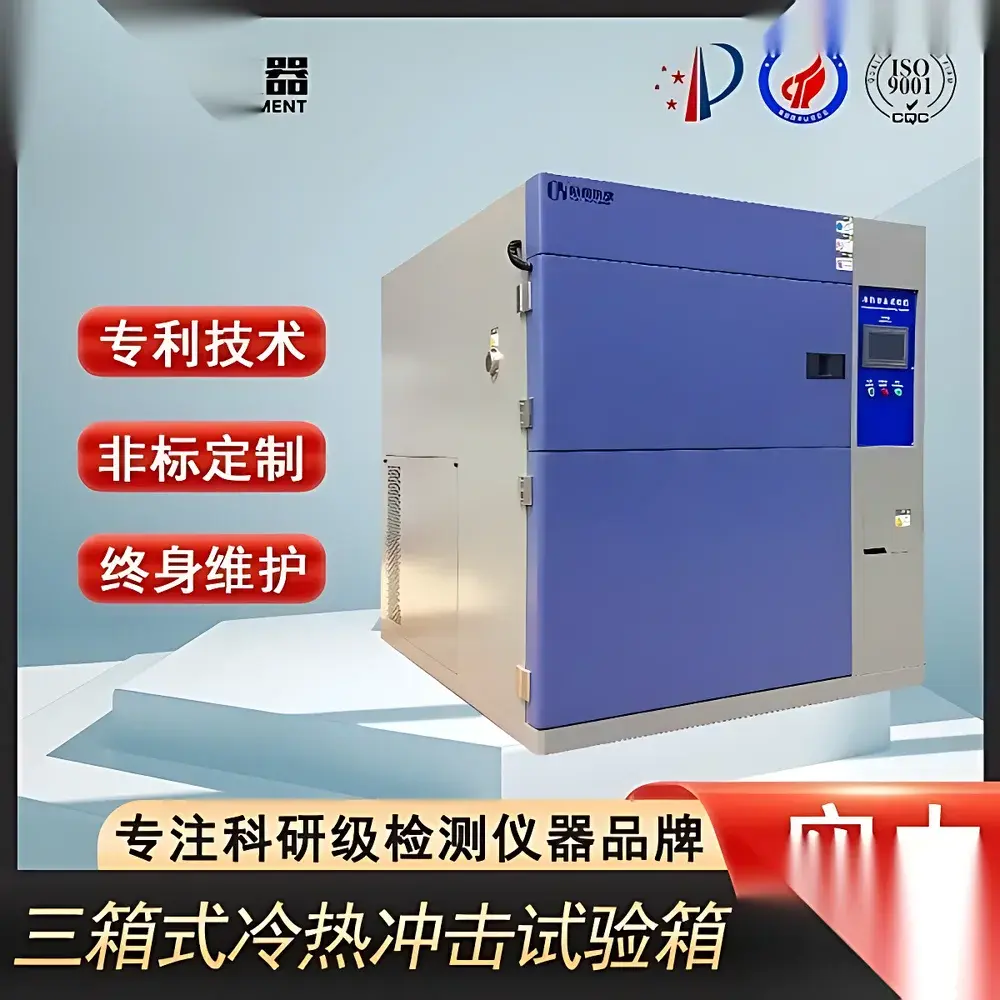
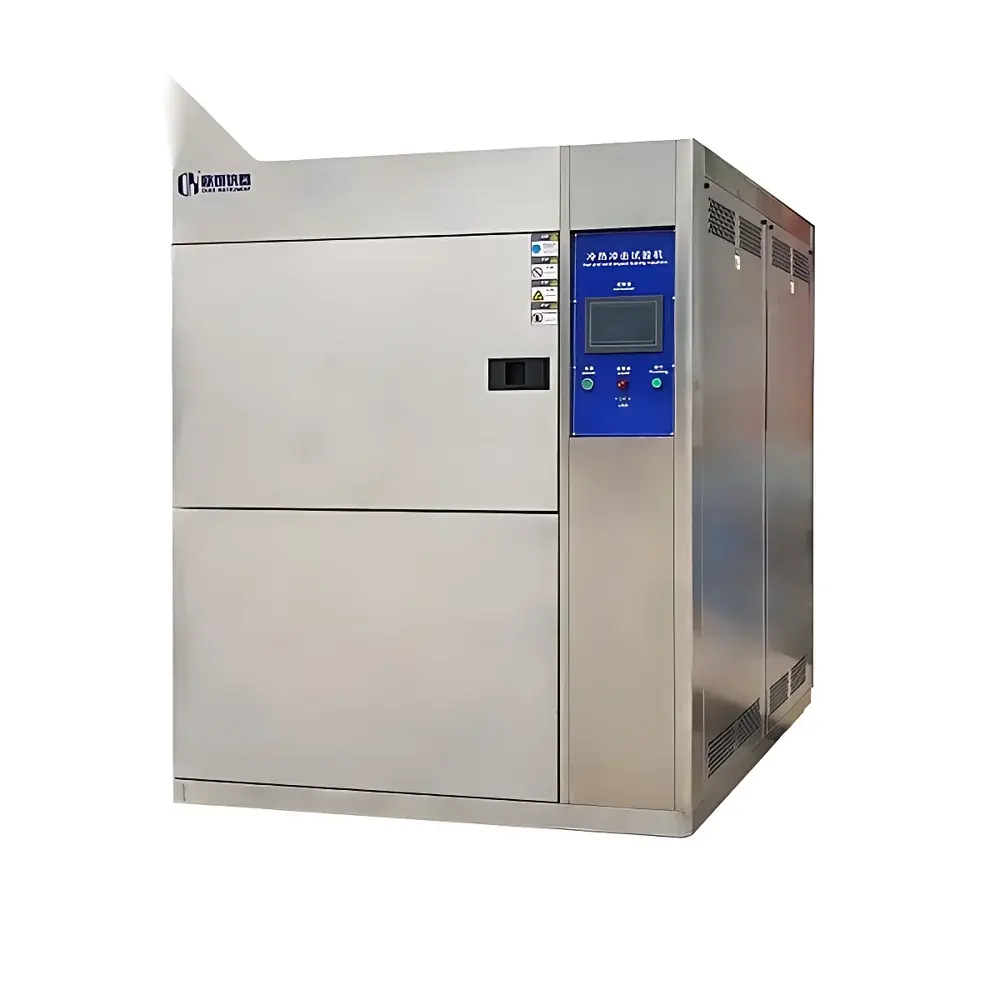
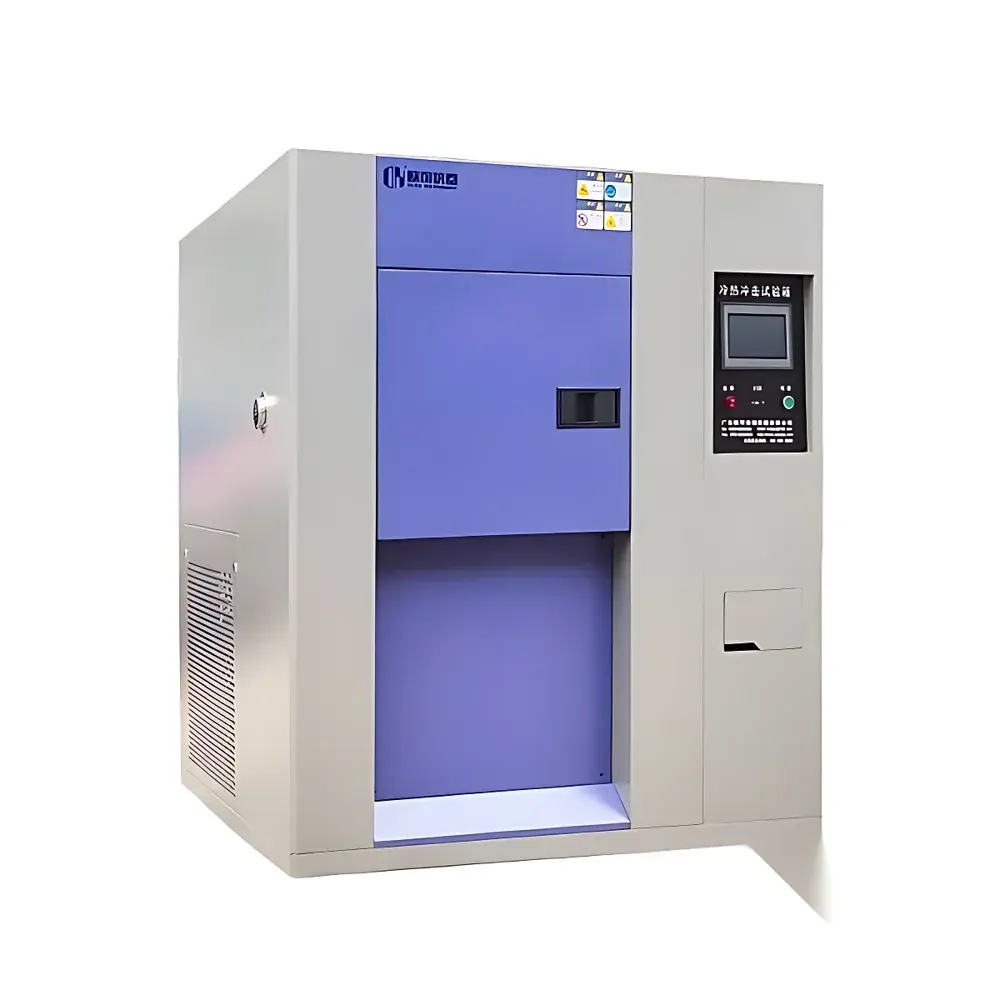
OK-TS-42 Thermal Shock Test Chamber
| Brand | OEM / Custom-Built |
|---|---|
| Origin | Imported |
| Manufacturer Type | Authorized Distributor |
| Temperature Range (Test Zone) | A: 0 °C to −40 °C |
| B | −10 °C to −55 °C |
| C | −10 °C to −65 °C |
| High-Temp Zone | +60 °C to +200 °C |
| Low-Temp Zone | A: −10 °C to −40 °C |
| B | −10 °C to −60 °C |
| C | −10 °C to −70 °C |
| Temperature Uniformity | ±3 °C |
| Temperature Stability | ±0.5 °C |
| Temperature Transition Time (Hot ↔ Cold) | ≤15 s |
| Recovery Time (to Setpoint) | 3–5 min |
| Heating Rate (High-Temp Chamber) | ~5 °C/min (avg.) |
| Cooling Rate (Low-Temp Chamber) | ~1.5 °C/min (avg.) |
| Dwell Time per Phase | ≥30 min |
| Test Port | Ø50 mm (left side) |
| Control System | PLC-based PID controller with 7″ color LCD HMI |
| Programmable Cycles | 1–999 |
| Soak Duration | up to 999 h 59 min |
| Predefined Test Standards | 96 built-in profiles |
| Compliance | Designed for ASTM D5229, ISO 16750-4, MIL-STD-810H Method 503.5, JESD22-A104, IEC 60068-2-14 |
Overview
The OK-TS-42 Thermal Shock Test Chamber is an engineered environmental stress screening (ESS) system designed for rapid, repeatable evaluation of material and component reliability under extreme thermal cycling conditions. It operates on the two-chamber or three-chamber thermal shock principle—utilizing physically isolated high-temperature and low-temperature reservoirs to generate abrupt thermal transients without subjecting test specimens to mechanical movement. This architecture ensures zero vibration transmission and eliminates positioning artifacts during transition, critical for assessing solder joint integrity, polymer dimensional stability, hermetic seal performance, and die-attach adhesion in electronics, aerospace, automotive, and medical device manufacturing.
Key Features
- Triple-zone configuration (high-temp chamber / low-temp chamber / test chamber) with vacuum-insulated stainless-steel walls and high-efficiency polyurethane foam insulation (≥120 mm thickness) for minimized thermal leakage and stable soak conditions.
- Independent dual-refrigeration circuits with cascade low-temperature compressors (R23/R404A mixed refrigerant system) enabling sustained operation down to −70 °C in the low-temp zone, compliant with IEC 60068-2-14 Category Z/AB specifications.
- Large-format 7-inch color TFT-LCD human-machine interface with touch-enabled navigation, supporting multi-language display (English & Chinese), real-time curve plotting, and event-log timestamping with SD-card data export capability.
- PLC-integrated control architecture with auto-tuning PID algorithms and adaptive compensation for load-dependent thermal inertia—ensuring setpoint accuracy within ±0.5 °C and spatial uniformity maintained at ±3 °C across the full 360 × 350 × 400 mm test volume.
- Dual-mode operation: selectable two-zone (hot/cold) or three-zone (hot/test/cold) thermal shock protocols; configurable dwell time (≥30 min), cycle count (1–999), and transition direction (cold-to-hot or hot-to-cold).
- Standard 50 mm diameter test port (left-side mounted, sealed with silicone gasket) for external sensor feedthrough, power cabling, or in-situ monitoring—compatible with thermocouple, strain gauge, and leakage current measurement setups.
Sample Compatibility & Compliance
The OK-TS-42 accommodates a broad range of sample geometries—including PCB assemblies, molded enclosures, battery modules, optical housings, and MEMS packages—within its 0.05 m³ test chamber. Its structural rigidity and non-vibrating test zone meet MIL-STD-810H acceleration limits (<0.05 g RMS). The system supports qualification testing per ASTM D5229 (low-temperature impact resistance), ISO 16750-4 (road vehicle electrical disturbance), JESD22-A104 (temperature cycling), and IEC 60068-2-14 (change of temperature). All firmware and calibration records are traceable to NIST-certified standards, and audit-ready electronic logs comply with GLP/GMP documentation requirements including 21 CFR Part 11–compliant user access control and change history tracking.
Software & Data Management
Embedded firmware provides native support for standard thermal shock profiles (e.g., “Condition A”, “Condition C”) and allows custom profile creation via intuitive drag-and-drop sequence editing. Real-time data—including chamber temperatures, compressor status, door interlock state, and alarm events—is logged at 1 Hz resolution and stored internally for ≥30 days. Export formats include CSV and PDF reports with embedded metadata (operator ID, test ID, calibration due date, ambient conditions). Optional Ethernet/IP or Modbus TCP connectivity enables integration into centralized MES or LIMS platforms for automated pass/fail decision routing and SPC charting.
Applications
- Failure mode analysis of surface-mount technology (SMT) interconnects under accelerated thermal fatigue.
- Qualification of conformal coatings and potting compounds for coefficient-of-thermal-expansion (CTE) mismatch resilience.
- Validation of wafer-level packaging (WLP) and fan-out wafer-level packaging (FOWLP) against delamination onset.
- Reliability screening of lithium-ion battery cells and modules prior to automotive AEC-Q200 certification.
- Material compatibility testing of elastomeric seals, optical adhesives, and composite laminates used in avionics enclosures.
FAQ
What is the minimum achievable temperature in the low-temperature chamber?
The OK-TS-42 achieves −70 °C in Configuration C using a cascade refrigeration system with dual-stage compression and R23/R404A mixed refrigerant.
Can the system perform ramp-and-soak profiles in addition to thermal shock?
Yes—the controller supports standalone high-temperature exposure, low-temperature storage, and combined thermal cycling modes with programmable ramp rates and dwell durations.
Is remote monitoring supported?
Standard Ethernet port enables SNMP-based status polling and optional web-server interface for live view of chamber parameters and alarm history.
How is temperature uniformity verified?
Uniformity is validated per IEC 60068-3-5 using nine calibrated PT100 sensors placed on a 3×3 grid at mid-height; full validation report is provided with each unit.
Does the system include calibration documentation?
Each unit ships with a factory calibration certificate traceable to NIST standards, covering all temperature sensors and control loop response characteristics.



