
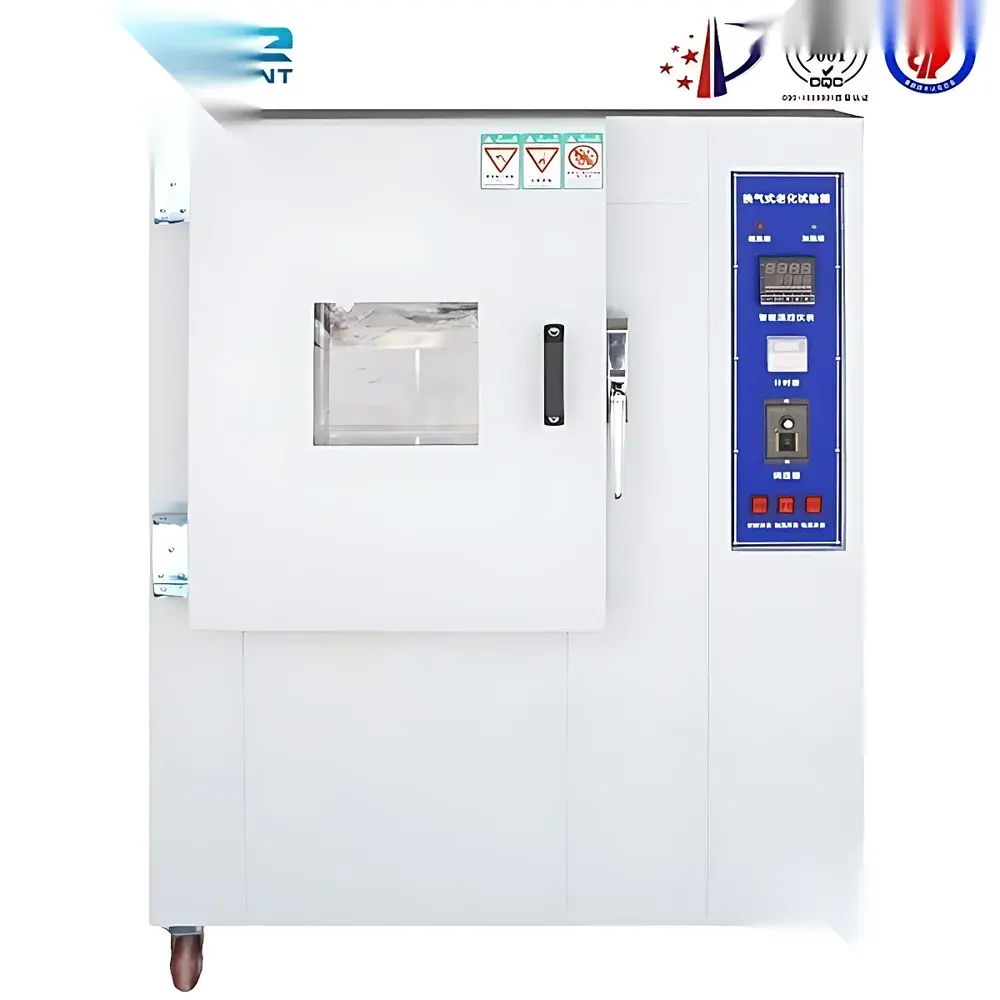
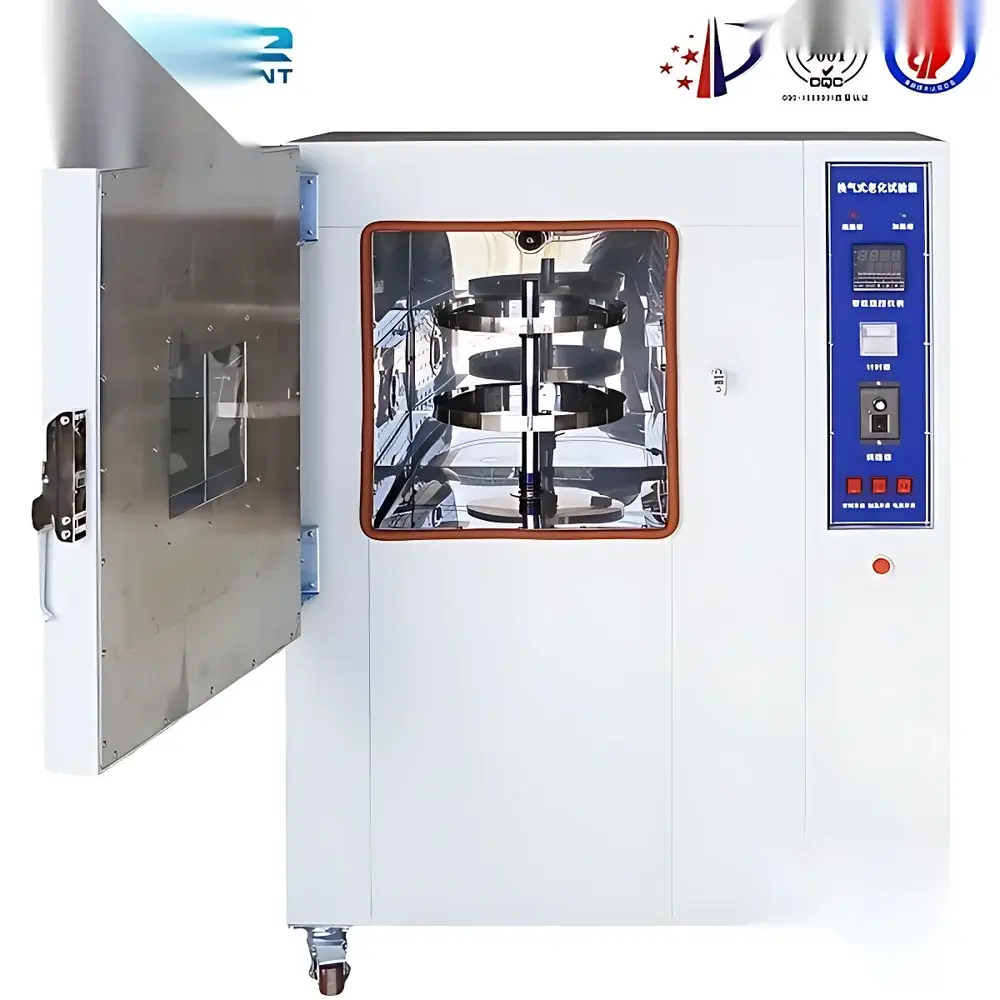
OK-HQ Series Forced-Air Circulating Thermal Aging Test Chamber
| Brand | OK |
|---|---|
| Origin | Imported |
| Manufacturer Type | Authorized Distributor |
| Temperature Range | RT+10°C to 200°C / 300°C |
| Temperature Uniformity | ±2°C |
| Temperature Stability | ±0.5°C |
| Air Exchange Rate | 2–100 cycles/hour (measurable per JIS K 7212 at 80°C) |
| Air Exchange Timer | 1 min – 99 h adjustable |
| Internal Chamber Dimensions (L×W×H, mm) | 450×450×500 to 800×1000×1000 |
| Power Consumption | 4.0–9.0 kW |
| Rotating Turntable Diameter | Φ250–Φ700 mm |
| Control System | PID + SSR Microprocessor Controller with LED Display |
| Compliance | ASTM D5423-09 (Type II), ASTM D5374-05, UL 1581, IEC 60811, GB/T 2951, JIS C 3005, VDE 0472 |
Overview
The OK-HQ Series Forced-Air Circulating Thermal Aging Test Chamber is an engineered environmental test system designed for accelerated thermal aging evaluation of polymeric materials—including elastomers, plastics, insulating compounds, textiles, and wire & cable sheaths—under controlled, reproducible high-temperature conditions. Based on the principle of forced convection heat transfer, the chamber maintains precise temperature profiles while enabling quantifiable air exchange to simulate oxidative degradation mechanisms in real-world service environments. Its architecture adheres to the physical requirements of ASTM D5423-09 (Type II laboratory ovens), ensuring compliance with standardized aging protocols used in R&D, quality assurance, and regulatory validation workflows across electrical insulation, automotive, aerospace, and wire & cable industries.
Key Features
- High-precision microprocessor-based PID + SSR temperature controller with 0.1°C resolution for both setpoint and display, supporting programmable timing (1–9999 minutes) and dual-purpose timer functionality—for aging duration and air exchange rate calibration.
- Horizontal forced-air circulation system featuring high-temperature-rated low-noise centrifugal blower and optimized baffle design, achieving ±2°C temperature uniformity across the working volume per ASTM D5374-05 verification methodology.
- Adjustable air exchange mechanism compliant with JIS K 7212: air exchange rate is calibrated via digital watt-hour meter and timer, enabling traceable determination of volumetric turnover (2–100 cycles/hour at 80°C), critical for oxidation kinetics modeling.
- Robust dual-layer chamber construction: interior lined with electropolished SUS304 stainless steel (mirror finish); exterior fabricated from A3 cold-rolled steel with powder-coated finish; insulated with high-density ultra-fine glass fiber (thermal conductivity ≤0.04 W/m·K) to minimize energy loss.
- Integrated rotating turntable (8–10 rpm, detachable, Φ250–Φ700 mm depending on model) ensures uniform thermal exposure of asymmetrical or multi-position samples during extended aging cycles.
- Standardized safety architecture: over-temperature cut-off, motor overheat protection, leakage current interruption, short-circuit tripping, and visual status indicators for all operational modes.
Sample Compatibility & Compliance
The OK-HQ chamber accommodates diverse specimen geometries—from flat sheet coupons and twisted wire bundles to molded elastomer rings and textile swatches—within its five standard internal volumes (100 L to 800 L). Its validated airflow dynamics and thermal stability meet the mechanical and metrological criteria specified in ASTM D5423-09 (Type II), ASTM D5374-05, UL 1581 Section 1060, IEC 60811-1-2, GB/T 2951.12, JIS C 3005, and VDE 0472. All units undergo factory verification per ISO/IEC 17025-aligned procedures, including temperature mapping (9-point grid), air exchange rate linearity testing, and controller accuracy audit—documentation available upon request for GLP/GMP audits.
Software & Data Management
While the base configuration employs a stand-alone LED-based controller, optional RS485/Modbus RTU interface enables integration into centralized lab data acquisition systems. The controller logs timestamped temperature readings at user-defined intervals and supports export of aging cycle metadata (start time, target temperature, dwell duration, air exchange count) for traceability. For regulated environments, optional firmware upgrades provide 21 CFR Part 11-compliant electronic signatures, audit trail generation, and role-based access control—fully compatible with LIMS and MES platforms.
Applications
- Aging performance assessment of PVC, PE, XLPE, EPDM, silicone, and fluoropolymer insulation under elevated temperature and controlled oxygen supply.
- Life prediction modeling of wire & cable assemblies per IEEE 98 and Arrhenius-based extrapolation protocols.
- Pre-compliance screening for UL, CSA, and TÜV certification programs requiring thermal endurance classification (e.g., UL 1581 Table 47.1).
- Material comparison studies evaluating antioxidant efficacy, crosslink density retention, and tensile property degradation kinetics.
- Process validation support for curing, post-baking, and stress-relief thermal treatments in component manufacturing.
FAQ
What standards does this chamber satisfy for wire and cable aging tests?
It meets ASTM D5423-09 (Type II), ASTM D5374-05, UL 1581 Section 1060, IEC 60811-1-2, and GB/T 2951.12 for thermal aging of electrical insulating materials.
How is air exchange rate measured and verified?
Per JIS K 7212, exchange rate is calculated from power consumption (recorded via integrated digital watt-hour meter) and chamber volume, with timing controlled by a dedicated digital timer—providing NIST-traceable calibration capability.
Is the turntable speed adjustable?
No—the turntable operates at a fixed 8–10 rpm, optimized for uniform thermal loading without inducing mechanical stress on specimens.
Can the chamber be integrated into a networked lab environment?
Yes—optional RS485/Modbus RTU communication allows connection to SCADA, LIMS, or custom monitoring software for remote supervision and automated reporting.
What documentation is provided for regulatory submissions?
Factory calibration certificates, temperature uniformity reports, air exchange verification records, and CE/ROHS declarations are included; full IQ/OQ documentation packages are available upon request for GxP environments.



