
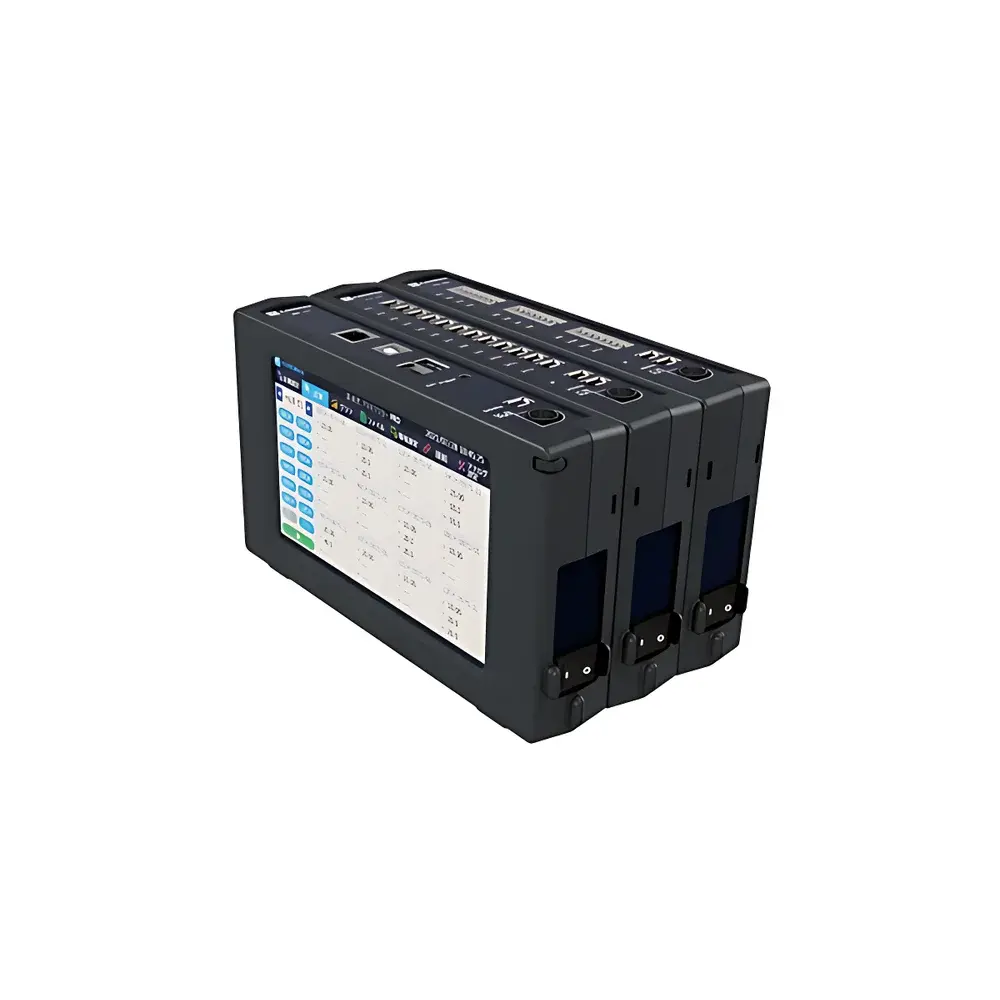
Kanomax PRO 1590-0C Multi-Point Thermal Anemometer System
| Brand | Kanomax |
|---|---|
| Origin | Japan |
| Model | PRO 1590-0C |
| Instrument Type | Thermal Anemometer |
| Resolution | 0.01 m/s |
| Measurement Range | 0.01–50.0 m/s |
| Accuracy | ±2% of reading or ±0.02 m/s (whichever is greater) |
| Operating Temperature | 5–40 °C |
| Operating Humidity | 0–85% RH (non-condensing) |
| Display | 7-inch color LCD touchscreen |
| Data Storage | 8 GB internal memory (24,500 measurements per unit) |
| Communication | USB 2.0, LAN (RJ45), serial interface |
| Power Supply | AC 100–240 V or DC 12–24 V |
| Dimensions (main unit) | 220 × 130 × 40 mm |
| Weight | 0.6 kg |
Overview
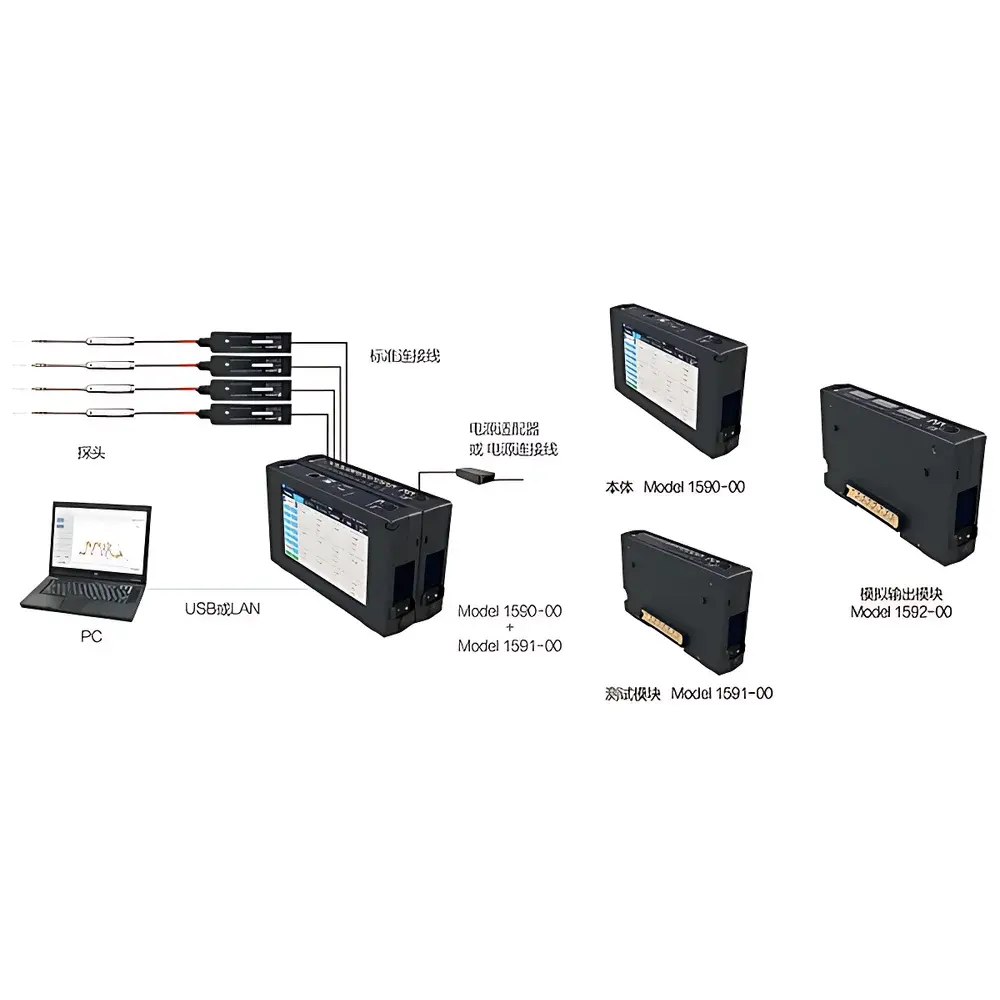
The Kanomax PRO 1590-0C is a modular, high-channel-count thermal anemometry system engineered for precision multi-point environmental monitoring in HVAC commissioning, cleanroom validation, industrial ventilation assessment, and laboratory airflow characterization. Unlike conventional single-point anemometers, the PRO 1590-0C architecture employs constant-temperature anemometry (CTA) principles—where a heated sensor element maintains a fixed temperature differential relative to ambient air, enabling linearized velocity measurement across an ultra-low threshold (0.01 m/s) up to 50.0 m/s. Its distributed architecture supports up to 144 simultaneous measurement channels via cascaded modules (1590-0C main unit + up to 11 × 1591-0C expansion modules), each capable of interfacing with up to 12 interchangeable probes. This scalability enables spatially resolved airflow mapping in large-volume environments such as aircraft cabins, pharmaceutical cleanrooms (ISO 14644-3), and semiconductor fab tool enclosures—without requiring real-time PC dependency due to its embedded 7-inch touchscreen interface and onboard data logging.
Key Features
- Modular channel expansion: One PRO 1590-0C main unit supports 12 probe channels directly; up to 11 additional MODEL 1591-0C modules can be daisy-chained via standardized serial bus, achieving a maximum of 144 synchronized channels.
- Probe interoperability: 15 certified probe variants—including directional and omnidirectional thermal anemometers, high-temperature models (up to 120 °C), micro-profile probes (minimum 3.5 mm diameter), and combined wind/temperature/humidity sensors—are mechanically and electrically compatible across all modules.
- Embedded human-machine interface: Integrated 7-inch capacitive touchscreen enables full system configuration, real-time data visualization (trend plots, min/max/avg), and CSV export without external computing hardware.
- Temperature-compensated sensing: All probes incorporate on-sensor thermistors and firmware-based compensation algorithms to maintain accuracy across operating ranges (5–40 °C ambient), eliminating drift from thermal gradients.
- Flexible analog output: Optional MODEL 1592-0C analog output modules support user-configurable 0–5 V or 4–20 mA outputs per channel, compliant with industrial SCADA and DCS signal standards (IEC 61000-4-5 surge immunity).
- Robust power architecture: Dual-input capability (AC 100–240 V / DC 12–24 V) with hot-swappable module interconnection ensures operational continuity during mobile deployments—including vehicle-mounted duct traverse testing and field-based HVAC balancing.
Sample Compatibility & Compliance
The PRO 1590-0C system is validated for use with gaseous media under standard atmospheric conditions (101.3 kPa, 23 °C). Probe selection determines compatibility with specific environments: MODEL 0976-13/14/17 probes are rated for continuous operation at 120 °C, suitable for exhaust ducts and oven ventilation validation; MODEL 0975-21/31 probes meet ISO 7726 Class B requirements for thermal comfort assessment (air velocity < 0.25 m/s); humidity-capable variants (e.g., 0975-31) comply with ISO 16710 humidity measurement uncertainty guidelines. The system meets EMC Directive 2014/30/EU and Low Voltage Directive 2014/35/EU. While not intrinsically safe, it is intended for non-hazardous area use per IEC 60079-0. Data integrity aligns with GLP/GMP documentation practices through timestamped CSV logging and audit-ready metadata tagging (probe ID, calibration date, operator ID).
Software & Data Management
Kanomax’s proprietary Windows 10-compatible software (v3.2+) provides dual-mode operation: standalone logging via USB mass storage or real-time streaming over TCP/IP (LAN). The interface supports tri-language display (English/Japanese/Chinese), customizable channel grouping, and automated report generation per ISO/IEC 17025 clause 7.8.2. Each probe’s calibration coefficients, serial number, and temperature compensation curve are stored in EEPROM and auto-loaded upon connection. Raw data streams include 10 Hz sampling resolution per channel, with post-processing options for moving average filtering (1–60 s window), statistical summaries (mean, SD, CV%), and export to Excel (.xlsx) or CSV with UTF-8 encoding. Software logs all user actions (configuration changes, start/stop triggers) for FDA 21 CFR Part 11-compliant audit trails when deployed with network authentication.
Applications
- HVAC system commissioning per ASHRAE Guideline 1 and ISO 16813, including diffuser throw verification, duct static pressure profiling, and room air change rate calculation.
- Cleanroom airflow uniformity testing (ISO 14644-3 Annex B), where ≥32-point velocity grids are required for Grade A/B zones.
- Pharmaceutical lyophilizer shelf airflow mapping to ensure product drying consistency (ICH Q5C).
- Aerospace cabin environmental control system (ECS) validation, including recirculation ratio analysis and smoke dispersion modeling input.
- Industrial furnace and kiln ventilation safety audits, leveraging high-temperature probe variants for stack velocity measurement.
- Academic research in boundary layer meteorology and indoor air quality (IAQ), where low-velocity sensitivity (<0.05 m/s) enables laminar flow characterization.
FAQ
What is the maximum number of probes supported per 1591-0C module?
Each MODEL 1591-0C test module supports up to 12 probes via standardized 8-pin mini-DIN connectors.
Can the system operate without a computer during data acquisition?
Yes—the 1590-0C main unit performs autonomous logging to internal 8 GB flash memory and displays real-time trends on its built-in touchscreen.
Are calibration certificates traceable to NIST or JCSS standards?
All probes ship with individual calibration reports traceable to JCSS-accredited laboratories; NIST-traceable certificates are available upon request with additional lead time.
Does the software support automated pass/fail evaluation against user-defined limits?
Yes—threshold-based alarms and color-coded deviation indicators (green/yellow/red) are configurable per channel in the software’s “Compliance Mode.”
What is the typical response time for low-velocity measurements (e.g., 0.03 m/s)?
Per Kanomax specification, directional probes (e.g., 0972-00) achieve 90% step response in ≤1 second at 1 m/s; at 0.03 m/s, effective response is governed by thermal inertia and typically falls within 3–5 seconds under stable ambient conditions.







