
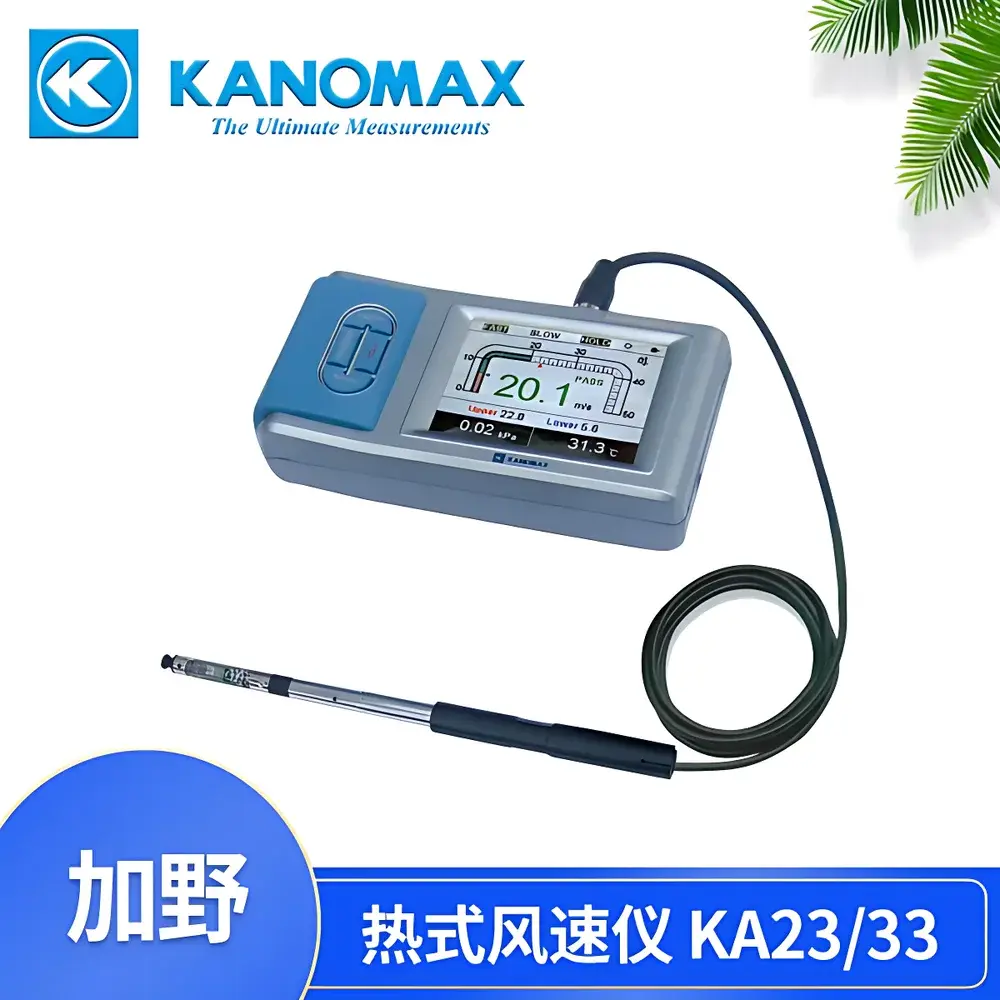
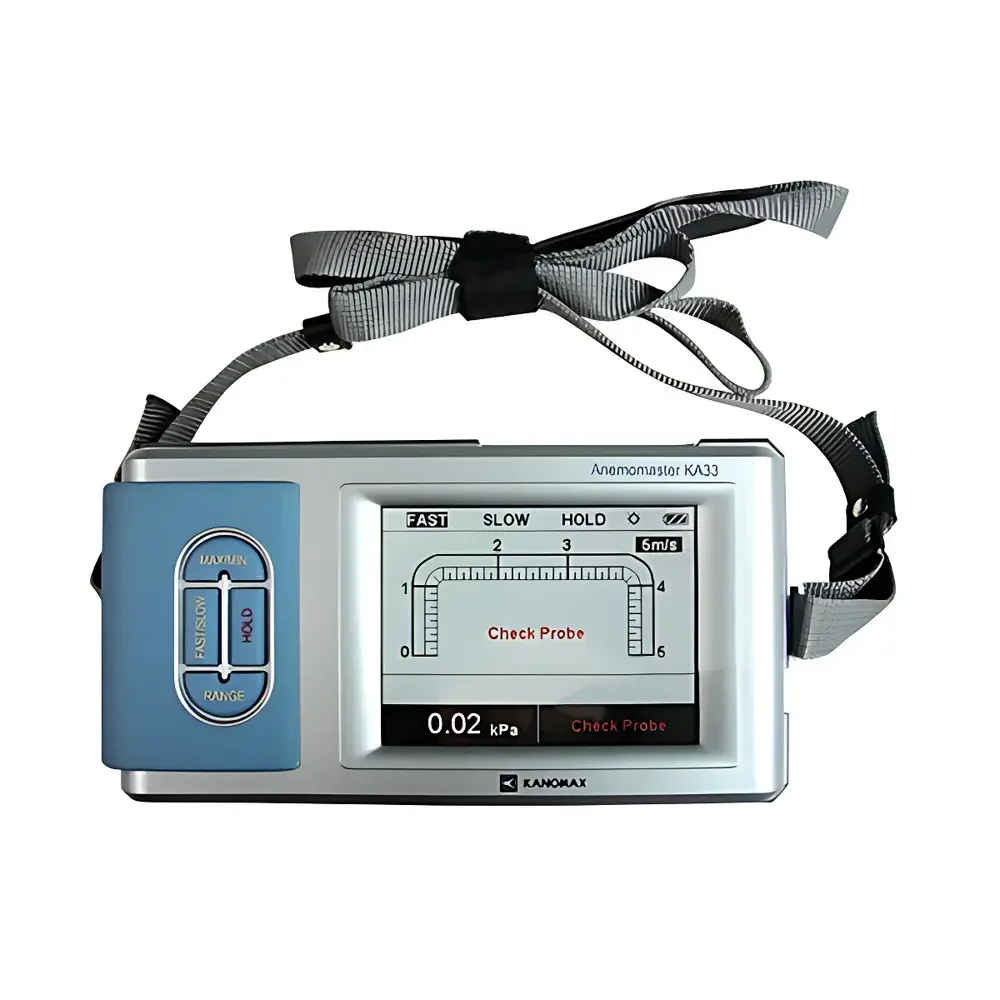
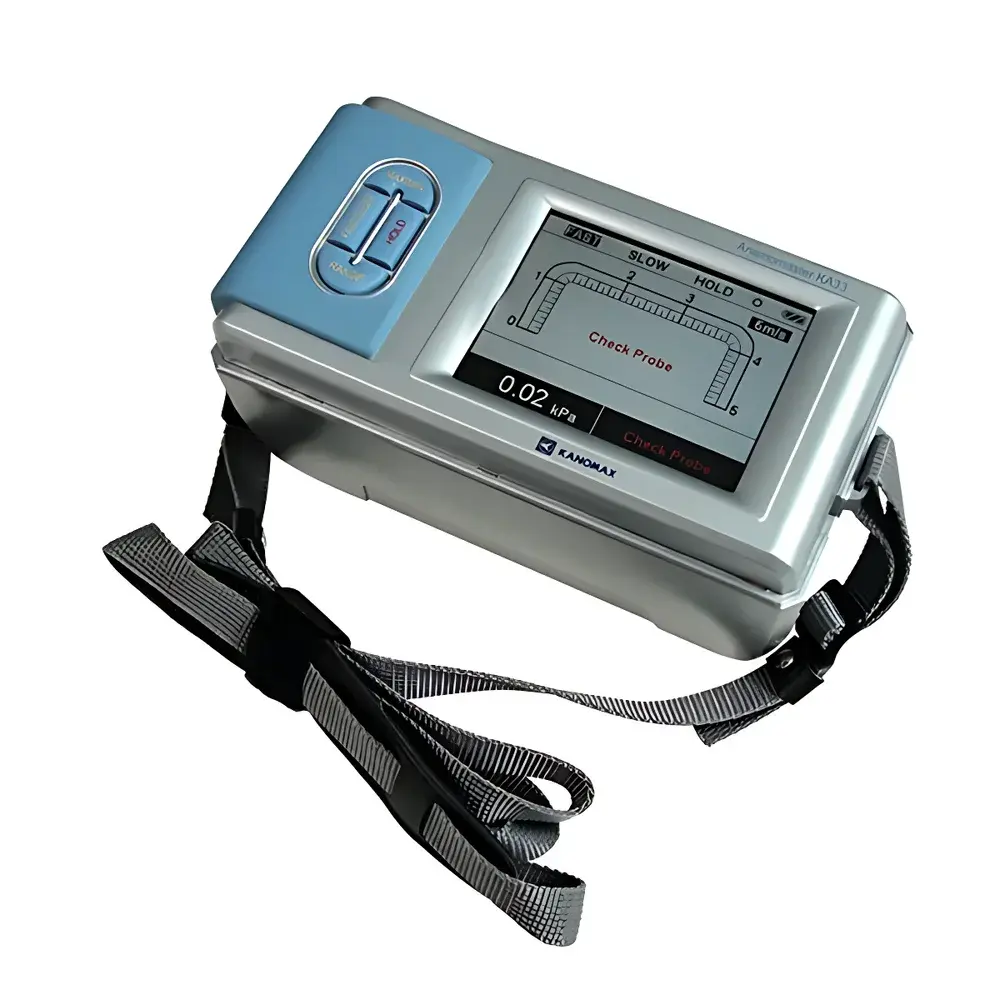
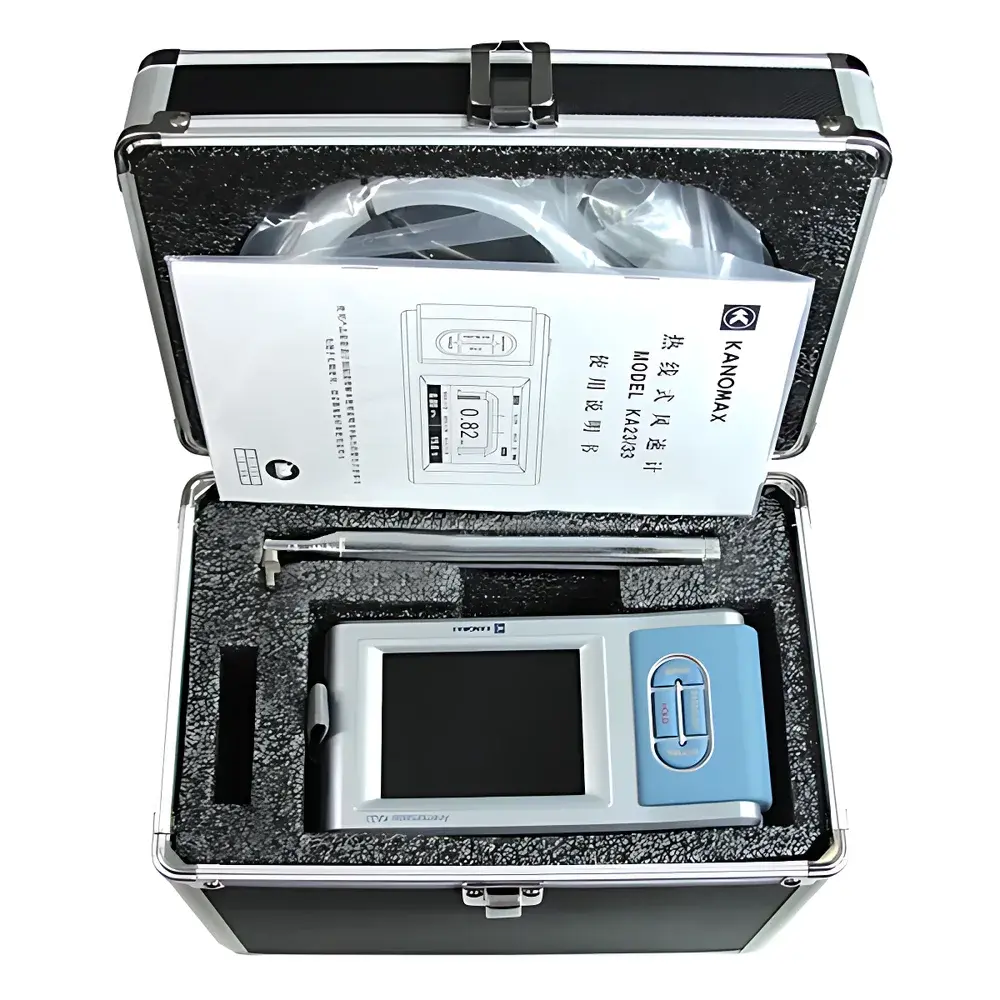
Kanomax KA23 Thermal Anemometer for Pharmaceutical Cleanroom Air Velocity Monitoring
| Brand | Kanomax |
|---|---|
| Origin | Japan |
| Model | KA23 |
| Instrument Type | Thermal Anemometer |
| Measurement Range | 0.01–50.0 m/s |
| Resolution | 0.01 m/s (0.00–9.99 m/s), 0.1 m/s (10.0–50.0 m/s) |
| Accuracy | ±2% FS |
| Operating Temperature | −20–100°C |
| Operating Humidity | 2.0–98.0% RH |
| Temperature Range & Accuracy | −20–100°C (±0.3°C in −20–0°C and 60–100°C: ±0.5°C) |
| Pressure Range & Accuracy | 0.00–±5.00 kPa (±0.1 kPa) |
| Display | Dual digital/analog view with 3-level backlight |
| Data Logging | Max/Min/Avg velocity, pass/fail threshold mode |
| Probe | Interchangeable, telescopic (Ø15 mm max, 140–235 mm extendable) |
| Power | 4× AA alkaline batteries or 5 V/2 A AC adapter |
| Dimensions (main unit) | 157(W)×42(H)×80(D) mm |
| case | 167(W)×66(H)×88(D) mm |
| Weight | ~450 g (with batteries) |
Overview
The Kanomax KA23 Thermal Anemometer is a precision-engineered instrument designed specifically for air velocity validation and routine monitoring in regulated pharmaceutical cleanroom environments. It operates on constant-temperature anemometry (CTA) principles—measuring convective heat loss from a heated sensor element to determine airflow velocity with high temporal resolution and low thermal inertia. Unlike cup or vane anemometers, the KA23’s thermal sensing architecture enables stable, low-flow sensitivity down to 0.01 m/s—critical for ISO 14644-1 Class A/B/C/D unidirectional airflow verification, laminar flow hood qualification, and HVAC terminal filter face velocity mapping. Its compact handheld form factor, rugged probe design, and calibrated traceability to JIS Z 8805 and ISO 14644-3 Annex B make it suitable for both GMP-compliant installation qualification (IQ) and operational qualification (OQ) protocols.
Key Features
- Thermal velocity measurement with dual-range resolution: 0.01 m/s (0.00–9.99 m/s) and 0.1 m/s (10.0–50.0 m/s), optimized for both laminar and turbulent airflow regimes.
- Integrated environmental sensing: Simultaneous real-time measurement of air velocity, ambient temperature (−20–100°C), and differential pressure (±5.00 kPa).
- Dual-mode display: Digital numeric readout paired with analog bar-graph visualization for rapid trend assessment—enhancing usability during dynamic cleanroom surveys.
- Configurable brightness backlight (3 levels) and user-defined upper/lower alarm thresholds for immediate pass/fail judgment per EU GMP Annex 1 or FDA Guidance for Industry (2022) requirements.
- Telescopic, interchangeable probe (Ø15 mm max, 140–235 mm extension) with robust stainless-steel housing—designed for repeated insertion into HEPA filter frames, ducts, and ISO 5 workstations without mechanical drift.
- On-device statistical functions: Automatic capture and storage of maximum, minimum, and time-weighted average velocity values—essential for documenting steady-state performance over 30–60 second sampling intervals per ISO 14644-3.
Sample Compatibility & Compliance
The KA23 is validated for use with clean, dry, non-corrosive air streams at standard atmospheric pressure (±10% variation). It is not intended for particulate-laden, high-humidity condensing, or chemically aggressive gas environments. Its measurement uncertainty profile meets the performance criteria outlined in ISO 14644-3:2019 (Annex B.3.2) for cleanroom airflow instrumentation, and its calibration traceability aligns with JIS Z 8805:2018 for thermal anemometers. The device supports compliance workflows under EU GMP Annex 1 (2022), USP , and FDA 21 CFR Part 211. While the KA23 itself does not provide electronic audit trails, its data output (via optional RS-232 or analog voltage interface) can be integrated into validated data acquisition systems compliant with 21 CFR Part 11 when paired with appropriate software and procedural controls.
Software & Data Management
The KA23 supports direct data export via optional serial communication (RS-232) to external PCs or PLC-based logging systems. When used with Kanomax’s proprietary KAN-LOG software (sold separately), users gain access to timestamped CSV exports, customizable reporting templates aligned with ISO 14644-3 test reports, and graphical trend overlays across multiple probe locations. All stored statistics (Max/Min/Avg) are retained in non-volatile memory even after power cycling. For regulated environments, laboratories must establish documented procedures for periodic verification of zero stability, span calibration (using NIST-traceable wind tunnel standards), and battery voltage monitoring—practices consistent with GLP and GMP documentation requirements.
Applications
- Unidirectional airflow velocity mapping across ISO Class 5 laminar flow hoods and critical process zones.
- HEPA/ULPA filter face velocity uniformity testing per ISO 14644-3 Section 6.2.2.
- Supply and return grille velocity profiling during HVAC commissioning and requalification.
- Environmental monitoring during aseptic process simulations (media fills) to verify airflow integrity under dynamic operating conditions.
- Validation of air shower and personnel airlock performance per ISO 14644-7 Annex D.
- Baseline characterization and trending of cleanroom airflow stability over time for continuous improvement initiatives.
FAQ
Is the KA23 suitable for ISO Class 5 laminar airflow verification?
Yes—the 0.01 m/s resolution and ±2% FS accuracy meet the minimum performance requirements specified in ISO 14644-3:2019 for Class 5 (ISO 5) unidirectional airflow testing.
Does the KA23 require annual recalibration?
Per ISO/IEC 17025 and internal quality system requirements, annual recalibration against a certified wind tunnel standard is recommended; more frequent verification (e.g., pre/post-use zero check) is required in GMP environments.
Can the KA23 measure velocity in exhaust ducts with high turbulence?
It is suitable for duct measurements within its operating range, but turbulent flows may require spatial averaging across multiple points per ISO 14644-3 Annex C to ensure representative results.
Is the probe sterilizable for aseptic applications?
The probe is not autoclavable; however, it is compatible with alcohol wipe decontamination (70% IPA) and ethylene oxide (EtO) sterilization—subject to user validation per ISO 14971 risk management protocols.
What documentation accompanies the instrument upon delivery?
Each unit ships with a factory calibration certificate (traceable to JIS Z 8805), operation manual, probe holder, carrying case, and AA battery set—no additional accessories are included by default.







