
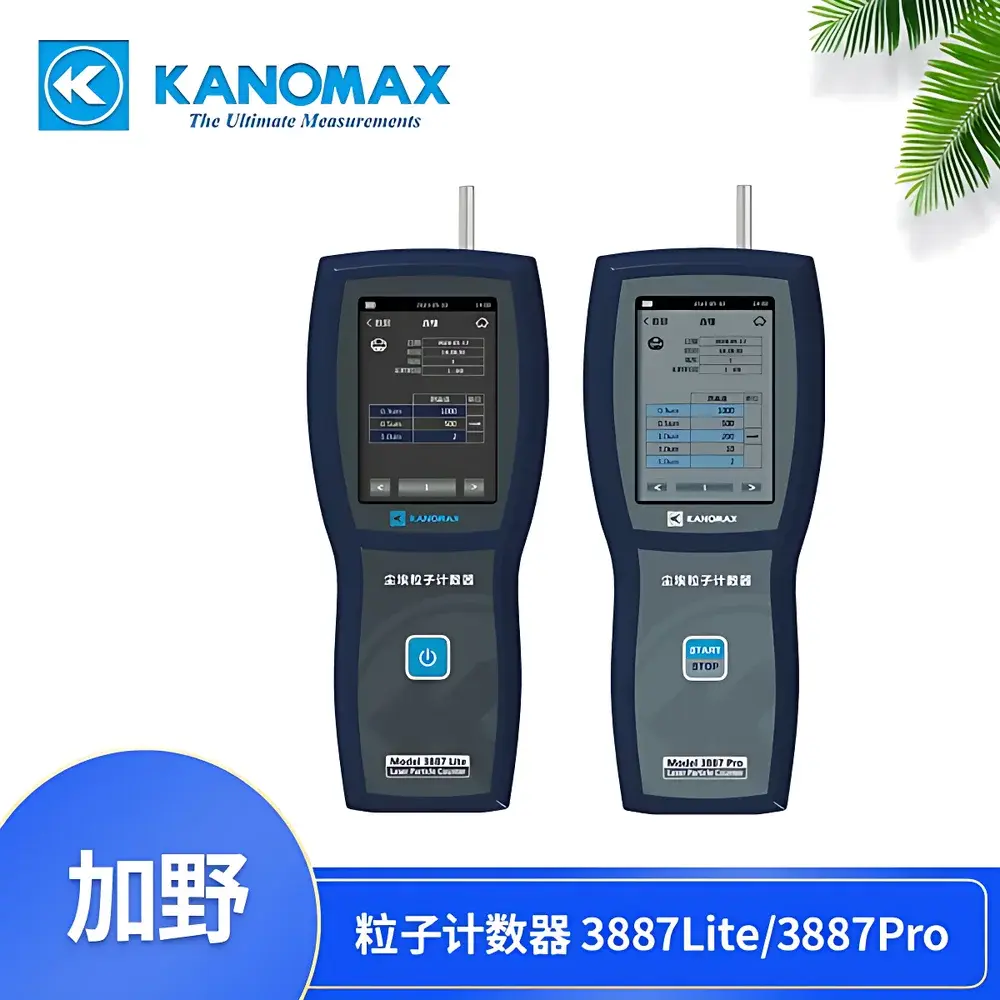
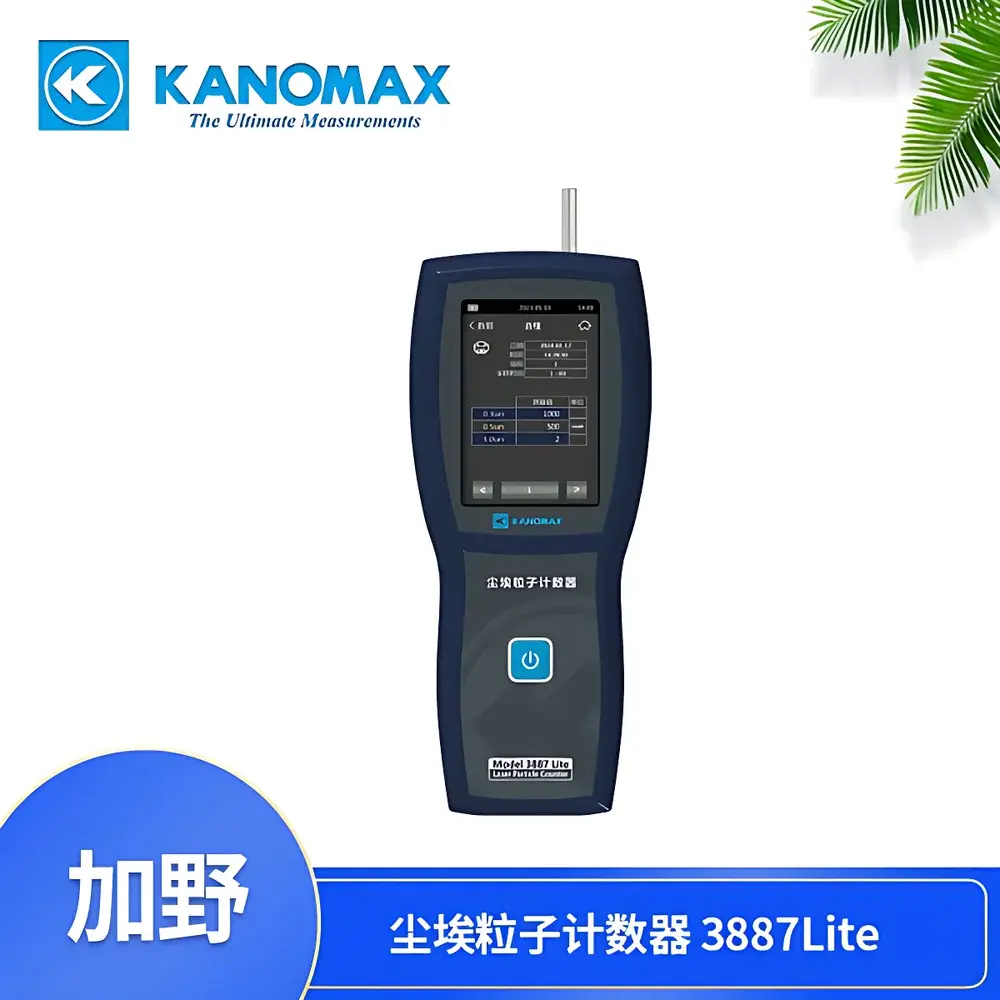
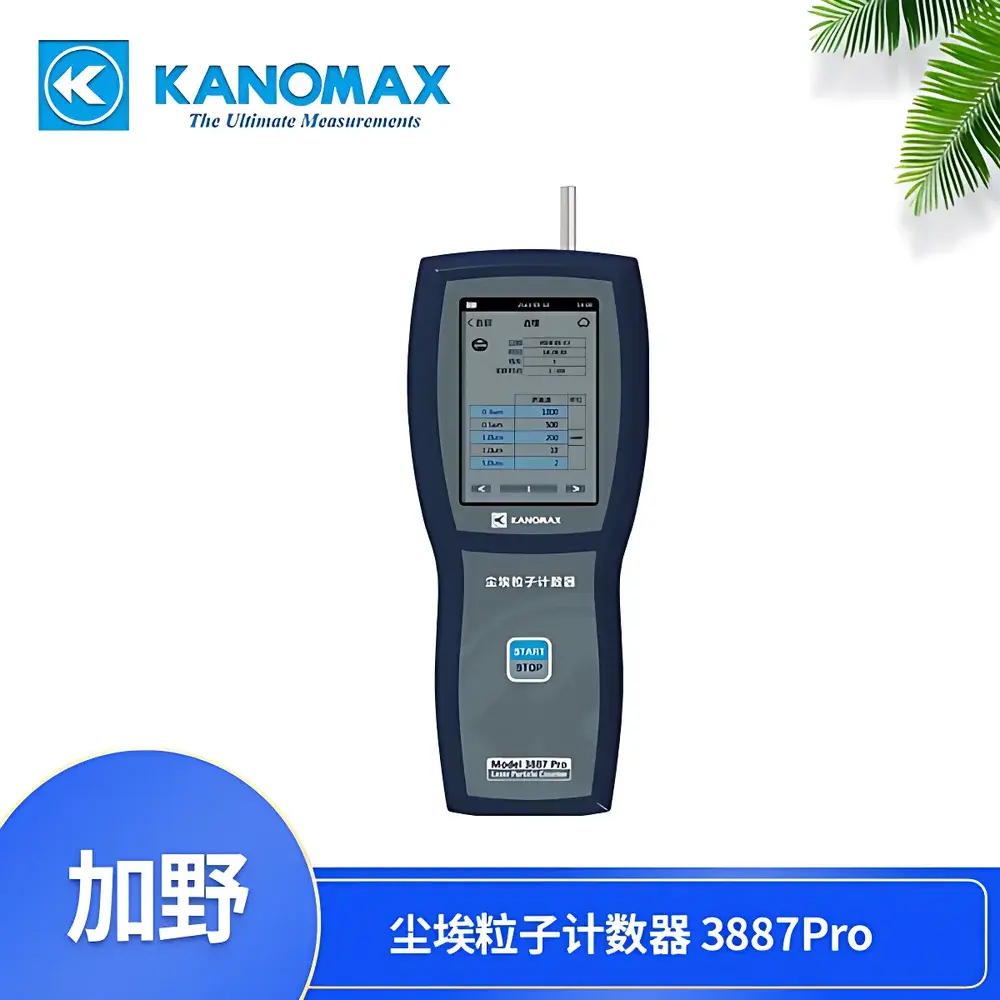
Kanomax 3887Lite / 3887Pro Handheld Laser Particle Counter
| Brand | Kanomax |
|---|---|
| Origin | Japan |
| Model | 3887Lite / 3887Pro |
| Instrument Type | Handheld |
| Flow Rate | 2.83 L/min ±5% |
| Particle Size Channels | 0.3, 0.5, 1.0, 3.0, 5.0 µm (3887Pro) |
| Display | 3.5-inch resistive touchscreen |
| Light Source | Laser diode |
| Counting Efficiency | Compliant with ISO 21501-4 and JIS B9921 |
| Max. Detectable Concentration | 2,000,000 particles/ft³ |
| Coincidence Loss | <5% at 2,000,000 particles/ft³ |
| Count Range | 1–70,000,000 |
| Sampling Modes | Single, Repeat, Continuous, Calculate, Remote, GB/T, ISO |
| Sampling Time | 6 sec – 99 min 59 sec |
| Interval Time | 6 sec – 99 min 59 sec |
| Sample Count | 1–999 or continuous |
| Data Storage Capacity | 7,000 measurement sets |
| Power | Rechargeable Li-ion battery (≈5 h operation) + USB-C AC adapter |
| Dimensions | 87 × 200 × 55 mm |
| Weight | ≈600 g |
| Operating Environment | 10–40 °C, 0–85% RH (non-condensing) |
| Communication | USB and RS-485 interfaces |
| Compliance | GB/T 16292–2010, ISO 14644-1, China GMP (2010), FDA-relevant cleanroom monitoring practices |
Overview
The Kanomax 3887Lite and 3887Pro are precision-engineered handheld laser particle counters designed for real-time airborne particulate monitoring in controlled environments. Based on light scattering principles—where a focused laser beam interrogates individual particles suspended in sampled air—the instruments detect and size particles via calibrated photodetector response. Each unit employs a Class 1 laser diode (IEC 60825-1 compliant) and adheres strictly to the metrological requirements of ISO 21501-4 and JIS B9921 for counting efficiency, resolution, and false count suppression. With a nominal volumetric flow rate of 2.83 L/min (0.1 CFM), these instruments meet the fundamental sampling criteria required for ISO 14644-1 classification audits and pharmaceutical cleanroom qualification per Annex 1 and Chinese GMP 2010. The dual-model architecture provides flexibility: the 3887Lite supports three standard channels (0.3, 0.5, 5.0 µm), while the 3887Pro extends capability to five channels (0.3, 0.5, 1.0, 3.0, 5.0 µm), enabling granular analysis across critical size thresholds used in semiconductor fab line control and aseptic processing validation.
Key Features
- High-fidelity 3.5-inch resistive touchscreen interface with intuitive icon-based navigation—optimized for gloved operation in cleanroom suits.
- On-device statistical engine: computes real-time max/min/average values across stored datasets (up to 7,000 records), eliminating post-processing dependency.
- Intelligent auto-resume functionality: upon power interruption during GB/T or ISO-mode sequences, the instrument restores prior sampling state—including remaining interval count, elapsed time, and channel configuration—ensuring data continuity and audit trail integrity.
- Dual communication architecture: native support for both USB 2.0 (for direct PC connection and firmware updates) and isolated RS-485 (for integration into facility-wide BMS or SCADA systems).
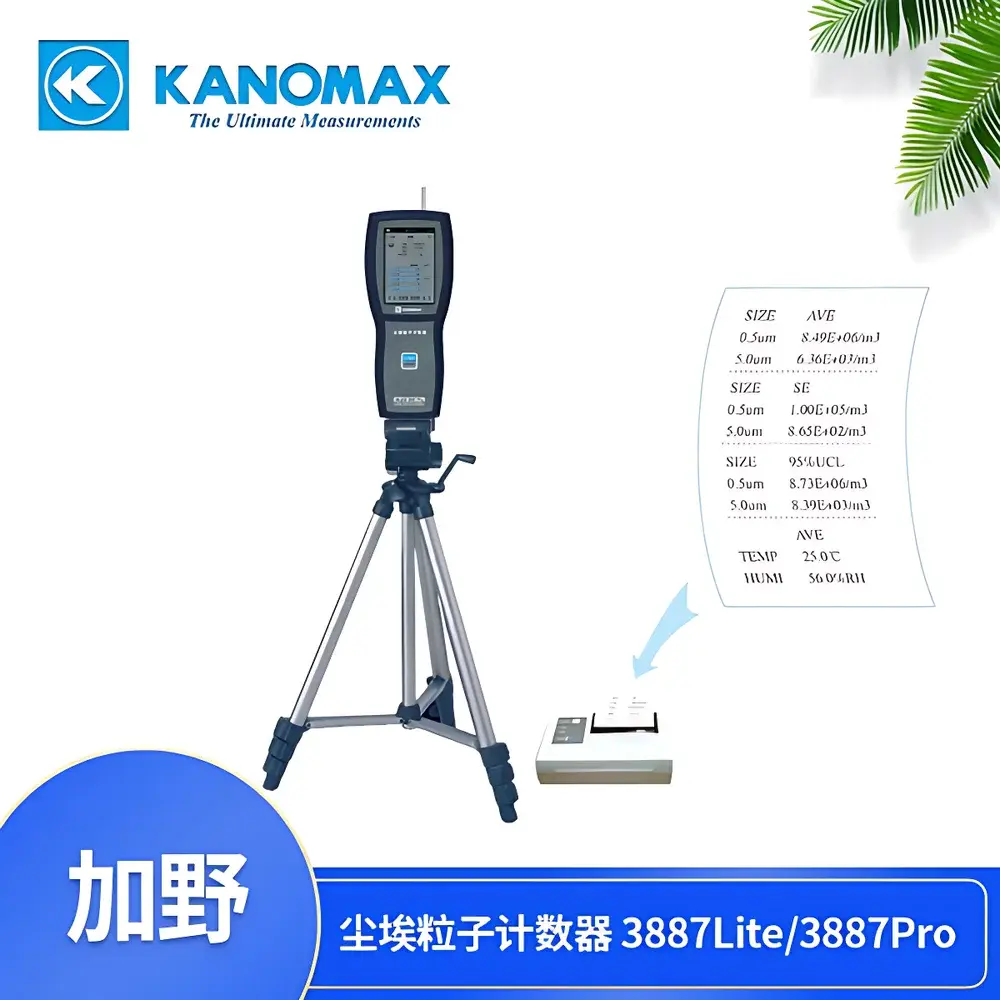
- Ruggedized industrial design: IP52-rated enclosure, 600 g mass, and ergonomic form factor (87 × 200 × 55 mm) facilitate extended handheld use or tripod-mounted stationary monitoring.
- Calibration traceability: supplied with NIST-traceable calibration report; zero-count filter included for routine background verification per ISO 21501-4 Section 6.4.
Sample Compatibility & Compliance
These instruments are validated for use with ambient air, HEPA-filtered supply air, and recirculated process air in ISO Class 5–8 environments. They comply with mandatory cleanroom monitoring standards including ISO 14644-1:2015 (airborne particle concentration limits), GB/T 16292–2010 (Chinese pharmaceutical cleanroom testing), and the environmental monitoring requirements outlined in China’s Good Manufacturing Practice (GMP) Regulations (2010 Edition). While not intrinsically safe for explosive atmospheres, their non-sparking electronics and low-power design make them suitable for Class 100–100,000 cleanrooms per Federal Standard 209E legacy references. All firmware and data logging routines support ALCOA+ principles—ensuring attributable, legible, contemporaneous, original, accurate, complete, consistent, enduring, and available records—aligned with FDA 21 CFR Part 11 expectations for electronic records in regulated industries.
Software & Data Management
The optional Kanomax Particle Analysis Software (v3.x) enables comprehensive post-acquisition evaluation. Installed on Windows-based laboratory PCs, it permits synchronized time-series visualization across all configured size channels, overlay of historical baselines, and automated generation of compliance reports conforming to ISO 14644-2 annexes. Data export is supported in CSV, PDF, and XML formats—with embedded metadata (timestamp, location ID, operator, instrument serial number, calibration due date). Audit trails record all user-initiated actions: parameter changes, data deletions, report generation events, and software updates. The software also supports batch import from multiple 3887 units, facilitating cross-zone correlation studies in multi-room facilities.
Applications
- Electronics manufacturing: monitoring Class 10–100 cleanrooms during photolithography, wafer bonding, and HDD head assembly.
- Pharmaceutical aseptic processing: environmental monitoring of Grade A/B zones during filling line qualification and media fill simulations.
- Medical device packaging: verification of ISO 14644-compliant laminar flow hoods and isolators.
- HEPA/ULPA filter integrity testing: upstream/downstream challenge assessments using polyalphaolefin (PAO) or sodium chloride aerosols.
- Research laboratories: aerosol generation characterization, HVAC system commissioning, and indoor air quality benchmarking in biosafety level (BSL)-2/3 facilities.
- Aerospace component assembly: contamination control in optical payload cleanrooms where sub-micron particle adherence risks coating defects.
FAQ
What standards does the 3887Pro comply with for cleanroom certification?
It meets ISO 14644-1:2015, GB/T 16292–2010, and supports test protocols referenced in EU Annex 1 and China GMP 2010 for airborne particle monitoring.
Can the instrument be integrated into a central monitoring system?
Yes—via its isolated RS-485 port, it supports Modbus RTU protocol for seamless integration with building management systems (BMS) or MES platforms.
Is the battery replaceable in the field?
No—the rechargeable Li-ion battery is sealed and serviced only by authorized Kanomax service centers to maintain IP rating and calibration integrity.
How is data security ensured during USB transfer?
All USB transfers occur in read-only mode from the device; no firmware or configuration files can be modified externally without authenticated service access.
Does the unit require annual recalibration?
Per ISO 21501-4 Section 7.2, users must verify counting efficiency and flow rate annually using certified reference aerosols and primary flow calibrators—documentation retained as part of quality system records.
Related Products







